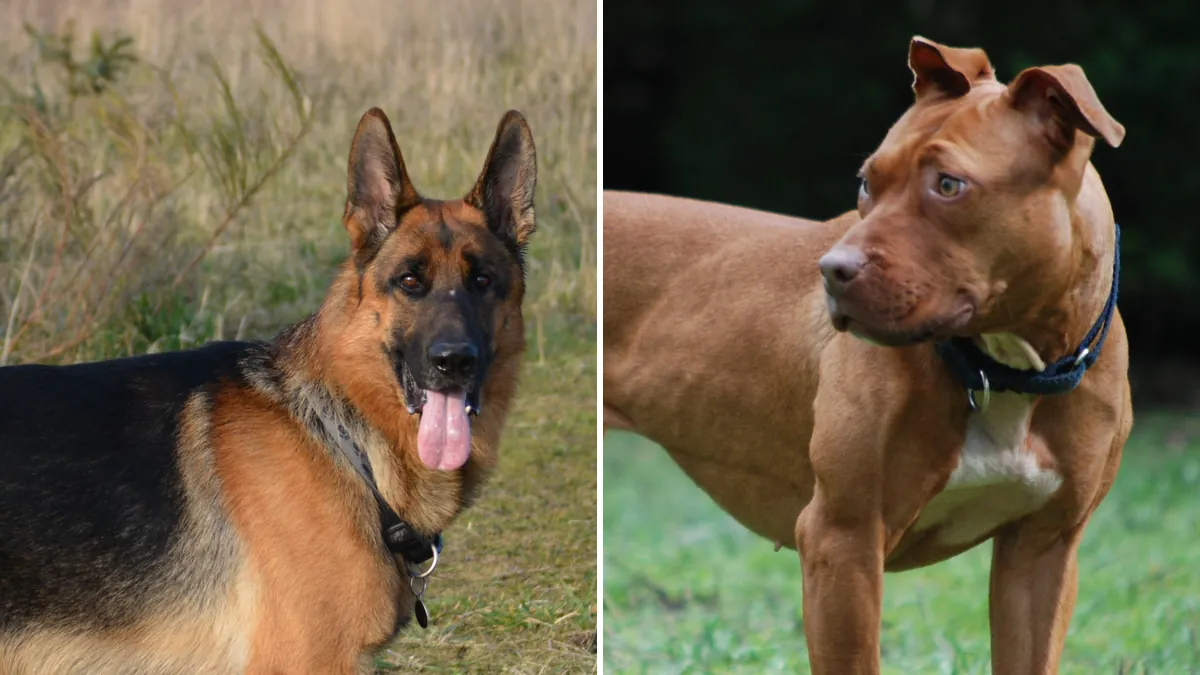

A Shepherd and Pitbull mix is a cross between a German Shepherd Dog and a pit bull-type dog, usually an American Pit Bull Terrier or American Staffordshire Terrier. Expect a medium-to-large, strong, smart and active dog that wants to be close to its people. Because it isn’t a recognized breed, size, coat and temperament vary from dog to dog, so the honest guide is what each parent breed is like, plus the dog in front of you.
You’ll also see the mix called a German Sheppit, Shepherd Pit, German Pit or Pit Shepherd, and you’ll often meet one in a shelter with “Shepherd/Pit mix” on the kennel card. Below is what the AKC, the UKC and veterinary research can tell you, where the answer is “it depends on the dog,” and how to tell whether one fits your life.
A note on our photos: we could find only one openly licensed photo of a dog identified as this exact cross (Junior, below). The top photo and the other breed photos show the parents and are labeled that way. If you have a German Shepherd pit mix and would share a photo, we’d love to hear from you.
Shepherd and Pitbull mix quick facts
Every figure here is for a parent breed, from that breed’s registry. None is a measurement of the mix itself.
- Also called: German Sheppit, Shepherd Pit, German Pit, Pit Shepherd. Informal names, not a recognized breed.
- Size (parent breeds): German Shepherd 22 to 26 in and 50 to 90 lb (AKC); American Pit Bull Terrier about 17 to 21 in and 30 to 60 lb (UKC); American Staffordshire Terrier 17 to 19 in and 40 to 70 lb (AKC). Together that’s roughly 17 to 26 inches and 30 to 90 pounds.
- Lifespan (parent breeds): 12 to 14 years for the German Shepherd (AKC) and 12 to 16 years for the AmStaff (AKC); the UKC’s APBT standard gives no lifespan. There is no published figure for the mix.
- Energy (AKC ratings): German Shepherd 5 out of 5, AmStaff 3 out of 5. Plan for an active dog.
- Grooming and shedding (AKC ratings): shedding 4 out of 5 for the German Shepherd and 2 out of 5 for the AmStaff. Easy coat care, but often a lot of hair.
- Good with young children (AKC ratings): German Shepherd 5 out of 5, AmStaff 3 out of 5. The UKC says APBTs “have always been noted for their love of children” (UKC). Supervise young children with any dog.
- Good with other dogs (AKC ratings): 3 out of 5 for both the German Shepherd and the AmStaff, and the UKC says “most APBTs exhibit some level of dog aggression.” Ask about other dogs and cats dog by dog.
- Health to ask about: hips and elbows, bloat, degenerative myelopathy, skin allergies, ear infections, weight, and a few inherited conditions each parent breed screens for. Details and sources below.
- Good fit for: an active person or household with time for daily exercise, training and company, and a home where a strong dog is welcome.
What a German Shepherd Pit Bull mix actually is
A Shepherd pit mix has a German Shepherd Dog on one side of the family and a pit bull-type dog on the other, sometimes several generations back. We found no reliable record of when or where the cross was first bred, so here are the two parents.
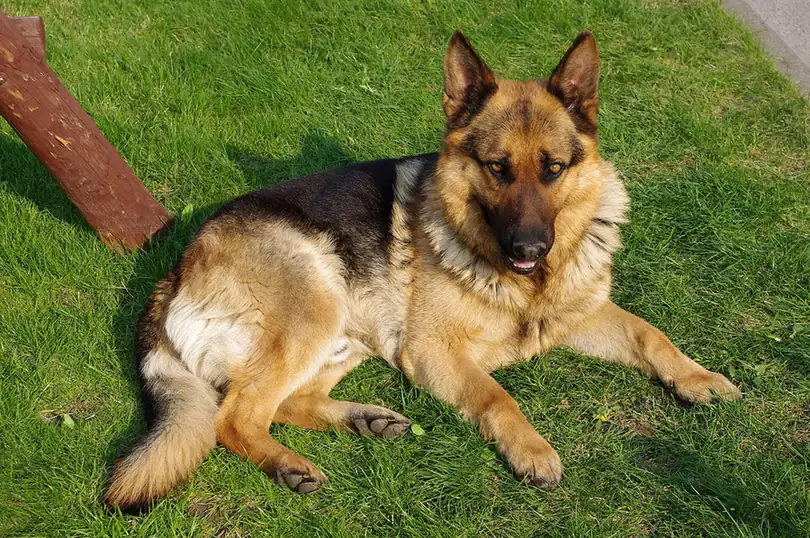
The German Shepherd side
In the late 1800s, a German cavalry officer, Captain Max von Stephanitz, set out to develop the ideal German herder. The AKC notes the breed’s famous intelligence and agility “were forged not in the police academy but in the sheep pasture.” The AKC recognized the breed in 1908 and calls it “dogkind’s finest all-purpose worker,” describing it as “loyal, confident, courageous, and steady” (AKC German Shepherd). Our Blue German Shepherd guide covers one color variety of the breed.

The pit bull side: a type, not one breed
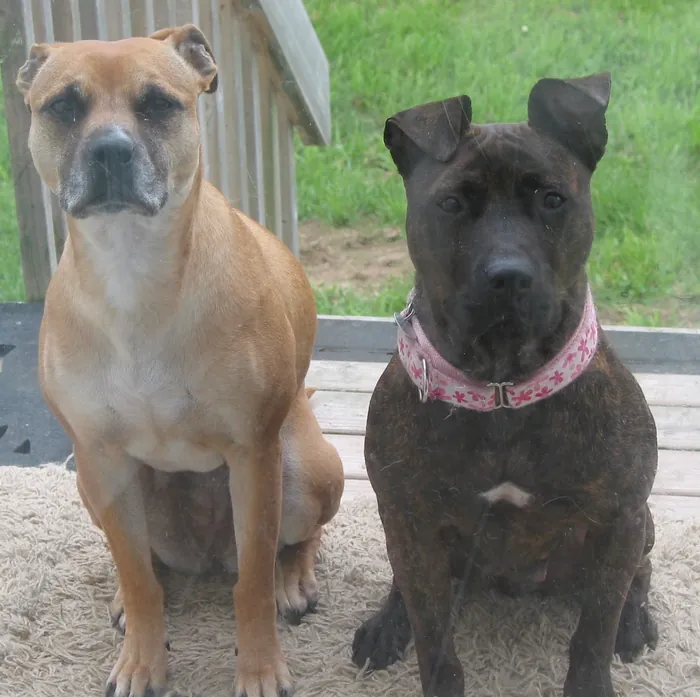
“Pit bull” isn’t a single breed but a loose label for several related breeds and look-alike mixes. One shelter study defined “pit bull-type” as the American Pit Bull Terrier, the American Staffordshire Terrier, the Staffordshire Bull Terrier, “pit bull,” and their mixes (Olson et al., 2015).
- The American Pit Bull Terrier (APBT) is recognized by the United Kennel Club, which says it was the first registry to do so, in 1898. The UKC describes it as “eager to please and brimming over with enthusiasm” (UKC).
- The American Staffordshire Terrier (AmStaff) is the AKC’s closely related breed, in its stud book since 1936. The AKC is candid that the breed descends from long-outlawed British blood sports, and calls today’s well-bred AmStaff “a more mellow fellow than his pit-fighting ancestors” (AKC AmStaff).
For how pit bull types differ from their stockier relatives, see our American Bully vs Pit Bull guide.

Shepherd pit mix vs German Shepherd vs pit bull
Here’s how the parents compare, using registry figures and the AKC’s 1 to 5 trait ratings (5 = most). The UKC doesn’t publish trait ratings for the APBT, so the AmStaff stands in for the pit bull side on those lines. A Shepherd pit mix can land anywhere between the parents on each line.
| German Shepherd Dog | American Pit Bull Terrier | American Staffordshire Terrier | Shepherd pit mix | |
|---|---|---|---|---|
| Height | 24 to 26 in (M), 22 to 24 in (F) | about 18 to 21 in (M), 17 to 20 in (F) | 18 to 19 in (M), 17 to 18 in (F) | Varies; parent span about 17 to 26 in |
| Weight | 65 to 90 lb (M), 50 to 70 lb (F) | 35 to 60 lb (M), 30 to 50 lb (F) | 55 to 70 lb (M), 40 to 55 lb (F) | Varies; parent span about 30 to 90 lb |
| Life expectancy | 12 to 14 yrs | Not given in UKC standard | 12 to 16 yrs | Not studied |
| Coat | Medium-length double coat | Short, glossy, smooth, close | Short, close, stiff, glossy | Short to medium, sometimes double |
| Affectionate with family | 5 | Not rated | 5 | Usually high |
| Good with young children | 5 | Not rated | 3 | Varies, supervise |
| Good with other dogs | 3 | Not rated; most show some dog aggression (UKC) | 3 | Often selective; ask |
| Openness to strangers | 3 | ”Extremely friendly, even with strangers” (UKC) | 4 | Varies |
| Watchdog / protective | 5 | ”Not the best choice for a guard dog” (UKC) | 5 | Varies |
| Energy | 5 | Not rated | 3 | Moderate to high |
| Trainability | 5 | Not rated | 3 | Moderate to high |
| Shedding | 4 | Not rated | 2 | Low to high |
| Mental stimulation needs | 5 | Not rated | 3 | Moderate to high |
| Breed-club health tests | Hips, elbows, temperament test | None listed in UKC standard | Hips, cardiac, thyroid, NCL-A DNA test | Ask the shelter or your vet |
Sources: AKC German Shepherd, UKC American Pit Bull Terrier standard, AKC American Staffordshire Terrier, German Shepherd Dog Club of America health statement, Staffordshire Terrier Club of America health statement. The UKC calls its APBT heights “a general and approximate guideline only.” The mix column is simply the range between the parents, not measured data.
The biggest differences are in build and in how each parent greets the world. The Shepherd side is taller, rangier, more watchful and pickier about strangers; the pit bull side is shorter, more muscular and, per the UKC, usually friendly with people. Where your dog falls on that line matters more for daily life than its coat color.
How big does a German Shepherd Pit Bull mix get?
Put the parents’ published ranges together and you get roughly 17 to 26 inches at the shoulder and 30 to 90 pounds. In every parent standard the female range is lower than the male’s. Many Shepherd pit mixes end up somewhere in the middle, but a dog that takes after the Shepherd side can be tall and long-legged, and one that takes after the pit bull side can be compact and stocky. If size matters to you, for your lease, your car or your own strength on the leash, an adult dog lets you see it instead of guessing.
Coat, colors and looks
The German Shepherd has a “medium-length, double coat” with a “dense, harsh, and close-lying outer coat” and a softer undercoat (AKC German Shepherd). The APBT’s coat is “glossy and smooth, close” and comes in “all colors and color patterns except merle” (UKC). A Shepherd pit mix can have anything from a short, sleek pit bull coat to a plusher Shepherd-style double coat, in black and tan, sable, fawn, brindle, solid colors or with white markings. Ears can stand up like a Shepherd’s, fold like a pit bull’s, or do one of each.
Temperament: what to realistically expect
These are registry descriptions of purebred parents, not predictions for any one mix.
The Shepherd side. The AKC says the German Shepherd “is extremely bonded to his people, so he is happiest when he lives with his family.” It rates the breed 5 out of 5 for affection with family and as a watchdog, and 3 out of 5 for openness to strangers and for getting along with other dogs (AKC German Shepherd).
The pit bull side. The UKC says APBTs “make excellent family companions and have always been noted for their love of children,” are “not the best choice for a guard dog since they are extremely friendly, even with strangers,” and that “aggressive behavior toward humans is uncharacteristic of the breed and highly undesirable.” The same standard is honest that “most APBTs exhibit some level of dog aggression,” and that the breed “requires an owner who will carefully socialize and obedience train the dog” (UKC). The AKC adds that dog aggression “can develop even in well-socialized” AmStaffs, and that an AmStaff “should never under any circumstances be left alone with other dogs” (AKC AmStaff).
What the science says about breed and behavior. A 2022 study in Science surveyed owners of 18,385 dogs and genotyped 2,155 of them. It found that breed explains just 9% of the behavioral variation between individual dogs (Morrill et al., 2022). In plain English: breed is a weak guide to how any one dog will behave. That’s good news if you’re adopting an adult, because you can meet the actual dog and ask about its history.
Put together, many Shepherd pit mixes are devoted, people-focused dogs. In daily life:
- Family: usually affectionate and wants to be included. Neither parent breed does well shut out in the yard.
- Strangers: some greet everyone like a friendly pit bull; others are watchful and bark at visitors like a Shepherd. Gentle, positive socialization helps either way.
- Other dogs and cats: the area to be most careful about, since both sides of the family can be selective. Ask whether this dog has lived with other animals, and introduce slowly.
- Children: many are wonderful with kids, but a strong, bouncy dog can knock over a small child or an unsteady adult. Supervise, and teach calm greetings early.
Exercise needs
Plan for an active dog. The AKC says the German Shepherd “requires lots of exercise for his physical and mental well-being,” and that a dog who isn’t exercised enough “will become frustrated and likely to develop undesirable behaviors” (AKC German Shepherd). For the AmStaff, it says the breed “requires a lot of exercise,” but that leaving the dog out in the yard all day “is not the right approach,” because “the AmStaff is a people-oriented dog who thrives when he is made part of the family” (AKC AmStaff).
For most Shepherd pit mixes that means daily walks plus real play, such as fetch, tug with rules, hiking or a dog sport, and brain work like sniff walks, food puzzles and short training games. The Shepherd side rates 5 out of 5 for mental stimulation needs, so a bored dog may invent its own job. How much a particular dog needs is something to ask the shelter or foster, who has seen it. Ask your vet before starting running or other high-impact exercise, for you or the dog.
Fencing. The UKC calls the APBT “one of the most capable canine climbers so good fencing is a must for this breed” (UKC). Walk your fence line for gaps and climbable spots, make sure gates latch on their own, and supervise yard time until you know how your dog behaves outside.
Training
The AKC rates the German Shepherd 5 out of 5 and the AmStaff 3 out of 5 for trainability. For German Shepherds, it says “consistency and positive, reward-based training will yield excellent results,” and calls early socialization and puppy classes “vital” (AKC German Shepherd). For AmStaffs, given the breed’s “strong will, physical strength, and exuberance,” it calls them “a necessity” (AKC AmStaff).
You’ll read online that this mix needs a “pack leader” or “dominant” owner. The American Veterinary Society of Animal Behavior disagrees: it says evidence supports reward-based methods for all dog training, that “there is no evidence that aversive training is necessary,” and it advises against intimidation techniques such as “alpha rolls” or “dominance downs” (AVSAB, 2021). Kind, consistent, reward-based training is both safer and more effective.
What works well with this mix:
- Loose-leash walking first. A strong dog that lunges is a real risk to your balance (more on that below). Practice indoors and in quiet places before busy streets, and ask a trainer about a well-fitted front-clip harness.
- Calm greetings. Teach “sit to say hello” so a happy dog doesn’t jump on visitors.
- “Leave it,” “drop it” and settling on a mat. Useful every day with a big, mouthy, curious dog.
- Slow, supervised introductions to other dogs, with distance and treats, especially if your dog leans toward either parent’s dog selectivity.
- Short, upbeat sessions with food and toys as rewards. If you hit a wall, a certified trainer who uses reward-based methods is money well spent.
Grooming
The AKC says the German Shepherd needs “a quick brushing every few days or so,” and sheds “more profusely once or twice a year,” when more frequent brushing helps (AKC German Shepherd). For the AmStaff’s short coat, “a quick once-over with a soft bristle brush every week is usually enough” (AKC AmStaff). So the right routine depends on which coat your dog has. Add regular nail trims (the AKC suggests monthly for German Shepherds whose nails don’t wear down naturally), tooth brushing and weekly ear checks.
Diet basics
There’s no special Shepherd pit diet. The AKC’s advice for both parents is the same: a high-quality food suited to the dog’s age, few table scraps, and an eye on weight. It warns that some AmStaffs “are prone to getting overweight” and that too many treats “can cause obesity” (AKC AmStaff). In a UK veterinary-records study, overweight or obesity was among the five most common problems in German Shepherds (O’Neill et al., 2017).
A word on grain-free food, which some breed guides recommend for this mix: since 2018 the US Food and Drug Administration has been investigating reports of dilated cardiomyopathy (a heart disease) in dogs eating certain diets, many labeled “grain-free,” and calls the possible link “a complex scientific issue that may involve multiple factors” (FDA). Talk to your vet before choosing a grain-free or boutique diet, and ask what a healthy weight looks like for your dog’s frame.
Health issues to know about
A mix can inherit health problems from either parent. A large University of California, Davis study found no difference between mixed-breed and purebred dogs in how often 13 inherited conditions turned up, including hip dysplasia; purebreds were more likely to have 10 others, including elbow dysplasia; and mixed-breed dogs were more likely to have a ruptured cranial cruciate ligament, a common knee injury (Bellumori et al., 2013). So being a mix may help with some conditions, but it’s no guarantee of good health.
| Condition | Which parent breed | What the source says |
|---|---|---|
| Hip and elbow dysplasia | Both | The German Shepherd club requires OFA hip and elbow evaluations (GSDCA); the AKC notes “some instances of mild hip dysplasia” in AmStaffs (AKC). Large breeds are more likely to have hip dysplasia and cruciate ligament problems (Witsberger et al., 2008). |
| Bloat (gastric dilatation) | German Shepherd | The AKC calls bloat “a sudden and life-threatening swelling of the abdomen,” and says owners should learn its symptoms and what to do (AKC). |
| Degenerative myelopathy | German Shepherd | A progressive spinal cord disease linked to a change in the SOD1 gene; early signs such as hind-leg weakness typically begin at 8 years or older (Awano et al., 2009). |
| Ear infections, osteoarthritis, weight | German Shepherd | The most common problems in a UK study of German Shepherds under everyday vet care were ear infections, osteoarthritis, diarrhea, overweight/obesity and aggression (O’Neill et al., 2017). |
| Skin and coat allergies | AmStaff | The AKC says instances have been found in the breed (AKC). |
| Cerebellar ataxia (NCL-A) | AmStaff | An inherited disease causing a progressive loss of coordination, first appearing between ages 3 and 5; a DNA test exists (AKC). |
| Heart and thyroid disease | AmStaff | The AKC mentions “some types of cardiac disease”; the breed club recommends a cardiac exam and thyroid testing for breeding dogs (AKC; STCA). |
The UKC’s APBT standard doesn’t list health tests, so the pit bull-side health information above comes from the AmStaff’s registry and breed club.
What this means day to day: keep your dog lean, check ears weekly, learn the signs of bloat and treat a suspected case as an emergency, and mention stiffness, limping or a wobbly back end to your vet early. Adopting? You may not have parent test results, and that’s fine. Get the shelter’s vet records, book a checkup soon after adoption, and share this list with your vet.
Lifespan
No study has measured this mix’s lifespan, so any single number you see online is a guess. As a frame of reference, the AKC lists 12 to 14 years for German Shepherds (AKC) and 12 to 16 years for AmStaffs (AKC), and a UK veterinary-records study found a median lifespan of 10.3 years for German Shepherds (O’Neill et al., 2017). Shepherd pit mixes can make lovely senior dogs. Weight, joint care, dental care and regular checkups shape any one dog’s years more than its breed label.
German Shepherd Pit Bull mix puppies
A puppy’s adult size, coat and temperament are especially hard to predict, since you’re guessing from two parents who may themselves be mixes. Junior, below, was described by his owner as a German Shepherd and American Staffordshire Terrier mix. At one month old, with his tan coat and dark muzzle, he looked more Shepherd than pit bull to our eye, a reminder that a single puppy can lean toward one parent.


Puppies also mean house training, chewing, and months of socialization and puppy classes before you know who the adult will be. There’s no breed club or health-testing program for this cross, so be cautious with anyone selling “Sheppit puppies.” Ask to meet the mother, ask which health tests both parents have had (the parent clubs’ lists are in the table above), and be wary of claims that the mix is “healthier” or “won’t shed.” For many people, especially first-time owners or anyone over 50, an adult from a shelter or foster home is the easier path.
Is that shelter dog really a Shepherd pit mix?
Maybe, maybe not. Shelter breed labels are usually a staff member’s best guess from looks, and the research on those guesses is humbling:
- In a University of Florida study across four shelters, staff labeled 52% of 120 dogs as pit bull-type by sight, but DNA identified only 21% as pit bull-type, and the authors concluded visual identification “was unreliable” (Olson et al., 2015).
- In a study of 20 adopted dogs, 87.5% of those that agencies had assigned specific breeds did not have all of those breeds detected by DNA (Voith et al., 2009).
- In a US and UK survey, shelter workers disagreed widely about which dogs were pit bulls (Hoffman et al., 2014).
- Arizona State researchers found a pit bull label changed how adopters saw a dog and how long it waited, and that removing kennel breed labels is a low-cost way to improve outcomes (Gunter et al., 2016).
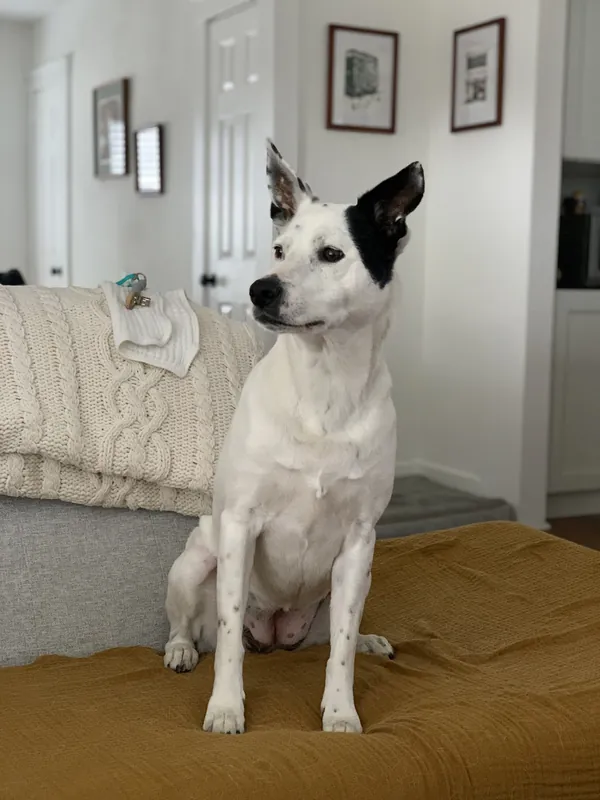

The takeaway: meet the dog, not the label. A dog with Shepherd ears and a pit bull’s chest could be this cross, or it could have Malinois, Boxer, Labrador or something else entirely in the mix. A DNA test can satisfy your curiosity later; our guide to figuring out your dog’s breed explains the options.
Is a Shepherd pit mix right for me? A quick checklist
Written with adopters over 50 in mind. A few “no” answers don’t rule you out; they tell you what to plan for, or which dog to ask about.
- Yes / No: I (or someone in my home) can give a dog an active walk and play every day, in the amount the shelter or foster says this dog needs.
- Yes / No: I can comfortably hold a strong 50 to 80 pound dog on a leash, or I’m willing to use a front-clip harness and practice loose-leash walking first.
- Yes / No: My yard is securely fenced with nothing to climb, or I’m happy to keep the dog leashed outdoors every time.
- Yes / No: Someone is home much of the day, or I can arrange a walker or daycare on long days.
- Yes / No: I’m comfortable introducing a new dog slowly to any dogs or cats at home, or I live without other pets.
- Yes / No: Dog hair on the furniture won’t bother me (or anyone with allergies at home).
- Yes / No: I’ve checked my lease, HOA and homeowner’s or renter’s insurance for breed rules (see the checklist below).
- Yes / No: I’ve thought about who would care for this dog if I ever couldn’t.
A Shepherd pit mix may suit you if you’re active, home a lot, enjoy training, and want a devoted dog that wants to be part of your day.
Consider a calmer or smaller dog if your balance or grip isn’t what it used to be and a strong puller would be a fall risk, if the dog would be alone most of the day, or if you have a busy home with other dogs and the dog you’re considering is selective. An adult that a foster knows to be mellow and leash-trained can be the exception.
A word on leash safety
This isn’t a reason to skip a big dog, but it’s worth planning for. A University of Pennsylvania study estimated that fractures among Americans 65 and older linked to walking leashed dogs rose from about 1,671 in 2004 to 4,396 in 2017, mostly in women, and the authors suggested obedience training so dogs don’t lunge on walks (Pirruccio et al., 2019). Practical steps: walk the dog yourself before adopting, use a harness rather than wrapping the leash around your wrist, wear good shoes, and start in quiet places.
Before you adopt: housing, insurance and breed-law checklist
Because visual breed labels are unreliable (Olson et al., 2015), a dog with any pit bull-type look may be treated as a pit bull by a landlord, insurer or local rule. Check these before you fall in love:
- Local laws. Ask your city or county animal services whether any breed-specific rules apply where you live, and where you might move.
- Your lease or HOA. Read the pet policy for breed, size or weight limits, and get approval in writing.
- Homeowner’s or renter’s insurance. Ask your insurer directly whether the policy excludes or surcharges certain breeds or mixes, and how it decides a dog’s breed.
- Senior or retirement communities. If you live in one, or may later, check its pet rules now.
The ASPCA opposes breed-specific laws. Its position statement notes that the US Centers for Disease Control and Prevention has recommended against them, and cites the difficulty of identifying breeds, especially in mixed-breed dogs (ASPCA).
Costs to plan for
We found no reliable cost figures for this mix specifically, and we don’t quote puppy prices. The ASPCA’s 2021 estimate for a dog is $1,391 a year, and $3,221 for the first year once one-time costs are included (ASPCA). Budget for:
- Adoption fee, which at shelters and rescues often includes vaccines, a microchip and spay or neuter surgery. Ask what’s included.
- Food for a medium-to-large, active dog.
- Routine vet care: exams, vaccines, parasite prevention, dental care.
- Pet insurance or an emergency fund. With joint problems and bloat on the parent-breed lists, it’s worth pricing insurance before any condition becomes pre-existing. Some insurers apply breed rules, so ask.
- Training classes and gear: a front-clip harness, a sturdy crate, a deshedding brush if your dog has a double coat, and care when you’re away.
Adopting a German Shepherd Pit Bull mix
Where to look
Start with shelters and rescues, and search for “Shepherd mix,” “German Shepherd mix,” “Pit Bull mix” and “Terrier mix,” since labels are often a guess. German Shepherd rescues and pit bull rescues sometimes list mixes too. Foster-based rescues are especially helpful, because a foster family can tell you how the dog behaves in a real home.
Questions to ask the shelter or rescue
The ASPCA suggests leaning on shelter staff “to help play matchmaker” and making sure the dog’s personality fits your lifestyle (ASPCA). For a Shepherd pit mix, ask:
- How does the dog walk on a leash? Can I walk it myself before deciding?
- How does it react to strangers, visitors and the doorbell?
- How has it done with other dogs, cats and children? In playgroups, a foster home, or only in the kennel?
- Any history of guarding food or toys, or of a bite or scuffle? What happened?
- How does it handle being left alone, and being handled for nail trims, brushing and baths?
- Has it ever escaped or climbed a fence?
- Any known skin, ear, joint, stomach or weight issues? What do the vet records show?
- Is there a foster-to-adopt or trial period, and what happens if it doesn’t work out?
Our list of 9 questions to ask when adopting a dog covers the general ones.
Give your dog a backup plan
A healthy Shepherd pit mix may be with you for a decade or more. Naming a backup caregiver now, someone who knows your dog and has agreed to step in, helps make sure your dog never has to go back to a shelter. Our guide What Happens to Your Dog When You Die walks you through it, and the free My Dog’s Backup Plan worksheet records your dog’s routine, vet, quirks and favorite things, so the person who steps in knows exactly how to care for them.
Similar dogs to compare
If you’re weighing a Shepherd pit mix, these related guides may help:
- Pitsky, the pit bull and Siberian Husky cross.
- Pitbull Lab mix, the Labrabull, a Labrador and pit bull cross.
- Labrador German Shepherd mix, the Sheprador, another big German Shepherd cross.
- Siberian Husky Shepherd mix and Weimaraner German Shepherd mix, two more Shepherd crosses.
- Doberman Shepherd, the German Shepherd crossed with a Doberman Pinscher.
- Weimaraner Pit Bull mix and Vizsla Pit Bull mix, two more pit bull crosses.
- American Bully vs Pit Bull and Dutch Shepherd, for each side of the family.
- Rottweiler Pitbull mix, the Pitweiler, another strong pit bull cross.
- Pitbull and Chihuahua mix, the Chipit, a pit bull cross whose size is hard to predict.
Frequently Asked Questions
Are German Shepherd pitbull mixes good dogs?
Many are wonderful dogs, but it depends on the individual. As parent-breed context, the AKC rates the German Shepherd 5 out of 5 for affection with family and trainability (AKC), and the UKC says American Pit Bull Terriers make excellent family companions (UKC). Both parents are strong, active dogs, and both registries flag that some dogs are selective with other dogs. Meet the dog, ask about its history, and be ready for daily exercise and training.
What is a German Shepherd and Pit Bull mix called?
You’ll see German Sheppit, Shepherd Pit, German Pit, Pit Shepherd and Shepherd Pit Bull mix. These are informal nicknames. No major kennel club recognizes the cross and there is no breed standard for it, so looks, size and temperament vary from dog to dog.
How big does a German Shepherd Pit Bull mix get?
There is no official size for the mix. The parent breeds together span about 17 to 26 inches at the shoulder and 30 to 90 pounds: the AKC lists German Shepherds at 22 to 26 inches and 50 to 90 pounds (AKC), the UKC gives American Pit Bull Terriers 30 to 60 pounds (UKC), and the AKC lists American Staffordshire Terriers at 40 to 70 pounds (AKC). Most land somewhere in that span, and an adult dog lets you see the size instead of guessing.
How long do German Shepherd pit mixes live?
No study has measured the mix’s lifespan. The AKC lists 12 to 14 years for German Shepherds and 12 to 16 years for American Staffordshire Terriers; the UKC’s American Pit Bull Terrier standard gives no figure. A UK veterinary-records study found a median lifespan of 10.3 years for German Shepherds (O’Neill et al., 2017). Weight, exercise and regular vet care shape any one dog’s years more than its label.
Are German Shepherd pit bull mixes aggressive?
Not as a rule, and breed is a weak predictor: a large study in Science found breed explains only about 9% of behavior differences between individual dogs (Morrill et al., 2022). The UKC calls aggression toward humans uncharacteristic of the American Pit Bull Terrier, but says most show some dog aggression (UKC), and the AKC rates German Shepherds 3 out of 5 with other dogs and 5 out of 5 as watchdogs (AKC). Ask for this dog’s behavior notes, and plan slow, supervised introductions.
Is it better to get a boy or girl pitbull?
Neither is better in general. In every parent standard the female size range is lower than the male’s, so a female Shepherd pit mix may be a little smaller, but none of the standards says sex predicts temperament. Choose the individual dog whose energy, leash manners and comfort with other animals fit your life, and ask your vet about spay or neuter timing.
Do pit bulls pick a favorite person?
We found no study showing that pit bulls, German Shepherds or their mixes reliably pick one favorite person. Many dogs bond most closely with whoever feeds, walks and plays with them. The AKC says the German Shepherd is extremely bonded to his people (AKC), and the UKC calls American Pit Bull Terriers eager to please and extremely friendly, even with strangers (UKC).
Do German Shepherd pit bull mixes shed?
Usually, yes. The AKC rates German Shepherds 4 out of 5 for shedding, with a double coat that sheds more heavily once or twice a year (AKC), and American Staffordshire Terriers 2 out of 5 for their short, stiff coat (AKC). A mix can land anywhere between, so plan on weekly brushing at least, more if your dog has the Shepherd’s undercoat.
Before you go
Whatever its kennel card says, the Shepherd pit mix in front of you is one specific dog with its own history and quirks, so weigh what you learn about that dog more heavily than anything on this page. And whatever dog you bring home, it’s worth deciding now who would step in for them if you ever couldn’t.
Sources
- American Kennel Club, German Shepherd Dog breed page (height, weight, life expectancy, trait ratings, history, temperament, exercise, training, grooming, nutrition, health and recommended screening)
- American Kennel Club, American Staffordshire Terrier breed page (height, weight, life expectancy, trait ratings, history, temperament, exercise, training, grooming, nutrition, health and recommended screening)
- United Kennel Club, American Pit Bull Terrier breed standard (revised 2017)
- German Shepherd Dog Club of America, Health Statement (2015)
- Staffordshire Terrier Club of America, Health Statement
- O’Neill DG et al. (2017). Demography and disorders of German Shepherd Dogs under primary veterinary care in the UK. Canine Genetics and Epidemiology 4:7.
- Bellumori TP et al. (2013). Prevalence of inherited disorders among mixed-breed and purebred dogs: 27,254 cases (1995-2010). JAVMA 242(11):1549-55.
- Witsberger TH et al. (2008). Prevalence of and risk factors for hip dysplasia and cranial cruciate ligament deficiency in dogs. JAVMA 232(12):1818-24.
- Awano T et al. (2009). Genome-wide association analysis reveals a SOD1 mutation in canine degenerative myelopathy that resembles amyotrophic lateral sclerosis. PNAS 106(8):2794-9.
- Morrill K et al. (2022). Ancestry-inclusive dog genomics challenges popular breed stereotypes. Science 376(6592):eabk0639.
- Olson KR et al. (2015). Inconsistent identification of pit bull-type dogs by shelter staff. The Veterinary Journal 206(2):197-202.
- Voith VL et al. (2009). Comparison of adoption agency breed identification and DNA breed identification of dogs. Journal of Applied Animal Welfare Science 12(3):253-62.
- Hoffman CL et al. (2014). Is that dog a pit bull? A cross-country comparison of perceptions of shelter workers regarding breed identification. Journal of Applied Animal Welfare Science 17(4):322-39.
- Gunter LM et al. (2016). What’s in a name? Effect of breed perceptions & labeling on attractiveness, adoptions & length of stay for pit-bull-type dogs. PLOS ONE 11(3):e0146857.
- Pirruccio K et al. (2019). Fractures in elderly Americans associated with walking leashed dogs. JAMA Surgery 154(5):458-459.
- American Veterinary Society of Animal Behavior, Position Statement on Humane Dog Training (2021)
- US Food and Drug Administration, Investigation into potential link between certain diets and canine dilated cardiomyopathy
- ASPCA, Position Statement on Breed-Specific Legislation, Cutting Pet Care Costs (2021 cost update) and Finding your Fido: tips for adopting your new BFF
- Photos: Wikimedia Commons contributors, credited under each image. Full license records are kept in this site’s image-credits file.