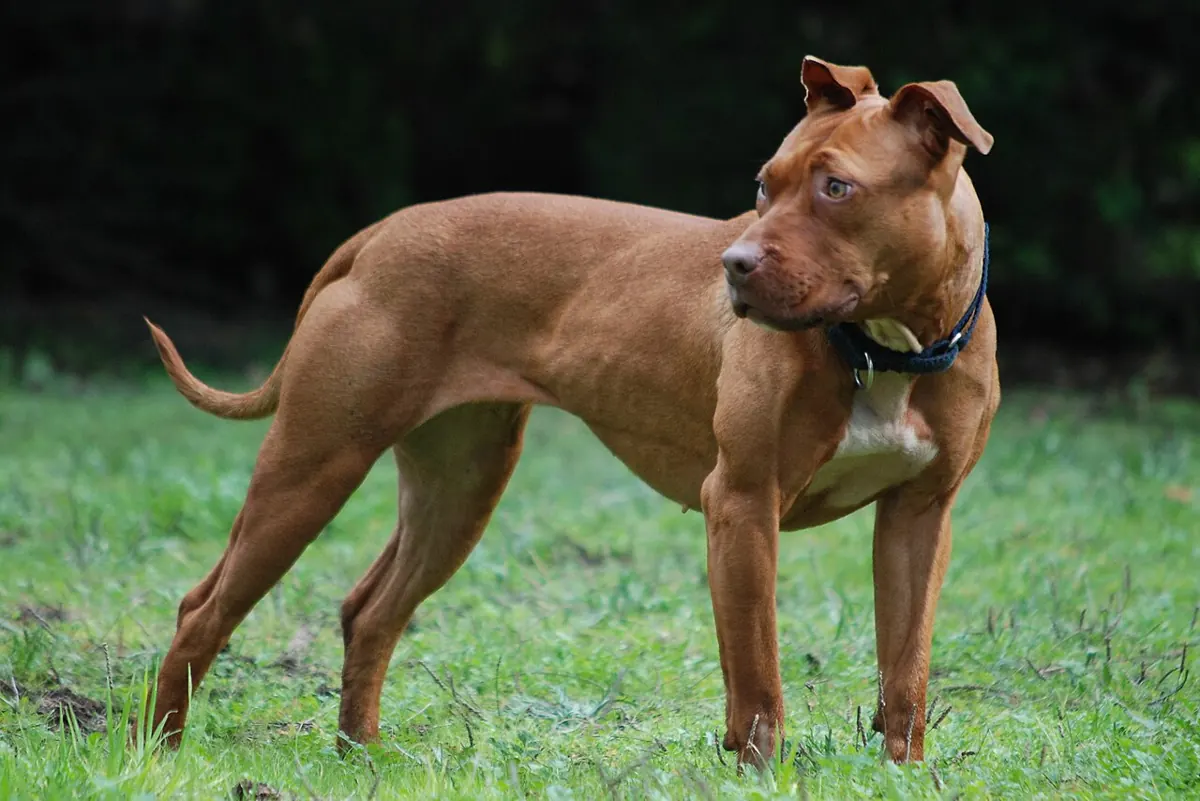
A Pitsky is a cross between a pit bull-type dog, such as an American Pit Bull Terrier or American Staffordshire Terrier, and a Siberian Husky (Olson et al., 2015 defines the pit bull-type group). The Pitsky is not standardized by the AKC or UKC parent-breed standards we cite here, so the size, health and temperament figures on this page are parent-breed context, not measurements of Pitskies. The best guide to any one Pitsky is the dog in front of you.
You’ll also see the mix called a Pit Bull Husky mix, a Husky Pit, or a Siberian Husky and Pit Bull mix. Below is what the parent breeds can honestly tell you, and where the answer is “it depends on the dog.”
Pitsky quick facts
Every figure here is for a parent breed, from that breed’s registry. None is a measurement of Pitskies, and your dog may fall inside, between or outside these ranges.
- Size (parent breeds): the three parent standards together span roughly 17 to 23½ inches at the shoulder and 30 to 70 pounds: APBT 17 to 21 in and 30 to 60 lb (UKC APBT standard), AmStaff 17 to 19 in and 40 to 70 lb (AKC AmStaff), Siberian Husky 20 to 23½ in and 35 to 60 lb (AKC Siberian Husky).
- Lifespan (parent breeds): the AKC lists 12 to 14 years for the Siberian Husky (AKC) and 12 to 16 years for the AmStaff (AKC); the UKC’s APBT standard gives no lifespan (UKC). We do not have a reliable mix-specific lifespan estimate; the parent figures are context, not a prediction.
- Energy (AKC ratings, parent breeds only): Siberian Husky 5 out of 5 (AKC), AmStaff 3 out of 5 (AKC). The UKC doesn’t publish trait ratings for the APBT.
- Shedding (AKC ratings, parent breeds only): Siberian Husky 4 out of 5 (AKC), AmStaff 2 out of 5 (AKC).
- Good with young children (AKC ratings, parent breeds only): Siberian Husky 5 out of 5 (AKC), AmStaff 3 out of 5 (AKC). The UKC says APBTs “have always been noted for their love of children” (UKC). Supervise young children with any dog.
- Good with other dogs (AKC ratings, parent breeds only): Siberian Husky 5 out of 5 (AKC), AmStaff 3 out of 5 (AKC). The UKC says “most APBTs exhibit some level of dog aggression” (UKC). We found no registry rating for cats, so ask about cats dog by dog.
Where the Pitsky comes from
We found no reliable record of when or where the cross was first bred, so this section covers the two parents.
The pit bull side: a type, not one breed
“Pit bull” isn’t a single breed but a loose label for several related breeds and look-alike mixes. One shelter study, for example, defined “pit bull-type” as the American Pit Bull Terrier, the American Staffordshire Terrier, the Staffordshire Bull Terrier, “pit bull,” and their mixes (Olson et al., 2015).
- The American Pit Bull Terrier (APBT) is recognized by the United Kennel Club, which says it was the first registry to do so, in 1898. The UKC traces the breed to 19th-century Bulldog and terrier crosses from England, Ireland and Scotland, later used by American farmers as catch dogs, for hunting and droving, and as family companions (UKC). The APBT does not appear in the AKC’s breed list.
- The American Staffordshire Terrier (AmStaff) is the AKC’s closely related breed. The AKC says American breeders developed a larger Staffordshire Terrier from the mid-1800s, that “the names Pitdog and Pitbull Terrier stuck,” and that the breed entered its stud book in 1936 (AKC AmStaff).
The AKC is candid that these breeds began in long-outlawed British blood sports, and describes today’s well-bred AmStaff as “a more mellow fellow than his pit-fighting ancestors” (AKC AmStaff). If you’re wondering how the pit bull compares with its stockier descendant, see our American Bully vs Pit Bull guide.

The Siberian Husky side
According to the AKC, the Siberian Husky’s ancestors were bred in northeastern Asia by the Chukchi people, as family companions and endurance sled dogs that hauled light loads over long distances in sub-zero temperatures. Siberians won lasting fame in 1925 by relaying diphtheria serum 658 miles to Nome, Alaska (AKC Siberian Husky).
Why you can’t predict a Pitsky from its parents
The two parent standards differ in coat, eye color and build (see below), and nothing in them tells you which parent’s traits a particular puppy will show. Breed labels on mixed dogs add more uncertainty: in a study of 20 adopted dogs, 87.5% of those that agencies had assigned specific breeds did not have all of those breeds detected by DNA (Voith et al., 2009). So a dog called a Pitsky may also have other breeds in its background.
Appearance, size and coat
Size. By the standards’ own figures, Siberian Husky males (21 to 23½ in) stand taller than APBT males (18 to 21 in) and AmStaff males (18 to 19 in) (AKC Siberian Husky standard; UKC; AKC AmStaff). The UKC describes the APBT as a “muscular, very agile breed” (UKC), and the AKC says Siberians are “quick and nimble-footed” (AKC). Those describe the parents. If you need a dog of a particular size, an adult lets you see it rather than guess.
Coat. The Husky has a double coat with a soft, dense undercoat (AKC standard). The APBT’s coat is “glossy and smooth, close” (UKC), and the AmStaff’s is “short, close, stiff to the touch, and glossy” (AKC standard). A dog from this cross could have either type of coat or something between; look at the actual dog.
Color. The Siberian Husky standard allows black, gray, agouti, sable, red and white, solid or in combination, and disqualifies merle and brindle (AKC standard). The APBT standard accepts any color or pattern except merle (UKC). Since both standards disqualify merle, a merle coat on a dog labeled “Pitsky” is one more reason to treat the label as a guess.
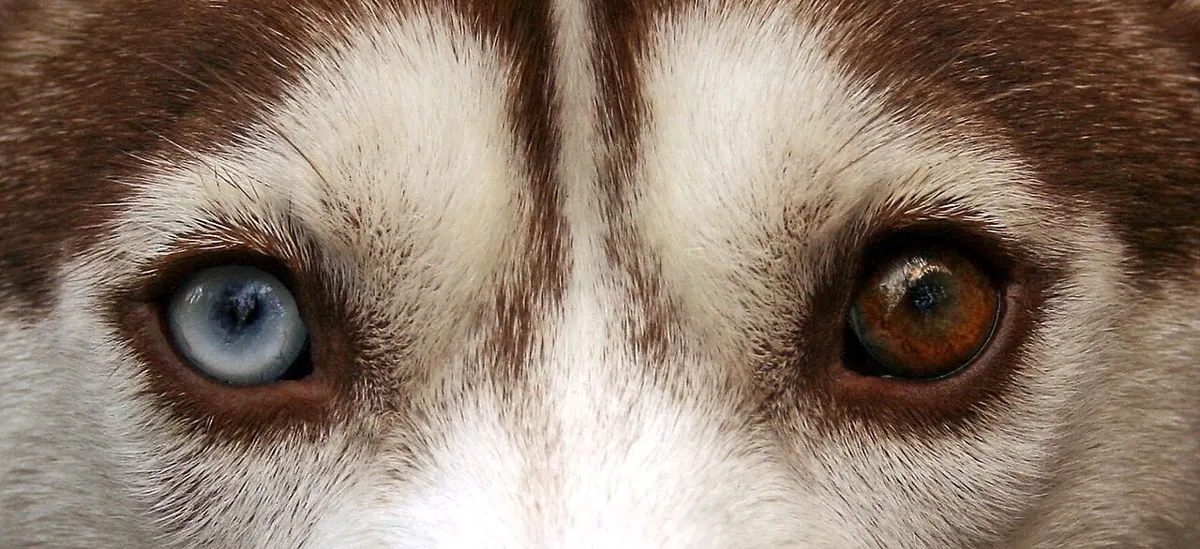
Eyes. The Siberian Husky standard says eyes “may be brown or blue in color; one of each or parti-colored are acceptable” (AKC standard). The APBT standard, by contrast, lists blue eyes and eyes not matched in color as serious faults in that breed (UKC). We know of no reliable way to predict the eye color of a puppy from this cross.

Male vs female
All three parent standards give separate figures for males and females, and in each one the female range is lower:
- APBT: males 35 to 60 lb and about 18 to 21 in; females 30 to 50 lb and about 17 to 20 in. The UKC calls these heights “a general and approximate guideline only” and says dogs outside the ranges aren’t penalized unless they’re out of proportion (UKC).
- AmStaff: males 55 to 70 lb and 18 to 19 in; females 40 to 55 lb and 17 to 18 in (AKC AmStaff).
- Siberian Husky: males 45 to 60 lb and 21 to 23½ in; females 35 to 50 lb and 20 to 22 in (AKC Siberian Husky).
These are purebred figures. They don’t tell you how big a particular male or female Pitsky will be, and none of the standards cited here says sex predicts a dog’s temperament. When choosing, we’d focus on the individual: its energy, how it does with other dogs, and how it walks on a leash for you. Ask your vet about the timing of spay or neuter surgery.
Pitsky vs American Pit Bull Terrier vs Siberian Husky
| Pitsky | American Pit Bull Terrier | Siberian Husky | American Staffordshire Terrier | |
|---|---|---|---|---|
| Height | Not standardized; parent span about 17 to 23½ in | 18 to 21 in (M), 17 to 20 in (F) | 21 to 23½ in (M), 20 to 22 in (F) | 18 to 19 in (M), 17 to 18 in (F) |
| Weight | Not standardized; parent span about 30 to 70 lb | 35 to 60 lb (M), 30 to 50 lb (F) | 45 to 60 lb (M), 35 to 50 lb (F) | 55 to 70 lb (M), 40 to 55 lb (F) |
| Lifespan | No reliable mix-specific estimate | Not given in UKC standard | 12 to 14 years | 12 to 16 years |
| Coat | Varies by dog | Glossy, smooth, close | Double, medium length | Short, close, stiff, glossy |
| AKC shedding rating (1 to 5) | Not rated | Not rated by AKC | 4 | 2 |
| AKC energy rating (1 to 5) | Not rated | Not rated by AKC | 5 | 3 |
| Climate notes | No registry guidance | No registry guidance | Bred for sub-zero sledding | No registry guidance |
| Registry standard | Not covered by the cited AKC/UKC standards | UKC (first registered 1898) | AKC | AKC |
Sources: UKC American Pit Bull Terrier standard; AKC Siberian Husky and standard; AKC American Staffordshire Terrier and standard. The “parent span” figures in the Pitsky column are simply the lowest and highest parent figures, not a measured result for the mix.
Temperament: what each parent breed is known for
These are registry descriptions of purebred parents. They are not predictions for a Pitsky.
The Husky side. The AKC describes the Siberian as “friendly, fastidious, and dignified,” and rates it 5 out of 5 for affection with family, openness to strangers, playfulness, and getting along with other dogs. It rates the breed just 1 out of 5 as a watchdog, and 5 out of 5 for barking, which on the AKC scale includes howling (AKC Siberian Husky).
The pit bull side. The UKC describes the APBT as “eager to please and brimming over with enthusiasm,” says the breed has “always been noted for their love of children,” and notes it is “not the best choice for a guard dog since they are extremely friendly, even with strangers.” It calls aggressive behavior toward humans “uncharacteristic of the breed and highly undesirable.” The same standard is honest that “most APBTs exhibit some level of dog aggression” and that the breed needs an owner who will socialize and train it carefully (UKC). The AKC says dog aggression “can develop even in well-socialized” AmStaffs and that an AmStaff “should never under any circumstances be left alone with other dogs” (AKC AmStaff).
What the science says about breed and behavior. A 2022 study in Science surveyed owners of 18,385 dogs and genotyped 2,155 of them. It found that breed explains just 9% of the behavioral variation between individual dogs (Morrill et al., 2022, doi:10.1126/science.abk0639). In plain English: breed is a weak guide to how any one dog will behave. That’s good news for anyone adopting an adult, because you can meet the actual dog and ask about its history.
Exercise, escape risk and alone time
Exercise
Both parent breeds are described as active. The AKC says Siberians “need a lot of exercise” and were “bred to run and will do so at every opportunity” (AKC Siberian Husky). It says the AmStaff “requires a lot of exercise” too, but that leaving the dog out in the yard all day “is not the right approach,” because “the AmStaff is a people-oriented dog who thrives when he is made part of the family” (AKC AmStaff).
How much exercise a particular Pitsky needs is something to ask the shelter or foster, who has seen the dog. Mixing walks with brain work, such as sniff walks, food puzzles and short training games, is an easy way to start. Ask your vet before starting running or other high-impact activity, for you or the dog.
Escape risk and fencing
Both parent registries flag containment. The AKC says Siberians “should be on leash or in a securely fenced-in area at all times and never allowed off lead” and must be kept “on a leash, in harness, or in a fenced yard at all times” (AKC Siberian Husky). The UKC calls the APBT “one of the most capable canine climbers so good fencing is a must for this breed” (UKC). The AKC also notes that chewing and digging can be hard to resolve in AmStaffs (AKC AmStaff).
Because one parent’s registry warns about running and the other’s about climbing, it’s sensible to check your fence before the dog comes home:
- Walk the fence line for gaps, loose boards, low spots and anything a dog could climb, like a woodpile or bench.
- Check that gates latch on their own, and that visitors know to close them.
- Keep a collar with an ID tag on, and ask the shelter whether the dog is microchipped and how to register your details.
- Supervise yard time until you know how this dog behaves outside, and ask the foster or shelter whether it has ever escaped.
Alone time
The AKC says Siberians “are very social, and regularly need the company of their people or other dogs; they are not suited to being left alone all day” (AKC Siberian Husky). For the AmStaff, it describes a people-oriented dog that thrives as part of the family, and says AmStaffs should never be left alone with other dogs (AKC AmStaff).
Those are parent-breed descriptions. A specific dog may cope better or worse, so ask about its alone-time history before you decide (see the shelter questions below). If you’re out for long days, a dog walker, a trusted neighbor or daycare can help, and a dog whose foster reports that it settles calmly when left is a better bet than a guess.
Grooming and shedding
The AKC calls the Siberian Husky a “natural” breed that’s “remarkably self-cleaning” and often needs only a few baths a year. It recommends weekly brushing, says the undercoat sheds twice a year, and advises raking out the loose coat then with a pin brush and metal comb (AKC Siberian Husky). The AmStaff’s short coat needs “a quick once-over with a soft bristle brush every week” (AKC AmStaff).
So the right routine depends on which coat your dog has. If it has a Husky-style undercoat, follow the Husky advice and expect heavier seasonal sheds; if it has a short, close coat, the AmStaff’s weekly brush is a good starting point. The AKC advises keeping nails trimmed for both breeds (AKC Siberian Husky; AKC AmStaff). Ask your vet about dental care.
Health: what to ask about
We have no health data for the Pitsky as a mix. Below are the conditions that the parent breeds’ clubs and the AKC document, so you know what to ask about. This isn’t a diagnosis checklist; if something worries you, talk to your vet.
| Condition | Which parent breed | What the source says |
|---|---|---|
| Hip dysplasia | Both | The AKC says incidence is “relatively low” in Siberians (AKC) and notes “some instances of mild hip dysplasia” in AmStaffs (AKC). Both breed clubs recommend hip evaluations for breeding dogs (SHCA; STCA). |
| Eye disease | Siberian Husky | The AKC says incidence is “relatively low” (AKC); the Siberian Husky Club of America (SHCA) still recommends a yearly eye exam by an ACVO board-certified ophthalmologist for breeding dogs (SHCA health statement). |
| Inherited neurologic conditions | Siberian Husky | The SHCA recommends DNA tests for Siberian Husky Shaking Puppy Syndrome Type 1 (SPS1) and Siberian Husky Polyneuropathy Type 1 (SHPN1) (SHCA). |
| Cerebellar ataxia (NCL-A) | AmStaff | The AKC says this inherited disease causes a progressive loss of coordination, with first signs usually between ages 3 and 5, and that a screening test exists (AKC AmStaff). |
| Skin and coat allergies | AmStaff | The AKC says instances of skin and coat allergies have been found in the breed (AKC AmStaff). |
| Heart disease | AmStaff | The AKC mentions “some types of cardiac disease” (AKC); the Staffordshire Terrier Club of America (STCA) recommends a cardiac exam by a cardiologist (STCA). |
| Thyroid disease | AmStaff | The STCA recommends annual autoimmune thyroiditis testing for breeding dogs (STCA health statement). |
The UKC’s APBT standard doesn’t list health tests (UKC), so the pit bull-type health information above comes from the AmStaff’s registry and breed club. The AKC calls Siberians “generally a healthy, relatively long-lived breed,” while noting that cancer and arthritis occur, “as in all breeds” (AKC Siberian Husky).
Adopting? You may not have parent test results, and that’s fine. Get the shelter’s vet records, book a checkup soon after adoption, and mention the conditions above to your vet.
Training
The AKC rates both the Siberian Husky and the AmStaff 3 out of 5 for trainability; these are parent-breed ratings (AKC Siberian Husky; AKC AmStaff). For AmStaffs, the AKC says early socialization and puppy classes are “a necessity,” and that the breed’s “intelligence and desire to please make training a fun, easy process” (AKC AmStaff). For Siberians, the AKC suggests making training exercises “fun for both dog and handler” (AKC Siberian Husky).
Practical starting points for the first weeks:
- A well-fitted harness and loose-leash walking practice, so walks are comfortable for you both.
- A reliable “sit” for greetings, “leave it,” and settling on a mat.
- Slow, supervised introductions to other dogs.
- Short, upbeat, reward-based sessions. If you’d like help, ask the shelter or your vet to recommend a trainer who uses reward-based methods.
Diet basics
There’s no special “Pitsky diet.” The AKC says Siberians maintain a healthy weight on less food than other breeds of the same size (AKC Siberian Husky), and its AmStaff page notes that some dogs are prone to getting overweight, so watch calories and treats (AKC AmStaff). Feed a complete, good-quality food suited to your dog’s age, keep fresh water out, and ask your vet how much your dog should eat and what a healthy weight looks like for its frame.
What a Pitsky costs
We don’t have cost data for this mix specifically, and we don’t quote puppy prices. The ASPCA’s 2021 estimate puts the annual cost of owning a dog at $1,391, with $3,221 for the first year once one-time costs are included (ASPCA). Ask any shelter or rescue what its adoption fee includes, such as vaccines, a microchip or spay or neuter surgery.
Puppy or adult?
An adult lets you see what you’re getting. The parent ranges in the table above are wide, so a puppy’s adult size, coat and eye color are guesses; with an adult, they’re facts. A shelter or foster can also tell you how the dog has behaved with people, other dogs, cats, car rides and time alone. And because breed explains only a small share of individual behavior (Morrill et al., 2022), that history is the most useful information you can get.
A puppy means planning for the unknowns: final size, coat type and energy level. The AKC calls early socialization and puppy classes “a necessity” for AmStaffs given their strength and exuberance (AKC AmStaff), so budget time for classes. Puppies also need frequent supervision and potty trips, which is worth weighing honestly against your energy and schedule.
If you’re considering a breeder
The AKC and UKC standards we cite don’t cover the Pitsky, so there’s no breed club for the cross itself. If you go to a breeder anyway, these questions come from the parent breeds’ own health guidance:
- Can I meet both parents? Seeing their size, coat and behavior is your best preview.
- Which health tests have both parents had? For a Husky parent, the SHCA’s list includes hips, a yearly eye exam by a board-certified ophthalmologist, and DNA tests for SPS1 and SHPN1 (SHCA health statement). For an AmStaff parent, the STCA lists hips, a cardiac exam by a cardiologist, autoimmune thyroiditis and NCL-A (STCA health statement).
- Can I check the results myself? The SHCA advises verifying a dog’s results in the OFA’s public database rather than taking a breeder’s word for it, and warns that DNA testing alone is not enough to call a dog “fully health tested” (SHCA health testing).
- What happens if I can’t keep the dog? Ask whether the breeder will take the dog back at any age.
If a breeder tells you the cross is healthier than either parent, ask what evidence that’s based on.
Is a Pitsky right for me? A quick checklist
Written with adopters over 50 in mind. A few “no” answers don’t rule you out; they tell you what to plan for, or which dog to ask about.
- Yes / No: I (or someone in my home) can give a dog daily exercise and play, in the amount the shelter or foster says this dog needs.
- Yes / No: I can comfortably hold a strong, medium-sized dog on a leash, or I’m willing to use a well-fitted harness and train loose-leash walking.
- Yes / No: My yard is securely fenced, or I’m happy to keep the dog leashed outdoors every time.
- Yes / No: Someone is home much of the day, or I can arrange a walker or daycare on long days.
- Yes / No: Dog hair and seasonal shedding won’t bother me (or anyone with allergies at home).
- Yes / No: I’ve checked my lease, HOA and homeowner’s or renter’s insurance for breed rules (see the checklist below).
- Yes / No: I’m comfortable introducing a new dog slowly to any dogs or cats already at home, or I live without other pets.
- Yes / No: I’ve thought about who would care for this dog if I ever couldn’t.
A Pitsky may suit you if you’re active, home a lot, and would enjoy a dog that wants to be included in family life. As parent-breed context, the AKC says Siberians “enjoy family life” (AKC Siberian Husky) and that the AmStaff “thrives when he is made part of the family” (AKC AmStaff).
Consider a calmer dog if you want a mostly relaxed companion, you’d struggle with a strong puller, or the dog would be alone most of the day. An adult Pitsky that a foster knows to be mellow can be the exception.
Shelter label reality check
A “Husky/Pit mix” label on a shelter website may be a visual guess, and the research on those guesses is humbling:
- In a University of Florida study across four shelters, staff labeled 52% of 120 dogs as pit bull-type by sight, but DNA identified only 21% as pit bull-type. Staff often disagreed with each other, and the authors concluded visual identification of pit bull-type dogs “was unreliable” (Olson et al., 2015, The Veterinary Journal).
- In a study of 20 adopted dogs, 87.5% of those that agencies had assigned specific breeds did not have all of those breeds detected by DNA (Voith et al., 2009).
- In a US and UK survey, shelter workers disagreed widely about which dogs were pit bulls, and 41% of those working under breed-specific laws said they would knowingly mislabel a restricted breed to help it get adopted (Hoffman et al., 2014).
- Arizona State researchers found a pit bull label changed how adopters saw a dog and how long it waited, and that dropping kennel breed labels is a low-cost way to improve outcomes (Gunter et al., 2016, PLOS ONE).
So read the label as a starting point, not a promise. Ask about the dog instead:
- Can we do a meet-and-greet, ideally more than once, and somewhere quieter than the kennel?
- What do the behavior notes say? How does the dog handle handling, vet care, baths and nail trims? Any guarding of food or toys?
- Has the dog been cat-tested? How did it react, and was it tested more than once?
- How has it done with other dogs? Playgroups, a dog-to-dog meeting, or a foster home with dogs?
- What’s its alone-time history? Has it been in a foster home, and how did it cope with being left for a few hours?
- Has it ever escaped or climbed a fence? And how does it walk on a leash?
- Is there a foster-to-adopt option, and what happens if it doesn’t work out?
Before you adopt: housing, insurance and breed-law checklist
Because visual breed labels are unreliable (Olson et al., 2015), a dog with any pit bull-type look may be treated as a pit bull by a landlord, insurer or local rule. Check these before you fall in love:
- Local laws. Ask your city or county animal services whether any breed-specific rules apply where you live, and where you might move.
- Your lease or HOA. Read the pet policy for breed, size or weight limits, and get approval in writing.
- Homeowner’s or renter’s insurance. Ask your insurer directly whether the policy excludes or surcharges certain breeds or mixes, and how it identifies a dog’s breed.
- Senior or retirement communities. If you live in one, or may later, check its pet rules now.
The ASPCA opposes breed-specific laws. Its position statement notes that the US Centers for Disease Control and Prevention has recommended against them, cites the difficulty of identifying breeds (especially in mixed-breed dogs), and gives the example of a state law under which pit bull guardians had great difficulty finding housing and homeowner’s or renter’s liability insurance (ASPCA).
Adopting a Pitsky
Search local shelters and rescues for “Husky mix,” “Pit Bull mix” and “Terrier mix,” since breed labels are guesses (see above). The Siberian Husky Club of America also keeps rescue resources for people looking to rescue a Siberian, and for owners whose circumstances have changed.
Adopting an adult has a real advantage: you see the dog’s actual size, coat and energy instead of guessing from a puppy, and a foster home can tell you how it handles visitors, car rides and quiet evenings.
Give your dog a backup plan
Whatever dog you bring home, it’s worth deciding now who would care for it if you ever couldn’t. That isn’t a gloomy thought; it’s one of the kindest things you can do for a dog you love. Our A Home for Life guide walks through naming a backup adopter, and My Dog’s Backup Plan is a free fillable profile that records your dog’s routine, vet, quirks and favorite things, so the person who steps in knows exactly how to care for them.
Related breed guides
If you’re weighing a Pitsky, these neighbors are worth a look: the Husky Boxer mix and the Doberman Husky mix (two more Husky crosses), the Brown Husky, the Shepherd and Pitbull mix (a German Shepherd cross), the Weimaraner Pit Bull mix, the Vizsla Pit Bull mix and the Pomeranian and Pit Bull mix. For more breed profiles, browse our breeds and adoption guides.
Frequently Asked Questions
How big does a Pitsky get?
We don’t have reliable mix-specific size data, so here is parent-breed context only. The parent standards together span about 17 to 23½ inches at the shoulder and 30 to 70 pounds: the UKC gives American Pit Bull Terriers 30 to 60 pounds (UKC), and the AKC gives American Staffordshire Terriers 40 to 70 pounds (AKC) and Siberian Huskies 35 to 60 pounds (AKC). Each of those standards gives a lower range for females than males, but they are purebred figures, not a prediction for any one Pitsky. If size matters to you, an adult dog lets you see it.
Are Pitskies good family dogs?
That depends on the individual dog. As parent-breed context only, the AKC rates the Siberian Husky 5 out of 5 (AKC) and the American Staffordshire Terrier 3 out of 5 (AKC) for being good with young children, and the UKC says American Pit Bull Terriers “have always been noted for their love of children” (UKC). None of these is a rating of Pitskies. Ask the rescue how this dog has done with children, and always supervise young children with any dog.
How long do Pitskies live?
We do not have a reliable mix-specific lifespan estimate; the parent figures are context, not a prediction. The AKC lists 12 to 14 years for the Siberian Husky (AKC) and 12 to 16 years for the American Staffordshire Terrier (AKC). The UKC standard for the American Pit Bull Terrier does not give a lifespan (UKC).
Do Pitskies shed?
It depends on the coat your dog has. The Siberian Husky has a double coat whose undercoat sheds twice a year, and the AKC rates the breed 4 out of 5 for shedding (AKC). The AKC rates the short-coated American Staffordshire Terrier 2 out of 5 (AKC). A dog from this cross could have either kind of coat or something between. The AKC recommends weekly brushing for both parent breeds, with extra raking during a Husky’s seasonal shed.
Are Pitskies aggressive?
A breed label can’t answer that for an individual dog: a large genetics study in Science found breed explains only about 9% of behavior differences between individual dogs (Morrill et al., 2022). As parent-breed context, the UKC says aggressive behavior toward humans is “uncharacteristic” of the American Pit Bull Terrier, but also that most APBTs show some level of dog aggression (UKC), and the AKC advises that an American Staffordshire Terrier never be left alone with other dogs (AKC). Ask the shelter for this dog’s behavior notes and history with people and other dogs, and plan slow, supervised introductions.
Can a Pitsky be left alone?
That depends on the dog in front of you, so ask the shelter or foster about its alone-time history. As parent-breed context, the AKC says Siberian Huskies “are not suited to being left alone all day” (AKC) and calls the American Staffordshire Terrier “a people-oriented dog who thrives when he is made part of the family” (AKC). If you’re out for long days, plan for a walker or daycare, or look for a dog whose foster reports it settles calmly when left.
Are Pitskies easy to train?
We don’t have a mix-specific trainability rating. As parent-breed context, the AKC rates both the Siberian Husky (AKC) and the American Staffordshire Terrier (AKC) 3 out of 5 for trainability. The AKC calls puppy classes “a necessity” for AmStaffs, suggests keeping Husky training “fun for both dog and handler,” and advises keeping Huskies on a leash or in a securely fenced area at all times. Short, reward-based sessions and patience are a good place to start.
Sources
- American Kennel Club, Siberian Husky breed page (size, life expectancy, trait ratings, history, health, grooming, exercise, training, nutrition)
- American Kennel Club, Official Standard of the Siberian Husky (height, weight, coat, color, eyes)
- American Kennel Club, American Staffordshire Terrier breed page (size, life expectancy, trait ratings, history, health, grooming, exercise, training, nutrition)
- American Kennel Club, Official Standard for the American Staffordshire Terrier
- United Kennel Club, American Pit Bull Terrier breed standard (revised 2017)
- Siberian Husky Club of America, Health Statement (2024), Health Testing information and Rescue Resources
- Staffordshire Terrier Club of America, Health Statement
- Morrill K, et al. (2022). Ancestry-inclusive dog genomics challenges popular breed stereotypes. Science 376(6592):eabk0639. doi:10.1126/science.abk0639
- Olson KR, et al. (2015). Inconsistent identification of pit bull-type dogs by shelter staff. The Veterinary Journal 206(2):197-202. doi:10.1016/j.tvjl.2015.07.019
- Voith VL, et al. (2009). Comparison of adoption agency breed identification and DNA breed identification of dogs. Journal of Applied Animal Welfare Science 12(3):253-62. PubMed
- Hoffman CL, et al. (2014). Is that dog a pit bull? A cross-country comparison of perceptions of shelter workers regarding breed identification. Journal of Applied Animal Welfare Science 17(4):322-39. PMC
- Gunter LM, et al. (2016). What’s in a name? Effect of breed perceptions & labeling on attractiveness, adoptions & length of stay for pit-bull-type dogs. PLOS ONE 11(3):e0146857. Article
- ASPCA, Position Statement on Breed-Specific Legislation
- ASPCA, Cutting Pet Care Costs (2021 cost update)