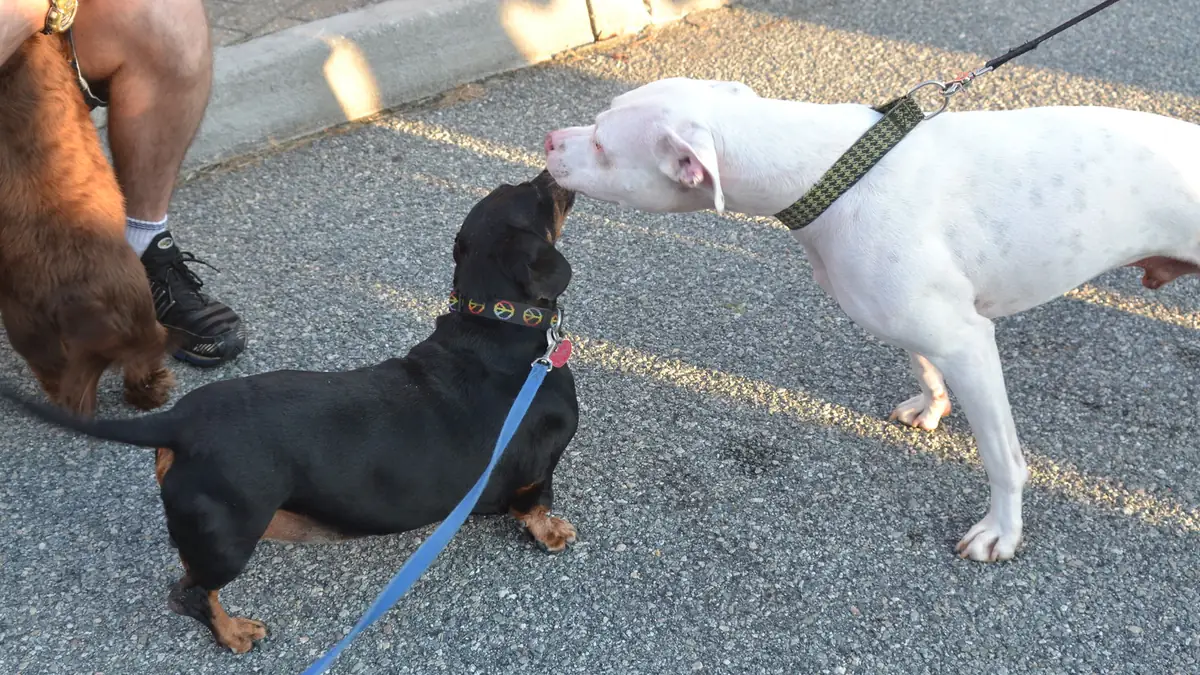
A pitbull doxie mix, often called a Doxie Pit or Dox-Bull, is a cross between a Dachshund and a pit bull-type dog, usually an American Pit Bull Terrier or American Staffordshire Terrier. Expect a short-coated, people-loving, often stubborn dog whose size and shape are hard to predict: it may have a pit bull’s head on a long, low Dachshund body, or look like a small pit bull. It isn’t a recognized breed, so meet the individual dog before you decide.
If you’ve spotted a “Dachshund/pit mix” on a shelter website, this guide is for you. Below is what the American Kennel Club (AKC), the United Kennel Club (UKC), veterinary schools and published research say about each parent, the realistic range of outcomes, the back health question that matters most for this cross, and an honest home-fit checklist.
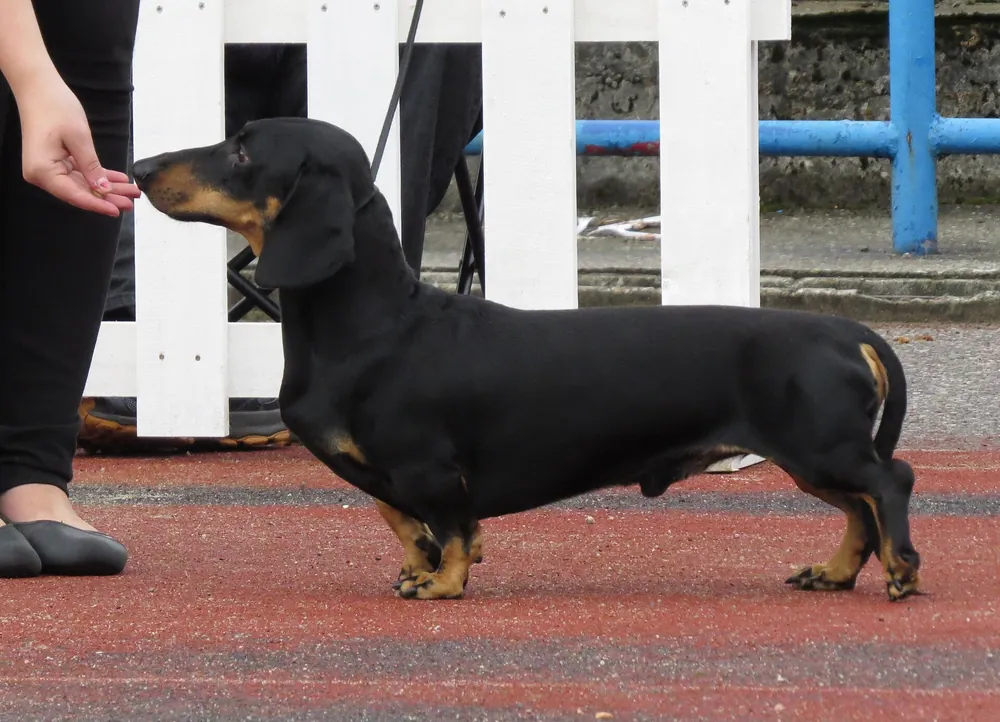
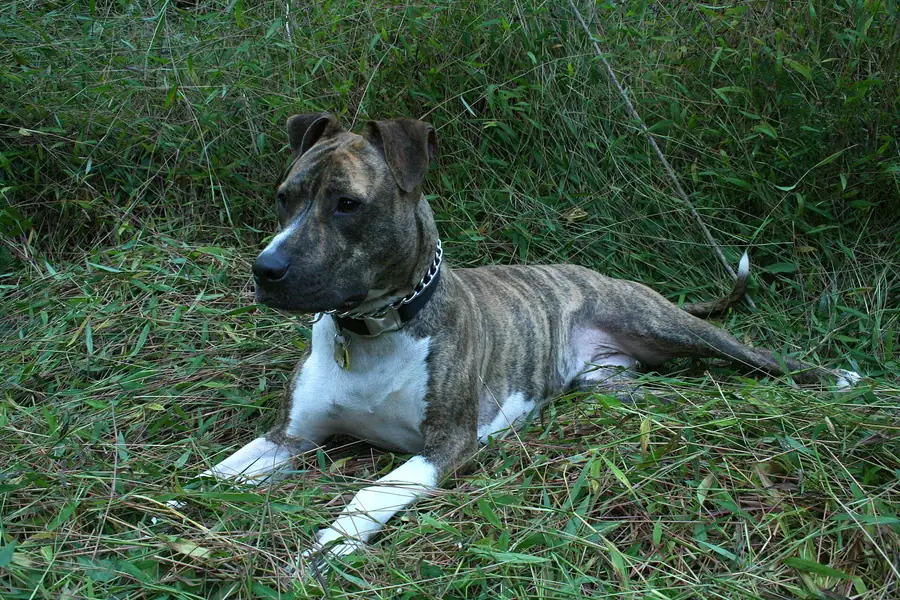
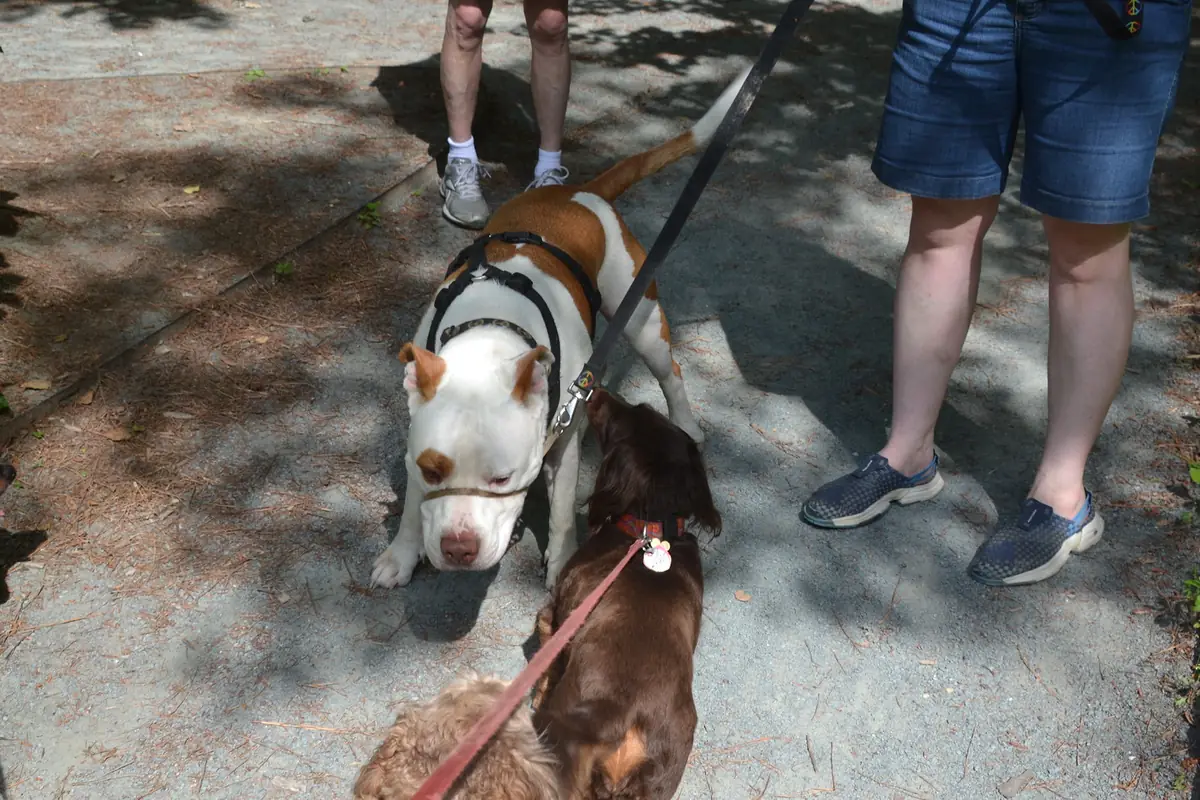
A note on our photos: we searched Wikimedia Commons, Flickr and other open-license libraries and couldn’t find a single openly licensed photo of a confirmed Dachshund and pit bull cross. So every photo on this page shows real Dachshunds and pit bulls, sometimes together, and is labeled that way. None of them is a Doxie Pit.
Pitbull doxie mix quick facts
These are figures for the parent breeds unless we say otherwise. None is a measurement of the mix.
- Also called: Doxie Pit, Dox-Bull, Doxie Bull, Dachshund pit mix. Informal names, not a recognized breed.
- Dachshund size: standard 8 to 9 inches and 16 to 32 pounds; miniature 5 to 6 inches and 11 pounds and under (AKC).
- Pit bull-type size: American Pit Bull Terrier about 17 to 21 inches and 30 to 60 pounds (UKC); American Staffordshire Terrier (AmStaff) 17 to 19 inches and 40 to 70 pounds (AKC).
- Size of the mix: not documented. It can land almost anywhere between the parents, and leg length is a coin toss (see below).
- Lifespan (AKC): 12 to 16 years for both the Dachshund and the AmStaff (AKC; AKC). Not studied for the mix.
- Energy (AKC ratings): 3 out of 5 for both parents.
- Grooming (AKC ratings): coat care 2 for the Dachshund and 1 for the AmStaff; shedding 2 for both. Easy, unless the dog inherits a long or wiry Dachshund coat.
- Good with young children (AKC ratings): 3 out of 5 for both. Supervise.
- Good with other dogs (AKC ratings): Dachshund 4, AmStaff 3, and the UKC says most American Pit Bull Terriers “exhibit some level of dog aggression.” Ask dog by dog.
- Health to know about: back disease (IVDD) from the Dachshund side, knees, hips and skin from the pit bull side, plus weight and teeth. Sources below.
- Good fit for: someone who wants a devoted, playful companion, can manage a strong-willed dog with reward-based training, and will protect a possibly long back.
What a Doxie Pit actually is
We found no reliable record of when or where Dachshunds and pit bulls were first crossed, so we don’t guess. Neither the AKC nor the UKC registers the mix, and there is no breed club or health-testing program behind it. A mixed-breed dog can still enroll in AKC Canine Partners and compete in sports such as agility, obedience and rally (AKC Canine Partners). The best place to start is the two parents.
The Dachshund side
“Dachshund” is German for “badger dog.” The AKC says the breed’s German history goes back some 600 years, and that its “long, low body was custom-made” for digging into a badger’s den. It comes in two sizes (standard and miniature) and three coats (smooth, wirehaired and longhaired). The AKC calls Dachshunds “smart and vigilant, with a big-dog bark,” “brave to the point of rashness, and a bit stubborn,” and says they “aren’t built for distance running, leaping, or strenuous swimming” (AKC Dachshund). Doxie, wiener dog and sausage dog are all nicknames for the same breed (Britannica). Our Dachshund guide has more.

The pit bull side: a type, not one breed
“Pit bull” is a loose label. One shelter study used it for the American Pit Bull Terrier, the American Staffordshire Terrier, the Staffordshire Bull Terrier, “pit bull,” and their mixes (Olson et al., 2015).
- American Pit Bull Terrier (APBT). The UKC says it was the first registry to recognize the breed, assigning registration number 1 to an APBT in 1898. The AKC doesn’t register it. The UKC describes a “medium-sized, solidly built, short-coated dog” that is “eager to please and brimming over with enthusiasm” (UKC).
- American Staffordshire Terrier (AmStaff). The AKC’s closely related breed, with a life expectancy of 12 to 16 years (AKC AmStaff).
Here’s a detail that matters for this mix: the UKC standard lists “short legs” among its eliminating faults and disqualifies dwarfism (UKC). In other words, a short-legged pit bull-type dog doesn’t fit the APBT standard, so a long, low dog with a blocky head is a hint that something else, such as Dachshund, may be in the family tree. Our American Bully vs Pit Bull guide sorts out the lookalikes, some of which are bred short and stocky.

How can such different-sized dogs have puppies?
It’s possible, but size matters for the mother’s safety. Cornell’s veterinary college lists puppies that are too large among the causes of a difficult birth (Cornell), and the Merck Veterinary Manual says the same (Merck). Dogster’s guide goes further and says no one should breed this pairing on purpose. We agree with the spirit: if a small Dachshund may have mated with a much larger dog, call a vet right away, and be wary of anyone selling Doxie Pit puppies as a designer breed.
Doxie Pit vs Dachshund vs pit bull: comparison table
Registry figures and the AKC’s 1 to 5 trait ratings (5 = most). The UKC doesn’t publish ratings for the APBT. The Doxie Pit column is the space between the parents, not measured data, and any one dog can fall outside it.
| Miniature Dachshund | Standard Dachshund | Doxie Pit (mix) | American Pit Bull Terrier | American Staffordshire Terrier | |
|---|---|---|---|---|---|
| Registry | AKC Hound Group (size class) | AKC Hound Group | Not a recognized breed | UKC (1898); not AKC | AKC, Terrier Group |
| Height | 5 to 6 in | 8 to 9 in | Not documented; parents span 5 to 21 in | About 17 to 21 in | 17 to 19 in |
| Weight | 11 lb and under | 16 to 32 lb | Not documented; parents span up to 70 lb | 30 to 60 lb | 40 to 70 lb |
| Life expectancy | 12 to 16 yrs | 12 to 16 yrs | Not studied | Not given in UKC standard | 12 to 16 yrs |
| Body shape | Long and low | Long and low | Long and low, square, or in between | Slightly longer than tall; short legs a fault | Stocky, muscular |
| Coat | Smooth, wire or long | Smooth, wire or long | Usually short; not documented | Short, glossy | Short, stiff |
| Affectionate with family | 5 | 5 | Not rated | ”Excellent family companions” (UKC) | 5 |
| Good with young children | 3 | 3 | Not rated; supervise | ”Noted for their love of children” (UKC) | 3 |
| Good with other dogs | 4 | 4 | Not rated; ask | Most show some dog aggression (UKC) | 3 |
| Openness to strangers | 4 | 4 | Not rated | ”Extremely friendly, even with strangers” (UKC) | 4 |
| Watchdog nature | 4 | 4 | Not rated | ”Not the best choice for a guard dog” (UKC) | 5 |
| Energy | 3 | 3 | Not rated | Not rated | 3 |
| Barking | 5 | 5 | Not rated | Not rated | 3 |
| Trainability | 4 | 4 | Not rated | Not rated | 3 |
| Shedding | 2 | 2 | Not rated | Not rated | 2 |
| Biggest health watch-outs | Back (IVDD), teeth | Back (IVDD) | Back, weight, knees, skin | Knees, hips, skin (AmStaff data) | Knees, hips, skin |
Sources: AKC Dachshund (the AKC rates the Dachshund as one breed across both sizes), UKC American Pit Bull Terrier standard, AKC American Staffordshire Terrier; health sources in the health section below.
The pattern to notice: both sides are affectionate with their people, with moderate energy and easy coats. Where they differ is barking (the Dachshund scores 5, the AmStaff 3), comfort with other dogs, and above all body shape, which drives the back risk.
Size and appearance: what a Doxie Pit looks like
There’s no documented size. Online guides quote 20 to 30 pounds and 8 to 13 inches, or 20 to 50 pounds; we couldn’t find a study behind any of those numbers. Here is what the sources do support:
- The Dachshund parent sets the floor. A miniature Dachshund parent (11 pounds and under) and a 60-pound pit bull are very different from a 30-pound standard Dachshund and a 35-pound female APBT. Ask which size the Dachshund parent was, if anyone knows.
- Legs are the big variable. Short legs in the Dachshund, Corgi and Basset Hound come from an extra copy of a gene called FGF4 (Parker et al., 2009). Two such gene copies exist, on chromosomes 12 and 18, and both contribute to short legs (Batcher et al., 2019). A Doxie Pit that inherits them may have short legs on a pit bull-sized body; one that doesn’t may look like a smallish, leggy pit bull.
- Heads, ears and coats vary too. The APBT standard calls for a broad head and small to medium ears, natural or cropped, in any color except merle (UKC). The Dachshund has long, hanging ears and three coat types (AKC Dachshund). A Doxie Pit can have folded, half-up or one-of-each ears.
- Males often run bigger. Both pit bull-type standards give larger ranges for males (UKC; AKC AmStaff).
If size matters for your lease, your car or your strength on the leash, adopt a grown dog. You’ll know the answer on day one.
Temperament: what to realistically expect
These are registry descriptions of the purebred parents, not predictions for any one mix.
The Dachshund side. The AKC rates Dachshunds 5 out of 5 for affection with family and 5 for barking, and says they are “very intelligent but are also independent and often stubborn,” with “a strong prey drive” (AKC Dachshund).
The pit bull side. The UKC calls APBTs “excellent family companions” that “have always been noted for their love of children,” and says aggression toward people is “uncharacteristic of the breed and highly undesirable.” It also says most APBTs show some level of dog aggression, so the breed “requires an owner who will carefully socialize and obedience train the dog” (UKC).
What the science says about breed and behavior. A 2022 study in Science surveyed owners of 18,385 dogs and genotyped 2,155. Breed explained just 9% of the behavior differences between individual dogs (Morrill et al., 2022). A label is a weak guide to the dog in front of you.
In daily life:
- Family: both parents score high for affection. Expect a dog that wants to be near you, often on you. The AKC says Dachshunds “don’t do well as outdoor dogs” because they want to be with their people (AKC Dachshund).
- Noise: with a 5-out-of-5 barker on one side, many Doxie Pits will announce the mail carrier. Ask the foster how vocal this particular dog is.
- Other dogs and cats: both parents have hunting or fighting histories, and the Dachshund has a strong prey drive. Ask how the dog has done with dogs, cats and small pets, and introduce slowly.
- Children: both parents score 3 out of 5 with young children (AKC Dachshund; AKC AmStaff). If grandchildren visit, supervise and give the dog a quiet place to retreat. A child picking up a long-backed dog the wrong way can hurt it.
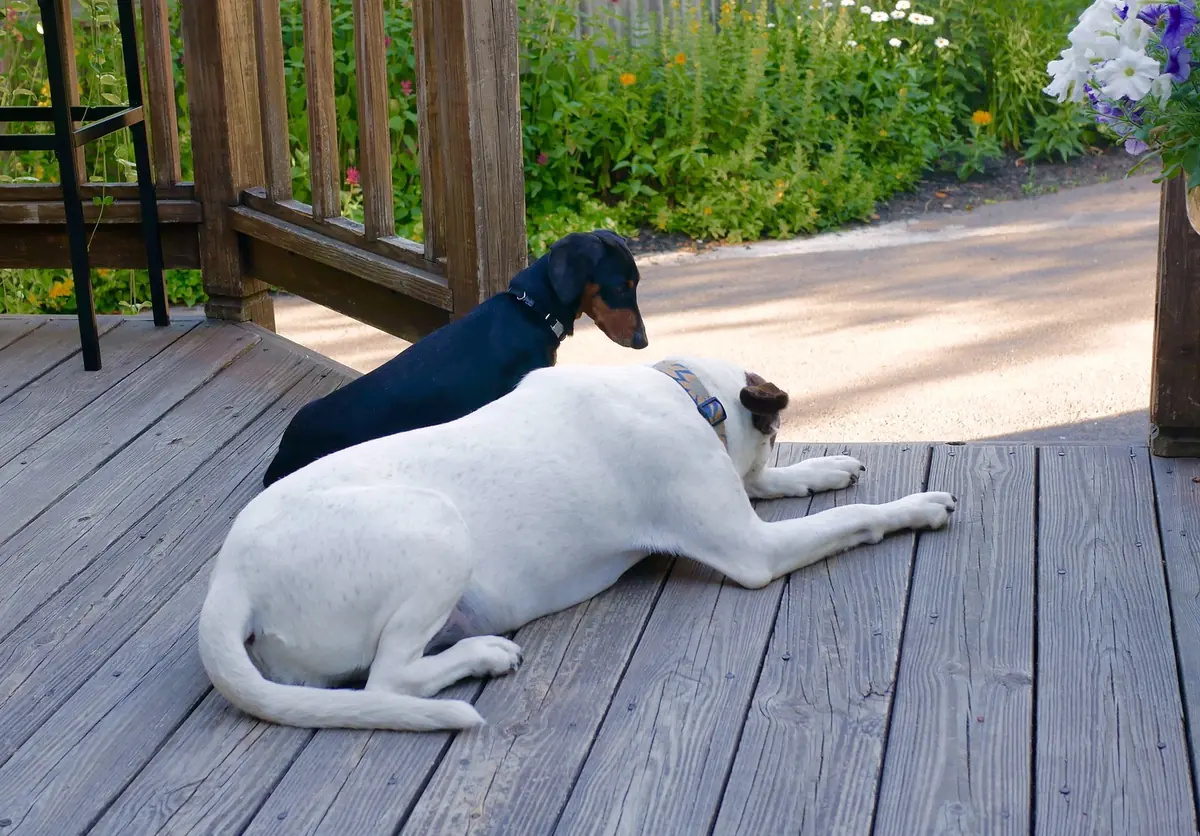
Exercise needs
Both parents score 3 out of 5 for energy with the AKC, so most Doxie Pits need daily activity but not marathon sessions. The AKC says Dachshunds need regular exercise “not only to stay fit, but also to build strong muscles to support and protect their back,” and that “two walks every day of moderate length should be sufficient” (AKC Dachshund). The Dachshund Club of America suggests a daily routine of on-leash walks and free play, and building a puppy’s activity up gradually until about a year old (DCA health).
You’ll see “at least an hour a day” or “30 to 60 minutes” quoted for this mix. We found no study behind those numbers. What we can say: in a UK survey of Dachshunds, dogs that got more than an hour of exercise a day had lower odds of back disease, and those that got under 30 minutes had higher odds (Packer et al., 2016). That’s a link, not proof, but it’s a good reason to keep a long-backed dog moving.
Practical tips:
- Two walks a day plus play. Sniff walks, short games of tug and food puzzles suit both sides.
- Go easy on jumping. The AKC advises not letting a Dachshund run up and down stairs or jump on and off furniture (AKC Dachshund). The Dachshund breed council says dogs that have already had a back episode are at higher risk if allowed to jump off furniture (Dachshund Health UK). Pet ramps help.
- Fence check. The UKC calls the APBT “one of the most capable canine climbers,” so “good fencing is a must” (UKC), and the AKC says Dachshunds were bred to dig (AKC Dachshund). Check above and below your fence.
- Leash safety for you. A US study estimated that emergency visits for fractures linked to walking leashed dogs among people 65 and older rose from 1,671 in 2004 to 4,396 in 2017 (Pirruccio et al., 2019). A sturdy Doxie Pit can pull hard. Do a test walk, hold the leash in your hand rather than wrapped around your wrist, and wear good shoes.
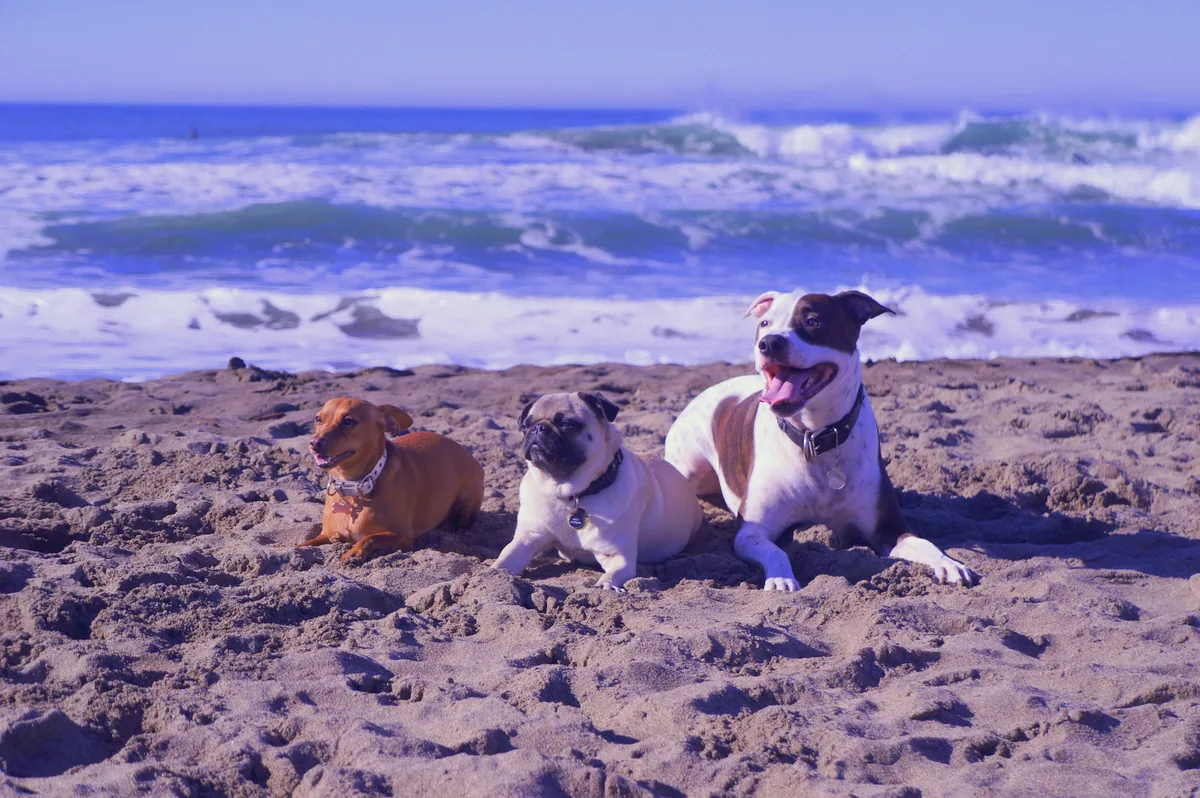
Training
Expect a smart dog with an opinion. The AKC says Dachshunds “do best with positive, reward-based training” and “will not react well to harsh commands or punishment,” and that because they were bred to stay focused on a trail, when they’re busy with something more interesting they “may not always pay attention to you” (AKC Dachshund). On the other side, the UKC calls the APBT “eager to please” and says it does well in performance events because of “its high level of intelligence and its willingness to work” (UKC).
You’ll read that you must be the “pack leader” with this mix. The American Veterinary Society of Animal Behavior says reward-based methods should be used for all dog training and advises against intimidation such as “alpha rolls” (AVSAB).
What to work on first:
- Loose-leash walking, with a well-fitted harness. A strong puller is a fall risk.
- Leave it and come, for squirrels, cats and dropped food.
- Calm greetings with other dogs, at a distance at first.
- Being lifted and handled. Teach the dog to accept being picked up with support under the chest and the back end, so the spine stays level.
- Quiet on cue. Reward silence after a bark or two.
- House training. Be patient and consistent; reward every success outdoors.
If you see growling, lunging or guarding that worries you, ask your vet for a referral to a qualified behavior professional. Asking early is good ownership.
Grooming
Most Doxie Pits are easy. The AKC rates the AmStaff 1 out of 5 for coat care and the Dachshund 2, and both 2 for shedding (AKC AmStaff; AKC Dachshund). The AKC calls smooth Dachshunds somewhat “wash and wear,” while longhaired coats need more brushing and wirehaired coats can be hand-stripped a few times a year (AKC Dachshund). A weekly brush, regular nail trims and ear checks (drop ears trap moisture) cover most dogs. The Dachshund Club of America says teeth should be cleaned at least once a week (DCA health).
Diet basics
There’s no special Doxie Pit diet. Feed a complete food suited to the dog’s age and size, measure meals, and count treats. Weight matters a lot here. The AKC says an overweight Dachshund is prone to diabetes, joint problems and “possibly, problems with the back” (AKC Dachshund), and the Dachshund Club of America says Dachshunds “should always be fed on a schedule and never allowed to free feed” (DCA health). Ask your vet what a healthy weight and waistline look like for your dog’s frame.
“Natural” doesn’t mean safe. The ASPCA warns that grapes and raisins can lead to kidney damage, that xylitol (found in some gum, candy and toothpaste) can cause low blood sugar and possible liver damage, and that onions, garlic, chocolate and macadamia nuts are also risky for pets (ASPCA). If your dog eats something worrying, call your vet or the ASPCA Animal Poison Control Center at (888) 426-4435.
Health: what to know and what to ask
We found no study of Doxie Pit health, so this section is about the parent breeds. Most dogs won’t have most of these problems. Use it as a list of questions for your vet.
You may read that mixes are automatically healthier. A University of California, Davis study of 27,254 dogs with inherited disorders found purebreds more likely to have 10 of 24 disorders, with no difference for 13, including hip dysplasia. Mixed-breed dogs were more likely to have one, a torn cranial cruciate ligament in the knee (Bellumori et al., 2013).
Back disease (IVDD): the big one for this mix
Intervertebral disc disease (IVDD) happens when a disc between the vertebrae ruptures and presses on the spinal cord, with effects that range “from mild discomfort to paralysis.” Dachshunds are first on Cornell’s list of commonly affected breeds (Cornell). In a survey of 2,031 Dachshunds led by the Royal Veterinary College, 15.7% had a vet-diagnosed case (Packer et al., 2016).
Why this matters for a mix: UC Davis researchers found that the chromosome 12 FGF4 gene copy, one of the two behind short legs, also causes early disc degeneration (Brown et al., 2017). A later study of 569 dogs that had disc surgery found that one copy is enough: it acts in a dominant way to lower the age of onset and raise the overall risk, and the relative risk ranged from 5.5 to 15.1 in mixed breeds and breeds where the gene varies (Batcher et al., 2019). So a Doxie Pit can inherit the Dachshund’s back risk from just one parent, and a heavier, more muscular dog may be putting more weight on that back. You can’t tell by looking. A cheek-swab test from the UC Davis Veterinary Genetics Laboratory shows whether your dog has zero, one or two copies.
Signs to call your vet about: reluctance to jump or climb stairs, a hunched back, crying when picked up, wobbling, or dragging the back legs. Sudden weakness or loss of use of the back legs is an emergency.
Other conditions the parents carry
| Condition | Which side | What the source says |
|---|---|---|
| Cruciate ligament (knee) disease | Pit bull | ACVS names the Staffordshire Terrier among breeds with a higher incidence (ACVS), and a study of dogs under two found a predisposition in AmStaffs (Duval et al., 1999). |
| Hip dysplasia | Pit bull | Most common in large breeds (ACVS); the AKC notes “some instances of mild hip dysplasia” in AmStaffs (AKC). |
| Skin allergies | Pit bull | Instances have been found in AmStaffs (AKC). |
| Cerebellar ataxia (NCL-A) | Pit bull | An inherited loss of coordination in AmStaffs; a DNA test exists (AKC). |
| Thyroid and heart testing | Pit bull | The AmStaff club recommends hip, heart, thyroid and NCL-A screening for breeding dogs (STCA). |
| Mitral valve (heart) disease | Dachshund | On the Dachshund club’s health list (DCA). |
| Gum disease | Dachshund | Miniature Dachshunds had 1.80 times the odds of periodontal disease compared with crossbreds in a UK study of 22,333 dogs (O’Neill et al., 2021). |
| Extra weight | Both | The AKC links excess weight to back trouble in Dachshunds (AKC). |
Spay and neuter timing. In a study of mixed-breed dogs, the risk of joint disorders from early neutering depended on adult weight: it was generally not raised in dogs under about 44 pounds, and higher in heavier dogs neutered before a year (Hart et al., 2020). Many shelter dogs are already altered. If you have a puppy, ask your vet about timing.
Lifespan: what we can and can’t say
No study has measured the Doxie Pit. Here’s the picture for its relatives:
- The AKC lists 12 to 16 years for the Dachshund and for the AmStaff (AKC; AKC).
- A 2024 study of 584,734 UK dogs estimated median lifespans of 13.2 years for Dachshunds, 14.0 for miniature Dachshunds, 12.0 for Staffordshire Bull Terriers, 12.5 for American Staffordshire Terriers (from only 142 dogs) and 12.0 for crossbreeds of every kind (McMillan et al., 2024, Supplementary Table S3).
You’ll see “8 to 12 years” or “10 to 14 years” quoted for the mix; neither comes with a source. A median is a midpoint, so about half of dogs live longer. Planning for a dog that may be with you well into its teens is sensible.
Doxie Pit puppies
A puppy’s adult size, leg length and back risk are all unknowns. If someone offers you a puppy, meet the mother where the puppies live, ask her size, and ask whether the father is known or a guess. Ask for proof of the health tests the parent breed clubs recommend: hips, heart, thyroid and NCL-A for the AmStaff side (STCA), and kneecap, heart and eye exams for the Dachshund side (AKC Dachshund), plus a CDDY result if the breeder has one (UC Davis VGL). We don’t quote puppy prices we can’t verify.
How to avoid a puppy mill or backyard breeder: walk away if the seller won’t let you see where the puppies are raised, offers to meet in a parking lot, has several “designer” crosses for sale at once, can’t show health test results, or pushes you to pay a deposit before you’ve met the dog. If you’d like to know a dog’s size and temperament up front, a grown dog from a shelter or foster home is the more predictable start.
Is that shelter dog really a Doxie Pit?
Maybe. Dachshund mixes and pit bull mixes both turn up in shelters, but labels by eye are shaky:
- In a University of Florida study at four shelters, staff labeled 52% of 120 dogs pit bull-type by sight; DNA identified 21%. The authors called visual identification “unreliable” (Olson et al., 2015).
- In DNA tests of 919 shelter dogs in Arizona and California, only 1.3% had two purebred parents of different breeds, which is what “half Dachshund, half pit bull” would mean. At one of those shelters, staff named at least one breed correctly for 67.7% of dogs, but both the first and second breed for only 10.4% (Gunter et al., 2018).
- In a study of 20 adopted dogs, the breed an agency named was among the main breeds in the DNA for only a quarter of them (Voith et al., 2009).
Labels have consequences. At those Arizona and California shelters, dogs with any pit bull-type ancestry waited an average of 37.5 days for a home, compared with 19.7 days for dogs with none (Gunter et al., 2018). If a long, low “pit mix” makes you smile, it may have been waiting a while. Our guide to figuring out your dog’s breed explains what DNA tests can and can’t tell you.
Housing, insurance and local rules: a short checklist
Nothing here is a reason to pass up a good dog. Most of it is a phone call or two, and it’s easier before adoption than after.
- The paperwork. Ask how the label was decided. If parentage is a guess, ask whether the records can say “mixed breed.” AVSAB says visual identification of breed is not reliable (AVSAB). Answer applications truthfully and keep any DNA report.
- Your lease, HOA or retirement community. Check both weight and breed limits, and get approval in writing. A 25-pound Doxie Pit may pass a weight limit and still trip a breed rule.
- Insurance. The Insurance Information Institute says some insurers won’t cover certain breeds such as pit bulls, some decide case by case, and some don’t ask about breed (Triple-I). If one says no, ask another.
- Local law. Where breed rules exist, they commonly cover pit bull-type dogs (AVSAB). Ask your city or county animal services how they treat mixes.
Both AVSAB and the ASPCA oppose breed-specific laws; the ASPCA supports breed-neutral laws that focus on behavior and responsible ownership (AVSAB; ASPCA).
Is a Doxie Pit right for me? A checklist for adopters 50+
A few “no” answers don’t rule you out; they tell you what to plan for, or which dog to ask about.
- Yes / No: I’ve walked this dog myself and can hold it if it lunges at a squirrel or another dog.
- Yes / No: I can give two walks a day and some play, in bad weather too.
- Yes / No: I can lift a dog of this size safely, or use a ramp, for the car and the couch.
- Yes / No: I’m willing to keep this dog lean, even when it begs.
- Yes / No: I can budget for vet care, including possible back treatment, and I’ll price pet insurance before anything is diagnosed.
- Yes / No: My lease, HOA and insurer are fine with a pit bull-type mix.
- Yes / No: A dog that barks at the door won’t bother me or my neighbors.
- Yes / No: Visiting grandchildren can be supervised, and the dog has a quiet spot.
- Yes / No: I’ve thought about who would care for this dog if I ever couldn’t.
A Doxie Pit may suit you if you want a devoted, playful, moderately active companion, enjoy short daily training, and are happy to manage a strong-willed dog.
Consider a different dog, or an older Doxie Pit with a known history, if a strong puller would be a fall risk, if you can’t lift a medium dog, or if a barker would be a problem where you live. There’s no shame in that. The right match keeps a dog home for life.
Costs to plan for
We found no reliable cost figures for this mix. The ASPCA’s 2021 estimate for a dog is $1,391 a year, and $3,221 for the first year once one-time costs are included (ASPCA). Budget for:
- The adoption fee, and what it covers. Ask.
- Routine vet care, plus pet insurance or an emergency fund. Back disease is on the Dachshund side’s list, so price insurance early.
- A ramp or pet steps, a well-fitted harness, food puzzles and a class or two.
- A CDDY test from the UC Davis VGL, if you want to know your dog’s back-gene status.
Adopting a pitbull Dachshund mix
Bone Voyage is a publisher now and doesn’t place dogs, but we love helping people find the right one.
Where to look
Search shelter listings for “Dachshund mix,” “pit bull mix,” “terrier mix” and “hound mix,” since labels are often a guess. Then try breed rescues, and ask each one whether it takes mixes:
- Dachshund rescues. Dachshund Rescue of North America rehomes Dachshunds and “mostly dachshund mixes.” Its Senior to Senior program lets approved adopters 60 or older adopt a dog 8 or older with no adoption fee. The Dachshund Club of America’s rescue page links to rescue contacts.
- Pit bull-type and all-breed rescues. The AKC Rescue Network lists breed rescues, including AmStaff groups. Many Doxie Pits are listed simply as “pit mix” or “terrier mix.”
- Foster-based groups are especially helpful, because a foster family can tell you how the dog behaves in a real home.
Questions to ask the shelter or rescue
- How was the breed label decided? Is either parent known, or has there been a DNA test?
- How much does the dog weigh, and does it have short legs and a long back?
- Any history of back pain, limping, wobbling or reluctance to jump? What do the vet records show?
- How does it walk on a leash? Can I walk it myself before deciding?
- How has it done with other dogs, cats and children, and in what setting?
- How vocal is it? How does it react to the doorbell and visitors?
- How does it handle being left alone, and being picked up?
- Is there a foster-to-adopt or trial period, and what happens if it doesn’t work out?
Our list of 9 questions to ask when adopting a dog covers the general ones.
Give your dog a backup plan
A Doxie Pit may live well into its teens, and a dog with a sensitive back does best with someone who already knows how to lift it and what it eats. Naming a backup caregiver now makes it far less likely that your dog would ever end up in a shelter. Our guide What Happens to Your Dog When You Die walks you through it, and the free My Dog’s Backup Plan worksheet records your dog’s routine, vet, food and quirks. Bone Voyage is also building the pledge: a volunteer’s pledge to adopt a specific senior’s dog if that senior dies or can no longer care for it.
Similar dogs to compare
- Chihuahua Dachshund mix (Chiweenie), Dachshund Corgi mix (Dorgi) and Golden Retriever Dachshund mix, three more Dachshund crosses with the same back question.
- Pitbull Chihuahua mix, another small-meets-sturdy pit bull cross, and Pitbull Lab mix.
- Dachshund, long-haired mini Dachshund and American Bully vs Pit Bull, for the parent breeds.
Frequently Asked Questions
What is a pitbull Dachshund mix called?
You’ll see Doxie Pit, Dox-Bull, Doxie Bull and Dachshund pit mix. These are informal names. Neither the AKC nor the UKC recognizes the cross as a breed, so there is no breed standard, and size, shape and temperament vary from dog to dog.
What does a Dachshund mixed with a pitbull look like?
There is no single look. Many people picture a broad pit bull head on a longer, lower body, but a puppy can take after either parent or land in between. The UKC standard calls for a medium-sized, athletic American Pit Bull Terrier in any color except merle (UKC), while the AKC describes the Dachshund’s long-backed body and little legs (AKC). Short legs come from a gene variant the Dachshund carries (Parker et al., 2009), so some Doxie Pits have them and some don’t.
How big does a pitbull doxie mix get?
No one has measured the mix. The AKC lists miniature Dachshunds at 11 pounds and under and standard Dachshunds at 16 to 32 pounds and 8 to 9 inches (AKC). The UKC gives American Pit Bull Terriers about 17 to 21 inches and 30 to 60 pounds (UKC). A Doxie Pit can land almost anywhere between, so adopting an adult is the surest way to know the size.
Are Doxie and Dachshund the same thing?
Yes. Doxie is a nickname for the Dachshund, along with wiener dog and sausage dog, according to Encyclopaedia Britannica (Britannica). A Doxie Pit is a Dachshund crossed with a pit bull-type dog.
Do Doxie Pits have back problems?
Some may. In a UK survey of 2,031 Dachshunds, 15.7% had a vet-diagnosed case of intervertebral disc disease (IVDD) (Packer et al., 2016). A gene variant behind short legs also raises disc risk, and one copy is enough, including in mixed-breed dogs (Batcher et al., 2019). A UC Davis cheek-swab test can tell you whether your dog carries it (UC Davis VGL). Keep the dog lean and active, and call your vet at the first sign of back pain.
How long does a Dachshund pit bull mix live?
No study has measured the mix. The AKC lists 12 to 16 years for both the Dachshund and the American Staffordshire Terrier (AKC; AKC). A large UK study found median lifespans of 13.2 years for Dachshunds, 12.0 for Staffordshire Bull Terriers and 12.0 for crossbreeds overall (McMillan et al., 2024). Those are parent and population figures, not a forecast for any one dog.
What foods should a Doxie Pit never eat?
The same foods that are risky for any dog. The ASPCA lists chocolate, xylitol (a sweetener in some gum, candy and toothpaste), grapes and raisins, onions, garlic and chives, and macadamia nuts among foods to keep away from pets (ASPCA). Because Dachshunds gain weight easily, go light on table scraps too. If your dog eats something worrying, call your vet or the ASPCA Animal Poison Control Center.
Is a Doxie Pit a good dog for someone over 50?
It can be, if you meet the individual dog first. A short-legged, 25-pound Doxie Pit and a leggy 50-pound one need different homes. Walk the dog yourself, check your lease and insurance for pit bull rules, plan for back care, and remember that an adult dog a foster home knows well lets you see its size and temperament first, while a puppy can be a great fit if you have the time and energy for training.
Before you go
Whatever the kennel card says, the dog in front of you is one specific dog with its own history and quirks. Weigh what you learn about that dog more heavily than anything on this page. And whatever dog you bring home, it’s worth deciding now who would step in if you ever couldn’t.
Sources
- American Kennel Club, Dachshund and American Staffordshire Terrier breed pages, Canine Partners and AKC Rescue Network
- United Kennel Club, American Pit Bull Terrier standard
- Staffordshire Terrier Club of America, Health Statement
- Dachshund Club of America, Health and Rescue
- Dachshund Health UK (the UK Dachshund Breed Council), Jumping and stairs
- Dachshund Rescue of North America, About and Senior to Senior
- Encyclopaedia Britannica, Dachshund
- Cornell Riney Canine Health Center, Intervertebral Disc Disease and Dystocia in dogs
- Merck Veterinary Manual, Dystocia in Small Animals
- UC Davis Veterinary Genetics Laboratory, CDDY and CDPA test
- Packer RMA et al. (2016). DachsLife 2015: an investigation of lifestyle associations with the risk of intervertebral disc disease in Dachshunds. Canine Genetics and Epidemiology 3:8.
- Parker HG et al. (2009). An expressed fgf4 retrogene is associated with breed-defining chondrodysplasia in domestic dogs. Science 325(5943):995-8.
- Brown EA et al. (2017). FGF4 retrogene on CFA12 is responsible for chondrodystrophy and intervertebral disc disease in dogs. PNAS 114(43):11476-81.
- Batcher K et al. (2019). Phenotypic Effects of FGF4 Retrogenes on Intervertebral Disc Disease in Dogs. Genes 10(6):435.
- O’Neill DG et al. (2021). Epidemiology of periodontal disease in dogs in the UK primary-care veterinary setting. Journal of Small Animal Practice 62(12):1051-1061.
- McMillan KM et al. (2024). Longevity of companion dog breeds: those at risk from early death. Scientific Reports 14:531 (breed medians in Supplementary Table S3).
- Bellumori TP et al. (2013). Prevalence of inherited disorders among mixed-breed and purebred dogs. JAVMA 242(11):1549-55.
- Duval JM et al. (1999). Breed, sex, and body weight as risk factors for rupture of the cranial cruciate ligament in young dogs. JAVMA 215(6):811-4.
- Hart BL et al. (2020). Assisting decision-making on age of neutering for mixed breed dogs of five weight categories. Frontiers in Veterinary Science 7:472.
- American College of Veterinary Surgeons, Canine Hip Dysplasia and Cranial Cruciate Ligament Disease
- Morrill K et al. (2022). Ancestry-inclusive dog genomics challenges popular breed stereotypes. Science 376(6592):eabk0639.
- Gunter LM et al. (2018). A canine identity crisis: Genetic breed heritage testing of shelter dogs. PLOS ONE 13(8):e0202633.
- Olson KR et al. (2015). Inconsistent identification of pit bull-type dogs by shelter staff. The Veterinary Journal 206(2):197-202.
- Voith VL et al. (2009). Comparison of adoption agency breed identification and DNA breed identification of dogs. Journal of Applied Animal Welfare Science 12(3):253-62.
- Pirruccio K et al. (2019). Fractures in elderly Americans associated with walking leashed dogs. JAMA Surgery 154(5):458-459.
- American Veterinary Society of Animal Behavior, Position Statement on Humane Dog Training (2021) and Position Statement on Breed-Specific Legislation
- Insurance Information Institute, Spotlight on: Dog bite liability
- ASPCA, People Foods to Avoid Feeding Your Pets, Cutting Pet Care Costs (2021 cost update) and Position Statement on Breed-Specific Legislation
- Photos: Flickr and Wikimedia Commons contributors, credited under each image. Full license records are kept in this site’s image-credits file.