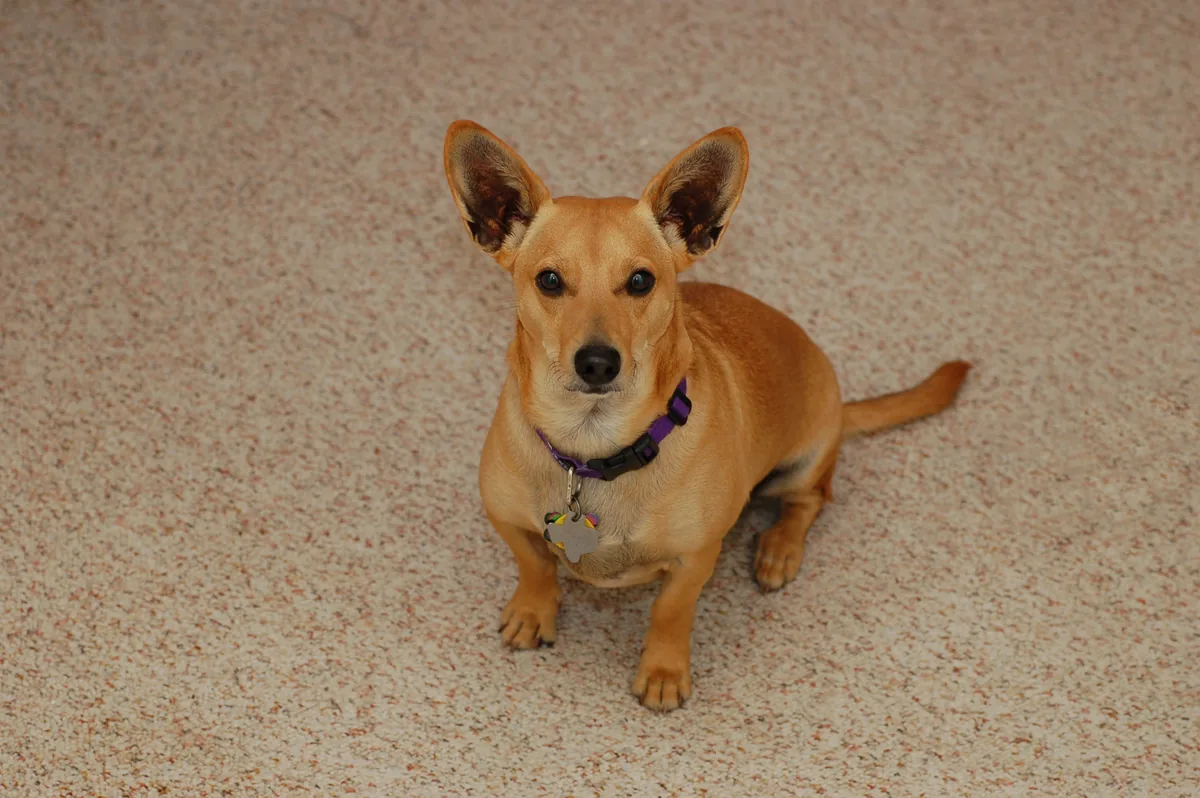

A Dachshund Welsh Corgi mix, usually called a Dorgi, is a cross between a Dachshund (standard or miniature) and a Pembroke or Cardigan Welsh Corgi. Most are small, sturdy dogs with long backs, short legs, a big bark and a lot of personality, weighing roughly 12 to 30 pounds by our estimate from the parent breeds. The thing to plan for above all is the back: both parent breeds carry a gene that raises the risk of disc disease, so the Dorgi does too.
This guide uses American Kennel Club (AKC) breed pages, UC Davis genetics research, the American College of Veterinary Surgeons (ACVS) and peer-reviewed studies. No one has studied the Dorgi as a group, so where the evidence is about the parent breeds, we say so.
Dorgi quick facts
- What it is: a mix of a Dachshund and a Pembroke or Cardigan Welsh Corgi. Not an AKC breed and has no breed standard.
- Height (estimate from parent ranges): roughly 7 to 12 inches at the shoulder. The parents span 5 to 12.5 inches (AKC Dachshund, Pembroke, Cardigan).
- Weight (estimate from parent ranges): roughly 12 to 30 pounds for most dogs; smaller with a miniature Dachshund parent, heavier with a Cardigan. The parents span 11 pounds and under (miniature Dachshund) to 38 pounds (male Cardigan).
- Life expectancy: not studied in the mix. Parents: 12 to 16 years (Dachshund), 12 to 13 (Pembroke), 12 to 15 (Cardigan) (AKC Dachshund, Pembroke, Cardigan).
- Energy: moderate to high for a small dog. Both parents are working breeds.
- Grooming: low to moderate, depending on coat. Expect shedding, especially with a double-coated Corgi parent.
- Barking: often a lot.
- With kids and pets: usually affectionate with family; may herd or nip at running children, and the Dachshund side has strong prey drive (PetMD).
- Biggest health watch-out: intervertebral disc disease (IVDD). Both parent breeds carry the chromosome 12 FGF4 gene at very high rates (Batcher et al., 2019).
- Best fit: someone home a good part of the day who wants a small, sturdy, chatty walking companion and will protect its back.
What is a Dorgi?
A Dorgi is any cross between a Dachshund and a Welsh Corgi. Breeders sell first-generation puppies (one purebred parent of each breed), and some breed Dorgi to Dorgi, but in shelters most are simply “Dachshund mix” or “Corgi mix” dogs whose exact background is unknown.
The two parents look alike at a glance, which is why the mix often looks “right”: both are long, low dogs with short legs. But they were bred for very different work.
- The Dachshund is a German hound. The name means “badger dog,” and the breed was developed to dig into a badger’s den (AKC Dachshund). The AKC describes its “ever-alert expression, and bold, vivacious personality.”
- The Welsh Corgis are herding dogs from Wales that drove cattle by nipping at their heels. The AKC calls the Pembroke “a strong, athletic, and lively little herder who is affectionate and companionable without being needy” (AKC Pembroke) and says every aspect of the Cardigan “is perfectly suited to moving cattle” (AKC Cardigan).
So a Dorgi can inherit a hound’s nose and independence, a herder’s alertness and bossiness, or any mix of the two. No breeder can promise which.

The royal dorgi story
The Dorgi’s claim to fame is Queen Elizabeth II. The Royal Family’s website says that as well as her corgis, “The Queen has also bred ‘dorgis’ - a cross between dachshund and corgis,” and that some of her corgis were crossed with Dachshunds, “most notably Pipkin, who belonged to Princess Margaret” (Royal Family, Royal Dogs; 50 facts about The Queen’s reign). PetMD’s vet-reviewed profile names the corgi in that first pairing as Tiny (PetMD). Accounts disagree on the exact year, so we don’t give one.
Two of the Queen’s dorgis, Vulcan and Candy, appeared with her corgis in the official photographs released for her 90th birthday in 2016 (Royal Family). Royal history doesn’t change what a Dorgi needs day to day, but it’s why so many people know the name.
Pembroke vs. Cardigan: which Corgi is in a Dorgi?
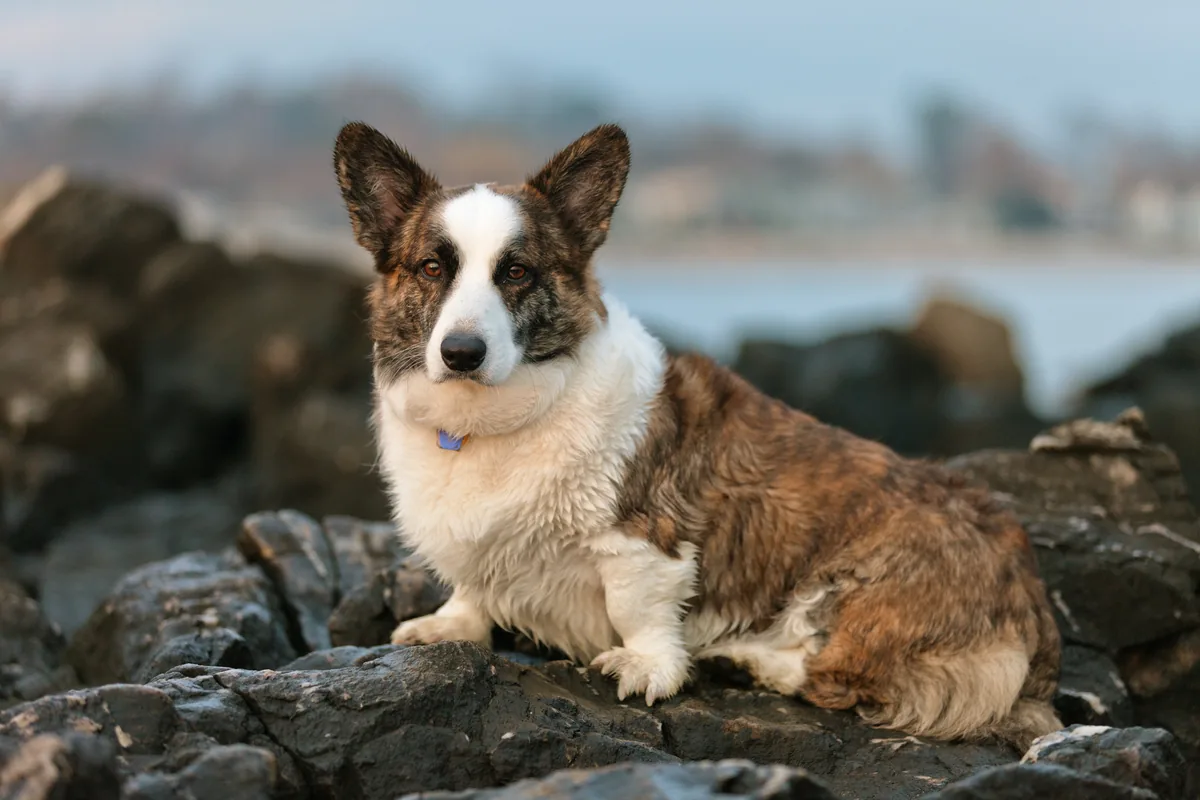
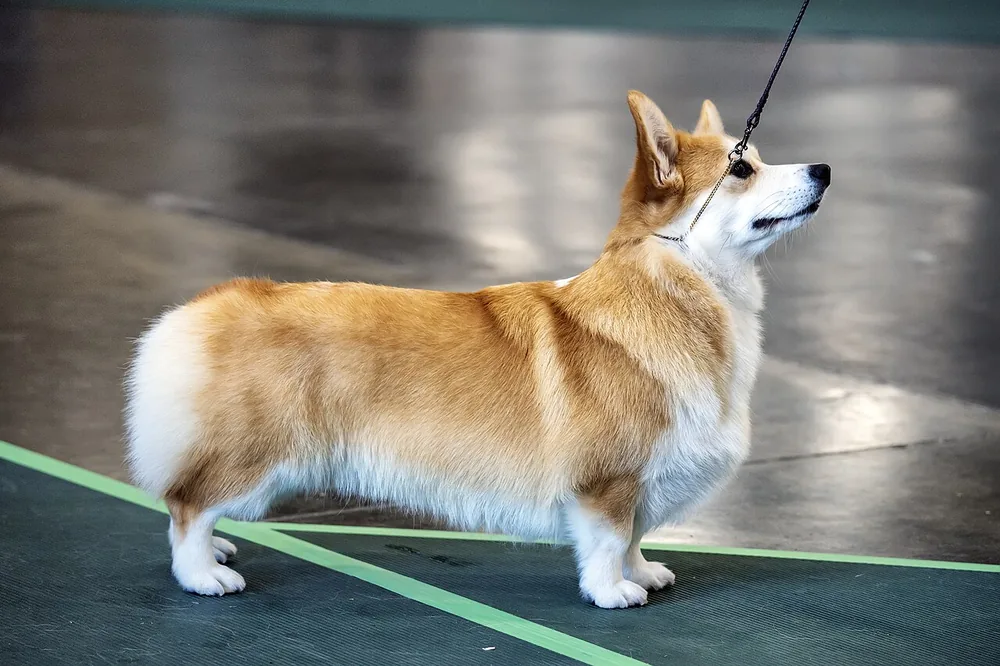
“Welsh Corgi” covers two separate AKC breeds, and either can be a Dorgi parent. Most Dorgis you’ll read about, including the royal ones, come from Pembrokes, but a Cardigan cross is a real possibility, especially in a shelter dog.
| Pembroke Welsh Corgi | Cardigan Welsh Corgi | |
|---|---|---|
| Tail | Usually docked close to the body (some are born short) | “Long, foxlike tail” |
| Ears | Upright | Upright, “larger and more rounded” |
| Size and bone | 10-12 in., up to 30 lb | 10.5-12.5 in., up to 38 lb; “heavier bone” |
| Colors | Red, sable, and tricolor, with white markings | Also brindle and blue merle, among others |
| History | The younger breed, traced to about 1000 AD | ”One of the oldest breeds in the British Isles” |
| Life expectancy (AKC) | 12-13 years | 12-15 years |
Sources: AKC, Cardigan Welsh Corgi vs. Pembroke Welsh Corgi, and the AKC Pembroke and Cardigan breed pages.
The AKC also notes a family link: the Corgis “descended from the German Teckel lineage (which also gave us the Dachshund)” (AKC). So a Dorgi is less of an odd couple than it looks.
What this means for a Dorgi:
- A Pembroke cross is the classic Dorgi. With a standard Dachshund parent, the two are similar in size.
- A Cardigan cross may be heavier, and brindle or merle coloring can come from the Cardigan side (dapple, the Dachshund word for merle, can come from the Dachshund side too). Cardigans carry both short-leg genes, which matters for the back (see Health).
- In a shelter dog, you usually can’t tell which Corgi it was without a DNA test. It doesn’t change how you care for the dog.


Standard vs. miniature Dachshund: why it matters
The Dachshund comes in two sizes, and which one was used changes the Dorgi more than anything else. The AKC lists standard Dachshunds at 8 to 9 inches and 16 to 32 pounds and miniatures at 5 to 6 inches and 11 pounds and under (AKC Dachshund). The miniature isn’t a separate breed, just a size class (Dachshund Club of America).
- Standard Dachshund x Corgi: the parents are close in weight, so most puppies end up in the 20-to-30-pound range of a typical Corgi. This is our estimate from the parent ranges, not a measured figure.
- Miniature Dachshund x Corgi: the parents can be two or three times apart in weight, so expect more spread, from small dogs in the low teens to Corgi-sized ones, even within one litter.
Dachshunds also come in three coats: smooth, wirehaired and longhaired (DCA). Most Dorgis you’ll meet are smooth or medium-coated, but a longhaired or wirehaired parent can change the coat and the grooming.
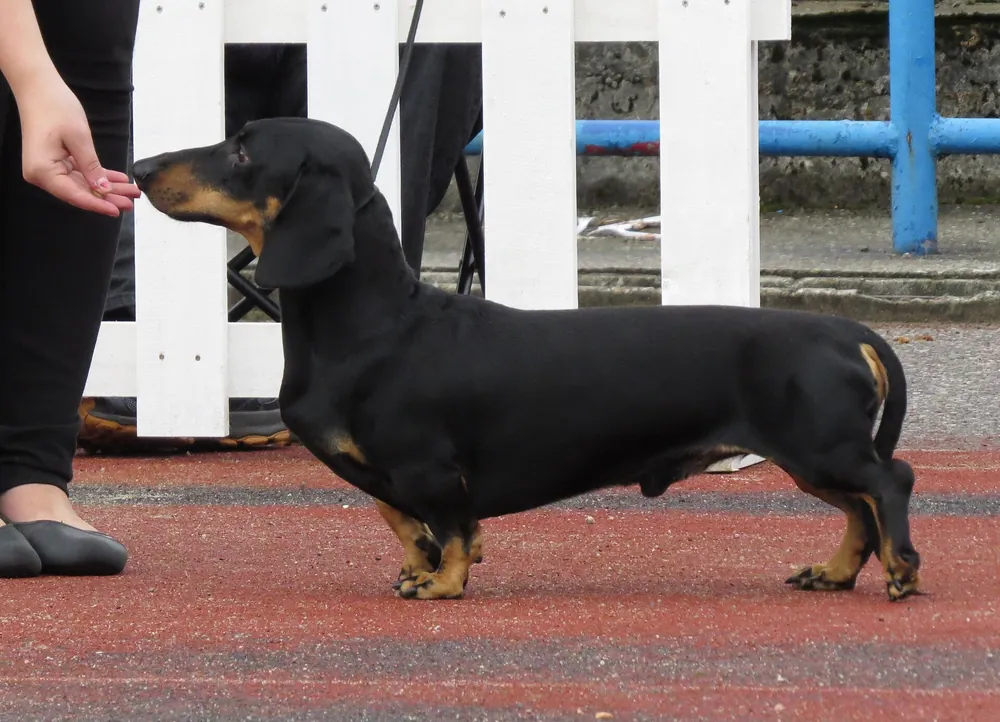

Dachshund vs. Corgis vs. Dorgi at a glance
| Dachshund | Pembroke Welsh Corgi | Cardigan Welsh Corgi | Dorgi (mix) | |
|---|---|---|---|---|
| Original job | Hunting badgers underground | Herding cattle | Herding cattle | Companion |
| Height | 8-9 in. (standard); 5-6 in. (mini) | 10-12 in. | 10.5-12.5 in. | Estimate: about 7-12 in. |
| Weight | 16-32 lb (standard); 11 lb and under (mini) | Up to 30 lb (males), 28 lb (females) | 30-38 lb (males), 25-34 lb (females) | Estimate: about 12-30 lb |
| Life expectancy | 12-16 years | 12-13 years | 12-15 years | Not studied |
| Coat | Smooth, wirehaired or longhaired | Double coat | Double coat | Varies; usually sheds |
| Tail | Long | Usually docked | Long, foxlike | Usually long |
| CDDY (chromosome 12 FGF4) allele frequency | 0.99 | 0.92 | Present; also has the chromosome 18 copy | Very likely to carry at least one copy |
Sources: AKC breed pages for the Dachshund, Pembroke and Cardigan and the AKC Corgi comparison; allele frequencies from Batcher et al., 2019 (Table 1, UC Davis DNA repository) and Brown et al., 2017. Dorgi ranges are our estimates from the parent ranges. The last row is our inference: when nearly every Dachshund carries two copies, nearly every puppy gets at least one.
Appearance and size
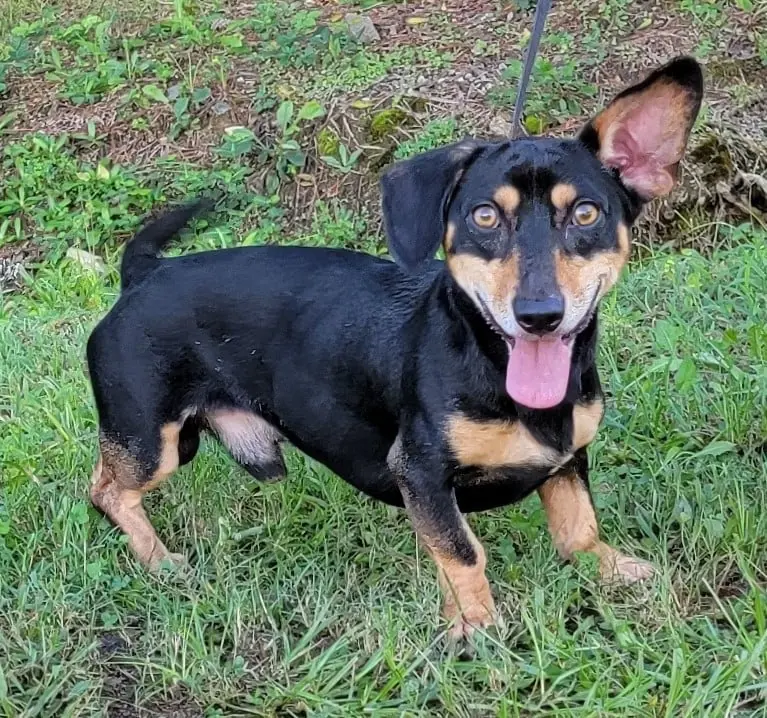
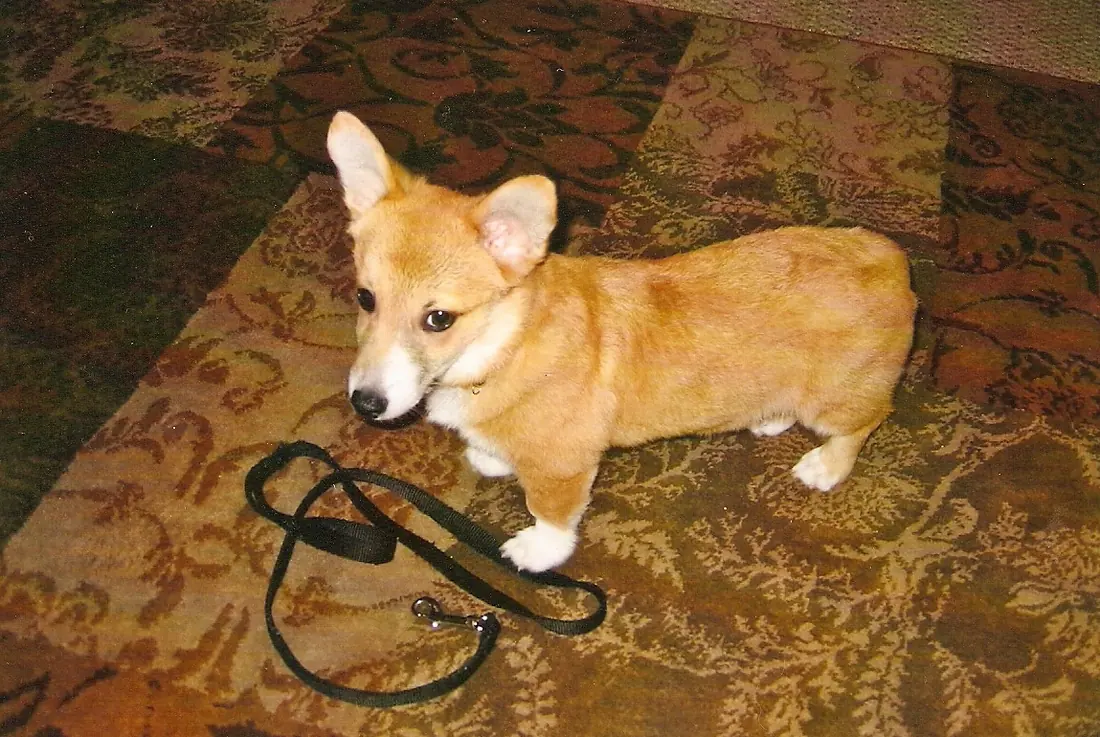
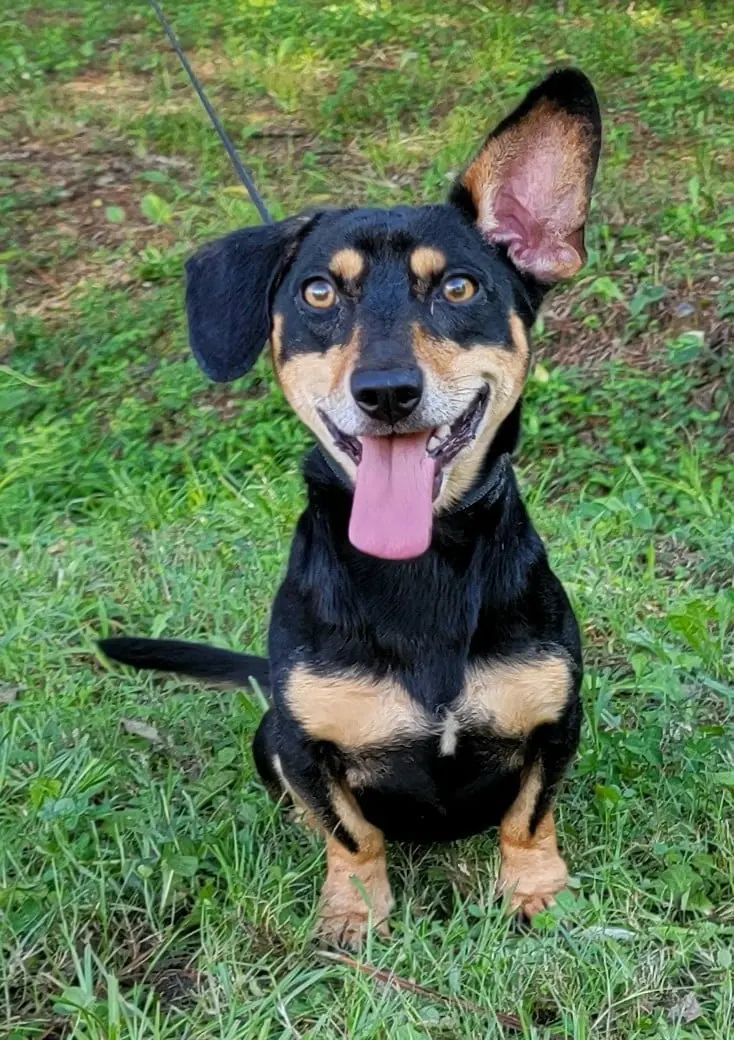
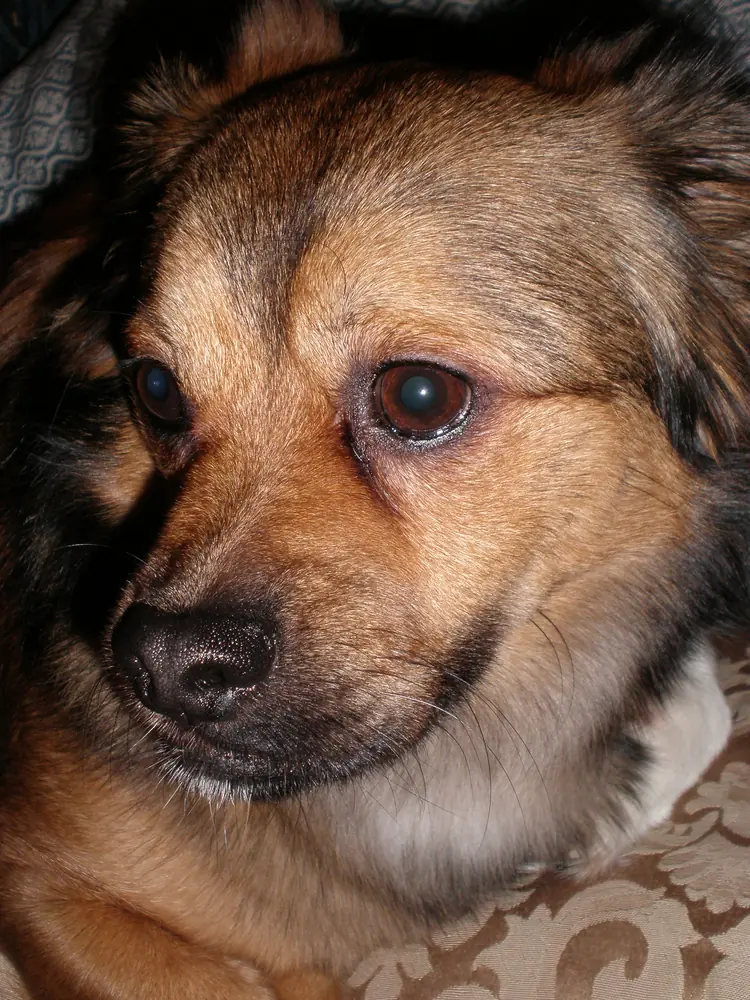
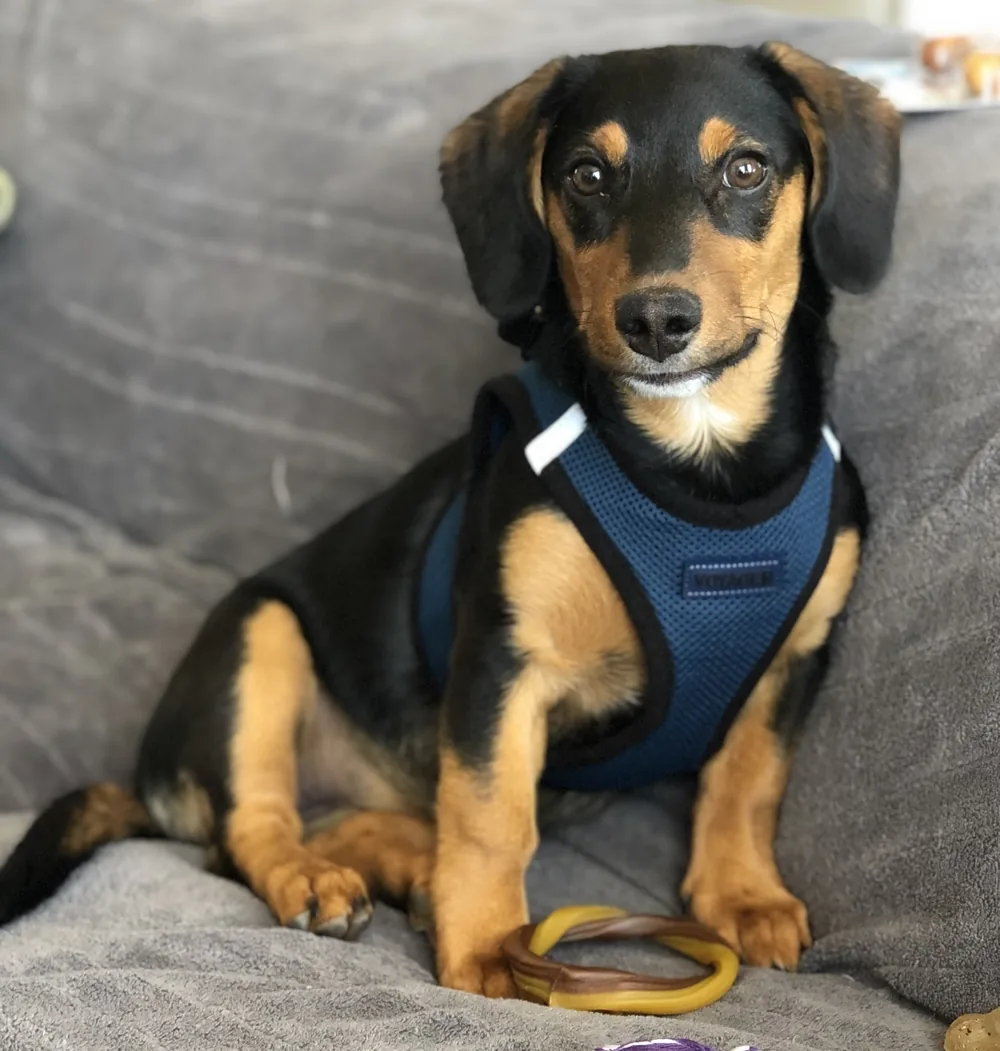
There’s no Dorgi standard, so appearance is a mix-and-match of the parents. What we’ve seen across genuine Dorgi photos, including the ones on this page:
- Body: long and low from both sides. That part is close to guaranteed.
- Ears: anything from the Corgi’s big upright ears to the Dachshund’s soft drop ears, or one of each.
- Color: red, sable, black and tan, tricolor, and with a Cardigan or dapple Dachshund parent, brindle or merle. White markings on the chest, feet and face are common.
- Tail: usually long. Dachshund and Cardigan tails are long, and Pembroke tails are usually docked rather than naturally short (AKC).

Temperament: what to expect
PetMD’s vet-reviewed profile describes Dorgis as “spunky, friendly dogs with parents that were bred to work,” noting that the parents share “barking loudly and often; clever and independent thinking; and a boldness that outsizes their compact frames” (PetMD). In everyday life, that often means:
- A devoted companion who wants to be near you. PetMD calls them “definitely indoor dogs” whose “social needs demand close proximity to their humans.”
- A watchdog with a big voice. PetMD warns the big-dog bark “could make living in an apartment (i.e., sharing walls with other people) difficult.”
- Herding habits. A Dorgi that takes after the Corgi may try to herd children or nip at heels.
- Prey drive. The Dachshund side may chase cats, rabbits and squirrels. Supervise introductions to small pets, and walk on a leash or in a fenced area.
- Independence. Clever, but happy to decide for itself whether your request makes sense.
These are tendencies from the parent breeds, not promises. Big genetic studies show breed explains only a small part of an individual dog’s behavior (Morrill et al., 2022), so the dog in front of you, and what its foster says about it, matters most.

Exercise needs
Short legs don’t mean a couch potato. Both parents are working breeds, and the Dachshund Breed Council says adult Dachshunds need “a daily exercise regime that combines ‘on-lead’ walking and free-running/playing” (Dachshund Health UK, exercise). Plan on at least two walks a day plus play and sniffing time. Nose games and puzzle feeders use up energy without hard impact on the back.
Exercise is also back protection. In the DachsLife 2015 survey of 2,031 Dachshunds, dogs that exercised more than an hour a day had lower odds of IVDD, and dogs exercised less than 30 minutes a day had higher odds (Packer et al., 2016). It was an owner survey, so it shows links, not proof, but it’s a good reason to keep a Dorgi fit and muscled.
Grooming
- Coat: brush weekly, more during seasonal sheds. Corgis have a double coat (AKC), so many Dorgis shed steadily all year. A longhaired or wirehaired Dachshund parent can mean more brushing and occasional trimming.
- Nails: trim every few weeks. Long nails change how a dog stands and walks.
- Teeth: brush daily if you can, with dog toothpaste. Small dogs are prone to gum disease (O’Neill et al., 2021).
- Ears: check weekly, especially floppy Dachshund-type ears.
Health: the back comes first
The Dorgi hasn’t been studied as a group, so there’s no health data on the mix itself. What we know comes from the parent breeds.
Why both parents carry back risk: CDDY and FGF4
Short legs in dogs come mostly from two extra copies of a growth gene called FGF4. One sits on chromosome 18 and mainly shortens legs. The other, on chromosome 12, was identified by UC Davis researchers in 2017. It causes both short legs and early degeneration of the spinal discs, a combination called chondrodystrophy (often abbreviated CDDY). Dogs with it had an odds ratio of 51 for IVDD in that study (Brown et al., 2017).
Here’s why that matters for a Dorgi:
- Dachshunds: the chromosome 12 copy had an allele frequency of 0.99 in the UC Davis repository, almost every dog (Batcher et al., 2019).
- Pembroke Welsh Corgis: 0.92 (Batcher et al., 2019).
- Cardigan Welsh Corgis: carry both FGF4 copies, which the authors link to their extra-short legs (Brown et al., 2017).
- One copy is enough. For disc disease, the chromosome 12 copy acts in a dominant way: one copy lowered the age at first disc surgery and raised overall risk (Batcher et al., 2019; UC Davis VGL).
Put those together and a first-generation Dorgi is very likely to carry at least one copy. That doesn’t mean your dog will have a disc problem. It means the risk is real and worth planning for. Among Dachshunds, an estimated 19 to 24% show signs of IVDD in their lifetime (Packer et al., 2016).
A cheek-swab test from the UC Davis Veterinary Genetics Laboratory tells you whether your dog has zero, one or two copies.
What IVDD looks like
Intervertebral disc disease happens when a disc between the vertebrae bulges or ruptures and presses on the spinal cord. The ACVS says chondrodystrophic breeds “account for the vast majority of all disc ruptures,” with Dachshunds alone accounting for 45 to 70% of cases, and that signs usually start between 3 and 6 years old and include “back or neck pain, possibly refusing to walk around the room” and a wobbly “drunken sailor” walk (ACVS). Other warning signs: a hunched back, crying when picked up, shaking, dragging a back leg or knuckling a paw.
Cornell’s Riney Canine Health Center adds subtler clues: a dog that “may avoid turning their head in one direction,” or walks to its food bowl and then just looks at it (Cornell). Its advice is plain: “At the first sign of back discomfort, contact your veterinarian.” If your Dorgi suddenly can’t walk normally, call your vet or an emergency clinic right away, and ask your vet before giving any medicine.
Other conditions in the parent breeds
| Condition | What it is | Which parent |
|---|---|---|
| Degenerative myelopathy (DM) | Spinal cord disease causing gradual hind-leg weakness, typically starting between 8 and 14 years old (OFA DM) | Pembroke Welsh Corgi (one of the breeds in the original SOD1 study, Awano et al., 2009); OFA DNA data show 53.8% of 5,479 Pembrokes and 15.5% of 1,025 Cardigans tested “at risk” (OFA) |
| Hip dysplasia | A loose, malformed hip joint | Corgis: 21.9% of 17,527 Pembrokes and 24.4% of 4,169 Cardigans evaluated were abnormal (OFA) |
| Gum (periodontal) disease | Infection of the gums and tooth supports | Common in small dogs (O’Neill et al., 2021) |
| Obesity | Extra weight that loads a long back | Both. Corgis and Dachshunds love food |
OFA figures are owner-submitted screening results, not a random sample of every dog. An “at risk” DM result means two copies of the variant; the OFA notes “not all dogs testing as A/A have shown clinical signs of DM” (OFA DM). Ask your vet which tests make sense for your dog.
Is a mix healthier?
Not automatically. A 2024 UK study of more than 584,000 dogs found many purebred breeds had longer median lifespans than crossbreeds (McMillan et al., 2024). Crossing two breeds that share the same back gene doesn’t cancel it out.

Back-safe living with a Dorgi (for you and your dog)
Most guides stop at “watch out for IVDD.” Here’s what that looks like day to day, with the evidence behind each step.
- Keep your Dorgi lean. The ACVS lists weight loss first among lifestyle changes for IVDD (ACVS). You should be able to feel the ribs easily and see a waist from above (WSAVA body condition chart).
- Keep it fit. Daily walks build the muscles that support the spine. In the DachsLife survey, more than an hour of daily exercise was linked to lower IVDD odds (Packer et al., 2016), and the Dachshund Breed Council reports that Dachshunds over 3 that only ran around the garden were “1.8 times more likely to suffer IVDD than dogs that were taken for walks” (Dachshund Health UK, exercise).
- Harness or collar? Ask your vet. The ACVS lists “switching to a body harness instead of neck lead” as a lifestyle change for dogs with IVDD (ACVS). But the evidence is mixed: in the breed council’s survey, Dachshunds walked in harnesses were more likely to have had IVDD than those walked in collars, which it says “does not imply causation,” and it notes that “90-95% of all Dachshund disc herniations occur in the middle to lower back, not in the neck” (Dachshund Health UK, collar vs harness). A well-fitted harness that doesn’t pull on the neck is a common choice, and it’s what most vets recommend after a neck disc problem.
- Go easy on big jumps down, especially for puppies, seniors and dogs with a disc history. Cornell advises minimizing “time spent going up and down stairs, and jumping on and off a deck, bed or sofa” (Cornell). The research is more nuanced: in the DachsLife survey, healthy adult Dachshunds allowed on furniture and stairs every day actually had lower odds of IVDD, which the breed council says “should not be taken as a cause and effect association.” It is clear that dogs that have already had an IVDD episode “will be at higher risk of further injury if they are allowed to jump off furniture” (Dachshund Health UK, jumping and stairs). Ramps or pet steps to the sofa, bed and car are a low-cost compromise, and they save your back too. See our guides to dog ramps for the bed and dog stairs.
- Pick up with two hands. One under the chest, one under the rump, back level, dog close to your body. Bend your knees, not your back.
- Use rugs on slick floors and a gate on stairs if your dog races up and down them.
- Watch your own footing. The CDC estimated more than 86,000 fall injuries a year in the US linked to pets, mostly dogs, with the highest rates in people 75 and older (Stevens et al., 2010). A low, fast dog underfoot is easy to miss. A night light, a collar tag that jingles and a solid “wait” at doors and stairs all help.
- Know your vet’s emergency plan before you need it.
Training
Dorgis are clever and food-motivated, which helps, but they can be stubborn. Keep sessions short and fun, use food and play rewards, and never use punishment; the American Veterinary Society of Animal Behavior recommends reward-based methods only (AVSAB). Priorities:
- “Quiet” and a calm greeting routine for the barking.
- A reliable recall, practiced on a long line, because scent can win over your voice.
- Handling practice (paws, mouth, being lifted) so vet visits and back care are easy.
- “Off” and “wait,” to manage jumping and door-dashing.

Diet basics
Feed a complete and balanced food for your dog’s life stage, measure every meal, and count treats; the WSAVA nutrition guidelines are a good plain-language starting point (WSAVA). Extra weight loads a long back, and it’s the risk factor you control most directly. Ask your vet how many calories your dog needs and check its body condition monthly.
Who a Dorgi suits, and who should skip it
A good match if you:
- Are home a good part of the day and want a close companion.
- Enjoy two walks a day and some training.
- Don’t mind a dog that barks at the doorbell, and some dog hair.
- Can budget for possible back care and dental cleanings.
Think twice if you:
- Need a quiet dog for an apartment with thin walls.
- Can’t lift a 25-pound dog or bend to the floor easily (an injured back may mean carrying the dog for weeks).
- Have cats or small pets and can’t manage careful introductions.
- Are away from home most of the day.
Is a Dorgi right for you? A quick checklist
- I’m OK with regular barking.
- I can walk a dog twice a day, every day.
- I’ll keep the dog lean and fit and protect its back.
- I can afford a vet emergency, or I’ll get pet insurance early.
- I have a plan for who would care for the dog if I couldn’t.
Realistic costs
We don’t quote Dorgi puppy prices. There’s no breed club or health-testing standard behind them, and online prices aren’t verified. For any dog, the ASPCA estimates $1,391 a year in ongoing costs and $3,221 in the first year, including about $300 a year for food, $225 for routine medical care and $500 for dental care (ASPCA). A small dog may eat less than average, but disc surgery and dental work can push costs much higher. If you’re considering pet insurance, get it early, before any back problem is diagnosed and excluded as pre-existing. The UC Davis CDDY test is an extra one-time cost.
Adopting a Dorgi
Bone Voyage ran a shelter and rescue from 2019 to 2024. Today it’s an educational resource and backup-plan movement, and it doesn’t place dogs. Here’s where to look.
- Local shelters and adoption sites. Search “Dachshund mix” and “Corgi mix,” not just “Dorgi.” Shelter breed labels are guesses: in one study, staff at a shelter who labeled dogs by looks matched more than one breed in the dog’s DNA only about 10% of the time (Gunter et al., 2018).
- Breed rescues. Dachshund and Corgi rescues mainly place purebreds, but many take mixes or know who does. Start with the AKC Rescue Network, the Pembroke Welsh Corgi Club of America rescue page and the Dachshund Club of America.
- Consider an adult or senior Dorgi. You’ll know its size, coat, voice and back history from day one.
Wondering what’s in your own short-legged mix? Our guide to figuring out what breed your dog is explains how DNA tests work.
Questions to ask the shelter or rescue
- Has this dog had any back pain, wobbliness, limping or disc problems? Any X-rays or vet notes?
- Has it had a DNA or CDDY test?
- How does it react to being picked up, having its paws touched and being brushed?
- How much does it bark, and at what?
- How is it with children, cats and other dogs?
- What’s its current weight, and what does it eat?
- Will you take it back if it doesn’t work out?
Our 9 questions to ask when adopting a dog covers the general ones.
Other long, low mixes to compare
- Chihuahua Corgi mix, a smaller Corgi cross with the same back watch-outs.
- Beagle Corgi mix, a hound-and-herder cross much like the Dorgi.
- Daug, a Dachshund and Pug mix.
- Golden Retriever Dachshund mix, a bigger Dachshund cross.
- Pitbull doxie mix, a Dachshund and pit bull cross with the same back question.
- Corgidor, a Corgi and Labrador cross.
- German Shepherd Corgi mix, a Corgi cross with a working shepherd on the other side.
- Long-haired mini Dachshund, if you love the small, fluffy Dachshund look.
Give your Dorgi a backup plan
A Dorgi can easily live into its teens. Deciding now who would care for it if you couldn’t makes it far less likely it will end up in a shelter. Write down its routine, vet, food, any back history and how it likes to be picked up. Our guide What Happens to Your Dog When You Die walks you through it, and the free My Dog’s Backup Plan worksheet keeps it all in one place. Bone Voyage is also building the pledge: a volunteer’s pledge to adopt a specific older adult’s dog if that person dies or can no longer care for it.
Frequently Asked Questions
What is a Corgi and Dachshund mix called?
Most people call it a Dorgi. You’ll also see Dachshund Corgi mix, Corgi Dachshund mix and occasionally Corgshund. It isn’t a breed: the American Kennel Club doesn’t register it and there’s no breed standard, so shelters usually list these dogs as a Dachshund mix or a Corgi mix.
Did Queen Elizabeth II have dorgis?
Yes. The Royal Family’s website says the Queen bred dorgis by crossing some of her corgis with Dachshunds, most notably Pipkin, who belonged to Princess Margaret. PetMD names the corgi in the first pairing as Tiny. Two of her dorgis, Vulcan and Candy, appeared in her official 90th-birthday photographs in 2016.
How big does a Dorgi get?
There’s no standard, so it’s a range. By AKC figures, standard Dachshunds weigh 16 to 32 pounds and miniatures 11 pounds and under, Pembroke Welsh Corgis weigh up to 30 pounds and Cardigans 25 to 38 pounds, and all of them stand about 5 to 12.5 inches tall. Our estimate from those parent ranges is that most Dorgis land somewhere around 12 to 30 pounds and 7 to 12 inches, with mini-Dachshund crosses smaller and Cardigan crosses bigger. An adult dog’s size is what it is, which is one reason to adopt an adult.
How long do Dorgis live?
No one has studied Dorgi lifespan. The AKC lists 12 to 16 years for Dachshunds, 12 to 13 for Pembroke Welsh Corgis and 12 to 15 for Cardigans, so planning for a dog that could live into its early or mid teens is sensible. Being a mix doesn’t automatically add years; keeping the dog lean and protecting its back matter more.
Do Dorgis have back problems?
They’re at higher risk than most dogs. Dachshunds and Pembroke Welsh Corgis both carry the chromosome 12 FGF4 gene (often called CDDY) at very high rates, and one copy is enough to raise the risk of intervertebral disc disease. A UC Davis DNA test can tell you whether your Dorgi carries it. Keep the dog lean and fit, ask your vet about a harness and ramps, and call your vet the same day for back pain, a hunched posture, wobbling or dragging legs.
Do Dorgis bark a lot?
Many do. The AKC says Corgis were developed to nip and bark at cattle to move them along, and PetMD’s vet-reviewed profile says both parent breeds share a habit of barking loudly and often. That big-dog bark can be a problem in apartments with shared walls. Reward-based training and plenty of exercise help, but expect a dog that announces visitors.
Is a Dorgi a Pembroke or a Cardigan Corgi cross?
Usually a Pembroke, because the Pembroke is far more common and it’s the breed in the royal dorgi story, but the term covers either. A Cardigan cross can be heavier and may carry a long Corgi tail and merle or brindle coloring. Without a breeder’s paperwork or a DNA test, you often can’t tell which Corgi is in a shelter Dorgi.
Is a Dorgi a good dog for someone over 50?
It can be a great fit for an older adult who wants a small but sturdy companion, enjoys daily walks and can live with some barking and shedding. Think twice if you can’t lift or bend easily, because back problems may mean carrying the dog, or if you need a quiet dog. Adopting an adult Dorgi lets you see its size, voice and energy before you commit.
Before you go
The Dorgi packs two working breeds into one long, low, chatty package: loyal, funny, a little bossy and always ready for a walk. Go in knowing the back risk, keep your dog lean and fit, and you’ll have a devoted companion for many years.
Sources
- American Kennel Club, Dachshund, Pembroke Welsh Corgi and Cardigan Welsh Corgi breed pages; AKC Rescue Network
- American Kennel Club, Cardigan Welsh Corgi vs. Pembroke Welsh Corgi
- Dachshund Club of America, Breed standard and Rescue
- Dachshund Breed Council, Dachshund Health UK: Exercise, Jumping and stairs and Collar vs harness
- Cornell University Riney Canine Health Center, Intervertebral disc disease
- Orthopedic Foundation for Animals, Degenerative myelopathy
- Brown EA et al. (2017). FGF4 retrogene on CFA12 is responsible for chondrodystrophy and intervertebral disc disease in dogs. PNAS 114(43):11476-81. UC Davis School of Veterinary Medicine. Via PubMed.
- Batcher K et al. (2019). Phenotypic effects of FGF4 retrogenes on intervertebral disc disease in dogs. Genes 10(6):435. Via PubMed.
- UC Davis Veterinary Genetics Laboratory, Chondrodystrophy (CDDY and IVDD) and Chondrodysplasia (CDPA)
- Packer RMA et al. (2016). DachsLife 2015: an investigation of lifestyle associations with the risk of intervertebral disc disease in Dachshunds. Canine Genetics and Epidemiology 3:8. Royal Veterinary College with the Dachshund Breed Council. Via PubMed.
- Awano T et al. (2009). Genome-wide association analysis reveals a SOD1 mutation in canine degenerative myelopathy that resembles amyotrophic lateral sclerosis. PNAS 106(8):2794-9. Via PubMed.
- American College of Veterinary Surgeons, Intervertebral Disc Disease
- Orthopedic Foundation for Animals, Disease statistics by breed
- PetMD, Dorgi (reviewed by Hannah Hart, DVM)
- The Royal Family, Royal Dogs, 50 facts about The Queen’s reign and Official photographs released for The Queen’s 90th birthday
- O’Neill DG et al. (2021). Epidemiology of periodontal disease in dogs in the UK primary-care veterinary setting. Journal of Small Animal Practice 62:1051-61.
- McMillan KM et al. (2024). Longevity of companion dog breeds: those at risk from early death. Scientific Reports 14:531.
- Morrill K et al. (2022). Ancestry-inclusive dog genomics challenges popular breed stereotypes. Science 376(6592):eabk0639.
- Gunter LM, Barber RT, Wynne CDL (2018). A canine identity crisis: Genetic breed heritage testing of shelter dogs. PLOS ONE 13(8):e0202633.
- Stevens JA, Teh SL, Haileyesus T (2010). Dogs and cats as environmental fall hazards. Journal of Safety Research 41(1):69-73.
- American Veterinary Society of Animal Behavior, Position Statement on Humane Dog Training (2021)
- World Small Animal Veterinary Association, Global Nutrition Guidelines and Body Condition Score chart
- ASPCA, Cutting Pet Care Costs
- Pembroke Welsh Corgi Club of America, Rescue
- Photos: Wikimedia Commons contributors, credited under each image. Six photos show genuine Dorgis; the Cardigan, Pembroke and miniature Dachshund photos show parent breeds and are labeled “Not a Dorgi.” Full license records are in this site’s image-credits file.