

A Golden Retriever Doxie mix, usually called a Golden Dox, is a cross between a Golden Retriever and a Dachshund. Expect a friendly, people-loving dog that sheds, with a size you can’t predict, because one parent weighs 55 to 75 pounds and the other 32 or less. The one thing to plan for is the back: the Dachshund side can pass on a real risk of disc disease.
Plenty of pages will tell you exactly how big a Golden Dox gets and how long it lives. We looked for the studies behind those numbers and couldn’t find any. So this guide gives you what the AKC, the parent breed clubs and veterinary researchers actually say about each parent, what nobody can promise about the mix, and an honest checklist for people over 50.
Golden Dox quick facts
Every figure here belongs to a parent breed. None is a measurement of the mix itself.
- Also called: Golden Dachshund, Golden Doxie, Golden Weiner, Golden Weenie. Informal names, not a recognized breed.
- Golden Retriever size: 21.5 to 24 inches, 55 to 75 pounds (AKC).
- Dachshund size: standard, 8 to 9 inches and 16 to 32 pounds; miniature, 5 to 6 inches and 11 pounds and under (AKC).
- Lifespan (parent breeds): 10 to 12 years for the Golden (AKC), 12 to 16 for the Dachshund (AKC). Not documented for the mix.
- Energy (AKC ratings): 3 out of 5 for both parents.
- Barking (AKC ratings): 1 out of 5 for the Golden, 5 out of 5 for the Dachshund. It’s a coin toss.
- Shedding (AKC ratings): 4 out of 5 for the Golden, 2 for the Dachshund.
- Coat care (AKC ratings): 2 out of 5 for both.
- Good with young children (AKC ratings): 5 for the Golden, 3 for the Dachshund. Supervise, and protect that back.
- Good with other dogs (AKC ratings): 5 for the Golden, 4 for the Dachshund.
- Health to ask about: back and neck first, then hips, elbows, eyes, heart, weight and cancer. Sources below.
- Good fit for: someone home a good part of the day who enjoys walks, will watch the food bowl, and can keep a dog off the stairs.
Where the cross comes from, and what it’s called
There’s no documented starting point for the Golden Dox. Some sites guess at a decade; we found no reliable record, so we leave it out. It isn’t on the AKC’s breed list or the UKC’s breed list, and it has no breed standard. Some dogs sold under the name may be second-generation crosses, with more of one parent than the other.
The Golden Retriever side
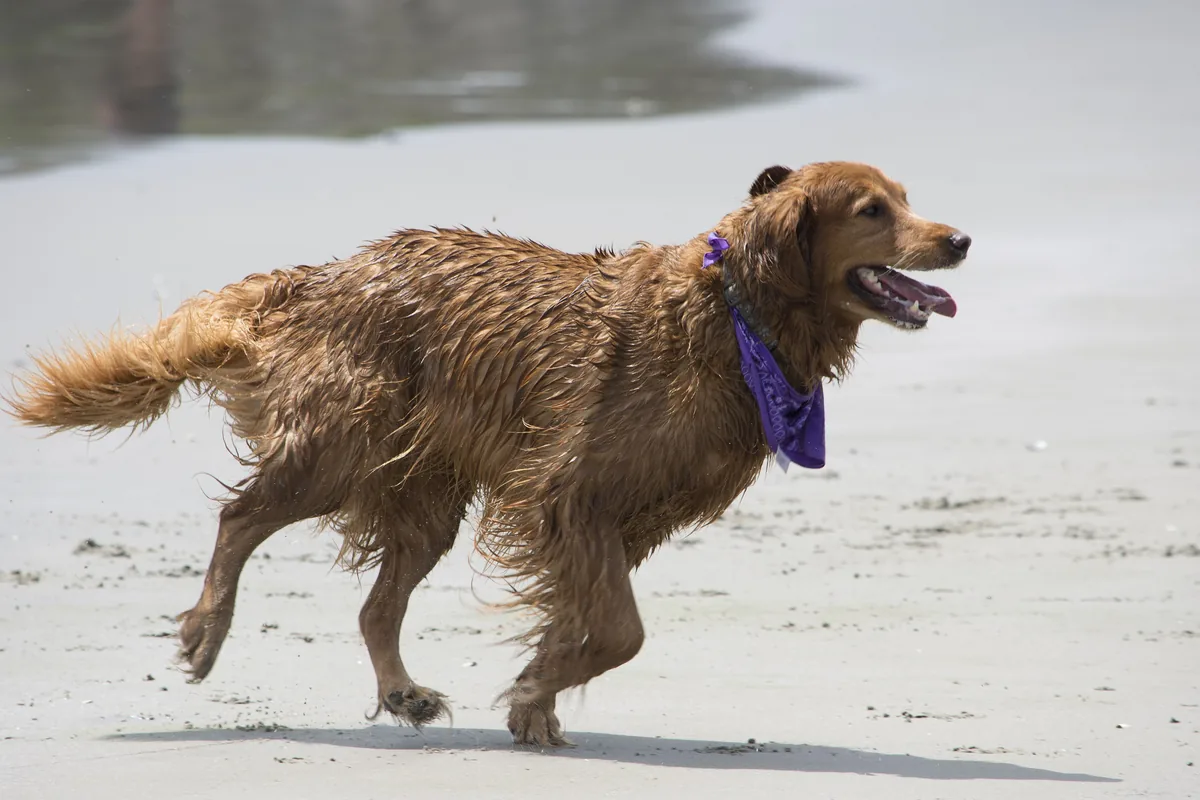
Dudley Marjoribanks, the first Lord Tweedmouth, developed the breed in the Scottish Highlands and kept careful breeding records from 1840 to 1890. He crossed his “Yellow Retriever” with the now-extinct Tweed Water Spaniel, and Irish Setter and Bloodhound were added later. The goal was a gundog for rainy, rugged country (AKC Golden Retriever). Read more in our Golden Retriever puppy guide.

The Dachshund side
“Dachshund” is German for “badger dog.” The long, low body was built for digging into a badger’s den, and the AKC says the surprisingly loud bark let the hunter above ground locate the dog below (AKC Dachshund). There are two sizes and three coats: smooth, wirehaired and longhaired. Our full Dachshund guide covers the breed, and there’s a separate page on the long-haired mini Dachshund.


Golden Dox vs Golden Retriever vs Dachshund
Registry figures and the AKC’s 1 to 5 trait ratings (5 = most) for the parents. The last column is the range between them, not measured data.
| Golden Retriever | Dachshund | Golden Dox | |
|---|---|---|---|
| AKC group | Sporting | Hound | Not a recognized breed |
| Height | 23 to 24 in (M), 21.5 to 22.5 in (F) | 8 to 9 in (standard), 5 to 6 in (mini) | Varies; parent span 5 to 24 in |
| Weight | 65 to 75 lb (M), 55 to 65 lb (F) | 16 to 32 lb (standard), 11 lb and under (mini) | Varies; somewhere between the parents is a reasonable guess |
| Body shape | Slightly longer than tall, ratio 12:11 | Long back, short legs | Varies |
| Life expectancy | 10 to 12 yrs | 12 to 16 yrs | Not studied |
| Coat | Dense, water-repellent double coat | Smooth, wirehaired or longhaired | Varies |
| Color | Shades of golden | Red, cream, black and tan, chocolate and tan, dapple and more | Varies |
| Affectionate with family | 5 | 5 | Not rated |
| Good with young children | 5 | 3 | Not rated; supervise |
| Good with other dogs | 5 | 4 | Not rated; ask |
| Openness to strangers | 5 | 4 | Not rated |
| Watchdog / protective | 3 | 4 | Not rated |
| Playfulness | 4 | 4 | Not rated |
| Energy | 3 | 3 | Not rated |
| Trainability | 5 | 4 | Not rated |
| Mental stimulation needs | 4 | 3 | Not rated |
| Barking | 1 | 5 | Not rated |
| Shedding | 4 | 2 | Not rated |
| Drooling | 2 | 2 | Not rated |
| Back disease (IVDD) | Not named by ACVS among the typical short-legged breeds | 45 to 70% of all disc ruptures, per ACVS | Possible; see below |
Sources: AKC Golden Retriever, AKC Golden Retriever standard, AKC Dachshund, Dachshund Club of America standard, ACVS.
Where the parents agree, you can plan: affectionate, moderate energy, playful. Where they’re far apart (size, barking, shedding, body shape), only the individual dog can tell you.
How big does a full-grown Golden Dox get?
Online you’ll find 15 to 30 pounds, 30 to 50 pounds, and 30 to 60 pounds, each stated as fact. They can’t all be right, and none of the pages we checked cites a measurement. The reason they disagree is simple: the parents could hardly be more different.
- A Golden crossed with a miniature Dachshund combines a 55 to 75 pound parent with one that weighs 11 pounds or less.
- A Golden crossed with a standard Dachshund combines that same Golden with a parent of 16 to 32 pounds.
- A second-generation cross could lean hard toward either side.
Height is just as slippery. Two gene variants linked to short legs are nearly universal in Dachshunds (more on those in the back section), which is a likely reason so many Golden Doxes in photos look low to the ground. We found no study that measured legs in this mix, so a longer-legged dog wouldn’t be a surprise.
Our advice: if you need to know the size, adopt an adult. If it’s a puppy, plan your lifting, your car and your lease for a medium dog and be happy if it turns out smaller.
Coat and colors
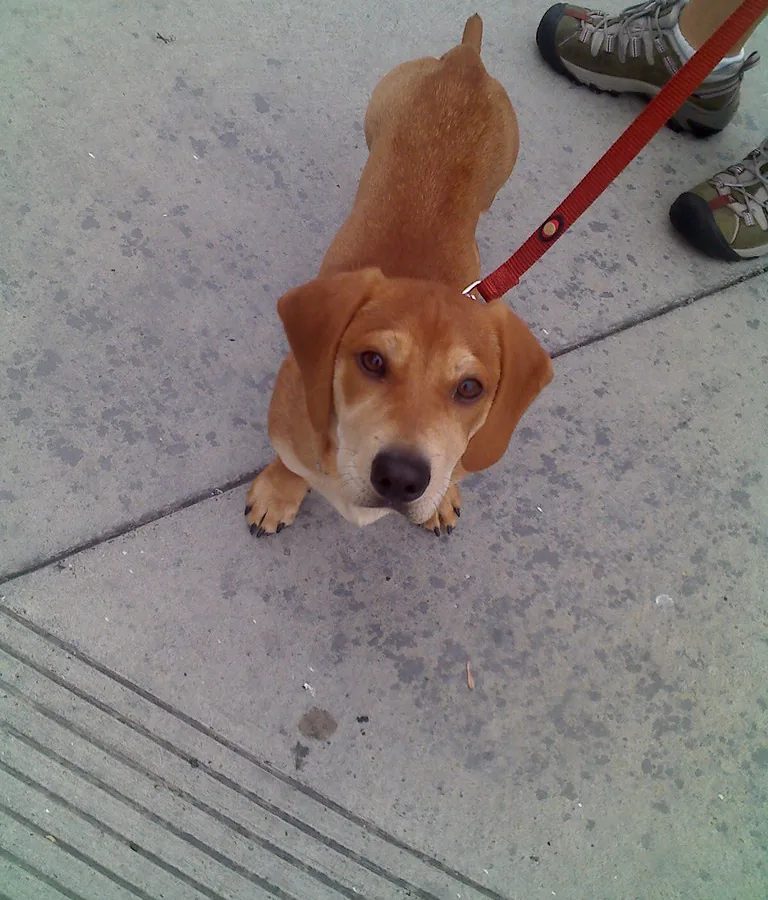
The Golden standard calls for a dense, water-repellent coat with a good undercoat, straight or wavy, in “rich, lustrous golden of various shades” (AKC standard). Dachshunds come in three coats and a long list of colors, from red and cream to black and tan, chocolate and tan, dapple and brindle (DCA standard). So a Golden Dox might be:
- Golden or red with some feathering, the look most people picture.
- Black and tan or chocolate, since those colors run on the Dachshund side.
- Short and smooth, soft and wavy, or a bit wiry, depending on which Dachshund coat is in the family.
Don’t pay extra for a color, and don’t let one put you off.

Temperament: what to realistically expect
These describe purebred parents. They aren’t predictions for any one mix.
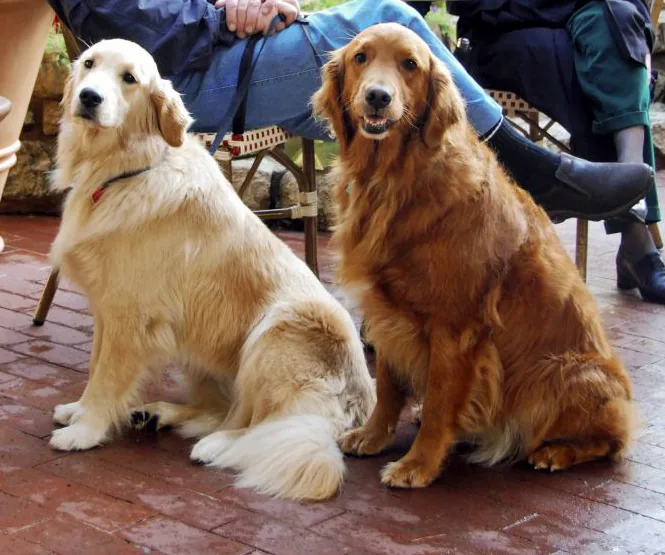
The Golden side. The breed standard’s words are “friendly, reliable, and trustworthy” (AKC standard). The AKC calls Goldens outgoing, eager to please, and says they keep a puppyish streak into adulthood (AKC Golden Retriever).
The Dachshund side. The standard says “clever, lively and courageous to the point of rashness” (DCA standard). The AKC adds that they’re “a bit stubborn,” have a strong prey drive, make fine watchdogs with a big-dog bark, and want to be with their humans (AKC Dachshund).
What the science says. In a 2022 study in Science, breed explained just 9% of the behavioral differences between individual dogs (Morrill et al., 2022). A label is a weak guide to the dog in front of you.
In daily life:
- Family: both parents rate 5 out of 5 for affection. This is likely to be a dog that follows you to the kitchen.
- Visitors: some will greet everyone like a Golden. Others will announce the mail carrier like a Dachshund first.
- Cats and small pets: ask. The Dachshund was bred to hunt, so introduce slowly and supervise.
- Children: the AKC rates Dachshunds 3 and Goldens 5. Teach children not to lift or carry the dog, because a wriggle and a fall is bad news for a long back.
- Time alone: the AKC says Dachshunds are very social and don’t do well as outdoor dogs. Build up alone time in small steps.
Exercise: enough, but the right kind
Here the two parents want different things. The AKC says Goldens need plenty of daily exercise, and that a Golden who doesn’t get enough is likely to get into mischief (AKC Golden Retriever). For Dachshunds it says two walks a day of moderate length should be enough, and warns against running up and down stairs or jumping on and off furniture (AKC Dachshund).
If your Golden Dox has a long back and short legs, follow the Dachshund rules whatever its energy level:
- Do: two or more walks a day, sniffing time, gentle play on flat ground, food puzzles, short training games.
- Ask your vet first: swimming, longer hikes, agility, jogging. The AKC says Dachshunds aren’t built for distance running, leaping or strenuous swimming (AKC Dachshund).
- Skip: high jumps for a ball or frisbee. Cornell puts it well: “Walking is safe for any dog. Leaping for a thrown toy, not so much” (Cornell IVDD).
Some popular guides recommend frisbee and jogging for this mix. We’d check with your vet before either one.
Don’t go too far the other way and wrap the dog in cotton wool. In a survey of 2,031 Dachshunds, dogs exercised less than 30 minutes a day had higher odds of disc disease, and dogs exercised more than an hour a day had lower odds (Packer et al., 2016). A survey can’t prove cause, since dogs already in trouble may be exercised less, but it fits the AKC’s advice that exercise builds the muscles that support the back.

Training
The AKC says Goldens’ eagerness to please makes them “very easy to train,” while Dachshunds are intelligent but independent, sensitive, and “will not react well to harsh commands or punishment” (AKC Golden Retriever; AKC Dachshund). Both point to the same method: patience and rewards. The American Veterinary Society of Animal Behavior says reward-based methods should be used for all dog training (AVSAB, 2021), so skip any advice to be “firm” with this mix.
What to work on first:
- Using a ramp or steps. Start on day one, with treats. It’s the most useful trick this dog will ever learn.
- Coming when called, inside and in fenced spaces. A nose that catches a scent may not hear you, so use a leash elsewhere.
- A quiet cue. Reward silence after a bark or two. Dachshunds were bred to be loud, so aim for less, not none.
- Four paws on the floor at the door, to spare that back.
- Being lifted properly. Ask your vet or a vet nurse to show you how to support chest and hips together so the spine stays level.
- Housetraining. Frequent trips, same spot, instant reward. For an adopted adult, start over as if it’s new.
Grooming and shedding
Plan on hair. The AKC rates Golden shedding 4 out of 5 and Dachshund shedding 2, so any page promising a light shedder is guessing. Goldens shed heavily once or twice a year and moderately the rest of the time (AKC Golden Retriever). Of Goldens, the Golden Retriever Club of America says whatever coat they have “will eventually fall out,” and that weekly brushing is enough most of the year, daily in a big shed (GRCA).
| If the coat is like a… | Plan on |
|---|---|
| Golden Retriever | Brushing once or twice a week, daily in shedding season (AKC) |
| Longhaired Dachshund | More frequent brushing, depending on thickness (AKC) |
| Smooth Dachshund | A wipe with a towel or hound glove (AKC) |
| Wirehaired Dachshund | Brushing once or twice a week, beard and eyebrow trims, hand-stripping a few times a year (AKC) |
For every coat: trim nails monthly, brush teeth, and check ears weekly. Both parents have drop ears, and the AKC mentions ear infections for both breeds. If bending is hard on your own back, groom on a non-slip surface at a safe height and lift with help.
Diet basics
There’s no special Golden Dox diet, but weight matters more here than in most mixes. The AKC calls it “extremely important” that a Dachshund not become overweight, because extra pounds strain the long back, and says some Goldens can become overweight too (AKC Dachshund; AKC Golden Retriever). The Dachshund Club of America says to feed on a schedule and never free feed (DCA health).
In a UK study of 700 dogs of many breeds, being overweight raised the risk of a disc extrusion, and so did a longer back relative to height (Packer et al., 2013). You can’t change the back. You can change the bowl. Ask your vet for a target weight and how many calories that takes, and count treats.
The back: the one risk to plan for
Intervertebral disc disease, or IVDD, happens when a cushion between the bones of the spine degenerates, then bulges or ruptures into the spinal cord. Effects run from mild discomfort to paralysis (Cornell IVDD). The American College of Veterinary Surgeons says Dachshunds account for 45 to 70% of all cases, with signs usually starting at 3 to 6 years in short-legged breeds (ACVS). In a survey of Dachshund owners, 15.7% of the dogs had a vet diagnosis (Packer et al., 2016).
Does the Golden parent cancel it out?
Probably not entirely, and this is what most guides miss. Researchers at UC Davis and elsewhere studied two gene variants, copies of a gene called FGF4, that help give Dachshunds their short legs (Batcher et al., 2019; Parker et al., 2009).
- Nearly every Dachshund carries them. The chromosome 12 variant, the one tied to disc disease, had a frequency of 0.98 in Dachshunds sampled in the US and UK and 0.94 in Switzerland. The paper’s main breed table doesn’t list Golden Retrievers separately.
- A puppy gets one copy of each gene from each parent. So a pup with a purebred Dachshund parent will nearly always inherit one copy from that side.
- One copy of the chromosome 12 variant is enough to matter. The team found it acted in a dominant way. Among mixed-breed dogs, those with one or two copies had about 15 times the risk of disc surgery of dogs with none.
That number sounds alarming, so keep it in proportion. It’s a comparison between patients at one teaching hospital, not the chance that your dog will get sick. Cornell says about 10% of dogs with two copies will eventually develop a disc problem (Cornell IVDD); other estimates for Dachshunds run higher, at 19 to 24% (Packer et al., 2016). We found no study of the Golden Dox, so nobody can give you its odds. By any of those figures, most Dachshunds never show signs, and simple habits are worth having from day one. A DNA test can tell you whether your dog carries the variant, and your vet can tell you whether the result would change anything.
A back-friendly home
- Keep the dog lean. The best-supported step on this list.
- Ramps or wide, stable steps at the sofa, the bed and the car.
- Gates on stairs. Cornell advises minimizing stairs and jumping on and off furniture (Cornell IVDD).
- Rugs or runners on slick floors.
- A well-fitted body harness for walks.
- Daily walks, to keep up muscle.
- A plan for lifting. If you can’t carry this dog’s weight, know now who could help, and ask your vet about a lift sling.
- Insurance or a savings fund. Price it before there’s a problem, and ask how pre-existing conditions are handled.
One honest wrinkle: in that Dachshund survey, dogs not allowed to jump on furniture had higher odds of disc disease, perhaps because owners restrict dogs already in trouble. The evidence on jumping isn’t settled. The AKC and Cornell still advise against it, and we’d go with them.
Signs that mean call the vet today
Cornell and ACVS describe a dog that won’t turn its head, walks to the bowl but doesn’t bend to eat, refuses to walk around, wobbles, crosses its back feet, or snaps when touched. A dog that can’t use its back legs, or can’t urinate, needs emergency care. Cornell’s advice if surgery is recommended: “don’t wait.”
There’s real hope here. ACVS says that when a dog can still feel pain in its limbs, surgery lets about 90% regain the use of them, and strict medical care 60 to 80% (ACVS).
Other health issues to know about
Being a mix may help with some conditions and not others. In a UC Davis study of 27,254 cases, purebreds were more likely to have 10 inherited conditions, including elbow dysplasia and cataracts; there was no difference for 13 others; and mixed-breed dogs were more likely to rupture a knee ligament (Bellumori et al., 2013).
| Condition | Which parent breed | What the source says |
|---|---|---|
| Disc disease (IVDD) | Dachshund | See above (ACVS). |
| Hip dysplasia | Golden | Named by the AKC for Goldens (AKC). The breed club says weight control and regular, moderate exercise are important for affected dogs (GRCA). |
| Elbow dysplasia | Golden | Estimated to affect about 10% of Goldens (GRCA). |
| Eye disease: cataracts, pigmentary uveitis, progressive retinal atrophy | Golden | Pigmentary uveitis tends to appear in middle-aged or senior dogs (GRCA). |
| Heart: subvalvular aortic stenosis | Golden | A small percentage of Goldens; can be serious (GRCA). |
| Heart: mitral valve disease | Dachshund | On the breed club’s list of common health issues (DCA). |
| Hemangiosarcoma, a blood vessel cancer | Both | More common in Goldens (Cornell); also on the Dachshund club’s list (DCA). |
| Other cancers, such as lymphoma | Golden | See the note below (Kent et al., 2018). |
| Ear infections, weight gain | Both | Weekly ear checks and portion control (AKC; AKC). |
About cancer in Goldens. In 652 Golden Retrievers examined after death at a veterinary teaching hospital, 65% had died of cancer, most often hemangiosarcoma (Kent et al., 2018). Those were referral patients, so the figure may run high for Goldens in general, and no one has studied the mix. The “silent killer” label comes from hemangiosarcoma’s habit of showing little until a tumor bleeds. Cornell lists weakness, low appetite and tiring easily early on, and collapse, pale gums and trouble breathing as emergencies (Cornell). Ask your vet what checkups make sense as your dog ages.
Spay and neuter timing. Two findings are worth taking to your vet. In mixed-breed dogs of 20 kg (about 44 pounds) or more, neutering before a year was generally linked to a higher risk of joint disorders; under 20 kg, no increase was found (Hart et al., 2020). In Dachshunds, neutering before 12 months was linked to more disc herniation than neutering later (Dorn and Seath, 2018). Many shelter dogs are already altered, and that’s fine. If you have a puppy, ask your vet about timing.
Tests to ask about. The AKC lists hip, elbow, heart and eye exams plus a DNA test for Goldens, and kneecap, heart and eye exams for Dachshunds (AKC; AKC). If you’re offered a puppy, ask to see both parents’ results.
Lifespan
We found no study of this mix, so “10 to 14 years” is a guess. The AKC lists 10 to 12 years for Goldens and 12 to 16 for Dachshunds. A large UK study found median survival of 13.2 years for Golden Retrievers, 13.2 for Dachshunds and 14.0 for miniature Dachshunds, with 12.0 for crossbreeds overall (McMillan et al., 2024, breed figures in its Supplementary Table S3). Those aren’t a forecast for your dog, but planning for a decade or more is sensible.
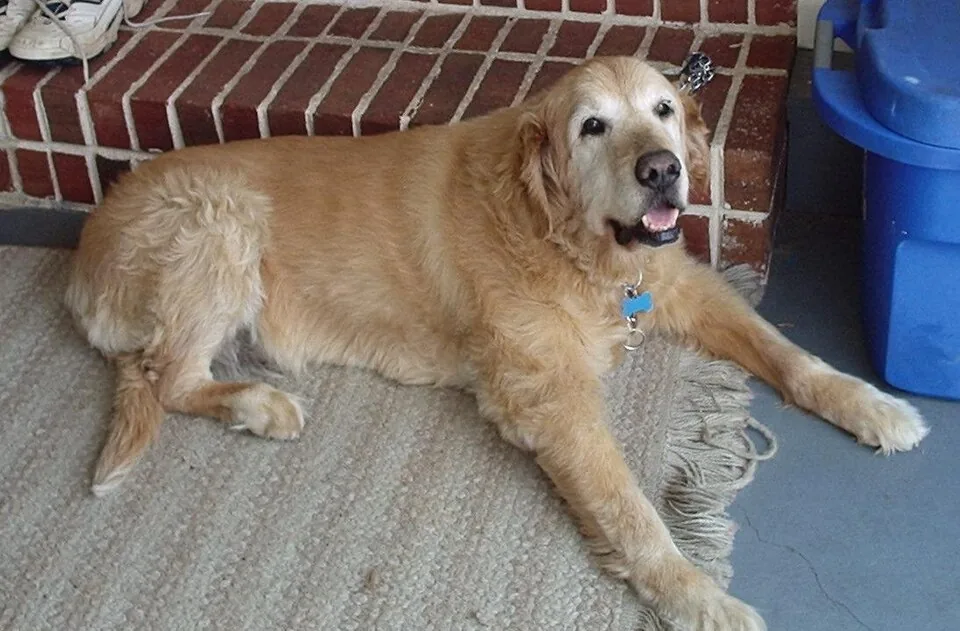

Golden Dox puppies
A puppy means guessing at adult size, coat, legs and voice. It also means energy: the Golden Retriever Club of America says a Golden’s need for exercise is most pronounced up to about two years of age (GRCA), and the Dachshund Club says to build up a puppy’s activity gradually until about a year, while bones and muscles develop (DCA health).
There’s no breed club or health-testing program for this cross. If you talk with someone who has a litter, ask to meet the mother, see where the pups are raised, and see health results for both parents, including back history. Walk away from anyone who promises an adult weight, a “healthier” dog, or a “rare” color, or who wants a deposit before you visit.
For many people over 50, an adult dog is the easier road. What you see is what you get.
Is that shelter dog really a Golden Dox?
Maybe. A long, low, gold-colored dog is easy to label “Golden/Dachshund,” but the research is humbling:
- In a study of 919 dogs at two shelters, only 1.3% had two purebred parents of different breeds, which is what a first-generation Golden Dox would be. At one shelter, staff matched at least one breed in 67.7% of the dogs tested, but more than one in only 10.4% (Gunter et al., 2018).
- In a study of 20 adopted dogs, 87.5% of those given specific breeds by an agency did not have all of those breeds show up in DNA (Voith et al., 2009).
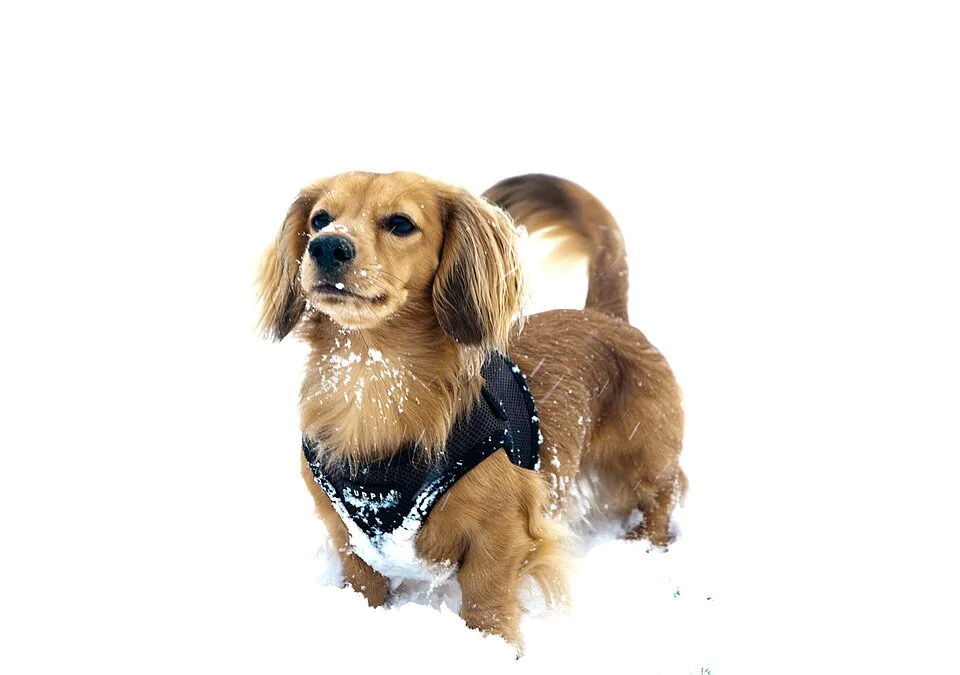
Costello, the puppy pictured above, makes the point: half Dachshund, half golden Lab, and easily mistaken for a Golden Dox. So weigh the back, the size and the temperament you can see. Our guide to figuring out your dog’s breed explains what DNA tests can tell you.
Is a Golden Dox right for me? A checklist for 50 and up
You’re likely a good match if:
- You want an affectionate dog that’s with you most of the day.
- Two or more gentle walks a day sounds good, in most weather.
- You can be strict about food, even with those eyes looking at you.
- You can put in ramps and gates, or you live on one level.
- You can safely lift this particular dog, or you have help nearby.
- You could handle a large vet bill through insurance or savings.
You may want a different dog if:
- Barking would cause trouble with neighbors or a lease.
- Your only way in or out is a flight of stairs.
- You want a predictable size or a light shedder.
- You’d like a jogging or frisbee partner. A plain Golden Retriever is the better fit.
- You’ve had a fall, or have wrist, hip or balance trouble, and a low dog underfoot worries you. A bell on the collar and a lit hallway can help; so can choosing a taller dog.
None of this is a reason to pass up a dog you love. It’s the list I’d want a friend to read first.
How to find a Golden Dox to adopt
One popular guide says you’re unlikely to find a Golden Dox puppy in a shelter. We’d look anyway. Dogs of every description need homes, and both parent breeds have rescues that take some mixes. Bone Voyage is no longer an active rescue and doesn’t place dogs, but these groups do:
- Dachshund Rescue of North America rehomes Dachshunds and “mostly dachshund mixes,” with foster homes mainly on the East Coast. Its Senior to Senior program lets approved adopters 60 or older adopt a dog 8 or older with no adoption fee.
- The Dachshund Club of America’s rescue page links to a list of rescue contacts.
- The Golden Retriever Club of America’s rescue list covers local groups by state. The club says Golden rescues began admitting Golden crosses as fewer purebreds needed homes (GRCA).
- Golden Retriever Rescue of the Rockies had a Golden mix among its available dogs when we checked in November 2026.
- Adopt a Pet lets you search shelters near you. Try “Golden Retriever mix” and “Dachshund mix,” since few listings will say Golden Dox.
Questions to ask the shelter or foster home
- Has this dog ever had back or neck pain, a wobbly walk, or crate rest? May I see the vet records?
- What does it weigh now, and what should it weigh?
- Does it use stairs or jump on furniture? Will it walk up a ramp?
- How does it feel about being picked up?
- How much does it bark, and at what?
- How is it with cats, small dogs, children and visitors?
- Is it housetrained, and how long can it be left?
- Is there a foster-to-adopt option, and what happens if it doesn’t work out?
Our 9 questions to ask when adopting a dog covers the general ones.
Give your dog a backup plan
A dog with a long back comes with routines another person would need to know: the ramp, the harness, the target weight, the early signs of trouble. Choose someone now who knows your dog and would step in if you couldn’t. Our guide What Happens to Your Dog When You Die walks you through it kindly, and the free My Dog’s Backup Plan worksheet gives you a place to write it down. Bone Voyage is also building the pledge, a promise by a volunteer to adopt a specific older adult’s dog if that person dies or can no longer care for it. You can join the free list on that same page.
Similar dogs to compare
- Daug (Dachshund and Pug mix) and Beagle Corgi mix, two other long-backed crosses.
- Golden Retriever Rottweiler mix and Golden Retriever Siberian Husky mix, bigger dogs from the Golden side.
- Goldendoodle, the best-known Golden cross.
Frequently Asked Questions
What do you call a Golden Retriever and Dachshund mix?
Golden Dox is the name you’ll see most. Golden Dachshund, Golden Doxie, Golden Weiner and Golden Weenie are used too. All are informal. Neither the AKC nor the UKC lists the cross as a breed, so there is no breed standard, and looks, size and temperament vary from dog to dog.
How big does a Golden Dox get?
There is no official size, and no study has measured the mix that we could find. The AKC lists Golden Retrievers at 55 to 75 pounds, standard Dachshunds at 16 to 32 pounds and miniature Dachshunds at 11 pounds and under. A mix can land anywhere between, so meeting an adult dog is the only way to know.
Does a Golden Dox have back problems?
It can. In a University of California, Davis study, a gene variant found in nearly all the Dachshunds tested raised the risk of disc surgery in mixed-breed dogs even when a dog carried one copy. Not every dog with it gets sick. Keep the dog lean, limit stairs and jumping, and call your vet at the first sign of back pain.
Do Dorkies bark a lot?
Many probably will. A Dorkie is a Dachshund and Yorkshire Terrier cross, and the AKC rates Dachshunds 5 out of 5 and Yorkies 4 out of 5 for barking. A Golden Dox may be quieter, because the AKC rates Golden Retrievers 1 out of 5, but either mix can take after its louder parent.
What is the silent killer in golden retrievers, and could a Golden Dox get it?
People usually mean hemangiosarcoma, a cancer of the blood vessels that Cornell’s veterinary college says may show few or no signs early on and is more common in breeds including Golden Retrievers. The Dachshund Club of America lists it as a Dachshund health issue too, so a mix could be affected. Collapse, weakness or pale gums is an emergency.
At what age do goldens calm down?
The Golden Retriever Club of America says the need for exercise is most pronounced in puppyhood, up to about two years of age, and that most Goldens can adapt to a less active life once they are mature and trained. The AKC adds that Goldens keep a puppyish streak into adulthood. Nobody has measured it in the mix.
What is a mini Doxie puppy?
It’s a miniature Dachshund puppy. Doxie is a nickname for the Dachshund. The breed standard says miniatures are not a separate breed but a class for Dachshunds 11 pounds and under at 12 months of age and older. Some Golden Doxes have a miniature Dachshund parent and some have a standard one, which is one reason sizes vary.
Is a Golden Dox a good dog for someone over 50?
Often, yes, if you can give it daily walks, keep it lean and set your home up so it doesn’t need stairs or jumping. The honest question is lifting: a dog with a sore back may need carrying, and a Golden Dox could weigh more than you can safely lift. An adult whose weight you already know is a sensible choice.
Before you go
The Golden Dox in front of you is one dog, with its own legs, voice and opinions. Meet it, ask about its back, and let it show you who it is. For more profiles, browse our breeds and adoption guides.
Sources
- American Kennel Club: Golden Retriever, Golden Retriever breed standard, Dachshund, Yorkshire Terrier (size, life expectancy, trait ratings, history, care)
- Dachshund Club of America: breed standard, health, rescue
- Golden Retriever Club of America: Is a Golden right for you?, health screenings, more topics before you buy, rescue list
- Cornell Riney Canine Health Center: intervertebral disc disease, hemangiosarcoma
- American College of Veterinary Surgeons, Intervertebral Disc Disease
- Batcher K et al. (2019). Phenotypic effects of FGF4 retrogenes on intervertebral disc disease in dogs. Genes 10(6):435.
- Parker HG et al. (2009). An expressed fgf4 retrogene is associated with breed-defining chondrodysplasia in domestic dogs. Science 325(5943):995-8.
- Packer RMA et al. (2013). How long and low can you go? PLOS ONE 8(7):e69650.
- Packer RMA et al. (2016). DachsLife 2015. Canine Genetics and Epidemiology 3:8.
- Dorn M, Seath IJ (2018). Neuter status as a risk factor for canine intervertebral disc herniation in dachshunds. Canine Genetics and Epidemiology 5:11.
- Hart BL et al. (2020). Assisting decision-making on age of neutering for mixed breed dogs. Frontiers in Veterinary Science 7:472.
- Kent MS et al. (2018). Association of cancer-related mortality, age and gonadectomy in golden retriever dogs. PLOS ONE 13(2):e0192578.
- Bellumori TP et al. (2013). Prevalence of inherited disorders among mixed-breed and purebred dogs. JAVMA 242(11):1549-55.
- McMillan KM et al. (2024). Longevity of companion dog breeds. Scientific Reports 14:531.
- Morrill K et al. (2022). Ancestry-inclusive dog genomics challenges popular breed stereotypes. Science 376(6592):eabk0639.
- Gunter LM et al. (2018). A canine identity crisis. PLOS ONE 13(8):e0202633.
- Voith VL et al. (2009). Comparison of adoption agency breed identification and DNA breed identification of dogs. Journal of Applied Animal Welfare Science 12(3):253-62.
- American Veterinary Society of Animal Behavior, Position Statement on Humane Dog Training (2021)
- Dachshund Rescue of North America: about, Senior to Senior
- Photos: Wikimedia Commons and Flickr contributors, credited under each image. Full license records are kept in this site’s image-credits file.