
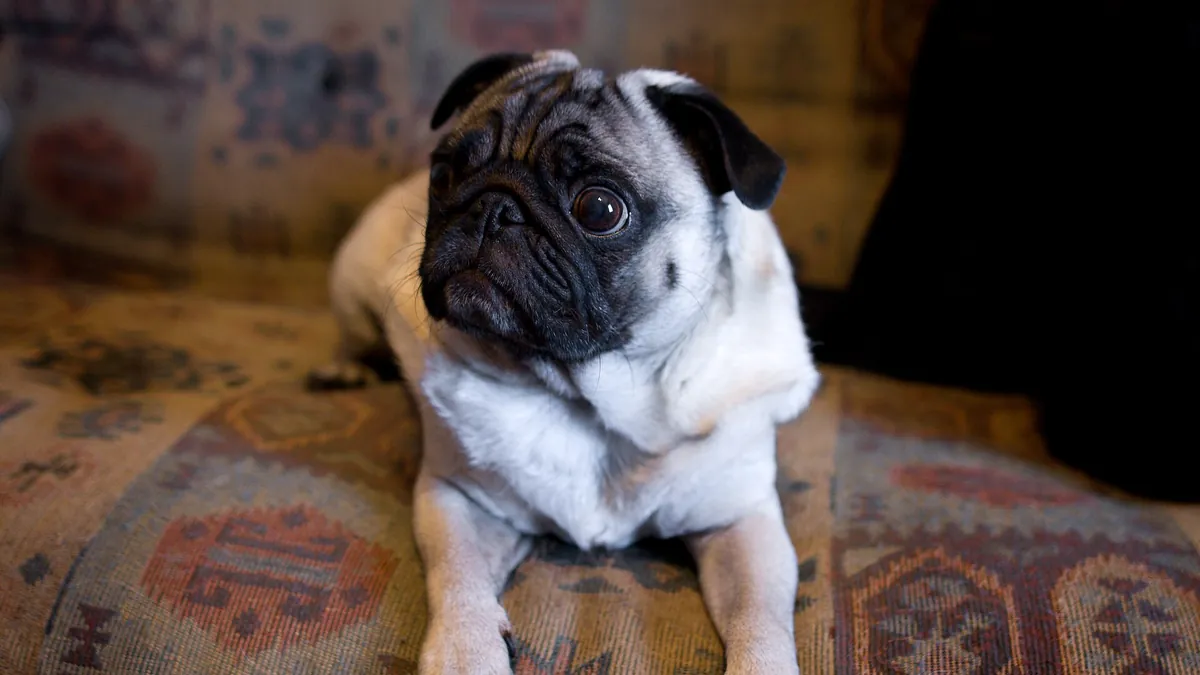
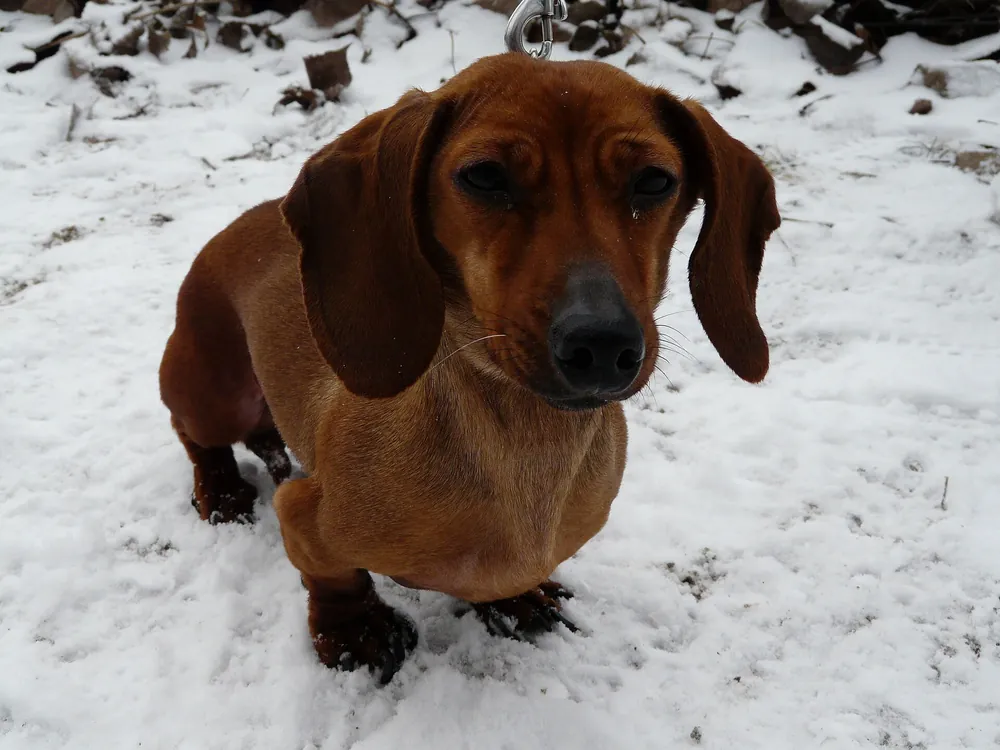
A Daug is a Dachshund and Pug mix: a small, sturdy, people-loving dog that might have a Dachshund’s long back, a Pug’s wrinkled face and curly tail, or some surprising blend of the two. “Daug” is an informal name. No kennel club recognizes the cross, and there is no breed standard for it.
Because two very different breeds go into the mix, the honest answer to most Daug questions is “it depends on the dog.” Here’s what the parent breeds’ official sources can tell you about size, health, temperament and care, and where the evidence runs out.
At a glance
- Adult size: small. Pugs are 10 to 13 inches and 14 to 18 pounds; standard Dachshunds are 8 to 9 inches and 16 to 32 pounds; miniature Dachshunds are 5 to 6 inches and 11 pounds and under (AKC Pug, AKC Dachshund).
- Lifespan frame of reference: the AKC lists 12 to 16 years for Dachshunds and 13 to 15 years for Pugs. There is no published figure for the mix.
- Energy: moderate. Both parents need daily walks but not marathon exercise.
- Shedding: expect some. Both parent breeds shed.
- Health to know about: back and spine problems, breathing problems linked to a short face, eye problems, kneecaps that slip, and weight gain. All are documented in one or both parent breeds.
- Good fit for: someone who is home a lot, wants a small companion that wants to be with them, and can keep a dog cool, lean and off the stairs.
What a Daug actually is
A Daug is a cross between a Dachshund and a Pug. Plenty of shelter dogs labeled “Dachshund/Pug” are a few generations removed or have other breeds mixed in, and only a DNA test can tell you for sure. Our guide to figuring out your dog’s breed explains the options.
The two parents were made for very different lives:
- The Dachshund is a German hunting dog. Its name means “badger dog,” and the AKC says its long, low body was “custom-made” for digging into badger dens (AKC Dachshund). Our full Dachshund breed guide covers the breed in depth.
- The Pug is an ancient companion breed that the AKC traces back some 2,000 years to the emperors of China, who favored flat-faced toy dogs as pets (AKC Pug). The AKC sums up its motto, “multum in parvo,” as “a lot in a little.”
One dog was bred to work and one to keep people company. A Daug can inherit any mix of those instincts, and two puppies from the same litter can look and act quite differently. There’s no “correct” Daug, only individual dogs.



How big does a Daug get?
The honest way to estimate size is to look at the parents’ published ranges:
| Pug | Standard Dachshund | Miniature Dachshund | |
|---|---|---|---|
| Height | 10 to 13 inches | 8 to 9 inches | 5 to 6 inches |
| Weight | 14 to 18 pounds | 16 to 32 pounds | 11 pounds and under |
| Life expectancy | 13 to 15 years | 12 to 16 years | 12 to 16 years |
Sources: AKC Pug, AKC Dachshund.
A Daug can land anywhere between these ranges, and occasionally outside them. The biggest clue is which Dachshund size was in the family: a cross with a miniature will usually be smaller than one with a standard. If you’re adopting a puppy, ask what the shelter knows about the parents. With an adult dog, what you see is what you get.
Coat, colors and shedding
Coat. The Pug has a “short, smooth, glossy coat” (AKC Pug), and the Pug Dog Club of America notes most Pugs are double coated and “shed quite a bit at times” (PDCA). Dachshunds come in smooth, wirehaired and longhaired coats, and the AKC calls them moderate shedders (AKC Dachshund). Most Daugs you’ll meet have short coats, but a cross with a wirehaired or longhaired Dachshund can turn out different.
Colors. The AKC lists Pugs as silver or apricot-fawn with a black face mask, or all black. Dachshunds come in a wide range of colors and patterns. A Daug’s color is anyone’s guess.
Shedding. Not a mix for someone who wants zero dog hair. Weekly brushing with a medium-bristle brush, rubber grooming mitt or hound glove, as the AKC suggests for Pugs, keeps it manageable.

Temperament and training
The Pug side. The AKC describes the Pug as having “an even and stable temperament, great charm, and an outgoing, loving disposition.” Pugs “live to please their people, so they are generally easy to train,” but “their feelings are easily hurt, and harsh training methods should never be used.” A Pug “will be unhappy if he is regularly left alone for long periods of time” (AKC Pug).
The Dachshund side. Dachshunds are “very intelligent but are also independent and often stubborn, so they can be a challenge to train.” They have a strong nose and prey drive, are sensitive, and do best with positive, reward-based training (AKC Dachshund). The Dachshund Club of America calls them “clever, a bit stubborn, and courageous to the point of rashness” (DCA).


Put together, many Daugs are affectionate, people-focused little dogs, and some add a Dachshund’s independent streak and nose. In daily life:
- Company matters. Both parents want to be with their people. This isn’t a dog for long days alone.
- Training. Short, upbeat, treat-based sessions work best for both sides. Watch the treat count, since both parent breeds gain weight easily.
- Kids and other pets. The PDCA says Pugs typically love all people including children, and “as with any dog, you need to supervise small children” (PDCA). With an adult Daug, ask how that specific dog has done with children, dogs and cats.
- On walks. The Dachshund’s nose can lead it off on a trail, so keep a Daug on a leash or in a secure yard.
Health issues to know about
A mix can inherit health problems from either parent, and where both parents share a problem, the mix doesn’t escape it. The conditions below are documented for the parent breeds by the AKC, the breed clubs and veterinary schools. This is not a diagnosis checklist; if something worries you, talk to your vet.
| Concern | Dachshund | Pug | Source |
|---|---|---|---|
| Back and spine | Intervertebral disc disease (IVDD) | Disc disease, Pug myelopathy, hemivertebrae | DCA, PDCA health |
| Breathing | Not a flat-faced breed | Brachycephalic obstructive airway syndrome (BOAS) | AKC Pug, Cambridge |
| Eyes | Ophthalmologist evaluation recommended | Corneal ulcers and dry eye | AKC Dachshund, AKC Pug |
| Kneecaps | Patella evaluation recommended | Patellar luxation | AKC breed pages, PDCA health |
| Weight | Prone to overweight | Prone to obesity | AKC breed pages |
| Other | Mitral valve disease, hemangiosarcoma | Pug Dog Encephalitis (PDE), hip dysplasia | DCA, PDCA health |
Backs: a shared concern
This is the big one. Cornell University’s College of Veterinary Medicine reports an American College of Veterinary Surgeons estimate that “Dachshunds alone account for 40 to 75% of all cases of IVDD,” a condition where a spinal disc ruptures and presses on the spinal cord, causing anything from mild pain to paralysis (Cornell). The Pug Dog Club of America lists disc disease, hemivertebrae and Pug myelopathy, a spinal condition that causes weakness and wobbliness in the back legs, among the conditions seen in Pugs (PDCA health).
What helps, based on the AKC and Cornell: keep the dog lean, limit stairs and jumping on and off furniture, and walk daily to build supporting muscle. Call your vet at the first sign of back pain, such as not wanting to turn its head, a wobbly walk, or weakness in the back legs. Our Dachshund guide has more on IVDD signs.
Breathing: the Pug’s short face
The AKC says that “like all flat-faced breeds, Pugs sometimes experience breathing problems and do poorly in sunny, hot, or humid weather” (AKC Pug). The University of Cambridge’s veterinary school explains that breeding for very short muzzles has left these breeds predisposed to upper airway obstruction, a condition called brachycephalic obstructive airway syndrome, or BOAS. It also notes that not all flat-faced dogs show signs (Cambridge).
A Daug may inherit a longer, Dachshund-style muzzle or a shorter, Pug-style face. No study has measured BOAS in this cross, so don’t assume a mix is automatically in the clear. Cambridge notes that snoring and snorting while awake are signs of airway obstruction, and that a high-pitched, wheezing noise is “particularly common in affected pugs” (Cambridge). If your Daug breathes noisily, tires quickly or struggles in the heat, ask your vet for an airway check.
Eyes and kneecaps
The AKC notes the Pug’s prominent eyes are “one of his vulnerable spots,” with corneal ulcers and dry eye known to occur, and it recommends eye exams for both parent breeds. Both also have kneecap screening on their recommended test lists. The PDCA explains that when the kneecap slides out of place, the dog may limp and carry the leg (PDCA health).
Exercise, grooming and daily care
Exercise. Dachshunds need regular walks to build muscle that protects the back; the AKC suggests two walks a day of moderate length. Pugs need daily moderate exercise, but the AKC warns they “shouldn’t do strenuous exercise when it’s warm or humid out” (AKC Dachshund, AKC Pug). For most Daugs, that means two easy walks a day, shorter and in the cool of the morning or evening in summer.

Food. The AKC says Pugs “live to eat and are prone to obesity,” and that keeping a Dachshund from becoming overweight is “extremely important” for its back. Measure meals, go easy on treats, and ask your vet what a healthy weight looks like for your dog.
Grooming. Brush weekly. Trim nails regularly; the AKC recommends monthly nail trims for Dachshunds. If your Daug has the Pug’s facial wrinkles, ask your vet how to keep them clean and dry.
Heat. Treat a flat-faced Daug like a Pug in hot weather: air conditioning, shade, water, and no hard exercise.
Lifespan
No study has measured the Daug’s lifespan, so any single number you see online is a guess. As a frame of reference, the AKC lists 12 to 16 years for Dachshunds and 13 to 15 years for Pugs (AKC Dachshund, AKC Pug). Weight, back health and breathing will shape any individual dog’s years more than its breed label.
Adopting a Daug
Rescue or breeder?
There is no breed club or recognized health-testing standard for this cross, so no breeder can offer the track record you’d expect from a reputable breeder of either purebred. Many Daugs come from accidental litters and end up in shelters and rescues. Search for “Dachshund mix” and “Pug mix,” since shelter labels are often a best guess.
Adopting an adult has a real advantage here: you can see the dog’s actual size, face shape and breathing, rather than guessing from a puppy photo.
Questions to ask a shelter or rescue
- Has the dog shown any back pain, trouble with stairs, or wobbly back legs?
- How does it breathe at rest, on a walk, and on a warm day? Does it snore while awake?
- What does it weigh, and what does the vet think it should weigh?
- How has it done with children, other dogs, cats and visitors?
- How does it handle being left alone?
- Any known eye or kneecap problems, and what does the adoption fee include?
- Is there a foster-to-adopt option, and what happens if it doesn’t work out?
Red flags in “Daug puppies for sale” ads
- No chance to meet the mother or see where the puppies are raised.
- No health screening on either parent. The AKC’s recommended tests include patella, cardiac and eye exams for Dachshunds, and hip, eye, kneecap and a PDE DNA test for Pugs.
- Claims that the mix is “healthier” or free of the parents’ problems. Back disease runs on both sides of this family.
- Pressure to pay a deposit right away, several “designer” breeds always available, or an offer to ship a puppy sight unseen.
Is a Daug the right dog for you?
Probably a great fit if:
- You want a small, affectionate dog that wants to be part of your day.
- You’re home much of the time, or the dog can come along.
- You can keep a dog lean, cool in summer, and off the stairs.
- A little snoring and some dog hair don’t bother you.
Think it over carefully if:
- You live somewhere hot without reliable air conditioning.
- Your home has lots of stairs and carrying a dog would be hard for you.
- The dog would be alone for long stretches most days.
- A big vet bill would be a crisis. Back and airway problems can be costly, so price pet insurance early.
If the Dachshund side is what draws you, see our full Dachshund breed guide and our profile of the long-haired mini Dachshund. For a bigger Dachshund cross with the same back-care homework, read about the Golden Dox, a Golden Retriever and Dachshund mix.
Frequently Asked Questions
What is a Daug?
A Daug is a cross between a Dachshund and a Pug. “Daug” is an informal name, not a breed: no kennel club recognizes it and there is no breed standard, so looks, size and temperament vary from dog to dog.
How big does a Daug get?
There is no official size for the mix. As a frame of reference, the AKC lists Pugs at 10 to 13 inches and 14 to 18 pounds, standard Dachshunds at 8 to 9 inches and 16 to 32 pounds, and miniature Dachshunds at 5 to 6 inches and 11 pounds and under. Most Daugs are small dogs, but which size of Dachshund was in the family makes a big difference.
How long do Daugs live?
There is no published lifespan for the mix. The AKC lists 12 to 16 years for Dachshunds and 13 to 15 years for Pugs, which is a reasonable frame of reference, but individual dogs vary.
Do Daugs have breathing problems?
Some may. The Pug is a flat-faced breed, and the AKC notes that, like all flat-faced breeds, Pugs sometimes have breathing problems and do poorly in heat and humidity. A Daug may inherit a longer Dachshund muzzle or a shorter Pug one, and no study has measured breathing in this cross, so watch for noisy breathing and talk to your vet.
Do Daugs have back problems?
They can. Dachshunds are strongly predisposed to intervertebral disc disease (IVDD), and the Pug Dog Club of America lists disc disease and other spinal problems among Pug health concerns too. Keeping a Daug lean and limiting stairs and jumping off furniture are sensible everyday precautions.
Are Daugs good dogs for older adults?
They can be. Both parent breeds are people-oriented companions, and the Pug Dog Club of America says older people often find Pugs perfect companions because their greatest need is to be by your side. Honest trade-offs to weigh are possible back and breathing problems, a tendency to gain weight, and the Dachshund’s stubborn streak.
Before you go
Whatever its kennel card says, the Daug in front of you is one specific dog with its own history and quirks, so weigh what you learn about that dog more heavily than anything on this page. And whatever dog you bring home, it’s worth deciding now who would care for it if you ever couldn’t. That’s what our A Home for Life guide is about. For more breed profiles, browse our breeds and adoption guides.
Sources
- American Kennel Club, Dachshund breed page (height, weight, life expectancy, recommended tests, history, health, nutrition, grooming, exercise, training)
- American Kennel Club, Pug breed page (height, weight, life expectancy, recommended tests, history, colors, health, nutrition, grooming, exercise, training)
- Dachshund Club of America, Health and public education (common health issues, temperament)
- Pug Dog Club of America, Health (spinal conditions, PDE, patellar luxation, hip dysplasia, BOAS) and About the Pug (coat, shedding, children, older owners)
- Cornell University College of Veterinary Medicine, Intervertebral disc disease (IVDD and the ACVS estimate for Dachshunds)
- University of Cambridge Department of Veterinary Medicine, About BOAS and Recognition and diagnosis (brachycephalic airway disease and its signs)