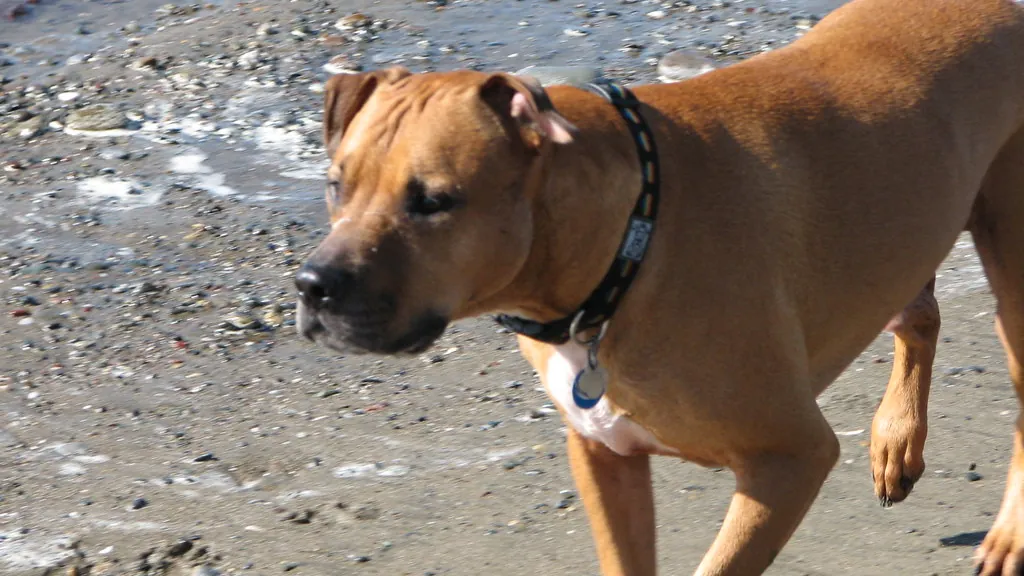
A Boxer Pitbull mix, often called a Bullboxer Pit, is a cross between a Boxer and a pit bull-type dog, usually an American Pit Bull Terrier or American Staffordshire Terrier. Expect a medium-to-large, short-coated, muscular dog that is playful, people-loving and energetic. It isn’t a recognized breed, so size, looks and temperament vary from dog to dog, and the honest guide is what each parent breed is like, plus the dog in front of you.
You’ll also see the mix called a Pitbull Boxer mix, Boxer Pit, Bullboxer or Pitoxer, and you’ll often meet one in a shelter with “Boxer/Pit mix” on the kennel card. Below is what the American Kennel Club (AKC), the United Kennel Club (UKC), the American Boxer Club and veterinary research can tell you, where the answer is “it depends on the dog,” and how to tell whether one fits your life.
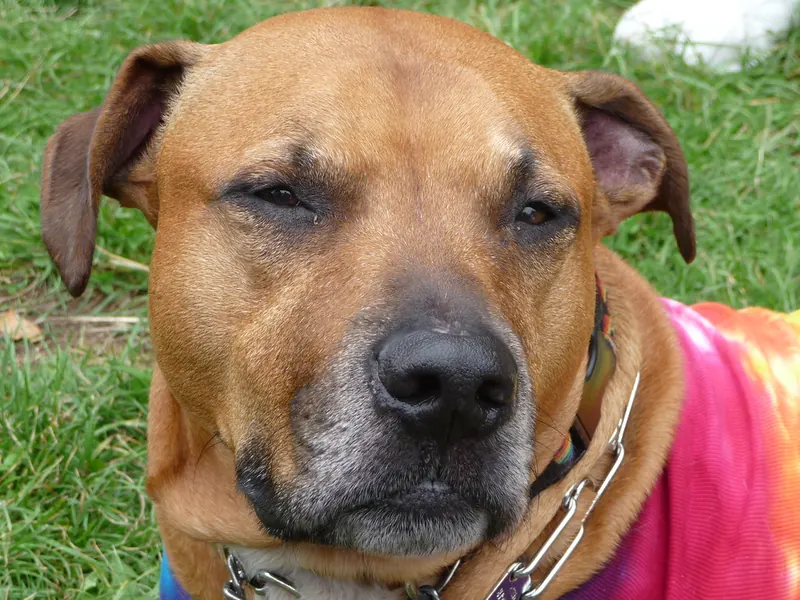
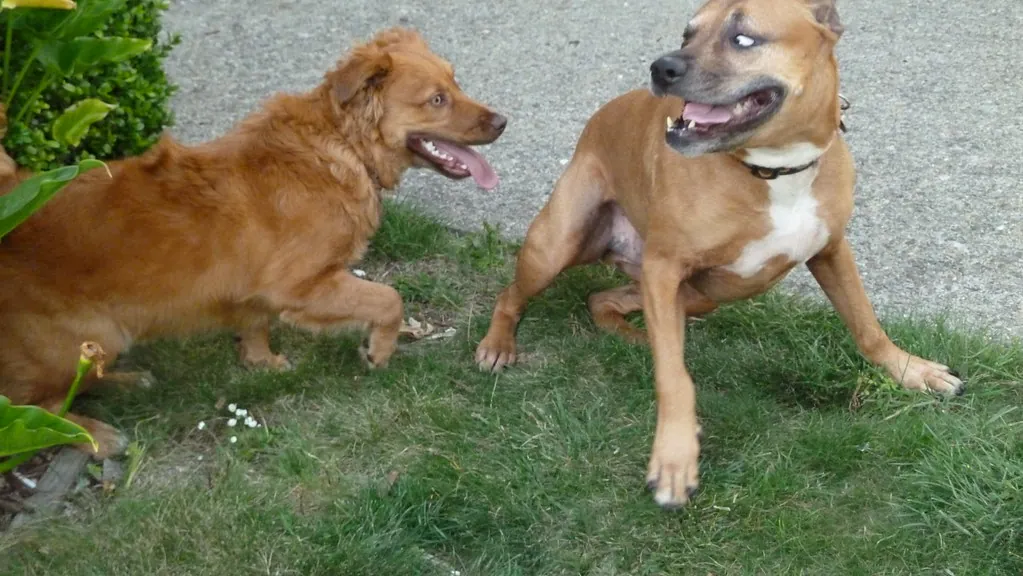
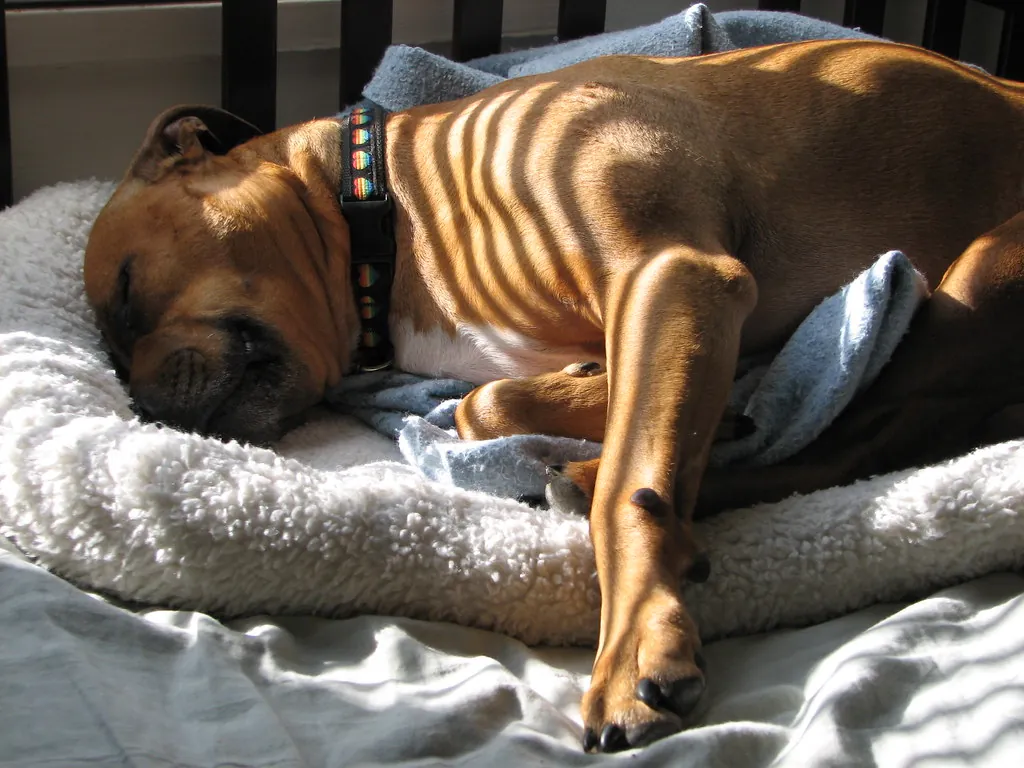
A note on our photos: every dog pictured on this page was described by its owner or shelter as a Boxer and Pit Bull mix. You’ll meet Banjo (top photo), Brooke and Mike. They show how differently the same cross can turn out.
Boxer Pitbull mix quick facts
Every figure here is for a parent breed, from that breed’s registry. None is a measurement of the mix itself.
- Also called: Bullboxer Pit, Bullboxer, Pitbull Boxer mix, Boxer Pit, Pitoxer, American Bullboxer. Informal names, not a recognized breed.
- Size (parent breeds): Boxer 23 to 25 in and 65 to 80 lb for males, 21.5 to 23.5 in for females, which the AKC says weigh about 15 lb less (AKC); American Pit Bull Terrier about 17 to 21 in and 30 to 60 lb (UKC); American Staffordshire Terrier 17 to 19 in and 40 to 70 lb (AKC). Together that’s roughly 17 to 25 inches and 30 to 80 pounds.
- Lifespan (parent breeds): 10 to 12 years for the Boxer (AKC) and 12 to 16 years for the AmStaff (AKC); the UKC’s APBT standard gives no lifespan. There is no published figure for the mix.
- Energy (AKC ratings): Boxer 4 out of 5, AmStaff 3 out of 5. Plan for an active, playful dog.
- Grooming and shedding (AKC ratings): shedding 2 out of 5 for both the Boxer and the AmStaff. Easy, short coat; Boxers rate 3 out of 5 for drooling.
- Good with young children (AKC ratings): Boxer 5 out of 5, AmStaff 3 out of 5. The UKC says APBTs “have always been noted for their love of children” (UKC). Supervise young children with any strong, bouncy dog.
- Good with other dogs (AKC ratings): 3 out of 5 for both the Boxer and the AmStaff, and the UKC says “most APBTs exhibit some level of dog aggression.” Ask about other dogs and cats dog by dog.
- Health to ask about: heart conditions (especially on the Boxer side), hips and elbows, thyroid, skin allergies, degenerative myelopathy, weight, and heat sensitivity. Details and sources below.
- Good fit for: an active person or household with time for daily exercise, training and company, and a home where a strong dog is welcome.
What a Boxer Pit Bull mix actually is
A Boxer pit mix has a Boxer on one side of the family and a pit bull-type dog on the other, sometimes several generations back. Some dogs are first-generation crosses of two purebred parents; many shelter dogs are mixes of mixes. We found no reliable record of when or where the cross was first bred, so here are the two parents.
The Boxer side
The AKC traces today’s Boxer to Germany in the late 1800s, “bred down by German dog fanciers from a larger, heavier German breed called the Bullenbeisser (‘bull biter’),” a hunting dog used to catch and hold bear, bison and wild boar. The English name, the AKC says, refers to the way the breed spars “like a prizefighter, with their front paws when playing or defending themselves.” The AKC registered its first Boxer in 1904, places the breed in its Working Group, and describes it as “active, bright, fun-loving.” Boxers have worked as police dogs, war dogs, guide dogs for the blind and watchdogs (AKC Boxer).
The breed’s national parent club is the American Boxer Club, which sets the health-testing guidelines for breeding Boxers (American Boxer Club). Our Boxer guide covers the purebred in more depth.
The pit bull side: a type, not one breed
“Pit bull” isn’t a single breed but a loose label for several related breeds and look-alike mixes. One shelter study defined “pit bull-type” as the American Pit Bull Terrier, the American Staffordshire Terrier, the Staffordshire Bull Terrier, “pit bull,” and their mixes (Olson et al., 2015).
- The American Pit Bull Terrier (APBT) is recognized by the United Kennel Club, not the AKC. The UKC says its founder registered his own APBT as UKC dog number 1 in 1898, and describes the breed as “eager to please and brimming over with enthusiasm” (UKC).
- The American Staffordshire Terrier (AmStaff) is the AKC’s closely related breed, recognized in 1936. The AKC is candid that the breed descends from long-outlawed British blood sports, and calls today’s well-bred AmStaff “a more mellow fellow than his pit-fighting ancestors” (AKC AmStaff).
For how pit bull types differ from their stockier relatives, see our American Bully vs Pit Bull guide.
Boxer pit mix vs Boxer vs pit bull vs Labrabull
Here’s how the parents compare, using registry figures and the AKC’s 1 to 5 trait ratings (5 = most), with the Labrabull (Pitbull Lab mix) alongside as another common pit bull cross. The UKC doesn’t publish trait ratings for the APBT, so the AmStaff stands in for the pit bull side on those lines. A Boxer pit mix can land anywhere between its parents on each line.
| Boxer | American Pit Bull Terrier | American Staffordshire Terrier | Boxer pit mix | Labrabull (Lab x pit) | |
|---|---|---|---|---|---|
| Registry | AKC (Working Group, 1904) | UKC (1898); not AKC | AKC (Terrier Group, 1936) | None; a mix | None; a mix |
| Height | 23 to 25 in (M), 21.5 to 23.5 in (F) | about 18 to 21 in (M), 17 to 20 in (F) | 18 to 19 in (M), 17 to 18 in (F) | Varies; parent span about 17 to 25 in | Varies; parent span about 17 to 24.5 in |
| Weight | 65 to 80 lb (M); F about 15 lb less | 35 to 60 lb (M), 30 to 50 lb (F) | 55 to 70 lb (M), 40 to 55 lb (F) | Varies; parent span about 30 to 80 lb | Varies; parent span about 30 to 80 lb |
| Life expectancy | 10 to 12 yrs | Not given in UKC standard | 12 to 16 yrs | Not studied | Not studied |
| Coat | Short, shiny, tight | Short, glossy, smooth | Short, close, stiff | Short | Short; may have a Lab’s double coat |
| Colors | Fawn or brindle, with or without white | All colors except merle | Any color; all white, mostly white, black and tan, and liver “not to be encouraged” | Many | Many |
| Affectionate with family | 4 | Not rated | 5 | Usually high | Usually high |
| Good with young children | 5 | Not rated | 3 | Varies, supervise | Varies, supervise |
| Good with other dogs | 3 | Not rated; most show some dog aggression (UKC) | 3 | Often selective; ask | Varies; ask |
| Openness to strangers | 4 | ”Extremely friendly, even with strangers” (UKC) | 4 | Usually friendly | Usually friendly |
| Energy | 4 | Not rated | 3 | Moderate to high | Moderate to high |
| Trainability | 4 | Not rated | 3 | Moderate to high | Moderate to high |
| Shedding | 2 | Not rated | 2 | Low to moderate | Low to high |
| Drooling | 3 | Not rated | 1 | Low to moderate | Low |
| Breed-club health tests | Hips, elbows, thyroid, heart (AS/SAS, Holter for cardiomyopathy, ARVC DNA test), DM DNA test | None listed in UKC standard | Hips, cardiac, thyroid, NCL DNA test | Ask the shelter or your vet | Ask the shelter or your vet |
Sources: AKC Boxer and Boxer standard, American Boxer Club testing guidelines, UKC American Pit Bull Terrier standard, AKC American Staffordshire Terrier and AmStaff standard, Staffordshire Terrier Club of America health statement, AKC Labrador Retriever. The UKC calls its APBT heights “a general and approximate guideline only.” The mix columns are simply the range between the parents, not measured data; the Labrabull column uses the Labrador’s 21.5 to 24.5 inches, 55 to 80 pounds, double coat and AKC trait ratings (AKC) as its other parent.
The biggest differences are in height and in how each side greets the world. The Boxer side is taller, more square and, per its standard, “deliberate and wary with strangers”; the pit bull side is shorter, more compact and, per the UKC, usually friendly with people. Where your dog falls on that line matters more for daily life than its coat color.
How big does a Boxer Pit Bull mix get?
Put the parents’ published ranges together and you get roughly 17 to 25 inches at the shoulder and 30 to 80 pounds. In every parent standard the female range is lower than the male’s. Many Boxer pit mixes end up in the middle, a sturdy medium-to-large dog, but one that takes after the Boxer can be tall and leggy, and one that takes after the pit bull can be compact and stocky. If size matters to you, for your lease, your car or your own strength on the leash, an adult dog lets you see it instead of guessing.
Coat, colors and looks
Both parents have short, low-maintenance coats. The AKC Boxer standard calls for a “short, tight-fitting coat” in fawn (“from light tan to mahogany”) or brindle, with or without white markings, and a “broad, blunt muzzle” with an undershot bite, where the lower jaw sticks out past the upper. The standard disqualifies show Boxers whose white markings cover more than one-third of the coat (AKC Boxer standard). The APBT’s coat is “glossy and smooth, close” and comes in “all colors and color patterns except merle” (UKC).
So a Boxer pit mix may be fawn, red, brindle, black, white, or any of those with white markings. Natural Boxer ears lie “flat and close to the cheeks in repose” (AKC Boxer standard), and the UKC allows APBT ears to be natural or cropped (UKC), so you’ll see everything from soft folded ears to cropped ones. Head shape can lean either way too: the Boxer’s “broad, blunt muzzle” and underbite, or the APBT’s head “shaped like a broad, blunt wedge” (UKC).
Temperament: what to realistically expect
These are registry descriptions of purebred parents, not predictions for any one mix.
The Boxer side. The AKC Boxer standard says that “with family and friends, his temperament is fundamentally playful, yet patient and stoical with children,” and that the Boxer is “deliberate and wary with strangers” but “responds promptly to friendly overtures honestly rendered” (AKC Boxer standard). The AKC rates the breed 5 out of 5 with young children, 4 out of 5 for affection, playfulness, openness to strangers and as a watchdog, and 3 out of 5 with other dogs. It adds that Boxers are “not always tolerant of other dogs of the same sex” (AKC Boxer).
The pit bull side. The UKC says APBTs “make excellent family companions and have always been noted for their love of children,” are “not the best choice for a guard dog since they are extremely friendly, even with strangers,” and that “aggressive behavior toward humans is uncharacteristic of the breed and highly undesirable.” The same standard is honest that “most APBTs exhibit some level of dog aggression,” and that the breed “requires an owner who will carefully socialize and obedience train the dog” (UKC). The AKC adds that dog aggression “can develop even in well-socialized” AmStaffs, and that an AmStaff “should never under any circumstances be left alone with other dogs” (AKC AmStaff).
What the science says about breed and behavior. A 2022 study in Science surveyed owners of 18,385 dogs and genotyped 2,155 of them. It found that breed explains just 9% of the behavioral variation between individual dogs (Morrill et al., 2022). In plain English: breed is a weak guide to how any one dog will behave. That’s good news if you’re adopting an adult, because you can meet the actual dog and ask about its history.
Put together, many Boxer pit mixes are clownish, affectionate, people-focused dogs. In daily life:
- Family: usually devoted and wants to be included. Neither parent breed does well shut out in the yard.
- Strangers: many greet everyone happily; some, like a watchful Boxer, bark at the door first and warm up after. Gentle, positive socialization helps either way.
- Other dogs and cats: the area to be most careful about, since both sides of the family can be selective, especially with dogs of the same sex. Ask whether this dog has lived with other animals, and introduce slowly.
- Children: many are wonderful with kids, but a strong, bouncy dog can knock over a small child or an unsteady adult. Supervise, and teach calm greetings early.
Exercise needs
Plan for an active dog. The AKC says Boxers “are very playful, high-energy dogs” that “need ample exercise every day, on leash or in a securely fenced area,” and that “the Boxer must never be allowed to run loose” (AKC Boxer). For the AmStaff, it says the breed “requires a lot of exercise,” but that leaving the dog out in the yard all day “is not the right approach,” because “the AmStaff is a people-oriented dog who thrives when he is made part of the family” (AKC AmStaff).
For most Boxer pit mixes that means daily walks plus real play: fetch, tug with rules, flirt-pole games, a dog sport, and brain work like sniff walks, food puzzles and short training games. How much a particular dog needs is something to ask the shelter or foster, who has seen it. Ask your vet before starting running or other high-impact exercise, for you or the dog.
Heat and cold. The AKC says the Boxer “does not have a high tolerance for either extreme heat or cold” (AKC Boxer). On hot days, walk early or late, bring water, and keep play gentle; on cold days, a short-coated dog may appreciate a coat.
Fencing. The UKC calls the APBT “one of the most capable canine climbers so good fencing is a must for this breed” (UKC). Walk your fence line for gaps and climbable spots, make sure gates latch on their own, and supervise yard time until you know how your dog behaves outside.
Training
The AKC rates the Boxer 4 out of 5 and the AmStaff 3 out of 5 for trainability. It says Boxers “are highly intelligent, but can become bored with repetition,” “tend to have a mind of their own,” and that “early socialization and puppy training classes are vital in channeling the breed’s energy and exuberance in a positive way.” Young Boxers, it adds, are “constantly in need of reminders” to keep all four feet on the floor (AKC Boxer). For AmStaffs, given the breed’s “strong will, physical strength, and exuberance,” the AKC calls those classes “a necessity” (AKC AmStaff).
You’ll read online that this mix needs a “firm” or “pack leader” owner. The American Veterinary Society of Animal Behavior disagrees with harsh methods: it says evidence supports reward-based methods for all dog training, that “there is no evidence that aversive training is necessary,” and it advises against intimidation techniques such as “alpha rolls” or “dominance downs” (AVSAB, 2021). Kind, consistent, reward-based training is both safer and more effective.
What works well with this mix:
- Loose-leash walking first. A strong dog that lunges is a real risk to your balance (more on that below). Practice indoors and in quiet places before busy streets, and ask a trainer about a well-fitted front-clip harness.
- “Four on the floor.” Reward sitting to say hello so a happy, springy dog doesn’t jump on visitors.
- “Leave it,” “drop it” and settling on a mat. Useful every day with a strong, mouthy, curious dog.
- Variety. Since Boxers can get bored with repetition, keep sessions short and mix in games and new tricks.
- Slow, supervised introductions to other dogs, with distance and treats.
Teenage phase. If you adopt a young dog, expect a wobble. In a study of guide-dog puppies, dogs were less likely to respond to their own carer’s “sit” at about 8 months, during adolescence, than at 5 months, and trainability scores improved again by 12 months (Asher et al., 2020). It’s a passing phase, not a failure, so keep training patient and upbeat.
Grooming
Easy. The AKC says the Boxer’s “short, shiny coat requires very little grooming,” just “a good once-over with a rubber curry-brush or a hound glove once or twice a week,” and that the Boxer “tends to be a clean dog, needing a bath only occasionally.” It recommends trimming nails at least monthly unless they wear down naturally, and brushing teeth often, daily if possible (AKC Boxer). For the AmStaff’s short coat, “a quick once-over with a soft bristle brush every week is usually enough” (AKC AmStaff). Add weekly ear checks, and keep a towel handy if your dog has inherited Boxer jowls and drools.
Diet basics
There’s no special Boxer pit diet. The AKC’s advice for both parents is the same: a high-quality food suited to the dog’s age, few table scraps, and an eye on weight, since “some dogs are prone to getting overweight” and too many treats “can cause obesity” (AKC Boxer; AKC AmStaff).
A word on grain-free food, which some breed guides recommend for this mix: since 2018 the US Food and Drug Administration has been investigating reports of dilated cardiomyopathy (a heart disease) in dogs eating certain diets, many labeled “grain-free,” and calls the possible link “a complex scientific issue that may involve multiple factors” (FDA). With heart disease already on the Boxer side’s screening list, talk to your vet before choosing a grain-free or boutique diet, and ask what a healthy weight looks like for your dog’s frame.
Health issues to know about
A mix can inherit health problems from either parent. A large University of California, Davis study found no difference between mixed-breed and purebred dogs in how often 13 inherited conditions turned up, including hip dysplasia; purebreds were more likely to have 10 others, including elbow dysplasia; and mixed-breed dogs were more likely to have a ruptured cranial cruciate ligament, a common knee injury (Bellumori et al., 2013). So being a mix may help with some conditions, but it’s no guarantee of good health.
| Condition | Which parent breed | What the source says |
|---|---|---|
| Boxer cardiomyopathy (ARVC) | Boxer | An inherited heart-rhythm disease that can cause sudden death. Washington State University researchers linked it to a deletion in the striatin gene (Meurs et al., 2010); the American Boxer Club recommends a 24-hour Holter monitor, annually for breeding dogs (ABC). |
| Aortic and subaortic stenosis | Boxer | A narrowing at the heart’s outflow valve. The AKC lists aortic stenosis among the conditions responsible breeders screen for, and the breed club recommends a stethoscope and Doppler exam (AKC; ABC). |
| Other heart disease | AmStaff | The AKC lists cardiac disease among AmStaff screening conditions, and the breed club recommends a cardiac exam (AKC; STCA). |
| Hip and elbow dysplasia | Both | The American Boxer Club recommends hip and elbow X-rays (ABC); the AKC lists hip dysplasia among AmStaff screening conditions (AKC). |
| Hypothyroidism | Both | The Boxer club recommends a thyroid panel (ABC), and the AKC lists a thyroid evaluation for AmStaffs (AKC). |
| Degenerative myelopathy | Boxer | A progressive spinal cord disease linked to a change in the SOD1 gene, found in Boxers among other breeds; early signs such as hind-leg weakness typically begin at 8 years or older (Awano et al., 2009). A DNA test is on the AKC’s Boxer screening list (AKC). |
| Certain cancers | Boxer | The AKC says responsible breeders screen their stock for “certain cancers” (AKC). |
| Skin and coat allergies | AmStaff | Listed by the AKC among AmStaff screening conditions (AKC). |
| Cerebellar ataxia (NCL) | AmStaff | An inherited disease causing a progressive loss of coordination, first appearing between ages 3 and 5; a DNA test exists (AKC). |
| Heat and cold sensitivity | Boxer | The AKC says the Boxer “does not have a high tolerance for either extreme heat or cold” (AKC). |
The UKC’s APBT standard doesn’t list health tests, so the pit bull-side health information above comes from the AmStaff’s registry and breed club.
What this means day to day: ask your vet to listen carefully to your dog’s heart at every checkup, and ask whether a heart-rhythm screen makes sense for a dog with Boxer heritage. Mention fainting, sudden weakness, coughing or tiring easily right away. Keep your dog lean, avoid hot-weather exertion, and mention stiffness, limping, lumps or a wobbly back end early. Adopting? You may not have parent test results, and that’s fine. Get the shelter’s vet records, book a checkup soon after adoption, and share this list with your vet.
Lifespan
No study has measured this mix’s lifespan, so any single number you see online is a guess. As a frame of reference, the AKC lists 10 to 12 years for Boxers (AKC) and 12 to 16 years for AmStaffs (AKC); the UKC’s APBT standard gives no figure. Boxer pit mixes can make lovely senior dogs. Heart checks, weight, joint care, dental care and regular checkups shape any one dog’s years more than its breed label.
Boxer Pit Bull mix puppies
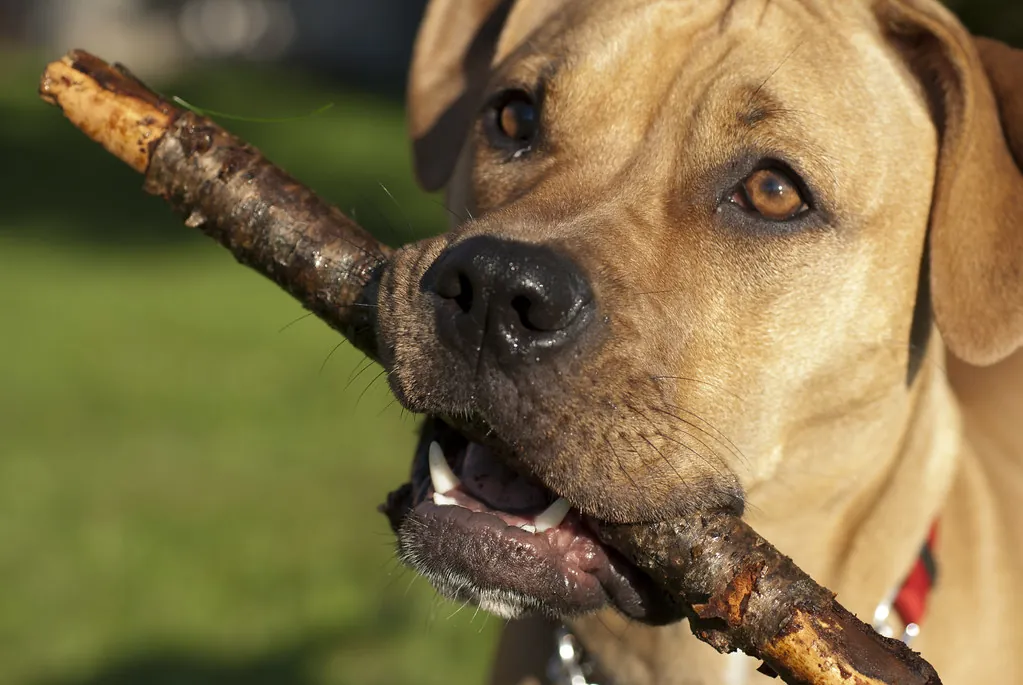
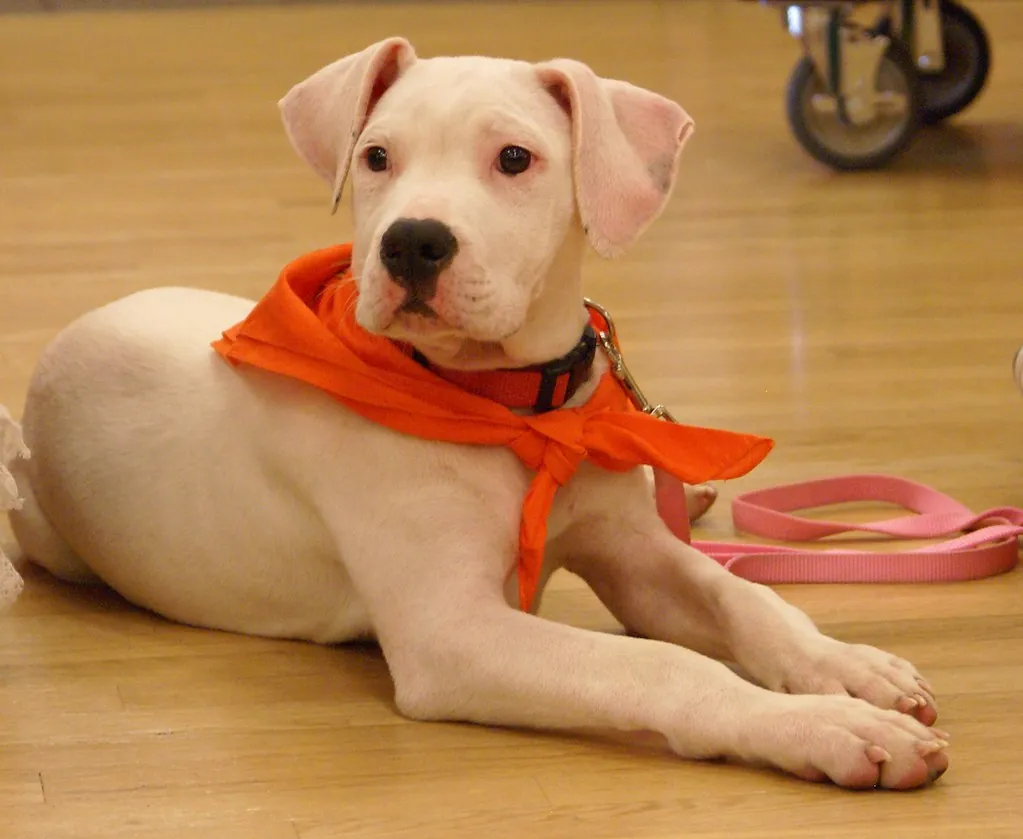
A puppy’s adult size, coat and temperament are especially hard to predict, since you’re guessing from two parents who may themselves be mixes. Brooke, below, was described by her owner as a Boxer and Pit Bull mix. Compare her puppy photo with the young dog holding a stick in the exercise section above: same dog, a few months apart.

Puppies also mean house training, chewing, the teenage phase above, and months of socialization and puppy classes before you know who the adult will be. There’s no breed club or health-testing program for this cross, so be cautious with anyone selling “Bullboxer puppies.” Ask to meet the mother, ask which health tests both parents have had (the parent clubs’ lists are in the table above, and heart testing matters most on the Boxer side), and be wary of claims that the mix is “healthier” than either parent. For many people, especially first-time owners or anyone over 50, an adult from a shelter or foster home is the easier path.
Is that shelter dog really a Boxer pit mix?
Maybe, maybe not. Shelter breed labels are usually a staff member’s best guess from looks, and the research on those guesses is humbling:
- In a University of Florida study across four shelters, staff labeled 52% of 120 dogs as pit bull-type by sight, but DNA identified only 21% as pit bull-type, and the authors concluded visual identification “was unreliable” (Olson et al., 2015).
- In a US and UK survey, shelter workers disagreed widely about which dogs were pit bulls (Hoffman et al., 2014).
- Arizona State researchers found a pit bull label changed how adopters saw a dog and how long it waited, and that removing kennel breed labels is a low-cost way to improve outcomes (Gunter et al., 2016).
The takeaway: meet the dog, not the label. A dog with a Boxer’s muzzle and a pit bull’s chest could be this cross, or it could have Mastiff, Bulldog, Labrador or something else entirely in the mix. A DNA test can satisfy your curiosity later; our guide to figuring out your dog’s breed explains the options.
Is a Boxer pit mix right for me? A quick checklist
Written with adopters over 50 in mind. A few “no” answers don’t rule you out; they tell you what to plan for, or which dog to ask about.
- Yes / No: I (or someone in my home) can give a dog an active walk and play every day, in the amount the shelter or foster says this dog needs.
- Yes / No: I can comfortably hold a strong 50 to 70 pound dog on a leash, or I’m willing to use a front-clip harness and practice loose-leash walking first.
- Yes / No: My yard is securely fenced with nothing to climb, or I’m happy to keep the dog leashed outdoors every time.
- Yes / No: Someone is home much of the day, or I can arrange a walker or daycare on long days.
- Yes / No: I’m comfortable introducing a new dog slowly to any dogs or cats at home, or I live without other pets.
- Yes / No: I can keep a short-coated dog cool in summer and warm in winter.
- Yes / No: I’m ready for regular vet checkups, including heart checks, and I’ve priced insurance or set aside an emergency fund.
- Yes / No: I’ve checked my lease, HOA and homeowner’s or renter’s insurance for breed rules (see the checklist below).
- Yes / No: I’ve thought about who would care for this dog if I ever couldn’t.
A Boxer pit mix may suit you if you’re active, home a lot, enjoy training and play, and want a goofy, affectionate dog that wants to be part of your day.
Consider a calmer or smaller dog if your balance or grip isn’t what it used to be and a strong, springy dog would be a fall risk, if the dog would be alone most of the day, or if you have a busy home with other dogs and the dog you’re considering is selective. The AKC itself says a Boxer “may not be the best choice for a very frail adult” (AKC Boxer). An older, mellow adult that a foster knows to be leash-trained can be the exception.

A word on leash safety
This isn’t a reason to skip a strong dog, but it’s worth planning for. A University of Pennsylvania study estimated that fractures among Americans 65 and older linked to walking leashed dogs rose from about 1,671 in 2004 to 4,396 in 2017, mostly in women, and the authors suggested obedience training so dogs don’t lunge on walks (Pirruccio et al., 2019). Practical steps: walk the dog yourself before adopting, use a harness rather than wrapping the leash around your wrist, wear good shoes, and start in quiet places.
Before you adopt: housing, insurance and breed-law checklist
Because visual breed labels are unreliable (Olson et al., 2015), a dog with any pit bull-type look may be treated as a pit bull by a landlord, insurer or local rule. Check these before you fall in love:
- Local laws. Ask your city or county animal services whether any breed-specific rules apply where you live, and where you might move.
- Your lease or HOA. Read the pet policy for breed, size or weight limits, and get approval in writing.
- Homeowner’s or renter’s insurance. Ask your insurer directly whether the policy excludes or surcharges certain breeds or mixes, and how it decides a dog’s breed.
- Senior or retirement communities. If you live in one, or may later, check its pet rules now.
The ASPCA opposes breed-specific laws. Its position statement notes that the US Centers for Disease Control and Prevention has recommended against them, and cites the difficulty of identifying breeds, especially in mixed-breed dogs (ASPCA).
Costs to plan for
We found no reliable cost figures for this mix specifically, and we don’t quote puppy prices. The ASPCA’s 2021 estimate for a dog is $1,391 a year, and $3,221 for the first year once one-time costs are included (ASPCA). Budget for:
- Adoption fee, which at shelters and rescues often includes vaccines, a microchip and spay or neuter surgery. Ask what’s included.
- Food for a medium-to-large, active dog.
- Routine vet care: exams, vaccines, parasite prevention, dental care, and any heart screening your vet recommends.
- Pet insurance or an emergency fund. With heart disease and joint problems on the parent-breed lists, it’s worth pricing insurance before any condition becomes pre-existing. Some insurers apply breed rules, so ask.
- Training classes and gear: a front-clip harness, a sturdy crate, durable toys, a coat for cold weather, and care when you’re away.
Adopting a Boxer Pit Bull mix
Where to look
Start with shelters and rescues, and search for “Boxer mix,” “Pit Bull mix,” “Terrier mix” and “Bulldog mix,” since labels are often a guess. Boxer rescues and pit bull rescues sometimes list mixes too. Foster-based rescues are especially helpful, because a foster family can tell you how the dog behaves in a real home.
Questions to ask the shelter or rescue
The ASPCA suggests leaning on shelter staff “to help play matchmaker” and making sure the dog’s personality fits your lifestyle (ASPCA). For a Boxer pit mix, ask:
- How does the dog walk on a leash? Does it jump up when excited? Can I walk it myself before deciding?
- How does it react to strangers, visitors and the doorbell?
- How has it done with other dogs (including dogs of the same sex), cats and children? In playgroups, a foster home, or only in the kennel?
- Any history of guarding food or toys, or of a bite or scuffle? What happened?
- How does it handle being left alone, and being handled for nail trims, brushing and baths?
- Has it ever escaped or climbed a fence?
- Has a vet listened to its heart? Any known heart murmur, fainting, skin, ear, joint or weight issues? What do the vet records show?
- Is there a foster-to-adopt or trial period, and what happens if it doesn’t work out?
Our list of 9 questions to ask when adopting a dog covers the general ones.
Give your dog a backup plan
A healthy Boxer pit mix may be with you for a decade or more. Naming a backup caregiver now, someone who knows your dog and has agreed to step in, helps make sure your dog never has to go back to a shelter. Our guide What Happens to Your Dog When You Die walks you through it, and the free My Dog’s Backup Plan worksheet records your dog’s routine, vet, quirks and favorite things, so the person who steps in knows exactly how to care for them.
Similar dogs to compare
If you’re weighing a Boxer pit mix, these related guides may help:
- Pitbull Lab mix, the Labrabull, a Labrador and pit bull cross.
- Shepherd and Pitbull mix and Pitsky, two more pit bull crosses.
- Boxer Lab mix, Husky Boxer mix, Boxer Beagle mix and Boweimar, four more Boxer crosses.
- American Bully vs Pit Bull and our Boxer guide, for each side of the family.
- Rottweiler Pitbull mix, the Pitweiler, another strong, short-coated pit bull cross.
- Pitbull and Chihuahua mix, the Chipit, a pit bull cross whose size is hard to predict.
Frequently Asked Questions
What is a Boxer pitbull mix called?
You’ll see Bullboxer Pit, Bullboxer, Pitbull Boxer mix, Boxer Pit, Pitoxer and American Bullboxer. These are informal nicknames. The AKC and UKC don’t recognize the cross, and there is no breed standard for it, so looks, size and temperament vary from dog to dog.
Are Boxer dogs a bully breed?
“Bully breed” is an informal label, not a registry category. The AKC places the Boxer in its Working Group, but its history overlaps with the bull breeds: the AKC says the Boxer was bred down from the German Bullenbeisser (“bull biter”), was once used for bullbaiting like all dogs of its type, and is a cousin to practically all Bulldog-type breeds (AKC Boxer). So many people do count the Boxer as a bully breed.
At what age does a pitbull calm down?
There’s no study that sets an age for pit bulls or Boxer pit mixes, and every dog is different. Research on young dogs found a dip in responsiveness to their owner at about 8 months, during adolescence, that improved again by 12 months (Asher et al., 2020). The AKC also notes young Boxers constantly need reminders to keep all four feet down (AKC Boxer). Steady exercise and reward-based training help at every age, and an adult dog lets you see its energy level before you adopt.
How big does a Boxer Pit Bull mix get?
There is no official size for the mix. The parent breeds together span about 17 to 25 inches at the shoulder and 30 to 80 pounds: the AKC lists Boxers at 21.5 to 25 inches and about 50 to 80 pounds, with females roughly 15 pounds lighter than males (AKC), and the UKC gives American Pit Bull Terriers about 17 to 21 inches and 30 to 60 pounds (UKC). Most land somewhere in that span, and an adult dog lets you see the size instead of guessing.
How long do Boxer pit mixes live?
No study has measured the mix’s lifespan. The AKC lists 10 to 12 years for Boxers (AKC) and 12 to 16 years for the American Staffordshire Terrier, a close relative of the American Pit Bull Terrier (AKC); the UKC’s APBT standard gives no figure. Heart screening, a healthy weight and regular vet care shape any one dog’s years more than its label.
Are Boxer Pit Bull mixes good family dogs?
Many are. The AKC standard describes the Boxer as playful yet “patient and stoical with children” (AKC Boxer standard), and the UKC says American Pit Bull Terriers make excellent family companions (UKC). Both parents are strong and bouncy, and both registries say some dogs are not tolerant of other dogs, so supervise children, introduce other pets slowly, and ask the shelter how this dog has done with kids and animals.
Do Boxer Pit Bull mixes shed?
A little, all year. The AKC rates both the Boxer and the American Staffordshire Terrier 2 out of 5 for shedding, and both have short, smooth coats that need only a weekly brush (AKC Boxer; AKC AmStaff). Boxers rate 3 out of 5 for drooling, so a dog that takes after that side may leave some slobber too.
Before you go
Whatever its kennel card says, the Boxer pit mix in front of you is one specific dog with its own history and quirks, so weigh what you learn about that dog more heavily than anything on this page. And whatever dog you bring home, it’s worth deciding now who would step in for them if you ever couldn’t.
Sources
- American Kennel Club, Boxer breed page (height, weight, life expectancy, trait ratings, history, exercise, training, grooming, nutrition, health and recommended screening) and Official Standard of the Boxer (2005)
- American Boxer Club, Testing and Reporting Guidelines (health statement hosted by the AKC)
- American Kennel Club, American Staffordshire Terrier breed page (height, weight, life expectancy, trait ratings, history, temperament, exercise, training, grooming, nutrition, health and recommended screening)
- American Kennel Club, Labrador Retriever breed page (height and weight, for the Labrabull comparison)
- American Kennel Club, Official Standard of the American Staffordshire Terrier (colors)
- United Kennel Club, American Pit Bull Terrier breed standard
- Staffordshire Terrier Club of America, Health Statement
- Meurs KM et al. (2010). Genome-wide association identifies a deletion in the 3’ untranslated region of striatin in a canine model of arrhythmogenic right ventricular cardiomyopathy. Human Genetics 128(3):315-24.
- Awano T et al. (2009). Genome-wide association analysis reveals a SOD1 mutation in canine degenerative myelopathy that resembles amyotrophic lateral sclerosis. PNAS 106(8):2794-9.
- Bellumori TP et al. (2013). Prevalence of inherited disorders among mixed-breed and purebred dogs: 27,254 cases (1995-2010). JAVMA 242(11):1549-55.
- Morrill K et al. (2022). Ancestry-inclusive dog genomics challenges popular breed stereotypes. Science 376(6592):eabk0639.
- Asher L et al. (2020). Teenage dogs? Evidence for adolescent-phase conflict behaviour and an association between attachment to humans and pubertal timing in the domestic dog. Biology Letters 16(5):20200097.
- Olson KR et al. (2015). Inconsistent identification of pit bull-type dogs by shelter staff. The Veterinary Journal 206(2):197-202.
- Hoffman CL et al. (2014). Is that dog a pit bull? A cross-country comparison of perceptions of shelter workers regarding breed identification. Journal of Applied Animal Welfare Science 17(4):322-39.
- Gunter LM et al. (2016). What’s in a name? Effect of breed perceptions & labeling on attractiveness, adoptions & length of stay for pit-bull-type dogs. PLOS ONE 11(3):e0146857.
- Pirruccio K et al. (2019). Fractures in elderly Americans associated with walking leashed dogs. JAMA Surgery 154(5):458-459.
- American Veterinary Society of Animal Behavior, Position Statement on Humane Dog Training (2021)
- US Food and Drug Administration, Investigation into potential link between certain diets and canine dilated cardiomyopathy
- ASPCA, Position Statement on Breed-Specific Legislation, Cutting Pet Care Costs (2021 cost update) and Finding your Fido: tips for adopting your new BFF
- Photos: Flickr photographers credited under each image, all under Creative Commons licenses. Full license records are kept in this site’s image-credits file.