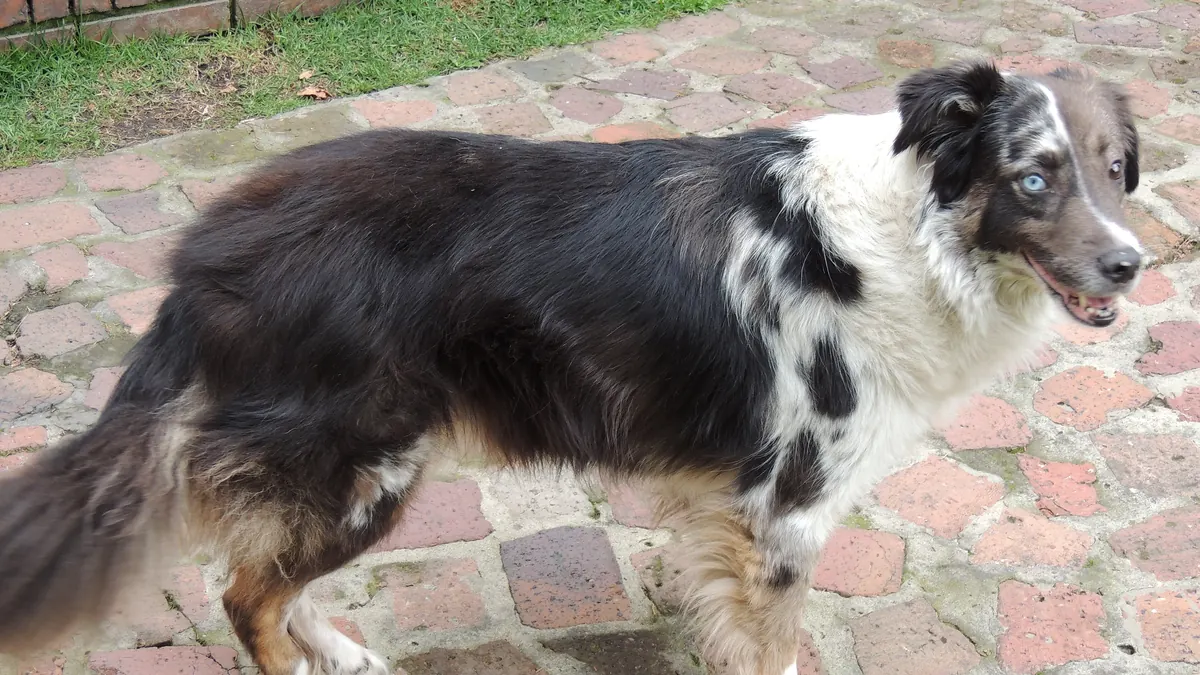

A Border Collie Australian Shepherd mix, usually called a Border Aussie, is a cross between two herding breeds. Expect a medium-sized, very smart, very busy dog of roughly 30 to 65 pounds that sheds moderately, bonds closely with its people and needs real exercise plus brain work every day. It isn’t a recognized breed, so looks and temperament vary from dog to dog.
If you’ve met one at a shelter, or someone has offered you an “Aussie/Border Collie mix,” this guide is for you. Below is what the AKC, the UKC, breed rescues and veterinary researchers say about each parent breed, the realistic range of what you might get, the merle coat question, a sample weekly plan and a frank fit checklist.
Border Aussie quick facts
Every figure here is for a parent breed, from its registry or a cited study. None is a measurement of the mix itself.
- Also called: Border Aussie, Border-Aussie, Aussieollie (petMD; Dog Breed Info). Informal names, not a recognized breed.
- Size (parent breeds): Border Collie 18 to 22 in and 30 to 55 lb (AKC); Australian Shepherd 18 to 23 in and 40 to 65 lb (AKC).
- Lifespan (parent breeds): 12 to 15 years for both (AKC Border Collie; AKC Australian Shepherd). Not documented for the mix.
- Energy (AKC ratings): 5 out of 5 for both parents.
- Mental stimulation needs (AKC ratings): 5 out of 5 for both. Brain work matters as much as miles.
- Grooming: double coat; AKC shedding rating 3 out of 5 for both. Weekly brushing, more in shedding season.
- Good with young children (AKC ratings): 5 for the Aussie, 3 for the Border Collie, which the AKC says does best with older, well-behaved children because it tends to herd people.
- Good with other dogs (AKC ratings): 3 out of 5 for both. Ask dog by dog.
- Health to ask about: hips, eyes (cataracts, collie eye anomaly), epilepsy, deafness, an MDR1 drug sensitivity gene, and double-merle risks if both parents were merle. Sources below.
- Good fit for: an active person or household that enjoys training, is home much of the day and wants a dog to do things with.
What’s in a name, and where the cross comes from
PetMD calls the mix the Border Aussie and describes it as “a relatively new crossbreed” that “is variable in both appearance and temperament and has no set standard” (petMD). Dog Breed Info lists the name Aussieollie and notes that several designer-dog registries list the cross; none of these are the AKC or UKC (Dog Breed Info). We couldn’t find a reliable record of when the two breeds were first crossed on purpose, so we don’t guess.
What the two parents share is a history. In the AKC’s telling, the Australian Shepherd descends from Basque shepherds’ dogs that were “refined… with judicious crosses to Australia’s British imports, Collies and Border Collies, among them” before the Basques moved on to California (AKC Australian Shepherd). So a Border Aussie is, in a sense, two branches of the same family tree meeting again. That’s one reason the two parents look and act alike, and why a shelter guess between “Border Collie,” “Aussie” and “mix” can be hard. For the purebred parent on its own, see our Australian Shepherd breed guide.
The Border Collie side
The AKC traces the Border Collie to herding dogs of the hills of Scotland and Wales and says Borders have dominated competitive sheepdog trials in the British Isles for more than a hundred years. The breed joined the AKC Herding Group in 1995. Its intense gaze, the “herding eye,” is a breed hallmark, and the AKC says having a job “is key to Border happiness” (AKC Border Collie). Our smartest dog breeds roundup covers the breed’s reputation for brains.
The Australian Shepherd side
Despite the name, the AKC calls the Aussie “a European breed perfected in California by way of Australia,” the cowboy’s herding dog of choice, recognized by the AKC in 1991. It says Aussies “exhibit an irresistible impulse to herd, anything: birds, dogs, kids,” and that “this strong work drive can make Aussies too much dog for a sedentary pet owner” (AKC Australian Shepherd). Two other Aussie crosses on this site are the Aussiedoodle and the Aussie Bernese.

Border Aussie vs Border Collie vs Australian Shepherd vs Mini American Shepherd vs Shollie
Registry figures and the AKC’s 1 to 5 trait ratings (5 = most). We added the Miniature American Shepherd (the AKC name for the breed once called the Miniature Australian Shepherd) because small Aussie-type dogs are often mixed up with Border Aussies, and the German Shepherd Border Collie mix (Shollie) because it’s the other common Border Collie herding cross. The two mix columns are ranges between parents, not measured data.
| Border Collie | Australian Shepherd | Miniature American Shepherd | Border Aussie (BC x Aussie) | Shollie (GSD x BC) | |
|---|---|---|---|---|---|
| AKC recognized | 1995 | 1991 | 2015 | Not a recognized breed | Not a recognized breed |
| Height | 19 to 22 in (M), 18 to 21 in (F) | 20 to 23 in (M), 18 to 21 in (F) | 14 to 18 in (M), 13 to 17 in (F) | Varies; parent span 18 to 23 in | Varies; parent span 18 to 26 in |
| Weight | 30 to 55 lb | 50 to 65 lb (M), 40 to 55 lb (F) | 20 to 40 lb | Varies; parent span 30 to 65 lb | Varies; parent span 30 to 90 lb |
| Life expectancy | 12 to 15 yrs | 12 to 15 yrs | 12 to 13 yrs | Not studied | Not studied |
| Coat | Double; rough or smooth | Double, medium length | Double, medium length | Double; varies | Double; varies |
| Merle possible | Yes | Yes | Yes | Yes, if a parent carries it | Not from the GSD side |
| Affectionate with family | 5 | 3 | 5 | Not rated | Not rated |
| Good with young children | 3 | 5 | 5 | Not rated; supervise | Not rated; supervise |
| Good with other dogs | 3 | 3 | 5 | Not rated; ask | Not rated; ask |
| Openness to strangers | 4 | 3 | 3 | Not rated | Not rated |
| Energy | 5 | 5 | 5 | Not rated | Not rated |
| Trainability | 5 | 5 | 5 | Not rated | Not rated |
| Mental stimulation needs | 5 | 5 | 5 | Not rated | Not rated |
| Barking | 4 | 3 | 3 | Not rated | Not rated |
| Shedding | 3 | 3 | 3 | Not rated | Not rated |
| Coat grooming | 3 | 2 | 3 | Not rated | Not rated |
| MDR1 mutation, approx. frequency | Rare (1 in 236 in one study) | 50% | 50% (listed as Mini Aussie) | Herding breed crosses: 10% | Herding breed crosses: 10% |
Sources: AKC Border Collie, AKC Australian Shepherd, AKC Miniature American Shepherd, AKC on merle, WSU MDR1, Alves et al., 2011; Shollie figures from our GSD Border Collie mix guide and the AKC German Shepherd page.
The pattern to notice: on energy, trainability and mental stimulation every column says 5, even the small one. A Border Aussie has no laid-back parent. Where the parents differ is in comfort with young children (Aussie higher), barking (Border Collie higher) and how often the MDR1 drug-sensitivity gene turns up (much more common in Aussies). Two littermates could feel quite different to live with.
How big do Border Collie Aussies get?
Put the parents’ AKC ranges together and you get roughly 18 to 23 inches at the shoulder and 30 to 65 pounds (AKC Border Collie; AKC Australian Shepherd). PetMD gives the same 30 to 65 pound span for the mix (petMD). Females usually run smaller: the AKC’s Aussie range is 50 to 65 pounds for males and 40 to 55 for females.
Because both parents are medium-sized, Border Aussies vary less in size than many mixes. The exception is a dog with a Miniature American Shepherd parent, which can be much smaller (the AKC lists 20 to 40 pounds for that breed) (AKC Miniature American Shepherd). If size matters for your car, your lease or your strength on the leash, adopt an adult and see exactly what you’re getting.
Coat, colors, eyes and ears
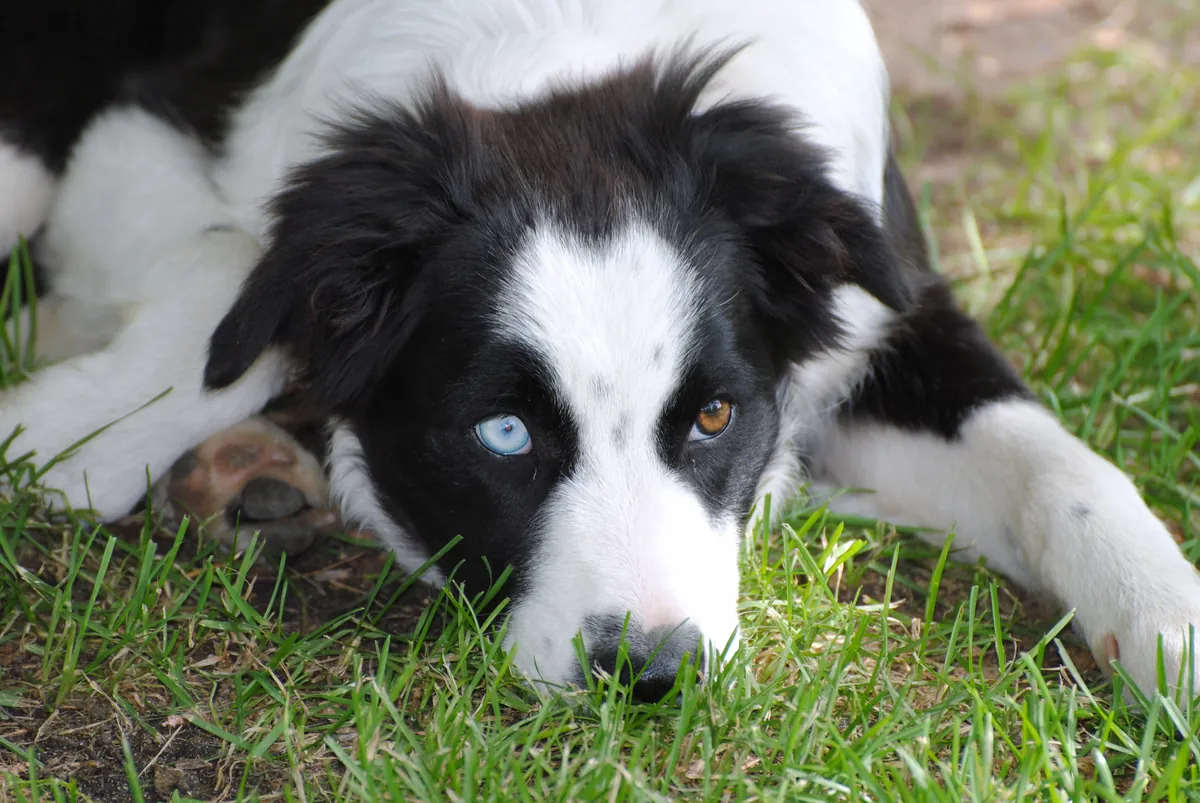
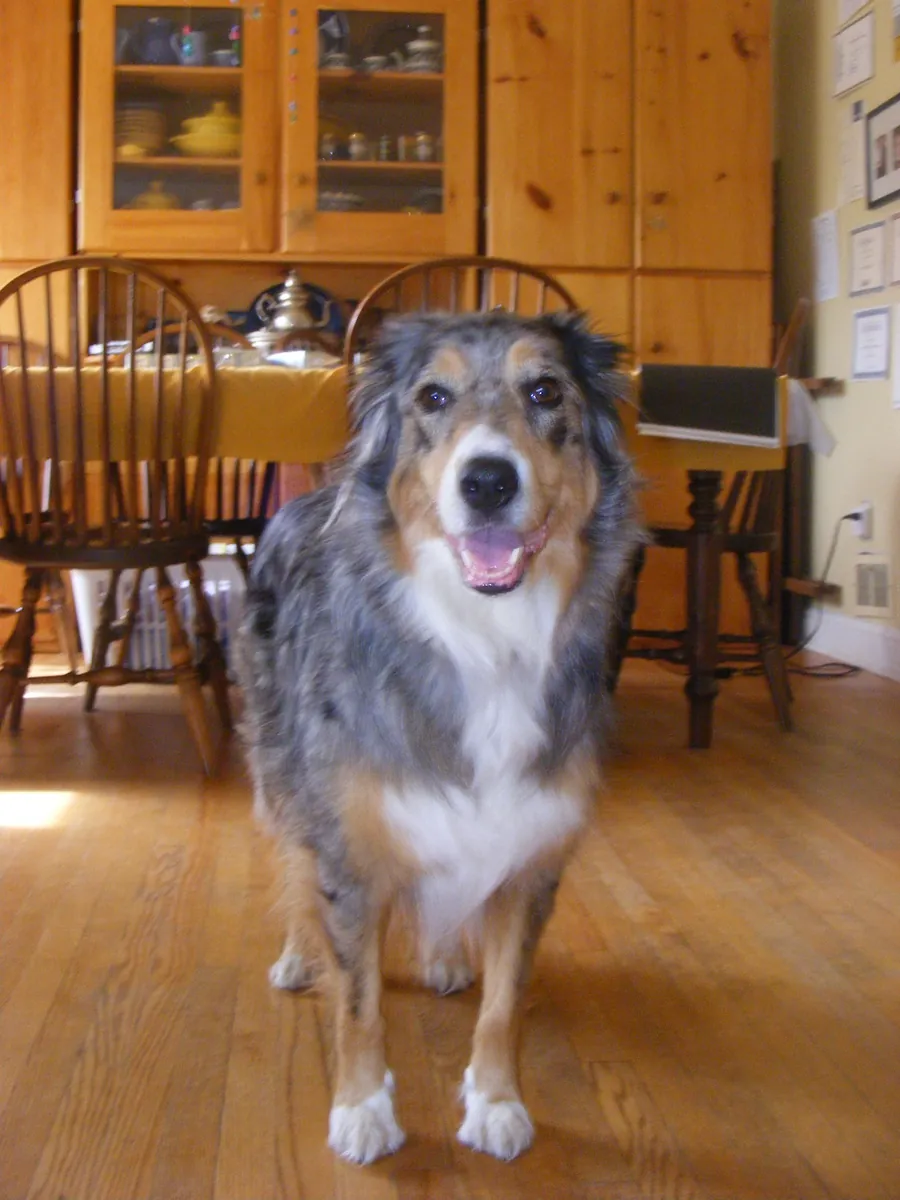
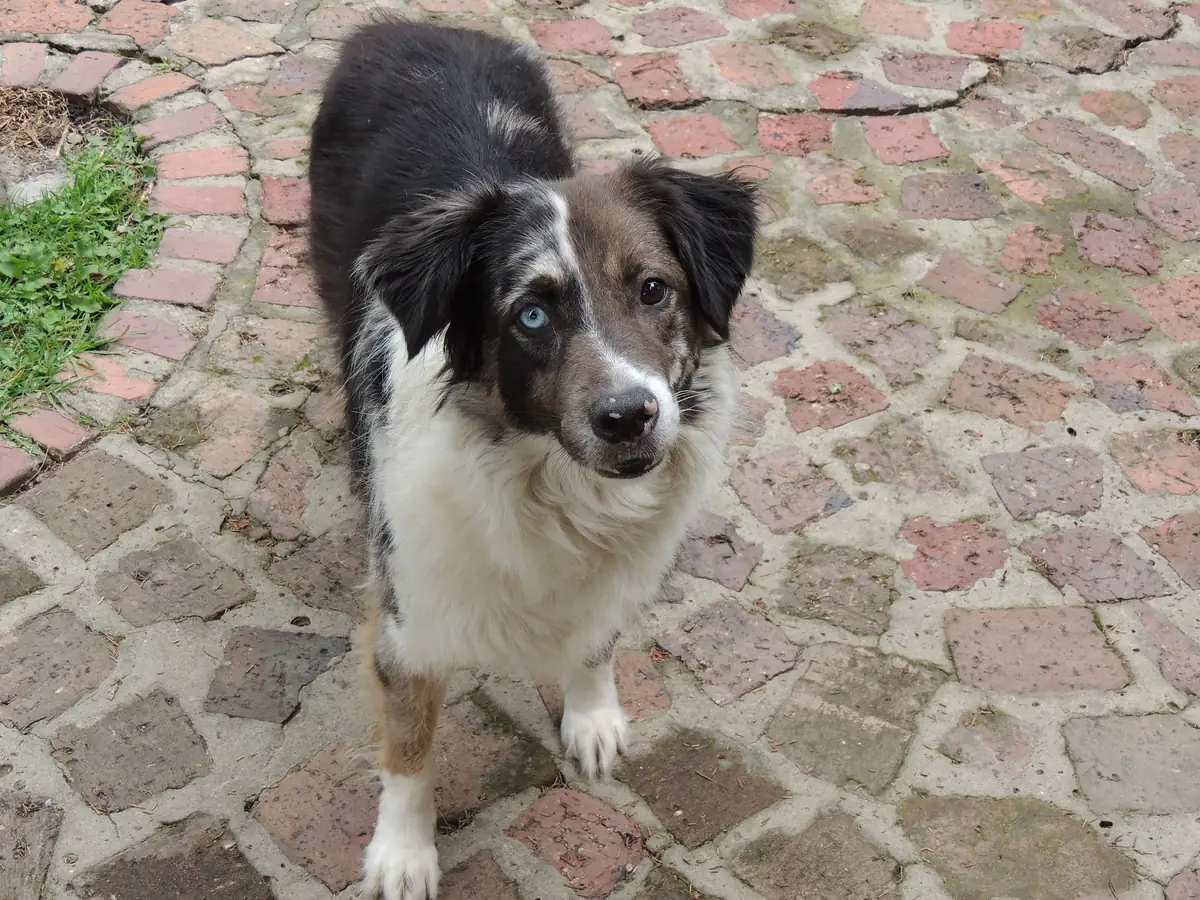
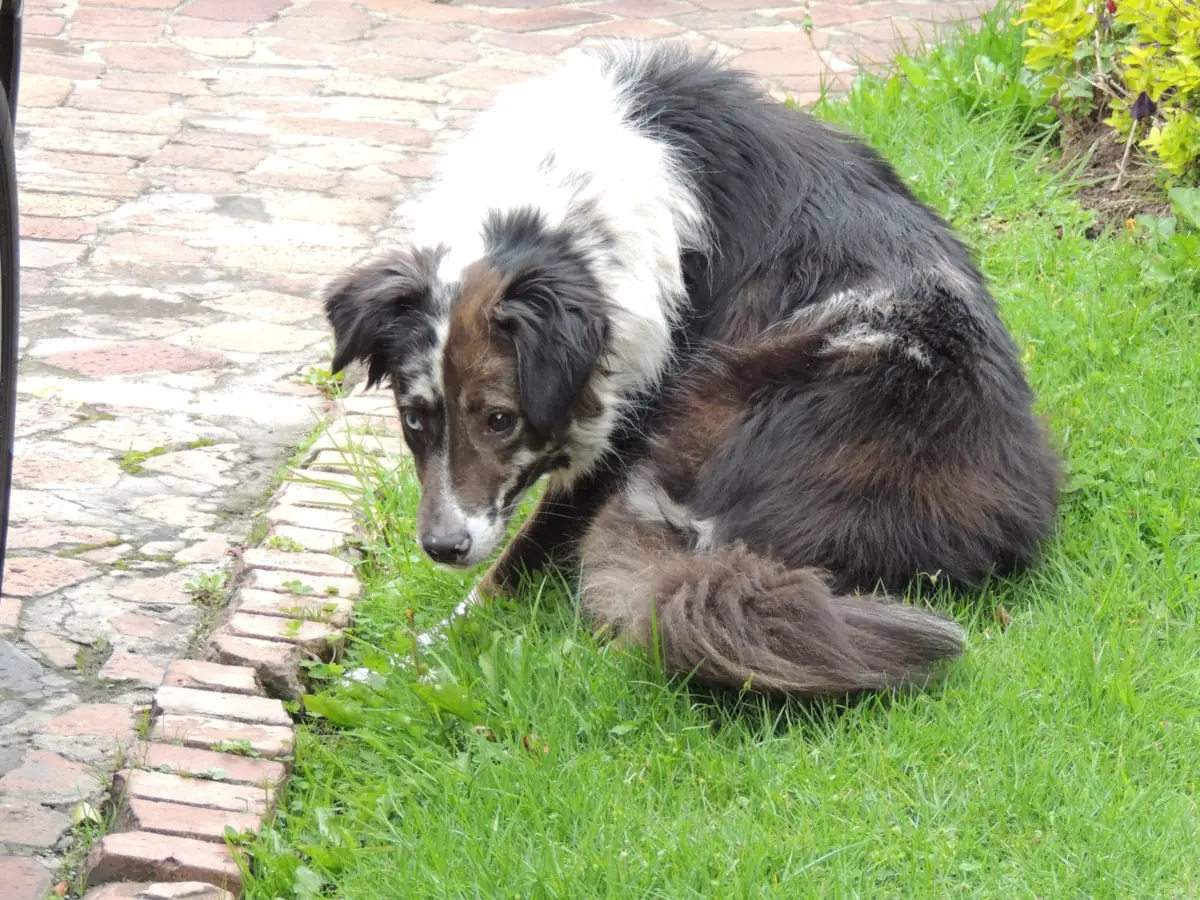
Both parents have dense double coats. The Border Collie comes in a medium-length feathered “rough” coat and a shorter, coarser “smooth” coat, in many colors and patterns (AKC Border Collie). The UKC’s Australian Shepherd standard recognizes blue merle, red merle, solid black and solid red, each with or without white markings and tan points (UKC Australian Shepherd). A Border Aussie can land anywhere in that range: black and white like a classic Border Collie, a tricolor, or a merle like the dog at the top of this page.
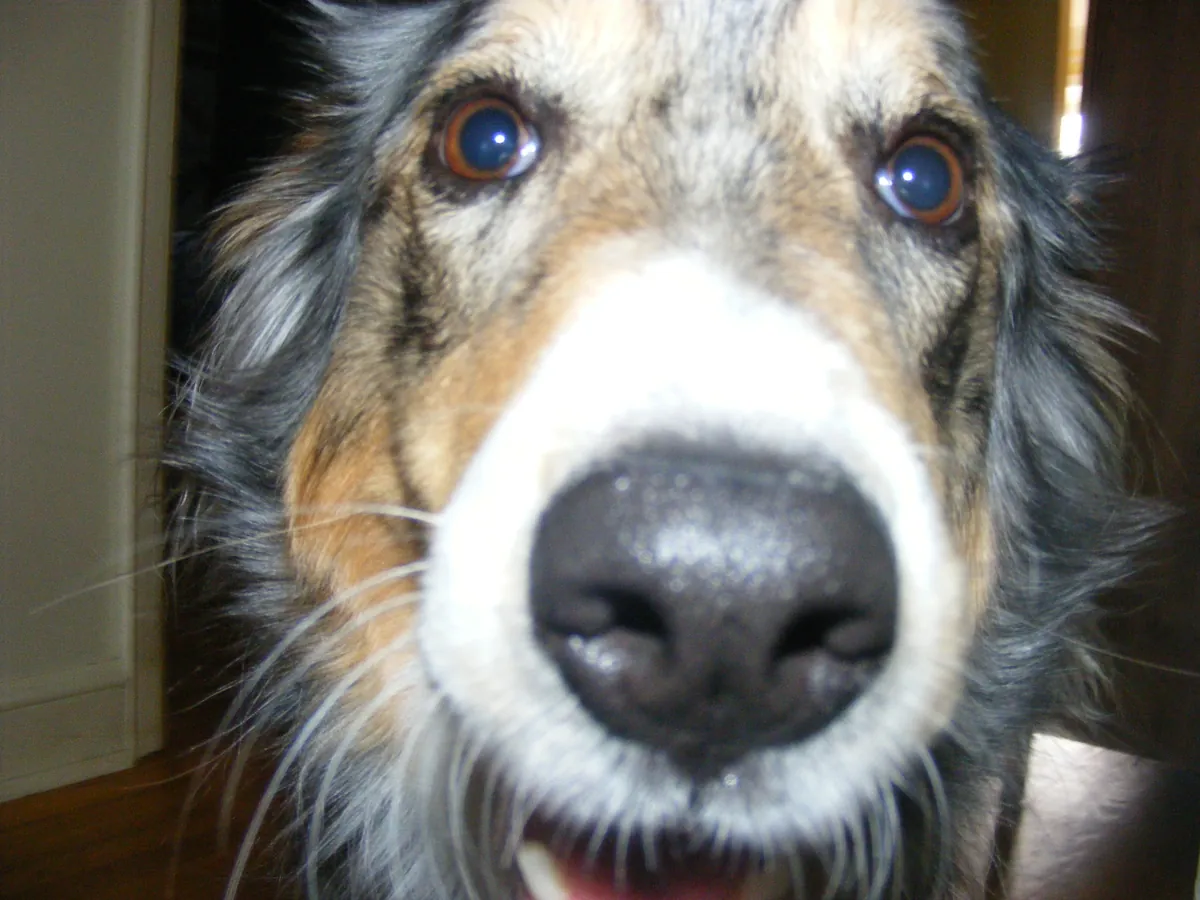
Eyes. The UKC Aussie standard allows “brown, blue, amber, or any variation or combination including flecks and marbling” (UKC Australian Shepherd), so odd eyes, like those of several dogs on this page, are common in the mix. In a study of 153 merle dogs, deafness wasn’t significantly linked to eye color (Strain et al., 2009). A blue eye isn’t a health problem by itself.
Ears. A Border Collie’s ears “may be carried drop, semi-erect or prick, and need not be matching” (UKC Border Collie); the Aussie standard calls for ears that “break slightly forward” (UKC Australian Shepherd). Expect anything in between.
Tail. The UKC lists a “natural or docked bobtail” as an identifying Aussie trait (UKC Australian Shepherd), so some Border Aussies have short tails and many have a full Border Collie tail.

Merle: the coat question every Border Aussie adopter should ask
Merle is the mottled coat pattern seen in many Aussies and some Border Collies; the AKC lists both breeds among those where merle is found (AKC on merle). One copy of the merle gene gives the pattern. Two copies, a “double merle,” can come from breeding two merle dogs, and the AKC says such a mating will on average produce a quarter double-merle puppies. It notes these dogs often have much more white, and that double merles can have deafness and small, poorly working eyes. Its advice: “it’s best to avoid breeding a merle to a merle” (AKC on merle).
The numbers from a study of 153 merle dogs tested by brainstem hearing tests (Strain et al., 2009):
- Single merles: 2.7% deaf in one ear, 0.9% deaf in both.
- Double merles: 10% deaf in one ear, 15% deaf in both.
What this means for you: a merle Border Aussie with ordinary amounts of white is very likely a single merle. If a puppy is mostly white, or both parents were merle, ask whether hearing (a BAER test) and eyes have been checked. Deaf dogs can make wonderful companions, but they need hand-signal training and an owner who has planned for it, so it’s better to know before you commit.
Temperament: what to realistically expect
These are registry and rescue descriptions of the purebred parents, not predictions for any one mix.
The Border Collie side. The AKC says Border Collies love their families “but may be somewhat reserved with strangers” (AKC Border Collie). New England Border Collie Rescue (NEBCR) is blunt: Border Collies “are not cuddly, couch-potato dogs,” don’t do well left alone for long hours, and have an urge to gather a flock that “could be sheep, children, cats, squirrels, or anything that moves, including cars.” The instinct “to nip, nudge, and bark,” it says, can’t be trained out, only directed (NEBCR).
The Australian Shepherd side. The AKC calls Aussies “remarkably intelligent, quite capable of hoodwinking an unsuspecting novice owner,” says they bond strongly to their families and “can be territorial and overprotective of their owners’ property,” and warns they “can become destructive if left without companionship for long periods too often” (AKC Australian Shepherd).
About the mix. PetMD says properly socialized Border Aussies “can get along well with people of all ages and other pets,” but that without training or enough stimulation their herding instincts can be turned on other animals and kids, and they “can also take time to warm up to new people” (petMD).
What the science says about breed and behavior. A 2022 study in Science surveyed owners of 18,385 dogs and genotyped 2,155. Breed explained just 9% of the behavioral differences between individual dogs (Morrill et al., 2022). The label is a weak guide to the dog in front of you.
In daily life:
- Family: expect a shadow who follows you room to room.
- Strangers: some Border Aussies will be friendly, others reserved or watchful. Let the dog choose to approach.
- Children: herding dogs may chase and nip at running children; the AKC says Border Collies do best with older, well-behaved children (AKC Border Collie). If grandchildren visit, plan for supervision and a quiet place for the dog.
- Other pets: stalking, staring and chasing are normal herding behaviors and need watching around cats and small dogs.

Exercise needs: a realistic weekly plan
Be honest with yourself here. The AKC says an Australian Shepherd “needs a great deal of exercise on a daily basis” and should have a large, fenced-in area to run in “for at least an hour or two daily” (AKC Australian Shepherd). It says a Border Collie needs “daily exercise beyond just a walk around the block or a quick romp in the yard” and calls it “a breed for an active owner” (AKC Border Collie). PetMD puts the mix at one to two hours of mental and physical exercise a day (petMD).
That doesn’t have to mean running. NEBCR says a brisk walk or a game of fetch every day “isn’t enough activity for a Border Collie” on its own; the dog needs a task (NEBCR). Brain work, training games and dog sports wear a herding dog out in ways a walk doesn’t. Here’s a sample week built on that idea. Adjust it to your dog, your joints and your weather, and ask your vet before adding running or jumping.
| Day | Body | Brain (10 to 20 minutes) |
|---|---|---|
| Mon | Two brisk walks | Teach a new trick, or polish an old one |
| Tue | One walk plus a slow “sniff walk” where the dog sets the pace | Food puzzle or scatter-feed breakfast in the yard |
| Wed | Two brisk walks | Hide-and-seek with a toy or treats indoors |
| Thu | Free running in a securely fenced area | Practice “settle on a mat” and calm greetings |
| Fri | Two brisk walks | Scent game: find the treat under one of three cups |
| Sat | Longer outing: a trail walk, class or dog-sport practice | Obedience, rally, agility, scent work or herding instinct class |
| Sun | Easy day with shorter walks | Chew time and a short training review |
The AKC lists herding, obedience, agility, rally, tracking, flying disc and flyball among the activities Border Collies excel in (AKC Border Collie), and herding, obedience, agility and dock diving for Aussies (AKC Australian Shepherd). If flying disc appeals, our dog frisbee guide covers the basics.
Go easy on endless ball-chasing. The University of Minnesota describes Border Collie collapse, an exercise-triggered nervous system disorder, and in an owner survey retrieving was the activity most often linked to episodes (University of Minnesota; Taylor et al., 2016). Build in breaks, especially in heat.
Keep the leash on in open areas. PetMD notes Aussies’ escape-artist reputation and recommends exercising on a leash or in a securely fenced area, because they may bolt after anything from squirrels to cars (petMD).
Training
Both parents rate 5 out of 5 for trainability, so most Border Aussies learn fast, including things you didn’t mean to teach. The AKC calls early socialization “especially vital” with Border Collies, through about seven months, and says obedience training should continue “throughout the BC’s life” (AKC Border Collie). For Aussies it says “early socialization and obedience training are both musts,” and that one of the most frequent reasons Aussies end up in rescue is that owners couldn’t or wouldn’t channel the breed’s energy through training (AKC Australian Shepherd).
Use reward-based methods. The American Veterinary Society of Animal Behavior says reward-based training should be used for all dogs and advises against intimidation such as “alpha rolls” (AVSAB, 2021), and NEBCR notes that sensitive Border Collies “may not take to strangers or correction well” (NEBCR).
What to work on first:
- No herding people. Reward the dog for calm behavior around moving feet, and give it a toy to carry when people walk around. Ask a trainer early if nipping at heels or circling starts.
- Settle on a mat. An off switch is the best gift you can give a busy dog.
- Loose-leash walking. Start indoors, then quiet streets. Ask a trainer to help fit a front-clip harness.
- Leave it and come. Useful when the dog locks eyes on a squirrel, a cat or a cyclist.
- Being alone. Build up alone time in small steps; both parent breeds are people-oriented.
- Handling. Pair nail trims, ear checks and being touched with treats, so vet visits go smoothly.
If you see growling, lunging, nipping or guarding that worries you, ask your vet for a referral to a qualified behavior professional. Asking early is good ownership.
Grooming and shedding
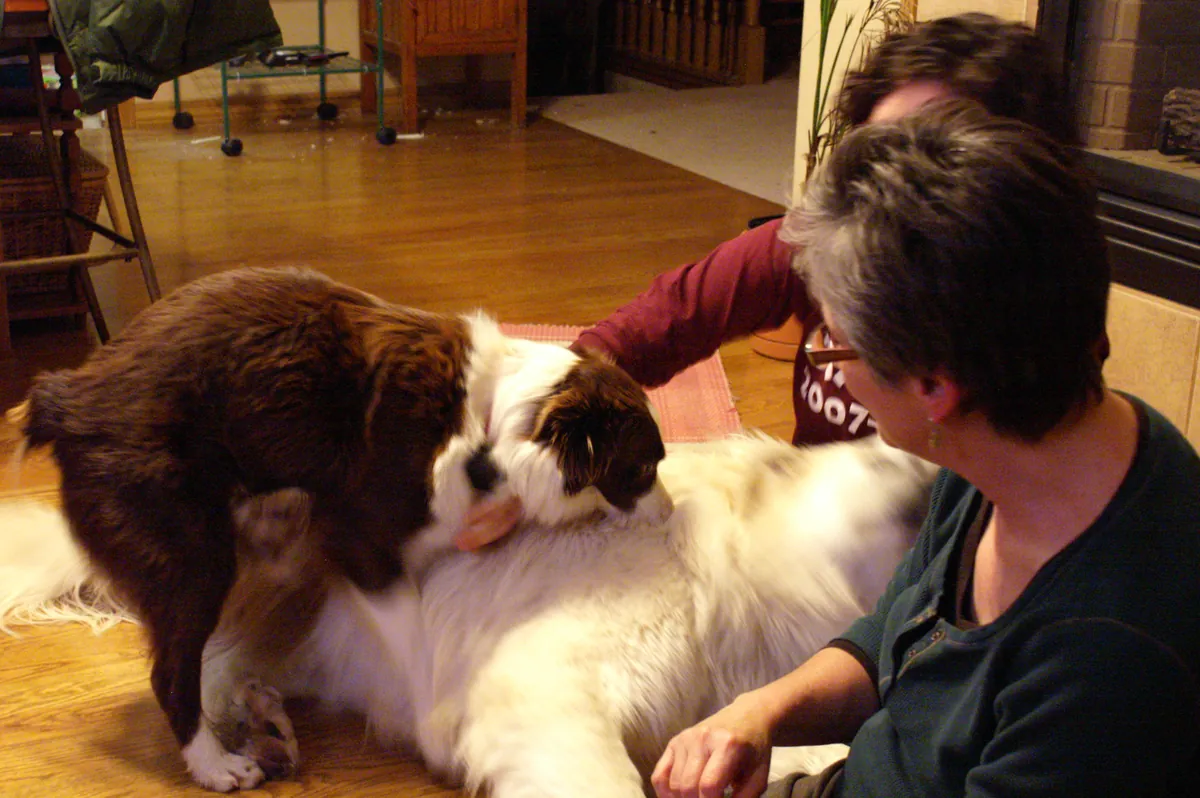
Plan on hair, though not as much as some double-coated breeds: the AKC rates both parents 3 out of 5 for shedding. For an Aussie it recommends weekly brushing, with an undercoat rake every two or three days during shedding season, and only an occasional bath (AKC Australian Shepherd). For a Border Collie, either coat type needs a pin brush once or twice a week and daily brushing in shedding season (AKC Border Collie). Long, feathered coats can mat behind the ears, on the legs and on the “pants,” so check there.
Add regular nail trims, tooth brushing and ear checks; the AKC recommends checking both breeds’ ears regularly (AKC Border Collie; AKC Australian Shepherd). A Border Aussie that spends a lot of time outdoors will collect burrs and ticks, so a quick once-over after hikes helps.
Diet basics
There’s no special Border Aussie diet. The AKC’s advice for both parents is a high-quality food appropriate to the dog’s age, an eye on treats and weight, fresh water at all times, and a check with your vet if you have concerns (AKC Australian Shepherd; AKC Border Collie). Practical points:
- Count training treats. A smart dog in daily training eats a lot of them. PetMD notes that treats should never make up more than 10% of a dog’s daily calories (petMD).
- Two meals a day for adults. PetMD says most adult dogs should eat two meals about 12 hours apart, and puppies usually do better with a third, midday meal (petMD).
- Make meals work. Food puzzles and scatter-feeding turn breakfast into brain work.
- Grow slowly, if it’s a puppy. Rapid weight gain and growth from too much food can complicate hip dysplasia (ACVS).
“Natural” doesn’t mean safe for dogs. The ASPCA warns, for example, that grapes and raisins can lead to kidney damage in dogs (ASPCA). Your vet can tell you what a healthy weight is for your dog’s frame.
Health issues to know about
A mix can inherit health problems from either parent. In a large University of California, Davis study, purebred dogs were more likely than mixed-breed dogs to have 10 inherited conditions, but there was no difference for 13 others, including hip dysplasia (Bellumori et al., 2013). Being a mix may help with some things. It isn’t a guarantee, and because these two breeds share a lot of ancestry, a Border Aussie can carry problems both sides share.
| Condition | Which parent breed | What the source says |
|---|---|---|
| Hip dysplasia | Both | On both breeds’ AKC breeder screening lists (AKC Aussie; AKC BC); explained by ACVS. |
| Epilepsy | Both | On both AKC screening lists. In a German study of 50 epileptic Aussies, most had moderate or severe courses and 56% had poor seizure control (Weissl et al., 2012). |
| Cataracts | Australian Shepherd | On the AKC screening list (AKC). Aussies carrying an HSF4 gene mutation were about 17 times more likely to develop cataracts in both eyes (Mellersh et al., 2009). |
| Collie eye anomaly, an inherited eye condition | Border Collie | On the AKC screening list (AKC). |
| Deafness | Border Collie; merle dogs | On the Border Collie screening list (AKC); much more common in double merles (Strain et al., 2009). |
| MDR1 drug sensitivity | Mainly Australian Shepherd | About 50% of Aussies carry it, per WSU; see below (WSU). |
| Neuronal ceroid lipofuscinosis (NCL) and trapped neutrophil syndrome (TNS), two rare inherited diseases | Border Collie | On the AKC screening list (AKC). |
| Certain cancers | Australian Shepherd | On the AKC screening list (AKC). |
| Border Collie collapse | Border Collie; also seen in Aussies | Exercise-triggered episodes (University of Minnesota). |
MDR1: the one to tell every vet about
The MDR1 (also called ABCB1) gene mutation makes affected dogs unusually sensitive to some common drugs. Washington State University’s veterinary college puts the approximate frequency at 50% in Australian Shepherds and in Miniature Australian Shepherds, and 10% in herding-breed crosses, and says the only way to know an individual dog’s status is to test it (WSU). In Border Collies it appears to be rare: a Swiss and German study found it in 1 of 236 (Alves et al., 2011). Because a Border Aussie has Aussie ancestry, mention the herding background before any new medication or anesthesia, and ask your vet about an MDR1 test.
Border Collie collapse
The University of Minnesota’s canine genetics lab describes Border Collie collapse (BCC) as “an episodic nervous system disorder that is triggered by strenuous exercise.” Episodes typically begin 5 to 15 minutes into hard exercise and can include confusion, swaying, staggering and falling; dogs recover within 5 to 30 minutes. The lab says a similar collapse condition has also been seen in other breeds, including the Australian Shepherd and the Miniature American Shepherd (University of Minnesota). In a survey of owners of 165 affected Border Collies, retrieving was linked to episodes in 68% of dogs and hot weather made episodes more likely for 67% (Taylor et al., 2016). If your dog staggers, seems confused or collapses during exercise, stop, cool them down, take video if you safely can, and call your vet. Heat stroke is an emergency, so don’t assume it’s “just BCC.”
Spay and neuter timing. In a study of mixed-breed dogs, neutering before one year of age was generally linked to a higher risk of joint disorders in dogs of 20 kg (about 44 pounds) or more (Hart et al., 2020). Many shelter dogs are already altered, and that’s fine. With a puppy, ask your vet about timing.
Lifespan
We found no study of this mix’s lifespan, so any single number you see for “the Border Aussie” is an estimate. The AKC lists 12 to 15 years for both the Border Collie and the Australian Shepherd (AKC Border Collie; AKC Australian Shepherd), and NEBCR says Border Collies “often live well into their teens” (NEBCR seniors). Those are breed figures, not a forecast for your dog.
An older Border Aussie can be a lovely match for someone who wants this kind of devotion with fewer zoomies. NEBCR says many older Border Collies have found their “off switch” and can be happy with “some nice long walks or playing a little ball or frisbee in the yard” (NEBCR seniors). Ask for recent vet records, especially hips, eyes and hearing.
Border Aussie puppies
A puppy’s adult size, coat and drive are hard to predict, since you’re guessing from two parents who may themselves be mixes. If you’d rather skip that guesswork, an adult is the easier road at any age: you can see its size, coat and energy, and a foster home can tell you how it behaves in a house.
There’s no breed club or health-testing program for this cross. If you’re talking with someone who has a litter, ask to meet the mother, ask whether either parent is merle (and avoid merle-to-merle litters), and ask to see results for the tests the AKC lists for each parent: hips, eyes, epilepsy history and, for Aussie lines, MDR1 (AKC Australian Shepherd; AKC Border Collie; AKC on merle). We don’t quote puppy prices we can’t verify.
Is that shelter dog really a Border Collie Aussie mix?
Maybe, maybe not. A merle or black and white dog with feathered legs is easy to label “Aussie/Border Collie mix,” but the research on those guesses is humbling:
- In a study of 919 dogs at two shelters, just 1.3% had two purebred parents of different breeds, which is what “half Border Collie, half Aussie” would mean. At one shelter, staff matched at least one breed in 67.7% of the dogs tested, but both named breeds in only 10.4% (Gunter et al., 2018).
- In a study of 20 adopted dogs, 87.5% of those that agencies had assigned specific breeds did not have all of those breeds detected by DNA (Voith et al., 2009).
English Shepherds, Australian Cattle Dog mixes and the Shetland Sheepdog can produce similar-looking dogs. So meet the dog, not the label. Our guide to figuring out your dog’s breed explains what DNA tests can and can’t tell you.
Is a Border Aussie right for me? A checklist for adopters over 50
A few “no” answers don’t rule you out. They tell you what to plan for, or which dog to ask about.
- Yes / No: I (or someone at home) can give this dog one to two hours of exercise and brain work every day, in bad weather too.
- Yes / No: I enjoy training and would take a reward-based class or try a dog sport.
- Yes / No: I’ve walked this dog myself and can hold it if it lunges after a squirrel, a bike or a car.
- Yes / No: I’m steady on my feet with a dog that may circle, bump or weave around my legs, and I’m willing to train it out of herding me.
- Yes / No: Someone is home much of the day, or I can arrange a walker or daycare.
- Yes / No: I have a securely fenced yard, or a safe fenced place to go.
- Yes / No: Visiting grandchildren can be supervised, and the dog has a quiet place to retreat.
- Yes / No: I’m fine with dog hair on clothes and furniture, and with some barking.
- Yes / No: I can budget for vet care, possibly including eye checks, joint care and an MDR1 test.
- Yes / No: I’ve thought about who would care for this dog if I ever couldn’t.
A Border Aussie may suit you if you’re active, home a lot, and want a bright, devoted partner for walks, training and maybe a dog sport.
Consider a calmer dog, or an older Border Aussie, if a strong puller or a dog that circles your feet would be a fall risk, if the dog would be alone most of the day, or if quiet evenings are the goal and daily training isn’t. There’s no shame in that. The right match is the one that keeps a dog home for life.
A word on leash and trip safety
This isn’t a reason to skip an active dog, but it’s worth planning for. A US study estimated that emergency visits for fractures linked to walking leashed dogs among people 65 and older rose from 1,671 in 2004 to 4,396 in 2017 (Pirruccio et al., 2019). Practical steps: do a test walk before adopting, hold the leash in your hand rather than wrapping it around your wrist, wear sturdy shoes, start in quiet places, and keep a herding dog’s bed out of your night-time path to the bathroom.
Costs to plan for
We found no reliable cost figures for this mix. The ASPCA’s 2021 estimate for a dog is $1,391 a year, and $3,221 for the first year once one-time costs are included (ASPCA). Budget for:
- The adoption fee, and what it covers. For example, New England Border Collie Rescue lists a base fee of $450 (NEBCR policies).
- Routine vet care, plus pet insurance or an emergency fund. Hips, eyes and epilepsy are on the parent lists, so price insurance before anything becomes pre-existing.
- An MDR1 test and, for a mostly white merle, a hearing test, if not already done.
- Training and enrichment: classes, food puzzles, a front-clip harness, a long line and a crate.
Adopting a Border Collie Australian Shepherd mix
Where to look
Search shelters for “Australian Shepherd mix,” “Border Collie mix,” “Aussie mix,” “Collie mix” and “herding mix,” since labels are often a guess. Then try breed rescues, and ask each one whether it takes mixes:
- Border Collie rescues. New England Border Collie Rescue keeps a state-by-state list of other Border Collie rescues across the US. NEBCR also runs a Seniors for Seniors program: it waives the adoption fee for adopters 60 or older who adopt a dog 10 or older, and covers that dog’s necessary vet care before adoption (NEBCR seniors). Some rescues require an obedience class; NEBCR asks for one with many of its dogs (NEBCR policies).
- Australian Shepherd rescues. Aussie Rescue & Placement Helpline (ARPH) places purebred Aussies through foster homes, with a standard fee of $300 (ARPH). Note that its rehoming form says it is “not able to take mixes” (ARPH rehoming), so Border Aussies usually end up with all-breed or Border Collie groups.
- All-breed shelters and rescues. Many Border Aussies are listed simply as “Aussie mix” or “Border Collie mix.”
Foster-based groups are especially helpful, because a foster family can tell you how the dog behaves in a real home. (Bone Voyage itself is no longer a rescue and doesn’t place dogs.)
Questions to ask the shelter or rescue
- How was the breed label decided? Is either parent known, or has there been a DNA test?
- Does the dog herd people: circling, nipping at heels, bumping legs? How does it do when people walk around the house?
- How does it walk on a leash? Can I walk it myself before deciding?
- How does it react to traffic, bikes, joggers, thunder and other sudden noises or movement?
- How much exercise and brain work does it need to settle in the evening?
- How has it done with dogs, cats and children, and in what setting?
- How does it handle being left alone?
- Is it merle? Has its hearing or eyesight been checked?
- Has it had an MDR1 test? Any seizures, limping, or wobbling during exercise?
- Is there a foster-to-adopt or trial period, and what happens if it doesn’t work out?
Our list of 9 questions to ask when adopting a dog covers the general ones.
Give your dog a backup plan
A smart, busy, people-focused dog like a Border Aussie does best with someone who already knows its routine. Naming a backup caregiver now, someone the dog knows and who can keep up with it, makes it far less likely your dog will end up in a shelter. Our guide What Happens to Your Dog When You Die walks you through it, and the free My Dog’s Backup Plan worksheet records your dog’s routine, vet, medications (including any MDR1 result), quirks and favorite games. Bone Voyage is also building the backup-adopter pledge, in which a volunteer pledges to adopt a specific senior’s dog if that senior dies or can’t care for it. You can join the free list on the guide page.
Similar dogs to compare
- German Shepherd Border Collie mix, the other common Border Collie herding cross.
- Queensland Heeler Border Collie mix (Border Heeler), the Border Collie crossed with the Australian Cattle Dog.
- Aussiedoodle and Aussie Bernese, two more Australian Shepherd crosses.
- Aussie Corgi mix (Auggie), a shorter-legged Australian Shepherd cross with the same MDR1 question.
- English Shepherd, Shetland Sheepdog and Blue Heeler, three more herding breeds.
- Smartest dog breeds, for the Border Collie’s reputation.
Frequently Asked Questions
What is a Border Collie Australian Shepherd mix called?
Usually a Border Aussie or Border-Aussie (petMD). Dog Breed Info also lists Aussieollie (Dog Breed Info), and some owners say Aussie Collie. These are informal names. The AKC and UKC recognize both parent breeds but not the cross, and there is no breed standard, so looks, size and temperament vary from dog to dog.
How big do Border Collie Aussies get?
There is no official size for the mix. The AKC lists Border Collies at 18 to 22 inches and 30 to 55 pounds (AKC), and Australian Shepherds at 18 to 23 inches and 40 to 65 pounds (AKC), so most Border Aussies land somewhere between 18 and 23 inches and 30 and 65 pounds. Females are usually smaller. Adopting an adult lets you see the size instead of guessing.
How long do Border Aussies live?
No study has measured the mix’s lifespan. The AKC lists 12 to 15 years for both the Border Collie and the Australian Shepherd (AKC Border Collie; AKC Australian Shepherd). Those are parent-breed figures, not a promise for any one dog; regular checkups and a lean weight matter more than the label.
Do Border Aussies shed a lot?
Moderately, with heavier seasons. Both parents have double coats and the AKC rates both 3 out of 5 for shedding. The AKC recommends weekly brushing for Aussies and once or twice a week for Border Collies, with daily brushing or an undercoat rake during shedding season (AKC Australian Shepherd; AKC Border Collie).
Where should a Border Collie Aussie mix sleep at night?
There’s no breed rule. The AKC suggests letting a dog on your bed only by invitation and keeping a dog bed or crate mat nearby as a backup spot, and says a dog whose problem behavior gets worse with co-sleeping should have its own space while you talk to a trainer or your vet (AKC). If you get up in the night, put the dog’s bed where you won’t trip over it.
Can a Border Aussie live in an apartment?
It can, if the exercise happens elsewhere. The AKC says an Australian Shepherd needs a large fenced area to run in for at least an hour or two daily (AKC), and New England Border Collie Rescue says Border Collies don’t do well left alone for long hours (NEBCR). Check your lease, your neighbors’ tolerance for barking and how close a safe fenced space is.
Are Border Aussies good family dogs?
Often, with older children and an active household. The AKC says Border Collies do best with older, well-behaved children because they tend to herd people (AKC), and that Aussies will herd “birds, dogs, kids” (AKC). Expect chasing and nipping at running feet unless the dog is trained and supervised.
Is a Border Aussie a good dog for an active person over 50?
It can be, if you enjoy daily training and long outings and are home much of the day. Both parent breeds rate 5 out of 5 for energy with the AKC. Walk the dog yourself before deciding. A puppy can work at any age if you have the time and energy for training; an adult whose foster home can describe its habits lets you see its energy before you commit.
Before you go
Whatever the kennel card says, the dog in front of you is one specific dog with its own history and quirks. Weigh what you learn about that dog more heavily than anything on this page. And whatever dog you bring home, it’s worth deciding now who would step in if you ever couldn’t.
Sources
- American Kennel Club breed pages: Border Collie, Australian Shepherd, Miniature American Shepherd and German Shepherd Dog
- American Kennel Club, Merle in Dogs and Should My Dog Sleep With Me?
- United Kennel Club, Australian Shepherd standard and Border Collie standard
- PetMD, Border Aussie (reviewed by Barri J. Morrison, DVM, updated April 2024)
- Dog Breed Info Center, Border-Aussie
- New England Border Collie Rescue: home, Is a BC Right for You?, Seniors for Seniors program, adoption policies and other Border Collie rescues
- Aussie Rescue & Placement Helpline: home, How to Adopt and Rehome your Aussie
- Washington State University College of Veterinary Medicine, Breeds commonly affected by MDR1 mutation
- Alves L et al. (2011). Polymorphisms in the ABCB1 gene in phenobarbital responsive and resistant idiopathic epileptic Border Collies. Journal of Veterinary Internal Medicine 25(3):484-9.
- Strain GM et al. (2009). Prevalence of deafness in dogs heterozygous or homozygous for the merle allele. Journal of Veterinary Internal Medicine 23(2):282-6.
- Weissl J et al. (2012). Disease progression and treatment response of idiopathic epilepsy in Australian Shepherd dogs. Journal of Veterinary Internal Medicine 26(1):116-25.
- Mellersh CS et al. (2009). Mutation in HSF4 is associated with hereditary cataract in the Australian Shepherd. Veterinary Ophthalmology 12(6):372-8.
- University of Minnesota Canine Genetics Lab, Border Collie Collapse
- Taylor S et al. (2016). Border Collie Collapse: Owner Survey Results and Veterinary Description of Videotaped Episodes. Journal of the American Animal Hospital Association 52(6):364-370.
- Bellumori TP et al. (2013). Prevalence of inherited disorders among mixed-breed and purebred dogs. JAVMA 242(11):1549-55.
- Hart BL et al. (2020). Assisting decision-making on age of neutering for mixed breed dogs of five weight categories. Frontiers in Veterinary Science 7:472.
- American College of Veterinary Surgeons, Canine Hip Dysplasia
- Morrill K et al. (2022). Ancestry-inclusive dog genomics challenges popular breed stereotypes. Science 376(6592):eabk0639.
- Gunter LM et al. (2018). A canine identity crisis: genetic breed heritage testing of shelter dogs. PLOS ONE 13(8):e0202633.
- Voith VL et al. (2009). Comparison of adoption agency breed identification and DNA breed identification of dogs. Journal of Applied Animal Welfare Science 12(3):253-62.
- Pirruccio K et al. (2019). Fractures in elderly Americans associated with walking leashed dogs. JAMA Surgery 154(5):458-459.
- American Veterinary Society of Animal Behavior, Position Statement on Humane Dog Training (2021)
- ASPCA, Cutting Pet Care Costs (2021 cost update) and People Foods to Avoid Feeding Your Pets
- Photos: Wikimedia Commons and Flickr contributors, credited under each image. Full license records are kept in this site’s image-credits file.