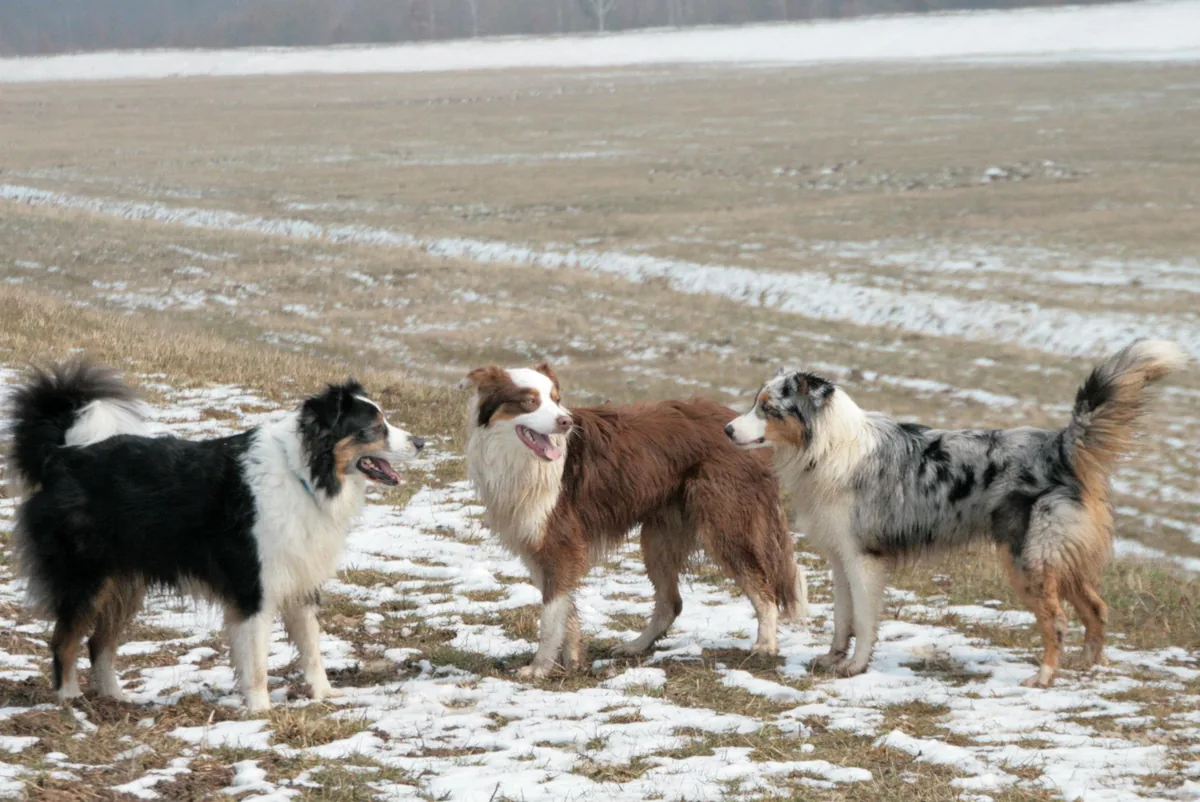

An Aussie and Corgi mix, often called an Auggie, is a cross between an Australian Shepherd (or a Mini Aussie) and a Pembroke or Cardigan Welsh Corgi. Expect a clever, busy, people-loving herding dog that sheds and often barks, in a body that can be anything from Corgi-low to a leggy medium dog. It isn’t a recognized breed, so size and temperament vary a lot. The things to plan for are daily exercise, a long back, a drug-sensitivity gene that is common on the Aussie side, and a coat that needs regular brushing.
Most pages about this mix are photo galleries or repeat the same size numbers with no source. This guide uses American Kennel Club (AKC) breed pages, Orthopedic Foundation for Animals (OFA) screening data, Washington State University’s veterinary pharmacology lab, the American College of Veterinary Surgeons (ACVS) and peer-reviewed research. Nobody has studied the Auggie as a group, so where the evidence is about a parent breed, we say so.
Aussie Corgi mix quick facts
- What it is: a cross of an Australian Shepherd or Miniature American Shepherd (often called a Mini Aussie) and a Pembroke or Cardigan Welsh Corgi. Not an AKC breed; no breed standard.
- Other names: Auggie, Augie, Augi, Aussie-Corgi, Corgi Aussie mix.
- Height (parent ranges): Australian Shepherd 18 to 23 inches; Miniature American Shepherd 13 to 18; Pembroke 10 to 12; Cardigan 10.5 to 12.5 (AKC Aussie; AKC MAS; AKC Pembroke; AKC Cardigan).
- Weight (parent ranges): Australian Shepherd 40 to 65 pounds; Miniature American Shepherd 20 to 40; Pembroke up to 30; Cardigan 25 to 38. No one has measured the mix.
- Life expectancy (parents, AKC): 12 to 15 years (Aussie and Cardigan), 12 to 13 (Pembroke and Miniature American Shepherd). Not studied in the mix.
- Energy: high. The AKC rates the Aussie 5 out of 5 and both Corgis 4.
- Shedding: moderate to heavy. All parents have double coats.
- Barking: often vocal. The AKC rates the Aussie 3, the Pembroke 4 and the Cardigan 5.
- Health to ask about: the MDR1 drug-sensitivity gene, back and disc disease, hips, eyes, epilepsy, degenerative myelopathy, and double-merle risks if both parents were merle.
- Best fit: an active person or family who is home a good part of the day and wants a smart, busy dog to do things with.
Where the Auggie comes from
The Auggie is a cross, not a breed with a written history. Some are deliberate “designer” litters; many more are unplanned and turn up in shelters as “Aussie mix” or “Corgi mix.” We found no reliable record of when the two breeds were first crossed on purpose, so we don’t guess. The AKC doesn’t register it, and says its conformation shows require “a defined breed standard, which does not exist for mixed breeds,” though mixed breeds can enter many other AKC sports (AKC). What we can describe well is the parents, and both are herding dogs.
The Australian Shepherd side
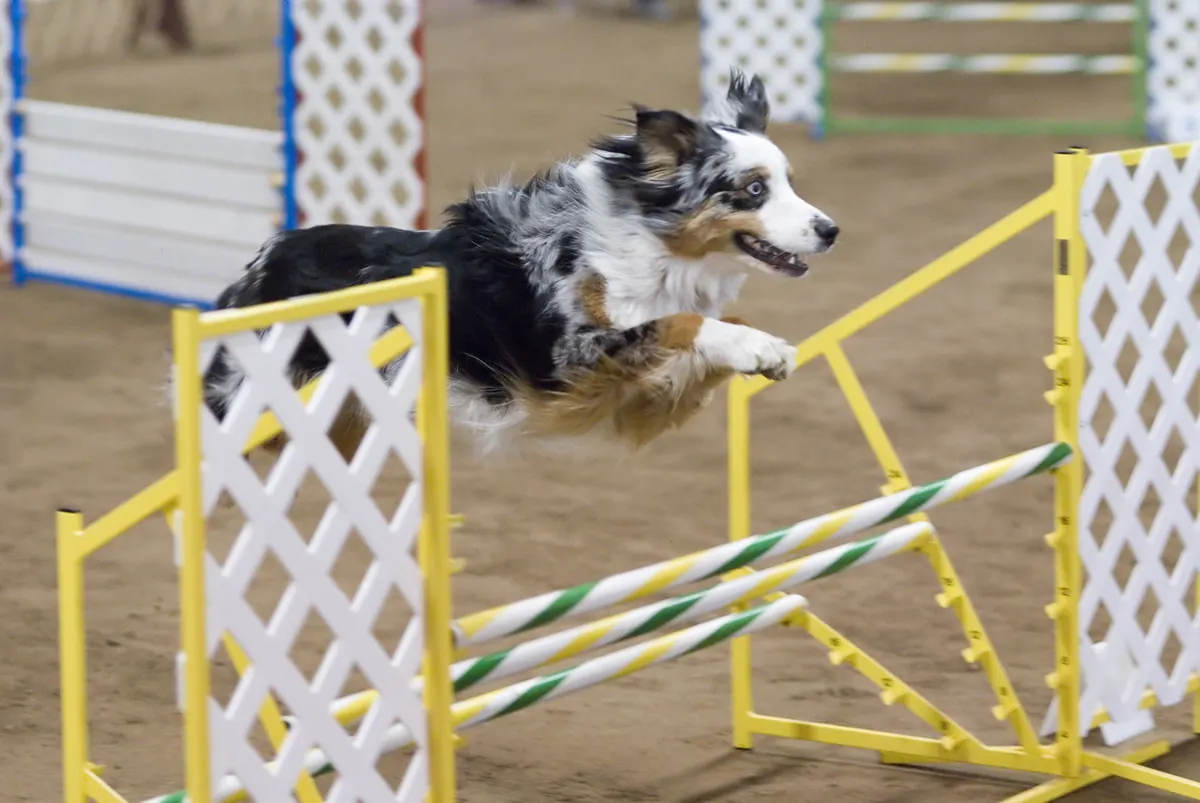
Despite the name, the Aussie was perfected in the American West. The AKC traces it to Basque shepherds from the Pyrenees, who took their dogs to Australia and later to California, where ranchers “assumed they were an Australian breed.” The breed entered the AKC Herding Group in 1993. The AKC is candid: Aussies “exhibit an irresistible impulse to herd, anything: birds, dogs, kids,” and “this isn’t the pet for everyone” (AKC Aussie). Our Border Collie Australian Shepherd mix guide covers the Aussie side in more depth.
Mini Aussies. Many Auggies, including most of the owner photos on the popular gallery pages, have a small Aussie parent. The AKC says that in the 1960s small Australian Shepherds were bred down further, and the result, first called the Miniature Australian Shepherd, is now the AKC’s Miniature American Shepherd (AKC MAS). Which size of Aussie was in the litter is the single biggest clue to how big an Auggie will be.
The Welsh Corgi side
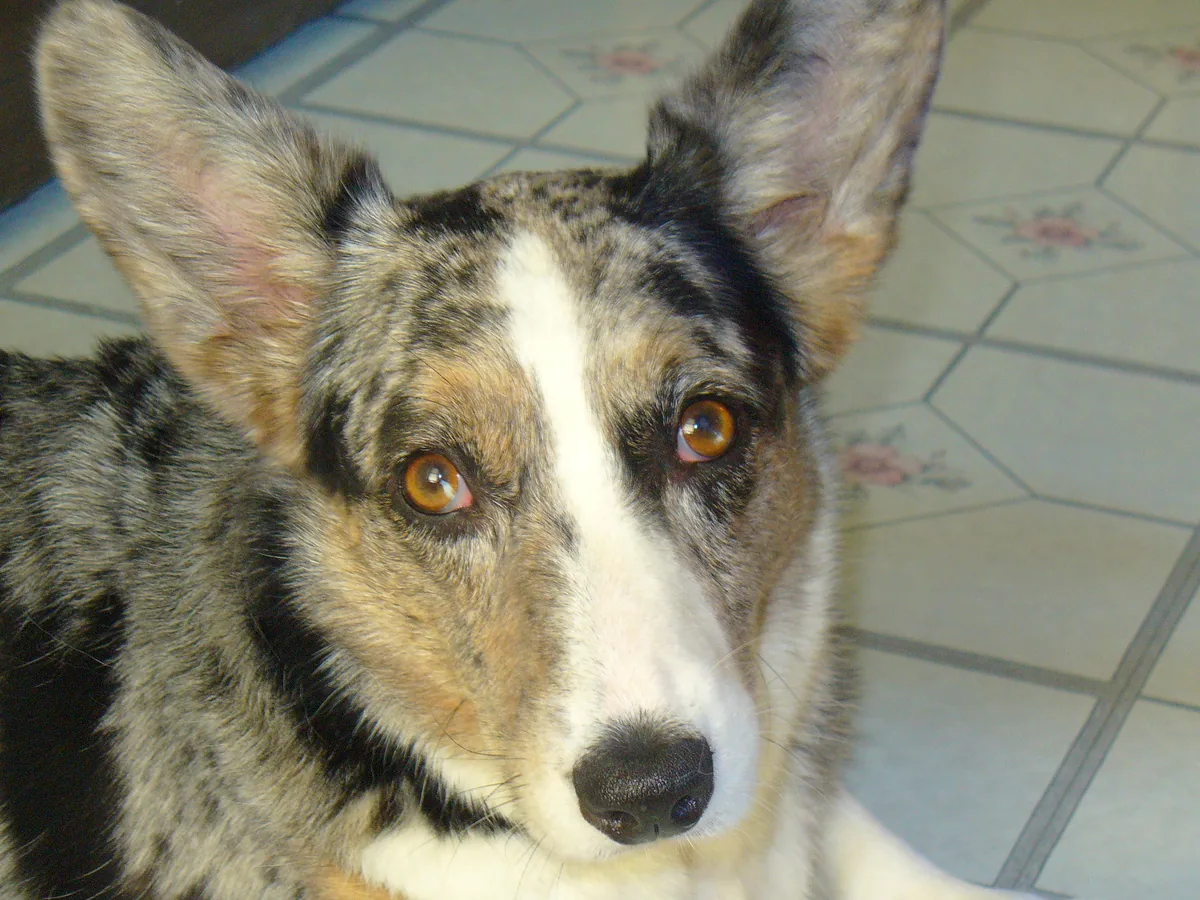
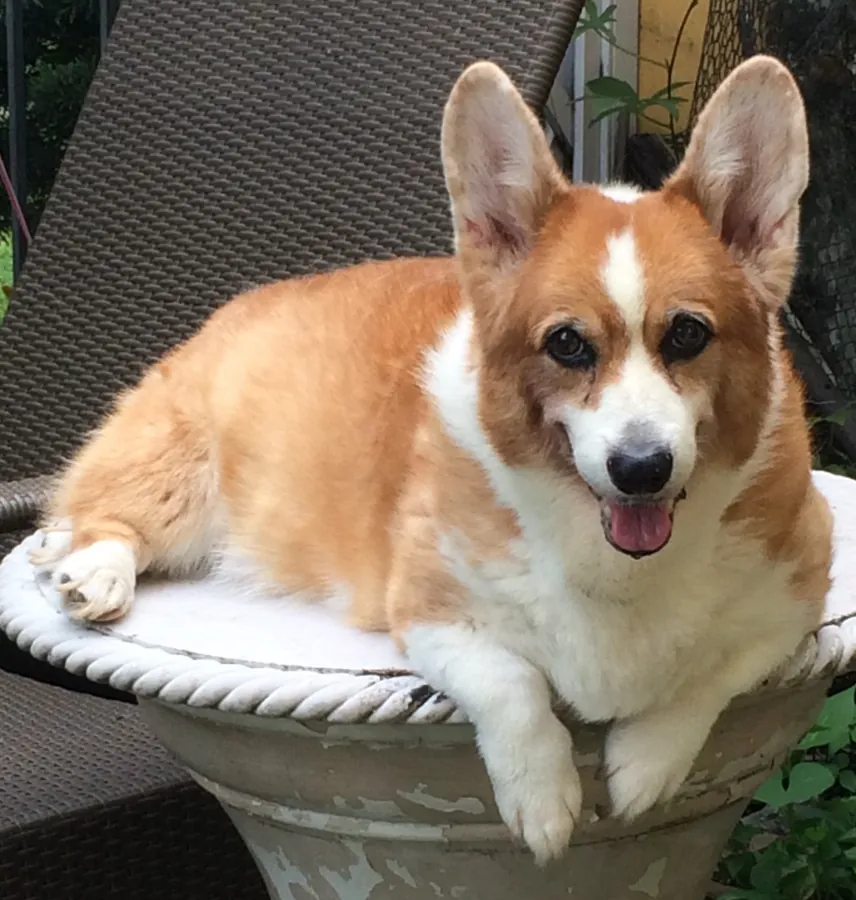
“Welsh Corgi” covers two separate AKC breeds, both cattle-driving dogs from Wales. The AKC calls the Pembroke “a strong, athletic, and lively little herder who is affectionate and companionable without being needy” (AKC Pembroke). The Cardigan is heavier-boned, has a long “foxlike” tail and comes in more colors, including blue merle (AKC Corgi comparison). The AKC recognized the Pembroke in 1934 and the Cardigan in 1935. The Pembroke is far more common, so most Auggies are probably Pembroke crosses, but in a shelter dog you usually can’t tell without a DNA test.

Australian Shepherd vs. Corgis vs. Auggie at a glance
AKC registry figures and the AKC’s 1 to 5 trait ratings (5 = most). The Auggie column is the range between the parents, not measured data.
| Australian Shepherd | Miniature American Shepherd | Pembroke Welsh Corgi | Cardigan Welsh Corgi | Auggie (mix) | |
|---|---|---|---|---|---|
| Height | 18-23 in. | 13-18 in. | 10-12 in. | 10.5-12.5 in. | Varies widely |
| Weight | 40-65 lb | 20-40 lb | Up to 30 lb | 25-38 lb | Varies; depends a lot on Aussie size |
| AKC life expectancy | 12-15 yrs | 12-13 yrs | 12-13 yrs | 12-15 yrs | Not studied |
| Energy | 5 | 5 | 4 | 4 | High |
| Mental stimulation needs | 5 | 5 | 4 | 4 | High |
| Trainability | 5 | 5 | 4 | 4 | Usually quick to learn |
| Shedding | 3 | 3 | 4 | 3 | Moderate to heavy |
| Barking | 3 | 3 | 4 | 5 | Often vocal |
| Good with young children | 5 | 5 | 3 | 4 | Supervise; may herd |
| Openness to strangers | 3 | 3 | 4 | 4 | Often reserved at first |
| Merle coat possible | Yes | Yes | No | Yes | If an Aussie or Cardigan parent is merle |
| MDR1 mutation (approx., WSU) | 50% | 50% (listed as Mini Aussie) | Not listed | Not listed | Herding crosses: 10% |
| AKC popularity rank | 12 of 211 | 24 of 210 | 15 of 211 | 60 of 211 | Not ranked |
Sources: AKC breed pages for the Australian Shepherd, Miniature American Shepherd, Pembroke and Cardigan, checked November 2026; AKC on merle; WSU MDR1 breed list.
Appearance and size
No two Auggies look alike, but most share a few things: big upright ears, a medium-length double coat, often a white collar or blaze, and a body that is longer than it is tall. Coat colors can come from either side. The UKC’s Aussie standard lists blue merle, red merle, solid black and solid red, each with or without white and tan (UKC Aussie); the AKC lists Pembrokes in red, sable, fawn and black and tan (AKC Pembroke), and Cardigans add brindle and blue merle (AKC Corgi comparison). Odd or blue eyes are common in Aussies, whose standard allows “brown, blue, amber, or any variation or combination” (UKC Aussie).
Tails vary too. Many Pembrokes are born with naturally short tails because of a variant in a gene called T (Hytönen et al., 2009), and the UKC Aussie standard allows a “natural bobtail or docked” tail (UKC Aussie). An Auggie may have a full tail, a short one or anything in between.
How big will an Auggie get?
Size is the hardest thing to predict. Three common outcomes:
| What the dog took after | What it tends to look like | What it means for you |
|---|---|---|
| Mostly Corgi | Short legs, long back, Corgi-sized, Aussie coat or colors | Easy to lift and handle; protect the back |
| In between | A medium dog on short-to-medium legs | The most common look in owner photos of the mix |
| Mostly Aussie | Leggy, can be 40+ lb with a standard Aussie parent | Stronger on the leash; heavier to lift |
This is our summary from the parent breeds and published owner photos, not a measured study. Several popular guides say the mix stands 10 to 13 inches and weighs 20 to 30 pounds. That fits a Corgi crossed with a small Aussie, but we found no measurements behind it, and a standard 23-inch, 65-pound Aussie parent can produce a much bigger dog. If size matters for your home, your car or your own strength, an adult dog lets you see it instead of guessing.

Temperament: what to expect
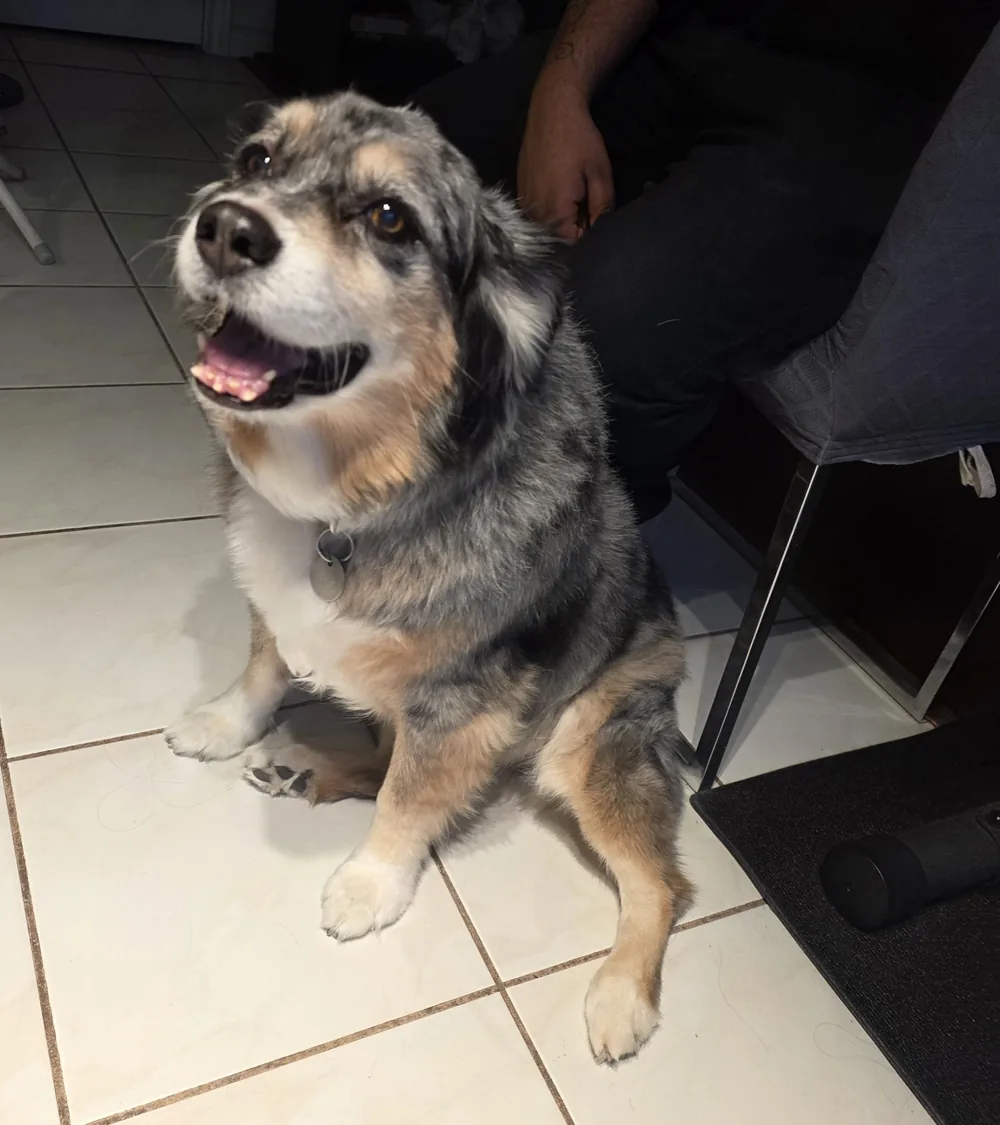
Both parents are smart, loyal working dogs, so most Auggies are too. In everyday life that often means:
- A devoted, busy companion. The AKC says Aussies “bond strongly to their families” and “can become destructive if left without companionship for long periods too often” (AKC Aussie). Pembrokes are affectionate without being needy (AKC Pembroke).
- Herding habits. Circling, staring, nudging and nipping at heels, especially of running children, are normal herding behaviors, not aggression. They need redirecting, not punishment.
- A watchdog voice. The AKC rates the Pembroke 5 out of 5 as a watchdog and the Cardigan 5 out of 5 for barking. Expect your Auggie to announce visitors.
- Some reserve with strangers. The AKC rates the Aussie 3 out of 5 for openness to strangers and notes Aussies “can be territorial and overprotective of their owners’ property” (AKC Aussie). Early, gentle socializing helps.
- A brain that needs a job. The AKC warns that Aussies are “quite capable of hoodwinking an unsuspecting novice owner” (AKC Aussie). A bored Auggie invents its own work.
These are tendencies, not guarantees. A large genetic study found that breed explains only a small part of an individual dog’s behavior (Morrill et al., 2022). The dog in front of you, and what its foster says about it, matters most.

Exercise needs
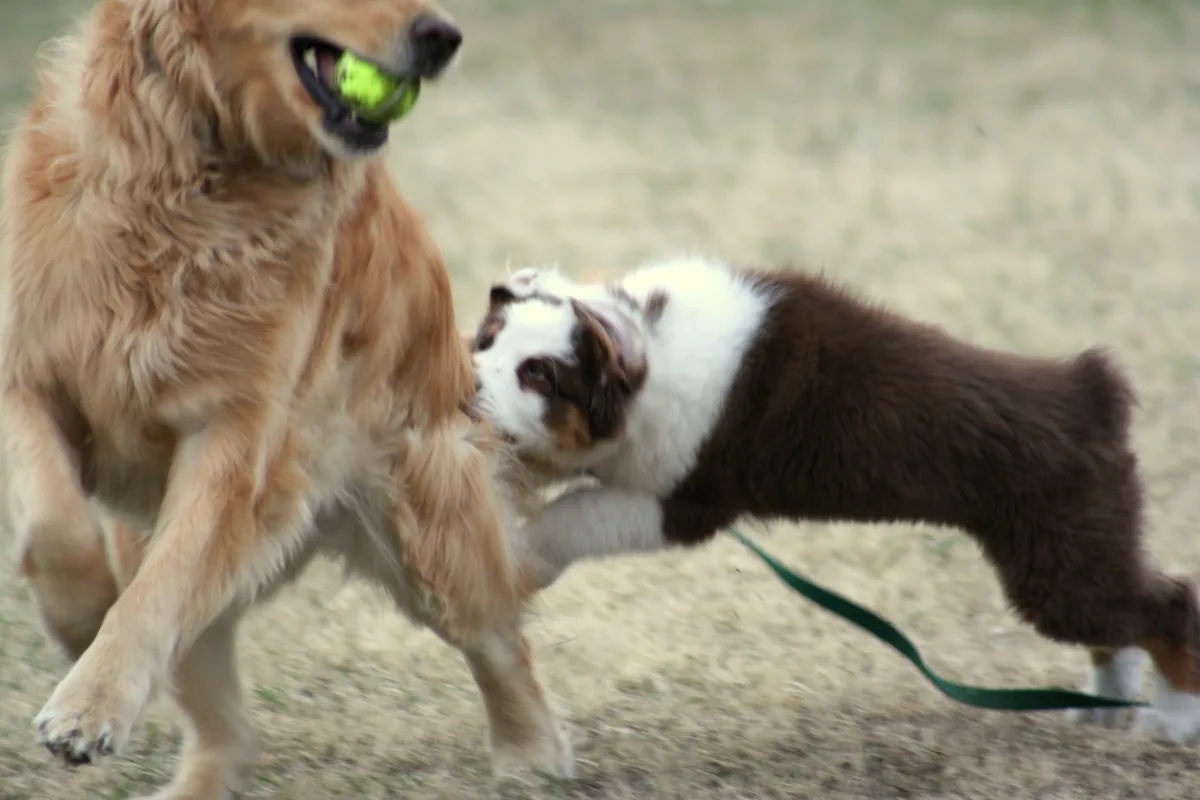
Plan on at least an hour of activity a day, split between walks, play and brain work. The AKC says the Aussie “needs a great deal of exercise on a daily basis” and does best with a job (AKC Aussie); Corgis rate 4 out of 5 for energy. A Corgi-sized Auggie still has a herding dog’s engine.
Good outlets that are kind to a long back and to your joints:
- Two brisk walks a day with time to sniff.
- Nose games, puzzle feeders and hide-and-seek with treats.
- Short training sessions and trick training, which tire a herding brain as much as a run.
- Low-impact dog sports such as rally or scent work. The AKC opens many of its sports to mixed breeds (AKC).
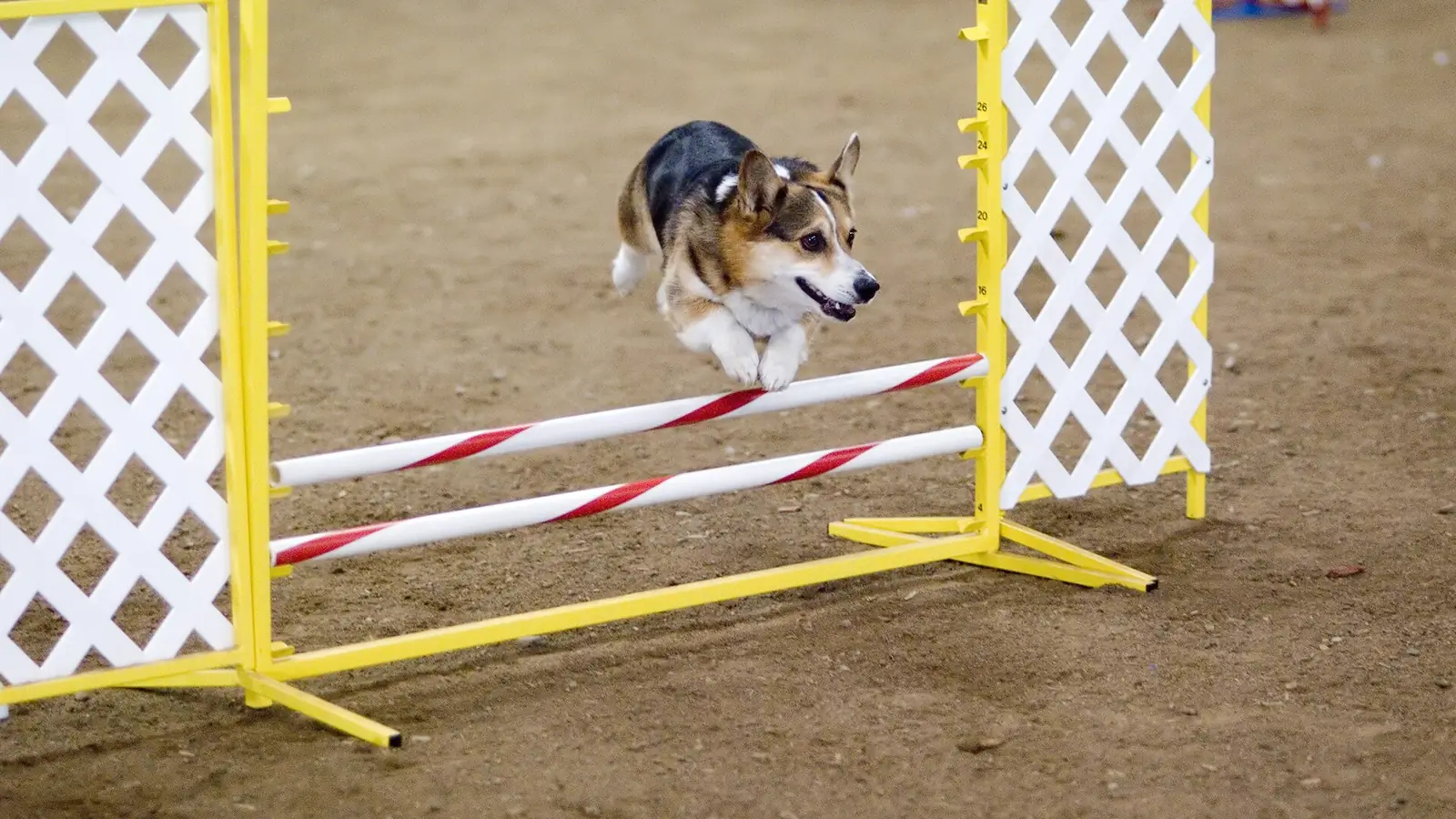
For a short-legged Auggie, go easy on repeated high jumps, jumping off furniture and long stair runs (see Health). Ramps or dog stairs for the bed and sofa help.

Grooming
- Brushing: once or twice a week, and every few days during the seasonal sheds. The AKC says weekly brushing keeps an Aussie’s “waterproof, double-layer coat looking its best,” with an undercoat rake “every two or three days” during shedding season (AKC Aussie). The Pembroke rates 4 out of 5 for shedding. Don’t shave a double coat.
- Baths: only occasionally, when the dog is dirty.
- Nails: trim every few weeks.
- Ears and teeth: the AKC says an Aussie’s ears should be checked regularly and teeth brushed regularly (AKC Aussie).
No Auggie is hypoallergenic. If you have dog allergies, spend real time with the specific dog and talk to your doctor first.
Health: what the parent breeds tell us
There’s no health data on the Auggie itself. What we know comes from the parent breeds, and a mix isn’t automatically healthier: in a large UC Davis study, purebred dogs had higher rates of 10 of 24 inherited disorders, but there was no difference for 13 others, including hip dysplasia (Bellumori et al., 2013).
Health screening at a glance
This table uses the OFA’s breed statistics, which are owner-submitted results, not a random sample of all dogs (OFA).
| Condition | Australian Shepherd (OFA) | Pembroke (OFA) | Cardigan (OFA) | What to ask for |
|---|---|---|---|---|
| Hip dysplasia | 6.3% dysplastic of 50,591 evaluated | 21.9% of 17,527 | 24.4% of 4,169 | OFA or PennHIP hip results for both parents |
| Elbow dysplasia | 4.8% abnormal of 22,006 | 5.6% of 2,541 | 5.4% of 1,388 | OFA elbow results |
| Degenerative myelopathy (SOD1 DNA test) | 13.6% at risk, 18.8% carriers, of 389 tested | 53.8% at risk, 31.7% carriers, of 5,479 | 15.5% at risk, 29.8% carriers, of 1,025 | DM DNA test for both parents, or the dog itself |
| Disc disease gene (chromosome 12 FGF4, “CDDY”) | Not reported in the breed | Very common: allele frequency 0.92 | Short-legged breed | UC Davis CDDY test if the dog has short legs |
| MDR1 drug sensitivity | About 50% of the breed (WSU) | Not on WSU’s list | Not on WSU’s list | MDR1 test for the dog |
Sources: OFA disease statistics (checked November 2026); Batcher et al., 2019; WSU.
MDR1: the one to tell every vet about
The MDR1 (also called ABCB1) gene mutation makes affected dogs unusually sensitive to some common drugs. Washington State University’s veterinary college puts the approximate frequency at 50% in Australian Shepherds and in Mini Aussies and 10% in herding-breed crosses, and says “the only way to know if an individual dog has the mutant MDR1 gene is to have the dog tested” (WSU).
What this means at home:
- Never give your Auggie Imodium without asking your vet. WSU says loperamide (Imodium), at doses used for diarrhea, “will cause neurological toxicity in dogs with the MDR1 mutation” and “should be avoided in all dogs with the MDR1 mutation” (WSU problem drugs). It’s a common medicine-cabinet drug, so this matters.
- Tell every vet and emergency clinic that your dog is part Aussie before any sedation, anesthesia or new medicine. WSU lists acepromazine, butorphanol and some chemotherapy drugs among the drugs that need special dosing (WSU problem drugs).
- Heartworm prevention is fine at label doses. WSU says all US heartworm products labeled for dogs have been tested in MDR1 dogs and found safe at those doses, though higher doses used for mange should be avoided (WSU heartworm).
- Write the result down. Put the MDR1 status on your dog’s medical card and in your My Dog’s Backup Plan worksheet, so a future caregiver knows too.
Back and disc disease (IVDD)
Corgi short legs come from extra copies of a growth gene called FGF4. The copy on chromosome 12 also makes spinal discs age early; dogs carrying it had an odds ratio of 51 for intervertebral disc disease (IVDD) in a UC Davis study (Brown et al., 2017). In the UC Davis repository, 92% of Pembroke chromosomes carried it (Batcher et al., 2019), and one copy is enough to raise the risk (UC Davis VGL). That research didn’t report Australian Shepherds among the breeds carrying it.
What that likely means: a first-generation Auggie with a Pembroke parent will often inherit one copy, through the Corgi side. That’s our inference from the frequencies, not a study of the mix. It doesn’t mean your dog will have a disc problem, only that the risk is real. A UC Davis cheek-swab test can tell you whether your dog carries it.
Signs of IVDD include back or neck pain, a hunched back, reluctance to move, crying when picked up and a wobbly walk (ACVS IVDD). If your Auggie suddenly can’t walk normally, call your vet or an emergency clinic right away, and don’t give any medicine without asking.
The double merle question
Merle is the mottled coat pattern seen in many Aussies. The AKC lists both the Australian Shepherd and the Cardigan Welsh Corgi among the breeds where merle is found; the Pembroke is not on that list (AKC on merle). One copy of the merle gene gives the pattern. Two copies, a “double merle,” can happen when two merle dogs are bred, and the AKC says such a litter will on average be a quarter double merles. Its advice: “it’s best to avoid breeding a merle to a merle.”
This is a risk specific to this cross that most guides miss: a merle Aussie bred to a merle Cardigan is a merle-to-merle litter. In a study of 153 merle dogs, 0.9% of single merles were deaf in both ears, compared with 15% of double merles (Strain et al., 2009). Double merles often have a lot of white. If you meet a mostly white Auggie, or learn both parents were merle, ask whether hearing (a BAER test) and eyes have been checked. Deaf dogs can make lovely companions, but they need hand-signal training, so it’s better to know before you commit.
Eyes, seizures and the rest
- Cataracts. The AKC lists eye exams among the recommended tests for Aussies (AKC Aussie). Aussies carrying an HSF4 gene mutation were about 17 times more likely to develop cataracts in both eyes (Mellersh et al., 2009).
- Epilepsy. The AKC says responsible Aussie breeders test for epilepsy. In a German study of 50 epileptic Aussies, most had moderate or severe courses and 56% had poor seizure control (Weissl et al., 2012). Any seizure is a reason to call your vet.
- Degenerative myelopathy (DM). A slowly progressive spinal cord disease that causes hind-leg weakness, “typically affecting dogs around eight years of age or older” (Cornell DM). The gene variant behind it was first linked to the disease in Pembrokes, among other breeds (Awano et al., 2009); see the table for how common it is in each parent.
- Hips. The ACVS says genetics is “the biggest single risk factor” for hip dysplasia and that “all dogs with CHD should be kept very slim” (ACVS hip). Both Corgi breeds show much more hip dysplasia than Aussies in OFA records.
- Weight. The AKC notes some Aussies are “prone to getting overweight” (AKC Aussie), and Corgis love food. Extra weight loads the hips and a long back.

Training
Auggies usually learn fast; the AKC gives the Aussie its top trainability score and both Corgis 4 out of 5. It says Aussie loyalty and intelligence “make them very easy to train,” but that one of the most frequent reasons Aussies end up in rescue is that owners couldn’t channel their energy through training (AKC Aussie). Use food, toys and praise, and skip punishment: the American Veterinary Society of Animal Behavior recommends reward-based methods only (AVSAB).
Priorities for an Auggie:
- “Leave it” and a calm settle, to redirect herding of feet, kids, cats and bikes.
- “Quiet,” rewarded early, for a watchful, vocal dog.
- “Wait” at doors and stairs, so the dog isn’t underfoot when you’re carrying things.
- Handling practice (paws, mouth, being lifted with support under chest and hips) so vet visits and back care are easy.
- Alone-time practice, in short steps, so a people-focused dog can relax when you go out.
If you see growling, snapping or guarding that worries you, ask your vet for a referral to a qualified behavior professional.
Diet basics
There’s no special Auggie diet. The AKC says Aussies do well on a high-quality food appropriate to the dog’s age, and warns that “giving too many [treats] can cause obesity” (AKC Aussie). Feed a complete and balanced food for your dog’s life stage, measure every meal and count treats; the WSAVA nutrition guidelines are a good plain-language starting point (WSAVA). You should be able to feel the ribs easily and see a waist from above (WSAVA body condition chart). Ask your vet before adding supplements.
Who an Auggie suits, and who should skip it
A good match if you:
- Walk every day and like a dog that wants to come along.
- Enjoy training, tricks or dog sports.
- Are home a good part of the day.
- Don’t mind dog hair and a dog that announces the mail carrier.
Think twice if you:
- Want a calm, low-energy lap dog.
- Live with thin walls and neighbors who won’t enjoy barking.
- Have toddlers or cats and can’t supervise a dog that may try to herd them.
- Can’t lift a 30-pound dog, or manage a strong puller if your Auggie turns out leggy.
A 50+ home checklist for an Auggie
Bone Voyage helps people 50+ adopt, keep, and thrive with dogs. This mix brings a few specific things to plan for:
- Watch the feet. The CDC estimated more than 86,000 fall injuries a year in the US linked to pets, mostly dogs, with the highest rates in people 75 and older (Stevens et al., 2010). A herding dog that circles your ankles is a trip hazard. Teach “wait” and “go to your bed,” add night lights and use non-slip rugs.
- Plan for lifting. Know how you’d get the dog into the car or to the vet if its back were hurt. Ramps help both of you; see our guide to dog ramps for the bed.
- Keep a medicine rule. No human medicines, especially Imodium, without your vet’s OK, and the MDR1 result written on the fridge.
- Match the energy to your week. If daily walks are hard some days, line up a dog walker, a neighbor or a brain-game routine.
- Budget for the senior years. Disc problems, DM and arthritis mostly show up in middle and old age.
- Write down a backup plan for who would care for your dog if you couldn’t (see the end of this guide).
Realistic costs
We don’t quote Auggie puppy prices. There’s no breed club or health-testing standard behind them, and the prices we found online weren’t verified. For any dog, the ASPCA estimates $1,391 a year in ongoing costs and $3,221 in the first year (ASPCA). Add one-time DNA tests (MDR1, and CDDY for a short-legged dog) if a rescue hasn’t done them. Back surgery for disc disease can cost far more than a year of routine care, so if you’re considering pet insurance, get it early, before any problem is diagnosed and excluded as pre-existing.
Adopting an Aussie Corgi mix
Bone Voyage ran a shelter and rescue from 2019 to 2024. Today it’s an educational resource and backup-plan movement, and it doesn’t place dogs. Here’s where to look.
- Local shelters and adoption sites. Search “Australian Shepherd mix” and “Corgi mix,” not just “Auggie.” Shelter breed labels are guesses: in one study, shelter staff who labeled dogs by looks matched at least one breed in the dog’s DNA for 67.7% of dogs, but only 10.4% when asked to identify more than one breed (Gunter et al., 2018).
- Breed rescues. Aussie and Corgi rescues mainly place purebreds but often take mixes or can refer you. Try Aussie Rescue & Placement Helpline, the Pembroke Welsh Corgi Club of America rescue page and the AKC Rescue Network.
- Consider an adult or senior Auggie. You’ll know its size, leg length, energy, voice and health history from day one, which is exactly what you can’t know with a puppy of this cross.
Curious what’s in your own herding-type mix? Our guide to figuring out what breed your dog is explains how DNA tests work.
Questions to ask the shelter or rescue
- How big is the dog now, and is it fully grown?
- Can I walk it myself? Does it pull?
- Has it had an MDR1 test? Any reactions to medicines or sedation?
- Is it merle? Has its hearing or eyesight been checked?
- Any back pain, limping, wobbliness or trouble with stairs? Any seizures?
- How does it act around children, cats, bikes and other dogs? Does it herd or nip?
- How much does it bark, and how does it do when left alone?
- Will you take the dog back if it doesn’t work out?
Our 9 questions to ask when adopting a dog covers the general ones.

Other Aussie and Corgi mixes to compare
- German Shepherd Corgi mix, another all-herder Corgi cross, usually bigger.
- Border Collie Australian Shepherd mix, an Aussie cross with even more drive.
- Beagle Corgi mix and Chihuahua Corgi mix, two smaller Corgi crosses.
- Dachshund Corgi mix (Dorgi), a long, low cross with even more back risk.
- Corgidor, a Corgi and Labrador cross.
- Aussiedoodle and Aussie Bernese, two more Australian Shepherd crosses.
Give your Auggie a backup plan
An Auggie can easily live into its teens. Deciding now who would care for it if you couldn’t makes it far less likely it will end up in a shelter. Write down its routine, vet, food, MDR1 result, health history and how it likes to be picked up. Our guide What Happens to Your Dog When You Die walks you through it, and the free My Dog’s Backup Plan worksheet keeps it all in one place. Bone Voyage is also building the pledge: a volunteer’s pledge to adopt a specific older adult’s dog if that person dies or can no longer care for it.
Frequently Asked Questions
What is an Aussie and Corgi mix called?
Most often an Auggie, also spelled Augie or Augi, or an Aussie-Corgi. These are informal names. The American Kennel Club doesn’t register the cross and there is no breed standard, so shelters usually list these dogs as an Australian Shepherd mix or a Corgi mix.
How big does an Aussie Corgi mix get?
There’s no standard size, and the range is wide. The AKC lists Australian Shepherds at 18 to 23 inches and 40 to 65 pounds, Pembroke Welsh Corgis at 10 to 12 inches and up to 30 pounds, and Cardigans at 10.5 to 12.5 inches and 25 to 38 pounds. Many Auggies have a smaller Miniature American Shepherd (Mini Aussie) parent, which the AKC lists at 13 to 18 inches and 20 to 40 pounds. Popular guides quote 10 to 13 inches and 20 to 30 pounds, but we found no measurements behind those numbers. Adopting an adult is the only way to know.
How long do Auggies live?
No one has studied the mix’s lifespan. The AKC lists 12 to 15 years for Australian Shepherds and Cardigan Welsh Corgis, 12 to 13 years for Pembrokes and 12 to 13 years for Miniature American Shepherds. Planning for a dog that could live into its teens is sensible.
Does an Aussie Corgi mix need an MDR1 test?
It’s worth asking your vet about. Washington State University’s veterinary college puts the MDR1 drug-sensitivity mutation at about 50% in Australian Shepherds and Mini Aussies and 10% in herding-breed crosses, and says testing is the only way to know an individual dog’s status. Dogs with the mutation can react badly to some common drugs, including the anti-diarrhea medicine loperamide (Imodium), which WSU says they should never get.
Why do corgis sploot?
A sploot is lying flat on the belly with the back legs stretched out behind. VCA Animal Hospitals says short-legged breeds like Corgis often favor the full sploot, and that dogs sploot to stretch, get comfortable or cool off on a cold floor (VCA). It’s normally nothing to worry about. If splooting comes with stiffness, limping, a bunny-hop run or trouble getting up, have your vet check the hips and back.
What’s the best food for Aussies and Aussie mixes?
There’s no single best brand. The AKC says Australian Shepherds do well on a high-quality diet suited to their age and warns that some are prone to weight gain. Choose a complete and balanced food for your dog’s life stage, measure meals, count treats and keep your dog lean, which matters even more if your Auggie has a long Corgi back. Your vet can help you pick a food.
Is an Aussie Corgi mix a good dog for someone over 50?
It can be a wonderful match for an active older adult who walks every day, enjoys training and doesn’t mind dog hair and some barking. Think twice if you want a calm couch companion, have trouble with balance around a dog that circles your feet, or can’t lift a 30-pound dog if its back is hurt. A grown Auggie from a rescue lets you see its size and energy before you commit.
Before you go
An Auggie packs two herding breeds into one bright, loyal, sometimes noisy dog, on legs that may be short or long. Go in knowing about MDR1, the back and the merle question, keep your dog lean and busy, and you’ll have a devoted walking partner for years.
Sources
- American Kennel Club, Australian Shepherd, Miniature American Shepherd, Pembroke Welsh Corgi and Cardigan Welsh Corgi breed pages; Cardigan Welsh Corgi vs. Pembroke Welsh Corgi; Merle in Dogs; Does the AKC like mixed breeds?; AKC Rescue Network
- United Kennel Club, Australian Shepherd breed standard
- Orthopedic Foundation for Animals, Disease statistics by breed (checked November 2026)
- Washington State University College of Veterinary Medicine, Breeds commonly affected by MDR1 mutation, Problem medications for dogs and Are heartworm prevention products safe if my dog has the MDR1 mutation?
- Brown EA et al. (2017). FGF4 retrogene on CFA12 is responsible for chondrodystrophy and intervertebral disc disease in dogs. PNAS 114(43):11476-81.
- Batcher K et al. (2019). Phenotypic effects of FGF4 retrogenes on intervertebral disc disease in dogs. Genes 10(6):435.
- UC Davis Veterinary Genetics Laboratory, Chondrodystrophy (CDDY and IVDD) and Chondrodysplasia (CDPA)
- American College of Veterinary Surgeons, Intervertebral Disc Disease and Canine Hip Dysplasia
- Strain GM et al. (2009). Prevalence of deafness in dogs heterozygous or homozygous for the merle allele. Journal of Veterinary Internal Medicine 23(2):282-6.
- Mellersh CS et al. (2009). Mutation in HSF4 is associated with hereditary cataract in the Australian Shepherd. Veterinary Ophthalmology 12(6):372-8.
- Weissl J et al. (2012). Disease progression and treatment response of idiopathic epilepsy in Australian Shepherd dogs. Journal of Veterinary Internal Medicine 26(1):116-25.
- Awano T et al. (2009). Genome-wide association analysis reveals a SOD1 mutation in canine degenerative myelopathy that resembles amyotrophic lateral sclerosis. PNAS 106(8):2794-9.
- Cornell University Riney Canine Health Center, Degenerative myelopathy
- Hytönen MK et al. (2009). Ancestral T-box mutation is present in many, but not all, short-tailed dog breeds. Journal of Heredity 100(2):236-40.
- Bellumori TP et al. (2013). Prevalence of inherited disorders among mixed-breed and purebred dogs: 27,254 cases (1995-2010). JAVMA 242(11):1549-55.
- Morrill K et al. (2022). Ancestry-inclusive dog genomics challenges popular breed stereotypes. Science 376(6592):eabk0639.
- Gunter LM, Barber RT, Wynne CDL (2018). A canine identity crisis: Genetic breed heritage testing of shelter dogs. PLOS ONE 13(8):e0202633.
- Stevens JA, Teh SL, Haileyesus T (2010). Dogs and cats as environmental fall hazards. Journal of Safety Research 41(1):69-73.
- American Veterinary Society of Animal Behavior, Position Statement on Humane Dog Training (2021)
- World Small Animal Veterinary Association, Global Nutrition Guidelines and Body Condition Score chart
- VCA Animal Hospitals, What is a sploot and why does my pet do it?
- ASPCA, Cutting Pet Care Costs
- Aussie Rescue & Placement Helpline, home page; Pembroke Welsh Corgi Club of America, Rescue
- Photos: we couldn’t find any openly licensed photos of a confirmed Aussie Corgi mix, so every photo on this page shows a parent breed and is labeled “Not an Auggie.” Full license records are in this site’s image-credits file.