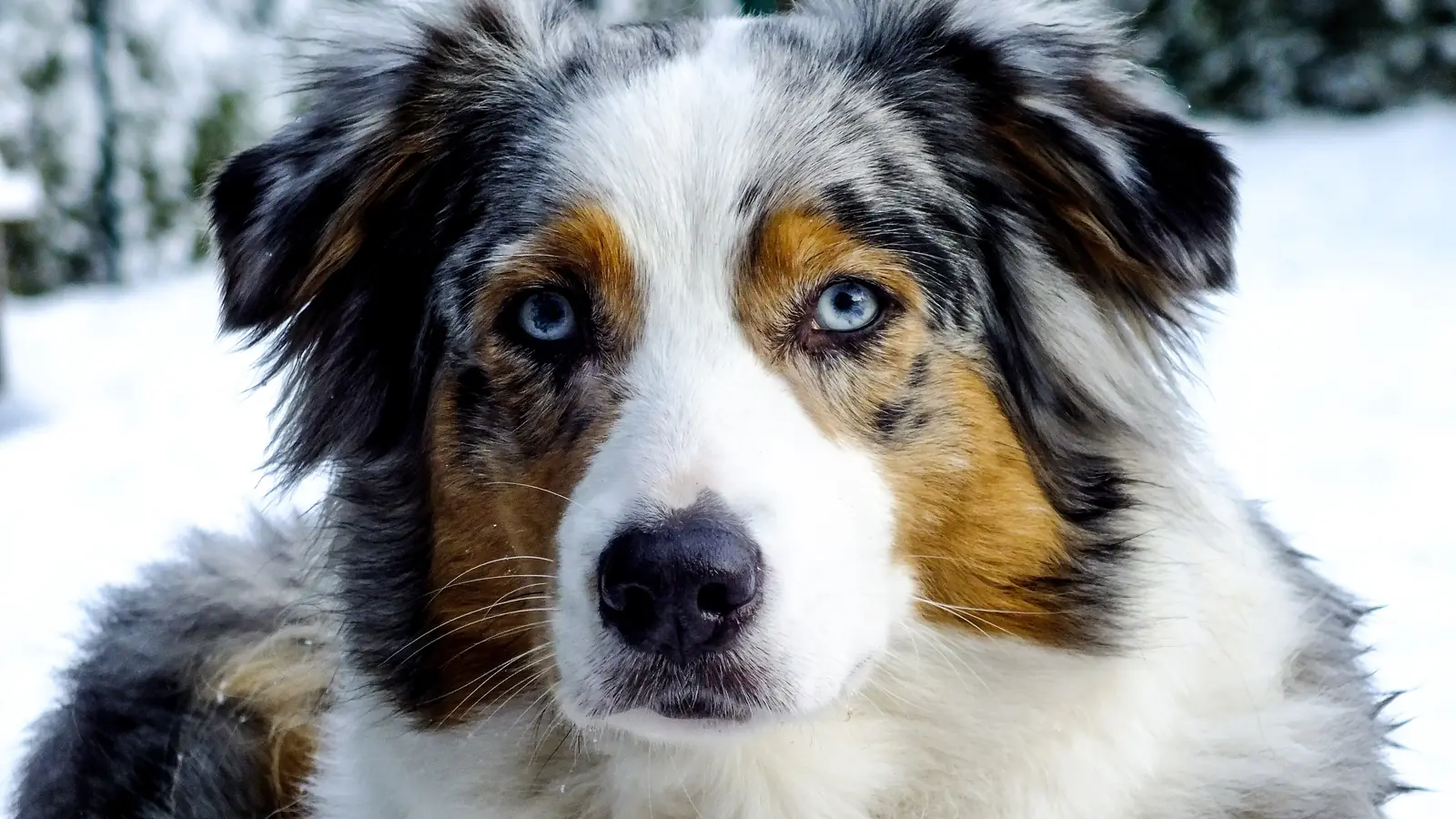

The Australian Shepherd is a medium-sized herding dog, 18 to 23 inches tall and 40 to 65 pounds, that lives 12 to 15 years and was developed on ranches in the western United States, not Australia. It is smart, loyal and very high energy, so it thrives with active people who give it exercise and a job every day, and struggles in a quiet, sedentary home.
Below is what the American Kennel Club (AKC), the United Kennel Club (UKC), both Aussie breed clubs, veterinary geneticists and pharmacologists say, with links. We also cover the questions most guides skip: what merle genetics means for health, the MDR1 medicine sensitivity, how the Miniature American Shepherd differs, and honest advice on who an Aussie suits, including adopters over 50.
Australian Shepherd quick facts
- Breed group: AKC Herding Group since 1993 (AKC). UKC-recognized since 1979 (UKC).
- Breed clubs: the Australian Shepherd Club of America (ASCA), the breed’s original club, established in 1957 and running its own registry (ASCA), and the United States Australian Shepherd Association (USASA), the AKC parent club (AKC; USASA).
- Height: 20 to 23 inches for males, 18 to 21 inches for females (AKC).
- Weight: 50 to 65 pounds for males, 40 to 55 pounds for females (AKC).
- Lifespan: 12 to 15 years (AKC).
- Colors: blue merle, black, red merle and red, each with or without white and tan (copper) markings (AKC standard).
- Coat: waterproof double coat of medium length; weekly brushing, more in shedding season (AKC).
- AKC ratings (1 to 5): energy 5, trainability 5, mental stimulation needs 5, good with young children 5, shedding 3, barking 3, openness to strangers 3 (AKC).
- Health tests to ask about: hips, elbows and an eye exam by a veterinary ophthalmologist, plus DNA tests such as MDR1 (see the health section).
- Good fit for: active people who want a training and adventure partner. Not a good fit for a mostly indoor, quiet life.
Where the Australian Shepherd really comes from
The name is a famous mix-up. In the AKC’s account, the breed’s story begins with Basque shepherds in the Pyrenees between France and Spain. In the 1800s many Basques took their dogs to Australia, crossed them with British imports including Collies and Border Collies, and later moved on to California. “California ranchers admired the Basques’ herding dogs and assumed they were an Australian breed,” the AKC says, “thus the misleading name Australian Shepherd” (AKC).
What everyone agrees on is that the modern breed was shaped in the American West. The AKC calls it “a European breed perfected in California by way of Australia” and says it became a fixture of rodeos, horse shows, movies and TV after World War II (AKC). The details of the earlier journey are hard to document, so treat the Basque story as the breed clubs’ best account rather than proven history.
Three organizations matter if you’re looking at papers:
- ASCA was established in 1957 and still runs its own registry (ASCA).
- The UKC has recognized the breed since 1979 (UKC).
- The AKC recognized it in 1991 and moved it into the Herding Group in 1993. Its parent club is the USASA (AKC).
A dog can be registered with ASCA, the AKC, both or neither. Registration says who the parents are; it does not tell you whether they were health tested.

Appearance, size and colors
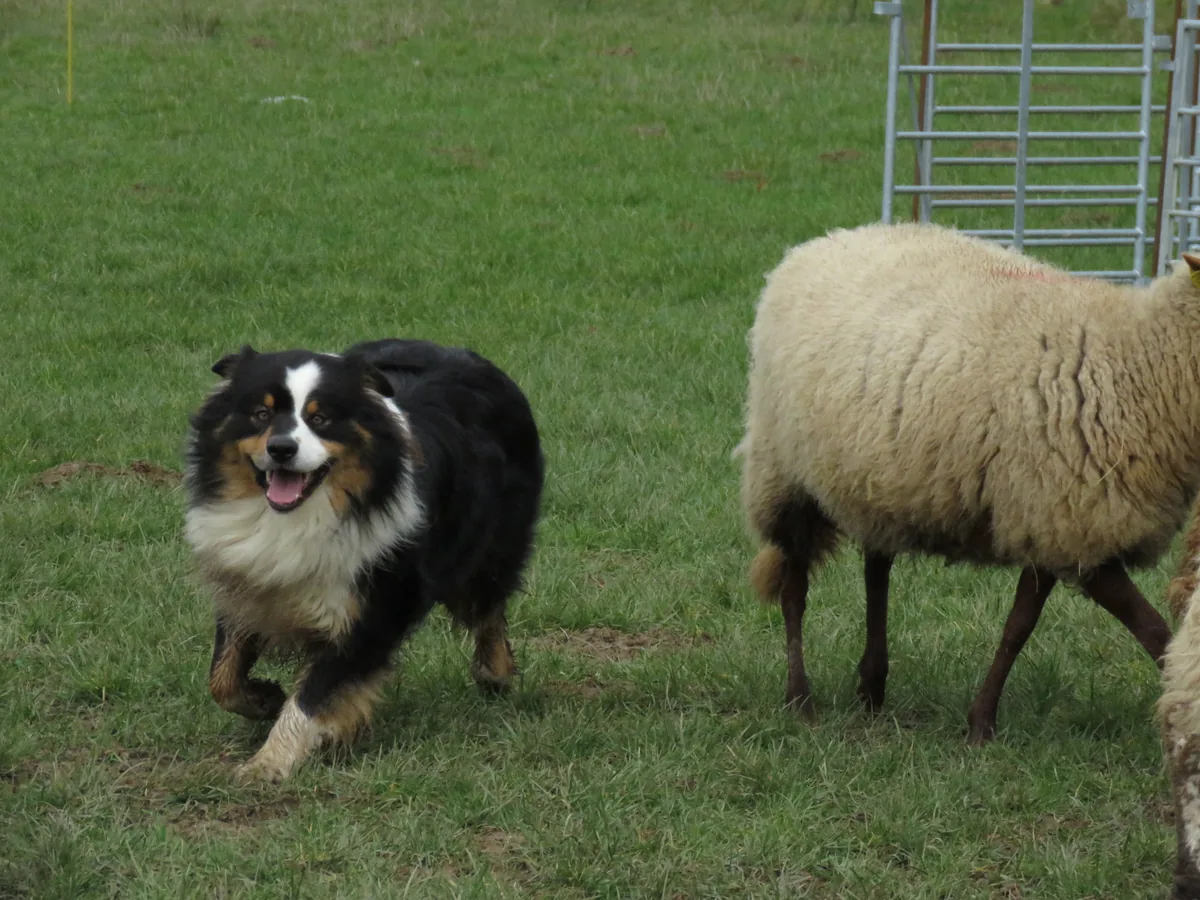
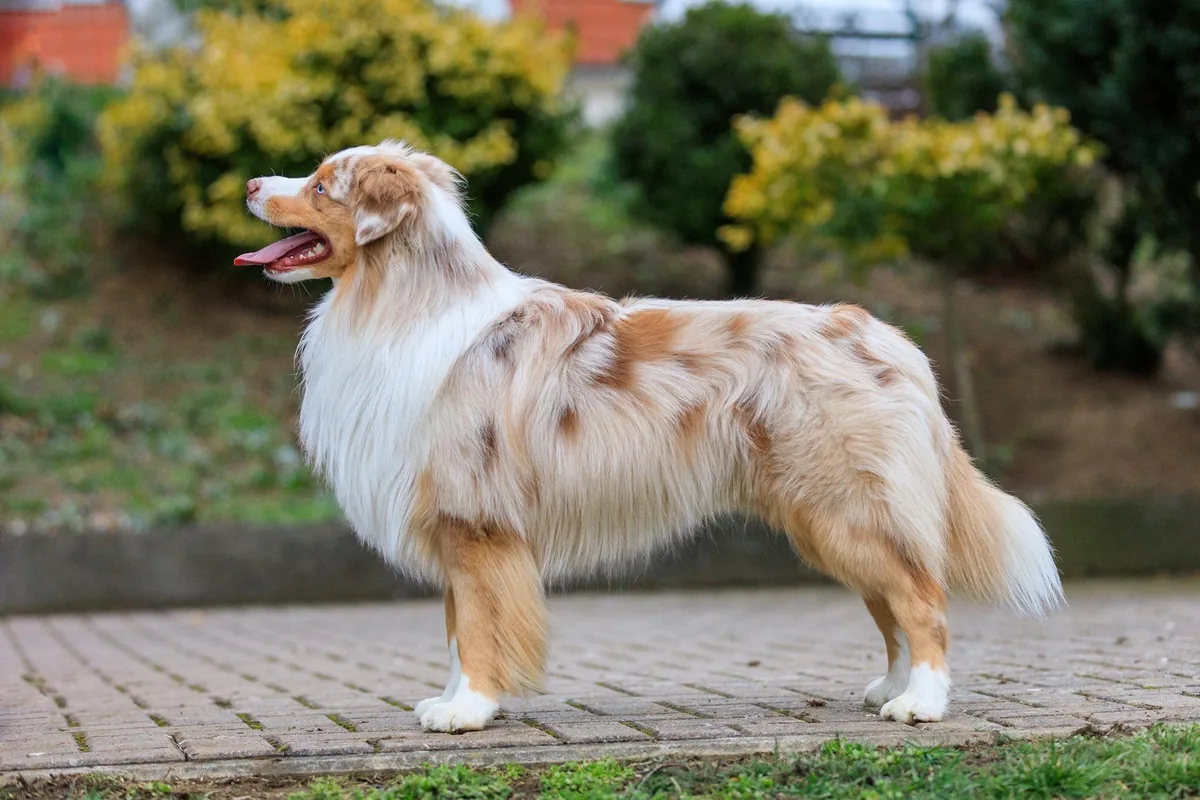
The AKC standard describes a dog “slightly longer than tall, of medium size and bone,” with a coat of moderate length and coarseness (AKC standard). Males are 20 to 23 inches and 50 to 65 pounds; females are 18 to 21 inches and 40 to 55 pounds (AKC). The thick coat makes many Aussies look bigger than they are.
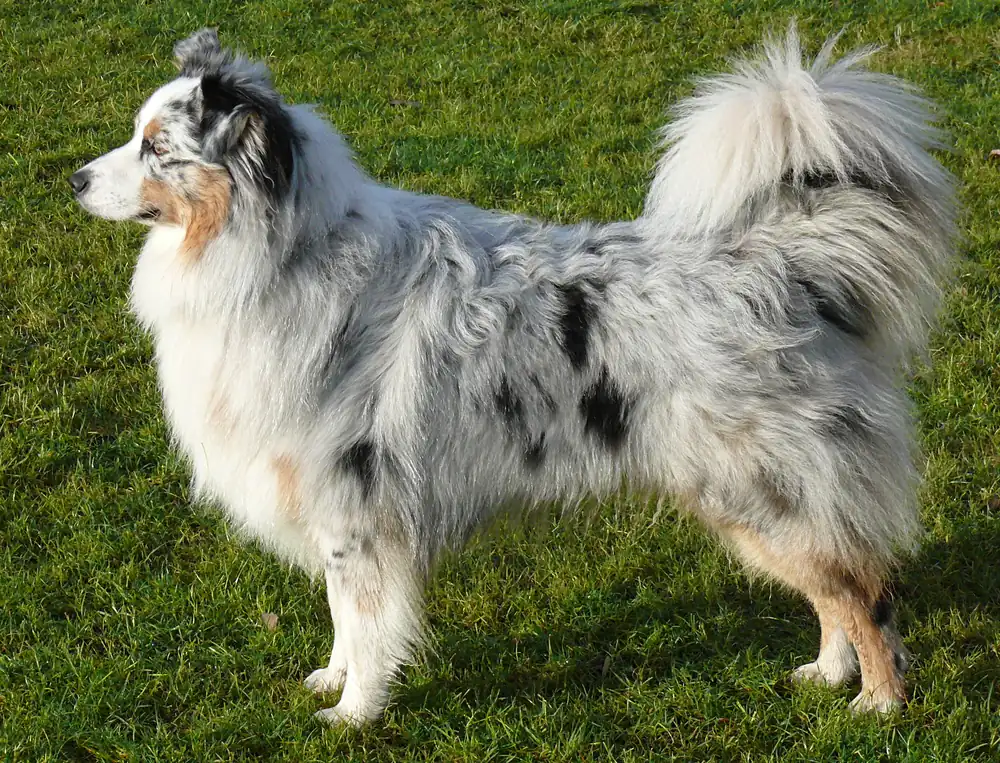

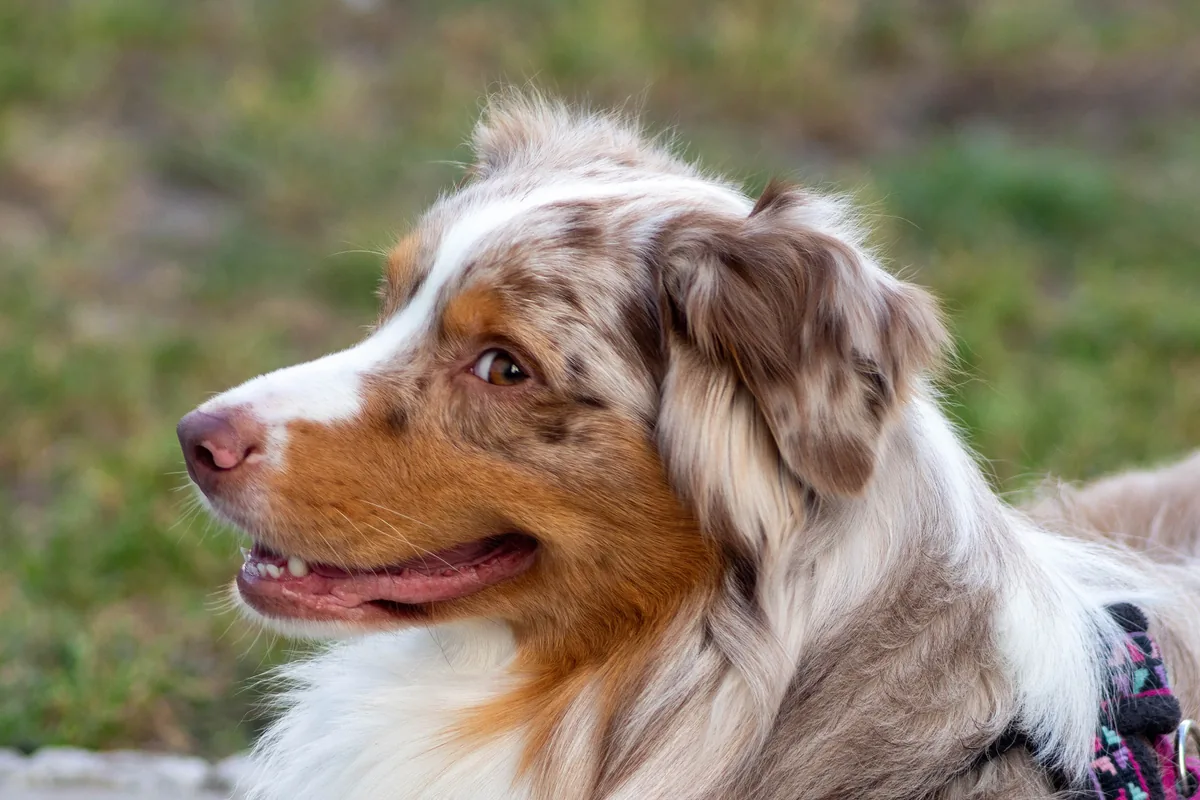
Colors. The AKC and UKC accept four: blue merle, black, red merle and red, “all with or without white markings and/or tan (copper) points, with no order of preference.” White must not surround the eyes or appear as splashes on the body, and the standard notes that “merles characteristically become darker with increasing age” (AKC standard; UKC). Owners often call a black or red dog with both white and copper markings a “tri.”
Eyes. The standard allows “brown, blue, amber or any variation or combination thereof, including flecks and marbling” (AKC standard). Two different-colored eyes, or one eye with two colors, are normal for the breed.
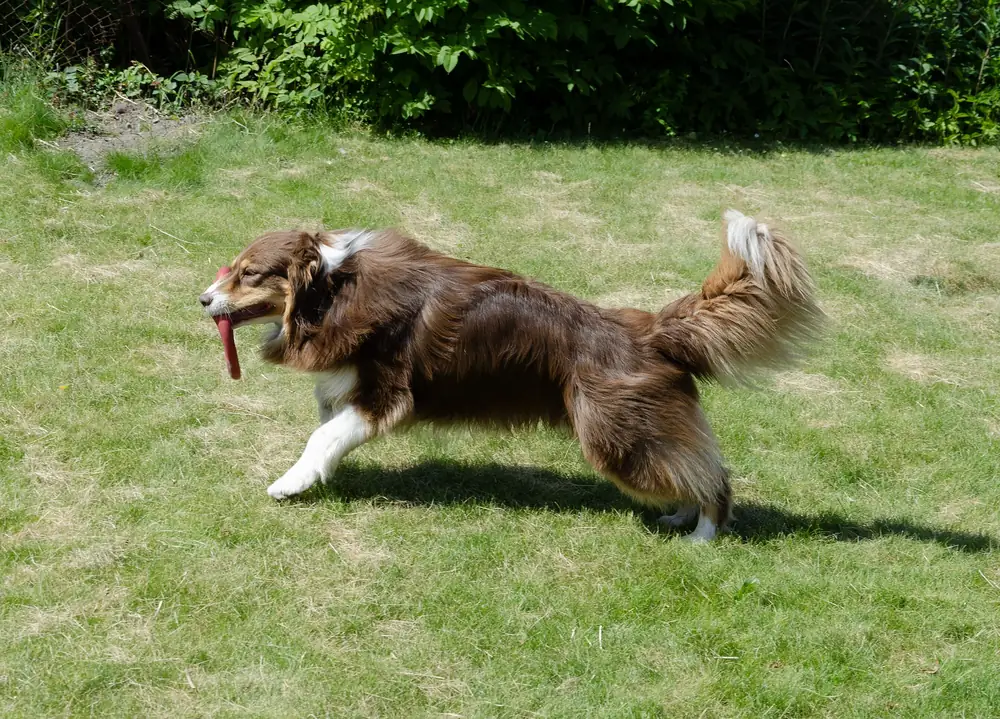
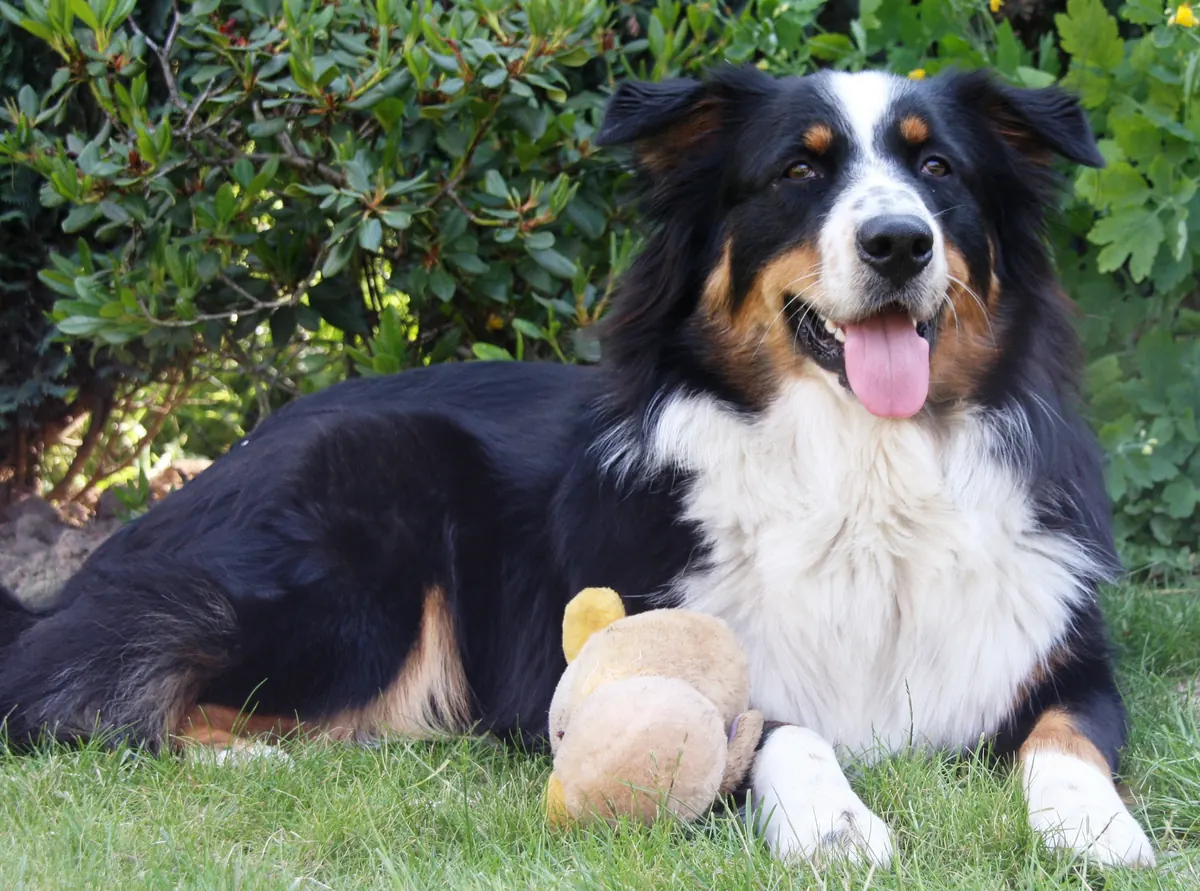
Tails. The AKC standard calls for a tail that is “docked or naturally bobbed, not to exceed four inches” (AKC standard). Many pet Aussies keep a full tail, like the dog above. The UKC says no dog in its events is penalized for a full tail (UKC).

Merle genetics and the double merle risk
Merle is the marbled coat that makes Aussies so recognizable, and it’s the part of the breed most worth understanding before you buy or adopt.
- What merle is. Researchers traced the pattern to an insertion in a pigment gene called SILV (also known as PMEL). It is inherited in an incompletely dominant way, so a dog with one copy (written Mm) is merle, and a dog with two copies (MM) is a “double merle” (Clark et al., 2006).
- Why it matters. The same study links the merle gene with “auditory and ophthalmologic abnormalities,” meaning problems with hearing and eyes (Clark et al., 2006).
- The numbers. In a hearing study of 153 merle dogs of several breeds, single merles had low rates: 2.7% were deaf in one ear and 0.9% in both. Double merles did far worse: 10% were deaf in one ear and 15% in both (Strain et al., 2009).
- Eyes. The AKC says double merles “often have microphthalmia” (abnormally small eyes) and other eye defects, and that “it is not recommended to breed two merles together” (AKC merle guide).
What a double merle looks like. The AKC describes them as having “much more white,” sometimes almost pure white, with small merle patches (AKC merle guide). If you see a mostly white Aussie advertised as “rare,” ask whether both parents were merle.
If you meet a double merle in a rescue, know that many deaf or low-vision dogs live full, happy lives. They need an owner ready to train with hand signals, keep them leashed or fenced, and work with a vet on their eyes. A BAER hearing test and an eye exam tell you about the individual dog. Our blue merle pitbull guide covers merle genetics in more depth.
Temperament: devoted, smart and busy
The AKC describes “an irresistible impulse to herd, anything: birds, dogs, kids,” and calls Aussies “remarkably intelligent, quite capable of hoodwinking an unsuspecting novice owner.” Its summary is blunt: “this isn’t the pet for everyone. But if you’re looking for a brainy, tireless, and trainable partner for work or sport, your search might end here” (AKC).
The USASA’s guide for new owners adds that Aussies are “‘people’ dogs” with “an intense need to be near their owners, following them from room to room,” and that “isolation from humans can quickly ruin an Aussie’s personality.” It also says they are “typically reserved with strangers and can be quite protective of their family and property” (USASA owner guide).
What that means day to day:
- A shadow. Expect a dog that follows you to the bathroom and wants to be part of everything.
- Herding people. Circling, staring and nipping at running children or ankles is herding instinct, not aggression. It needs redirecting with training.
- Reserved with strangers. The AKC rates openness to strangers 3 out of 5 (AKC). Early, gentle socialization helps.
- Boredom shows. The USASA says a dog that doesn’t get daily exercise “may bark or become destructive out of frustration” (USASA owner guide).
Breed is only part of the story. A study of 18,385 dogs found breed explains about 9% of the differences in behavior between individual dogs (Morrill et al., 2022). Meet the actual dog.

Exercise needs
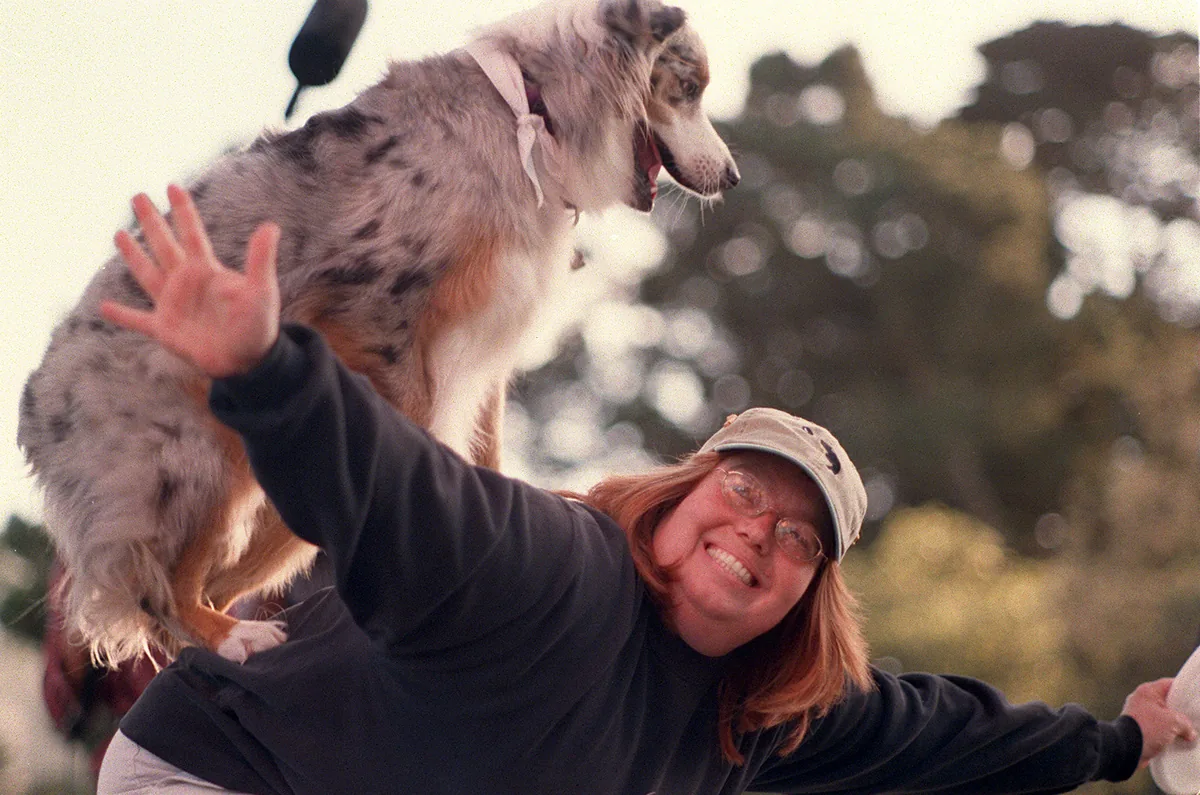
This is the deciding factor for most people. The AKC says an Aussie “needs a great deal of exercise on a daily basis,” and at minimum “a large, fenced-in yard to run around in for at least an hour or two daily.” It suggests long walks or hikes, running once the skeleton is fully grown, and above all a job: herding, obedience, agility or dock diving (AKC).
The USASA suggests running, playing with another dog, fetch, Frisbee and swimming, and says your Aussie should be confined to your home or a fenced area when it isn’t supervised, never allowed to roam (USASA owner guide).
Ideas that work for many owners over 50:
- Two real outings a day, such as a brisk walk or hike plus a game of fetch in a fenced area.
- Brain work, like puzzle feeders, scent games and short training sessions. The AKC rates the Aussie’s need for mental stimulation 5 out of 5 (AKC).
- A class or sport. Agility, rally, herding instinct tests and nose work give an Aussie a job and give you a community.
- A dog walker or daycare on days you can’t do it yourself.

Grooming and shedding
The AKC rates shedding 3 out of 5 and says weekly brushing keeps the waterproof double coat in good shape, with an undercoat rake every two or three days during shedding season. Baths are only needed occasionally (AKC). The USASA recommends brushing down to the skin weekly with a pin brush and using a slicker brush in shedding season, plus regular nail trims and tooth care (USASA owner guide). Watch for mats behind the ears and on the “pants” of the back legs.
Training
The AKC calls early socialization and obedience training “musts,” and notes that “one of the most frequent reasons Aussies end up in rescue situations is owners couldn’t (or wouldn’t) constructively channel the breed’s boundless energy through training” (AKC). The good news: the AKC rates trainability 5 out of 5.
The USASA says “positive training methods using lots of praise and/or treats will work well for most Aussies,” and that “harsh corrections are seldom necessary for this breed” (USASA owner guide). That fits the American Veterinary Society of Animal Behavior’s position that “there is no evidence that aversive training is necessary” (AVSAB, 2021).
Start with these:
- A solid recall and “leave it,” because herding dogs chase.
- A “settle” on a mat, so your Aussie learns to switch off indoors.
- Calm greetings with visitors, rewarded every time.
- Redirect herding of people and pets to a toy or a job.
- Short sessions. Five minutes a few times a day beats one long lesson.
Health: what to know and ask
The AKC says Aussies are generally healthy and that responsible breeders test for “hip dysplasia, epilepsy, cataracts and certain forms of cancer” (AKC). The USASA’s owner guide also lists inherited eye defects, skin allergies and bleeding disorders among problems parents should be screened for (USASA owner guide).
Health testing: OFA and CHIC
The Orthopedic Foundation for Animals (OFA) runs the Canine Health Information Center (CHIC) database, where results of a breed club’s recommended tests are listed publicly (OFA CHIC). For the Australian Shepherd, the AKC lists the national breed club’s recommended tests as a hip evaluation, an elbow evaluation and an ophthalmologist evaluation (AKC health testing requirements). Ask to see the parents’ results on the OFA website, not just a breeder’s word.
MDR1 medicine sensitivity
This is the health topic every Aussie owner should know.
- What it is. A mutation in the MDR1 gene stops the dog making a working version of P-glycoprotein, a pump that keeps certain drugs out of the brain. It was discovered at Washington State University (Mealey et al., 2001).
- How common. WSU’s veterinary pharmacology lab lists the approximate frequency in Australian Shepherds at 50%, and the same for Miniature Australian Shepherds (WSU VCPL).
- Why it matters. WSU says dogs with the mutation “can become very ill or die if given certain medications.” For example, it says loperamide (Imodium) “should be avoided in all dogs with the MDR1 mutation” (WSU VCPL).
- What to do. A cheek-swab DNA test shows your dog’s status. Put the result in your dog’s records, tell every vet and emergency clinic, and never give a human or leftover medicine without asking your vet first.
Hips, elbows, eyes and epilepsy
| Condition | What the source says |
|---|---|
| Hip dysplasia | A malformed hip joint; genetics is the biggest single risk factor (ACVS). Breeders test for it (AKC). |
| Elbow dysplasia | Part of the breed club’s recommended tests (AKC health testing); most commonly seen in large to giant breeds, though it can occur in most breeds (ACVS). |
| Hereditary cataracts | A mutation in the HSF4 gene is linked to cataracts in Aussies. Dogs carrying it were about 17 times more likely to develop cataracts in both eyes, and other mutations are likely involved (Mellersh et al., 2009). |
| Merle-related deafness and eye defects | Low in single merles, much higher in double merles (see the merle section) (Strain et al., 2009). |
| Idiopathic epilepsy | A study of 50 affected Aussies found mostly moderate to severe cases, with poor seizure control in 56%, unrelated to MDR1 status, and evidence of a genetic basis (Weissl et al., 2012). |
Ask a breeder or rescue for: hip, elbow and eye exam results for the dog or its parents, MDR1 and other DNA test results, whether either parent was merle (to rule out a double merle), any seizures in the family, and the dog’s current weight. Medical decisions belong with your vet; this list is for asking good questions.
Lifespan
The AKC gives a life expectancy of 12 to 15 years (AKC). We couldn’t find a study that splits Aussie lifespan by sex or color. Weight matters for every dog: in a lifelong study of Labradors, dogs fed 25% less lived significantly longer (Kealy et al., 2002).
Diet basics
The AKC says Aussies do well on a high-quality food appropriate to their age, warns that some are prone to weight gain, and advises asking your vet about weight and diet (AKC). Working and sport dogs burn more; a retired or senior Aussie may need less. Your vet can tell you how much to feed your dog.
Australian Shepherd puppies
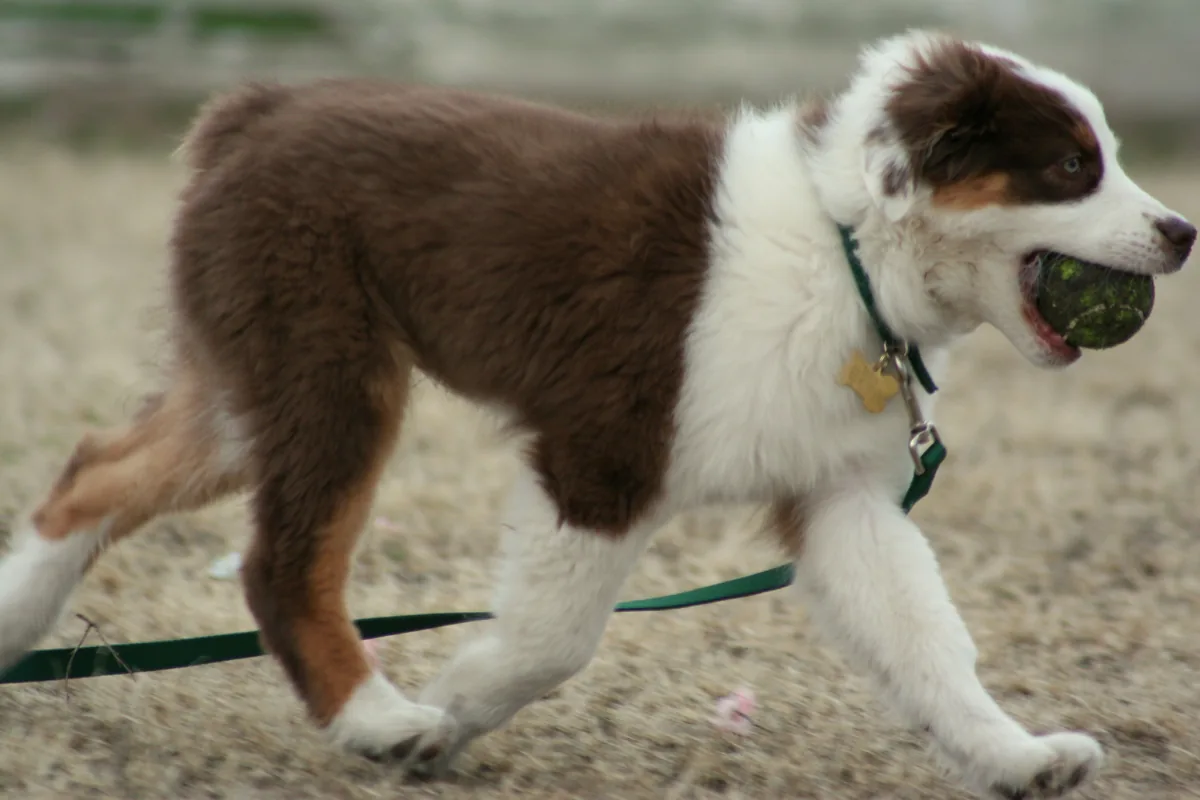

An Aussie puppy is a bright, busy, mouthy whirlwind. The AKC recommends early socialization and obedience training, and says running should wait until the skeleton is fully formed (AKC).
“Australian Shepherd puppies for sale.” We don’t quote prices or recommend breeders. If you buy, the AKC lists breeder referral contacts through the USASA (AKC). Meet the mother, ask for OFA hip, elbow and eye results on both parents and MDR1 test results, and walk away from anyone who breeds merle to merle or sells mostly white puppies as “rare.”
Australian Shepherd vs Miniature American Shepherd vs Border Collie
The Miniature American Shepherd (often called a “Mini Aussie”) is a separate AKC breed. The AKC says it began in the 1960s when “small-size Australian Shepherds found working the U.S. rodeo circuit were selectively bred to further reduce their size,” and was first called the Miniature Australian Shepherd (AKC Mini American Shepherd). Its parent club is the Miniature American Shepherd Club of the USA (MASCUSA).

Ratings are the AKC’s (1 to 5, 5 = most).
| Australian Shepherd | Miniature American Shepherd | Border Collie | |
|---|---|---|---|
| AKC recognition | 1991 (Herding Group 1993) | 2015 | 1995 |
| Height | 20 to 23 in (M), 18 to 21 in (F) | 14 to 18 in (M), 13 to 17 in (F) | 19 to 22 in (M), 18 to 21 in (F) |
| Weight | 50 to 65 lb (M), 40 to 55 lb (F) | 20 to 40 lb | 30 to 55 lb |
| Life expectancy | 12 to 15 yrs | 12 to 13 yrs | 12 to 15 yrs |
| Energy | 5 | 5 | 5 |
| Good with young children | 5 | 5 | 3 |
| Good with other dogs | 3 | 5 | 3 |
| Openness to strangers | 3 | 3 | 4 |
| Barking | 3 | 3 | 4 |
| Shedding | 3 | 3 | 3 |
| MDR1 frequency (WSU) | About 50% | About 50% (listed as “Australian Shepherd, Mini”) | Not given in WSU’s table |
| AKC parent club | USASA | MASCUSA | Border Collie Society of America |
Sources: AKC Australian Shepherd, Miniature American Shepherd and Border Collie pages; WSU VCPL.
How to choose. The Mini is smaller and the AKC says it is “very adaptable” and can do well as a city dog with enough exercise (AKC Mini American Shepherd), but it is still a herding dog with top energy ratings. If you’re drawn to Aussie mixes, our guides to the Border Collie Australian Shepherd mix, the Aussie Bernese and the Aussiedoodle cover them, and our English Setter vs Australian Shepherd page compares a gentler sporting breed. The English Shepherd is another American farm herder that’s often confused with the Aussie.
Is an Australian Shepherd right for me? A checklist for 50+ adopters
Be honest with yourself. A few “no” answers usually mean a different dog would make you both happier.
- Yes / No: I can give a dog one to two hours of real exercise every day, in all weather.
- Yes / No: I enjoy training and would like a dog sport, class or job to do together.
- Yes / No: I’m home a lot, or have help, because this breed doesn’t do well alone for long hours.
- Yes / No: I have a securely fenced yard or a safe fenced place nearby.
- Yes / No: My knees, hips and balance can handle a 40- to 65-pound dog that may lunge after a squirrel.
- Yes / No: I’m fine with dog hair, and with brushing every week.
- Yes / No: Visiting grandchildren can be supervised, since Aussies may herd and nip at running kids.
- Yes / No: I’ll test for MDR1 and make sure every vet knows the result.
- Yes / No: I have a named person who has agreed to take my dog if I can’t.
An Aussie may suit you if you hike, run, ride, keep livestock or want to try agility, and you like a dog that’s always at your side.
Consider a different dog if your days are mostly quiet, you live alone in an apartment with long days out, or walking is getting harder. That’s no failing. Our guide to the best dog breeds for older adults has calmer options, and an older Aussie from a rescue can be a lovely middle ground.

Costs to plan for
We don’t quote puppy prices; sellers set their own, and we found no reliable figure. The ASPCA estimates $1,391 a year to keep a dog, and $3,221 in the first year with one-time costs (ASPCA). For an Aussie, add classes or dog sports, health testing (MDR1 and eye exams) and a dog walker for busy days.
Adopting an Australian Shepherd
Bone Voyage is a publisher now and doesn’t place dogs. The AKC lists Aussie Rescue & Placement Helpline (ARPH) as the breed’s rescue contact (AKC); ARPH describes itself as a volunteer-run 501(c)(3) dedicated to the breed (ARPH). Local shelters and online adoption listings are also worth checking, because energetic young Aussies are often surrendered by people who underestimated them. That can be your gain: an adult or senior rescue lets you see the dog’s real energy level before you commit.
Is that shelter dog really an Aussie? Maybe. In one study, shelter staff’s main breed label matched the main breed in the dog’s DNA for 56.7% of 384 dogs (Gunter et al., 2018). A merle dog with blue eyes might be an Aussie, a Border Collie, a Catahoula or a mix. Our guide to figuring out your dog’s breed explains the options.
Questions to ask the rescue or shelter
- How much exercise does this dog get now, and how does it act indoors after a walk?
- How is it with children, cats and other dogs? Does it herd or nip?
- How does it react to strangers and visitors?
- Has it been tested for MDR1? Has it had a hearing or eye exam? Are both parents known, and were they merle?
- Any seizures, limping or eye trouble?
- How does it do when left alone?
- Why was it given up, and will you take it back if it doesn’t work out?
The ASPCA suggests leaning on shelter staff to find a match for your life (ASPCA), and our 9 questions to ask when adopting a dog covers the general ones.
Give your dog a backup plan
Aussies bond tightly with their people, so a sudden move to strangers is especially hard on them. Naming a backup caregiver now, someone your dog already knows and who has agreed to step in, protects that bond. Our guide What Happens to Your Dog When You Die walks you through it, and the free My Dog’s Backup Plan worksheet records routine, exercise needs, vet details and, for an Aussie, the MDR1 result. Bone Voyage is also building the pledge: a volunteer agrees to adopt a specific older adult’s dog if that person dies or can no longer care for it. You can join the free list on the guide page.
Frequently Asked Questions
Are Australian Shepherds good dogs to own?
For the right home, yes. The AKC calls the Aussie a brainy, tireless and trainable partner, and rates it 5 out of 5 for energy, trainability and need for mental stimulation. It also warns that the breed’s strong work drive can make it too much dog for a sedentary owner, and that “this isn’t the pet for everyone.” An Aussie suits people who want daily exercise, training and a dog that follows them everywhere (AKC).
What is the lifespan of a male Australian Shepherd?
The AKC gives a life expectancy of 12 to 15 years for the breed and does not list a separate figure for males and females. We found no study that splits Aussie lifespan by sex. Keeping a dog lean, choosing a puppy from health-tested parents and regular vet checkups matter more than sex (AKC).
What is the rarest Australian Shepherd color?
No breed club publishes an official rarest color. The AKC and UKC standards accept four colors, blue merle, black, red merle and red, each with or without white markings and tan (copper) points, with no order of preference. Colors outside those four, or a mostly white coat, aren’t rarer versions of the breed standard; a mostly white Aussie from two merle parents may be a double merle with a higher risk of deafness and eye defects (AKC standard; UKC; AKC merle guide).
Is a Mini Aussie the same as a Miniature American Shepherd?
Mostly, by history. The AKC says the Miniature American Shepherd began in the 1960s when small Australian Shepherds were bred to reduce their size, and that it was first called the Miniature Australian Shepherd. The AKC recognized it as a separate breed in 2015, at 13 to 18 inches and 20 to 40 pounds. Some sellers still use “Mini Aussie” for dogs that aren’t registered as either breed, so ask which registry the parents are in (AKC).
Why is it called an Australian Shepherd if it’s American?
Because of a detour. In the AKC’s account, Basque shepherds took their herding dogs from the Pyrenees to Australia in the 1800s and then on to California, where ranchers assumed the dogs were an Australian breed. The AKC says the breed was then refined and perfected in America, where it became part of Western ranch and rodeo life (AKC).
What is the MDR1 gene in Australian Shepherds?
MDR1 is a gene mutation that lets certain medicines build up in the brain and cause serious reactions. Washington State University’s veterinary pharmacology lab, which discovered the canine mutation, lists its approximate frequency at about 50% in Australian Shepherds. A simple cheek-swab test shows a dog’s status. Tell every vet who treats your Aussie, and ask your vet before giving any medicine (WSU VCPL; Mealey et al., 2001).
Is an Australian Shepherd a good dog for someone over 50?
It can be, if you’re active and want a working partner. An Aussie needs an hour or two of exercise every day, plus training and company. It suits a 50+ adult who hikes, runs, does dog sports or keeps livestock. If you want a calmer companion, consider an adult or senior Aussie from a rescue whose energy you can see, or a lower-energy breed.
For a high-energy Australian Shepherd crossed with a Siberian Husky, see our Husky Aussie mix guide.
Before you go
The Australian Shepherd is one of the most rewarding dogs there is for someone who wants a partner, not just a pet. Give it exercise, a job and your company, test for MDR1, and steer clear of merle-to-merle breeding. If that life isn’t yours right now, there’s no shame in choosing a calmer dog, and there are plenty waiting in shelters.
Sources
- American Kennel Club, Australian Shepherd, Miniature American Shepherd and Border Collie breed pages, Official Standard of the Australian Shepherd, Merle in Dogs and Herding Group Health Testing Requirements
- United Kennel Club, Australian Shepherd breed standard
- Australian Shepherd Club of America, home page and history
- United States Australian Shepherd Association, club website and Congratulations on your new Australian Shepherd owner guide (2025)
- Miniature American Shepherd Club of the USA, club website
- Orthopedic Foundation for Animals, CHIC program: Australian Shepherd
- Washington State University College of Veterinary Medicine, MDR1 in Dogs (Veterinary Clinical Pharmacology Lab)
- American College of Veterinary Surgeons, Canine Hip Dysplasia and Canine Elbow Dysplasia
- Aussie Rescue & Placement Helpline, home page
- American Veterinary Society of Animal Behavior, Position Statement on Humane Dog Training (2021)
- ASPCA, Cutting Pet Care Costs and Finding your Fido
- Clark LA et al. (2006). Retrotransposon insertion in SILV is responsible for merle patterning of the domestic dog. PNAS 103(5):1376-81.
- Strain GM et al. (2009). Prevalence of deafness in dogs heterozygous or homozygous for the merle allele. J Vet Intern Med 23(2):282-6.
- Mealey KL et al. (2001). Ivermectin sensitivity in collies is associated with a deletion mutation of the mdr1 gene. Pharmacogenetics 11(8):727-33.
- Mellersh CS et al. (2009). Mutation in HSF4 is associated with hereditary cataract in the Australian Shepherd. Vet Ophthalmol 12(6):372-8.
- Weissl J et al. (2012). Disease progression and treatment response of idiopathic epilepsy in Australian Shepherd dogs. J Vet Intern Med 26(1):116-25.
- Kealy RD et al. (2002). Effects of diet restriction on life span and age-related changes in dogs. JAVMA 220(9):1315-20.
- Morrill K et al. (2022). Ancestry-inclusive dog genomics challenges popular breed stereotypes. Science 376(6592):eabk0639.
- Gunter LM et al. (2018). A canine identity crisis. PLOS ONE 13(8):e0202633.