
A blue merle pitbull is a pit bull-type dog with two coat genes at once: two copies of the recessive dilution gene that turns black pigment blue-gray, and one copy of the dominant merle gene that breaks that color into random dark patches on a lighter, marbled base. It is not a separate breed. Merle is not part of traditional pit bull lines, so the United Kennel Club (UKC) disqualifies it in the American Pit Bull Terrier, and a merle dog’s ancestry almost always includes a merle-carrying breed somewhere.
The coat is striking. It also comes with health questions that most pages about these dogs skip or get wrong, especially what happens when two merles are bred together. This guide is built from kennel club breed standards, peer-reviewed coat-color genetics, the Orthopedic Foundation for Animals (OFA) and veterinary sources. Where the evidence runs out, we say so. We also include an honest home-fit checklist if you’re thinking about adopting one.
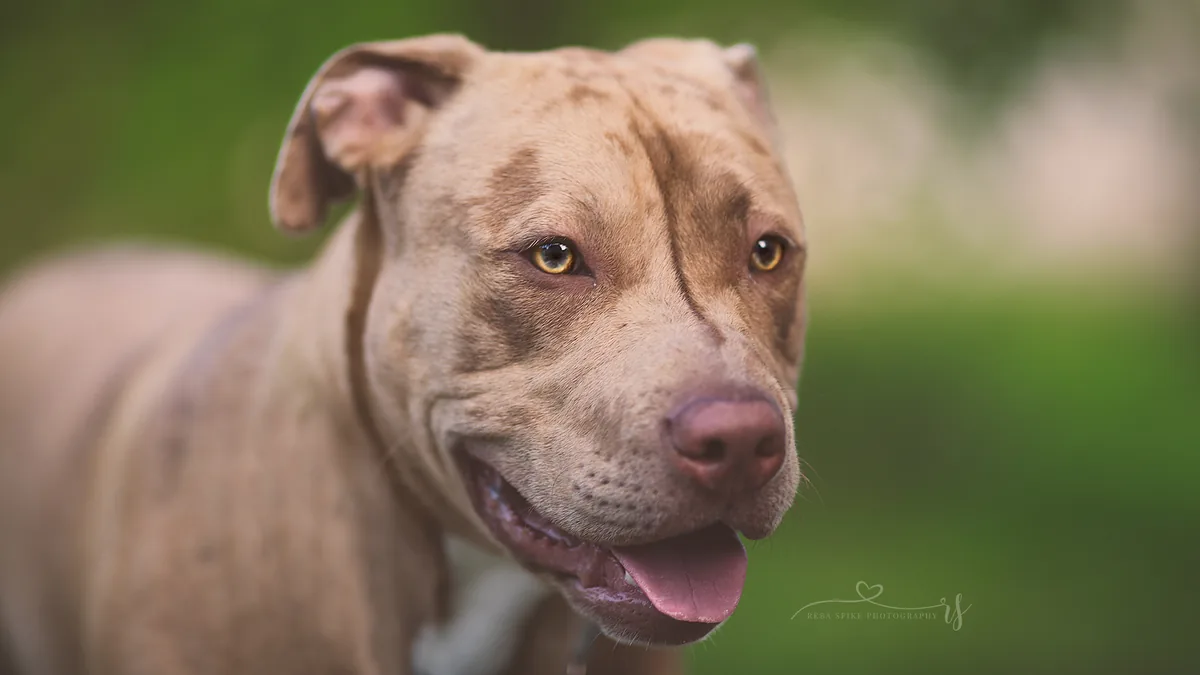
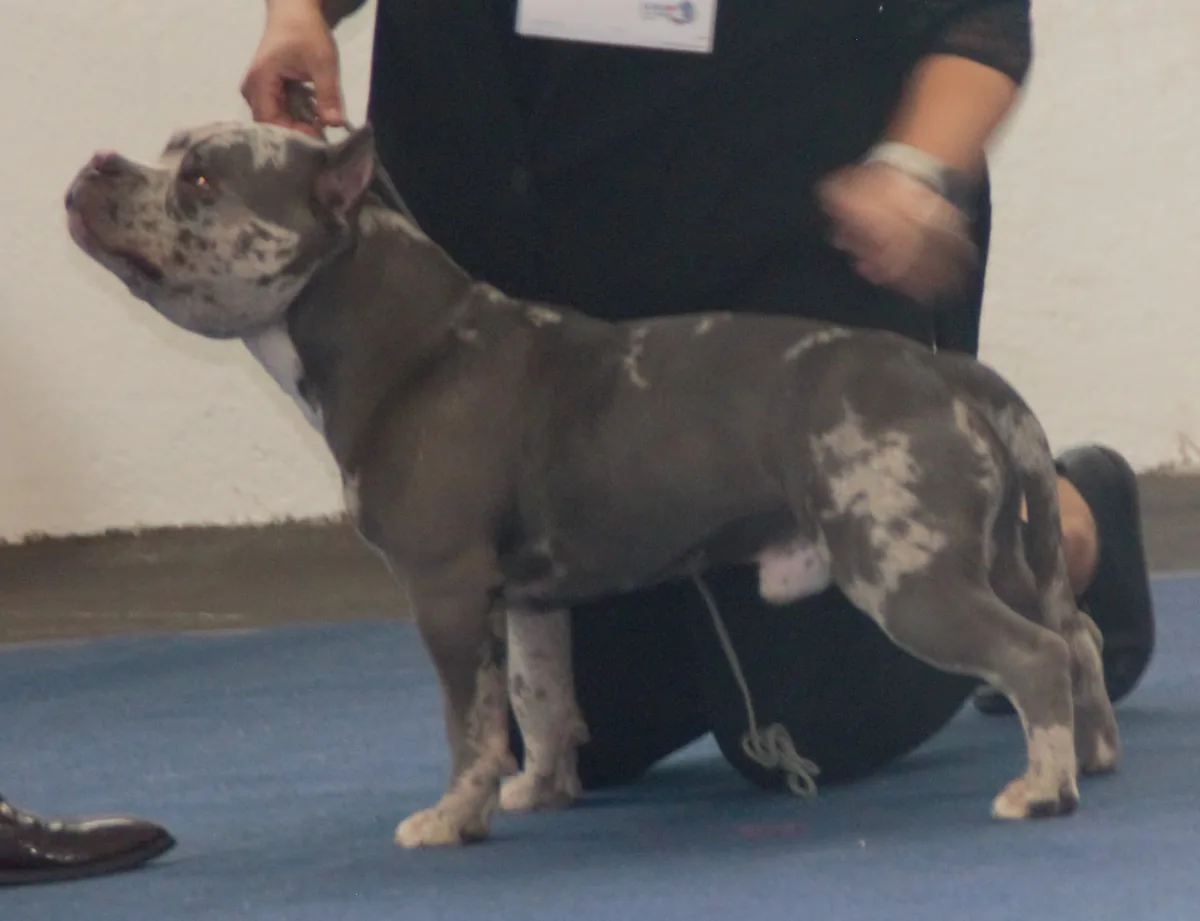
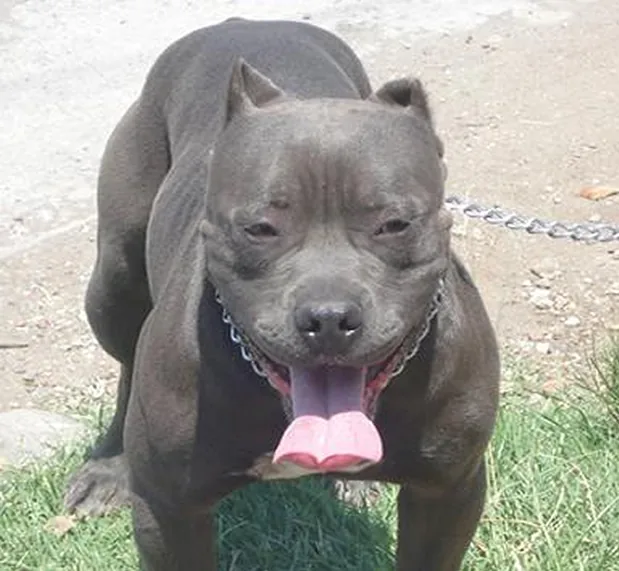
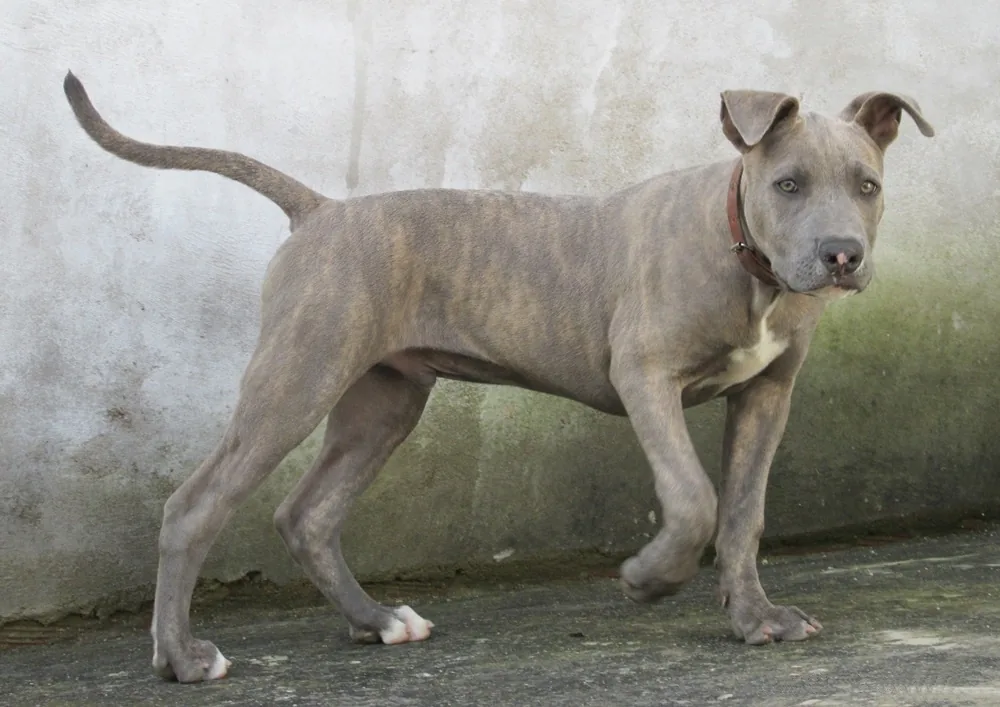
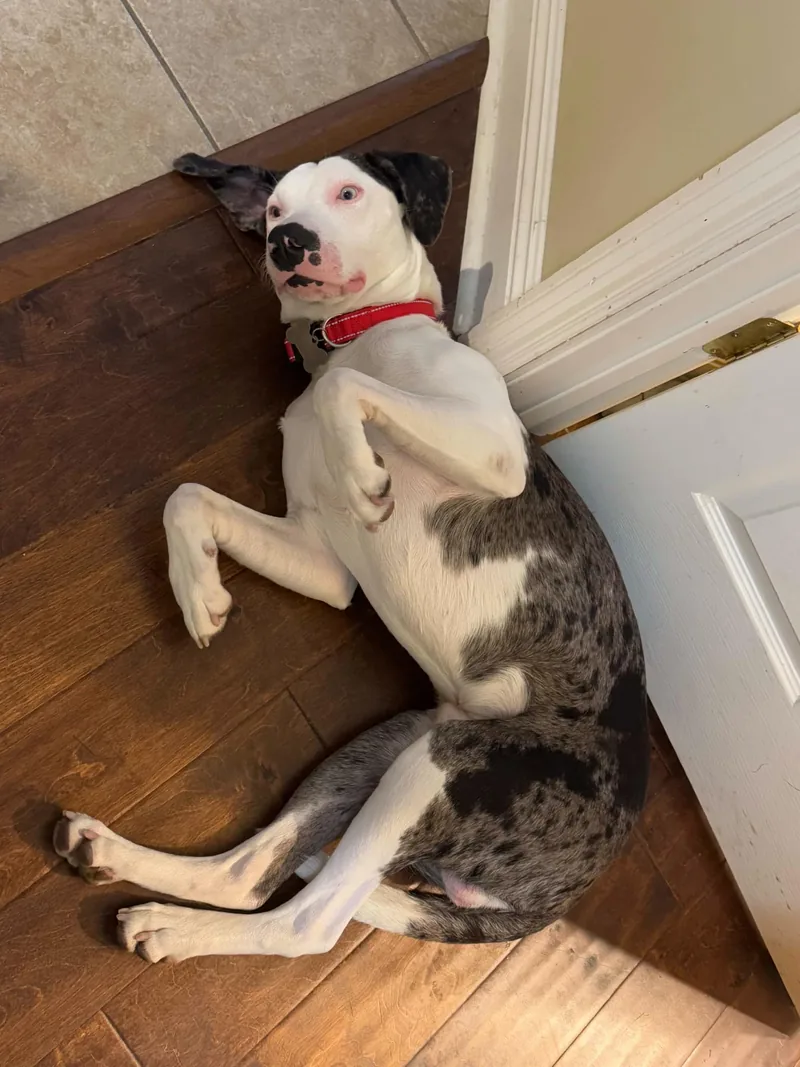
A note on photos: genuine blue merle pit bulls are rare in freely licensed photo libraries. We found two real merle pit bull-type dogs: the merle pit bull mix at the top (a liver merle) and a blue merle American Bully below. The other photos show related coats, such as a solid blue pit bull, a blue brindle puppy and merle Catahoulas, and each caption says exactly what the dog is.
Blue merle pitbull quick facts
- What it is: a pit bull-type dog (American Pit Bull Terrier, American Staffordshire Terrier, American Bully or a mix) with a blue merle coat. A color, not a breed.
- Kennel club status: merle is a disqualification in the UKC American Pit Bull Terrier and UKC American Bully standards and the AKC Staffordshire Bull Terrier standard. The ABKC American Bully standard allows all colors and patterns (UKC APBT; UKC Bully; AKC SBT standard; ABKC).
- Size: depends on the type. UKC American Pit Bull Terrier: 18 to 21 inches and 35 to 60 pounds for males, 17 to 20 inches and 30 to 50 pounds for females. AKC American Staffordshire Terrier: 18 to 19 inches and 55 to 70 pounds for males, 17 to 18 inches and 40 to 55 pounds for females (UKC APBT; AKC AmStaff).
- Life expectancy: no data for merle pit bulls specifically. The AKC gives 12 to 16 years for the American Staffordshire Terrier and 12 to 15 for the Staffordshire Bull Terrier (AKC AmStaff; AKC SBT).
- Coat genetics: blue merle = dilute (dd, MLPH gene) + merle (Mm, PMEL/SILV gene) on a black-based dog (Clark et al., 2006; Drögemüller et al., 2007).
- Energy: high. These are athletic terriers that need daily exercise and play.
- Grooming: easy. A short, close, glossy coat; weekly brushing is plenty for most dogs.
- With kids and pets: often affectionate with people. The UKC standard itself notes that “most APBTs exhibit some level of dog aggression,” so introductions to other dogs need care (UKC APBT).
- Main health concerns: deafness and eye defects (much higher in double merles), color dilution alopecia in blue dogs, hip and elbow dysplasia, kneecap and knee ligament problems, skin allergies and thyroid disease.
What is a blue merle pitbull? The genetics, in plain English
Two separate genes have to line up to make a blue merle.
1. The dilution gene (the “blue”). Dogs carry a gene called MLPH at what geneticists call the D locus. Dilution is recessive: a dog has to inherit a copy from each parent (dd) for it to show. When it does, black pigment is softened to a slate blue-gray, and the nose turns gray too (Drögemüller et al., 2007). That’s the whole story of the “blue nose pitbull.” It is a pit bull with diluted black pigment, not a separate breed or bloodline.
2. The merle gene (the “merle”). Merle comes from a small piece of mobile DNA (a SINE insertion) in the PMEL gene, also called SILV. A team led by Leigh Anne Clark found this insertion and showed it travels with the merle pattern in many breeds (Clark et al., 2006). Merle is dominant (strictly, incompletely dominant), so one copy (Mm) is enough. It randomly dilutes patches of the coat, leaving irregular spots of full color on a lighter, marbled background. It can also turn one or both eyes blue.
Put them together. On a black dog, merle alone makes a black-and-gray “blue merle” in herding-breed language. On a dog that is also dilute, the dark patches are blue-gray instead of black and the lighter areas are paler still. Some breeders and photo libraries call this slate merle. On a liver (brown) dog, merle makes a red or liver merle like the dog at the top of this page.
The merle gene comes in sizes. Researchers have since found that the length of the merle insertion varies, and length affects how the coat looks. Langevin and colleagues described a range of merle alleles, from cryptic merle (Mc), which can leave a dog looking solid, to harlequin (Mh), and found that 16.6% of the dogs they tested were mosaic, carrying more than one merle length (Langevin et al., 2018; Murphy et al., 2018). The practical point: a dog can carry merle without looking merle. Only a DNA test reliably tells you.

Blue merle vs blue nose vs double merle vs brindle
These four get mixed up all the time, including by sellers. Here’s how they differ.
| Blue nose (solid blue) | Blue merle | Double merle | Blue brindle | |
|---|---|---|---|---|
| Genes involved | Dilution only (dd) | Dilution (dd) + one merle copy (Mm) | Two merle copies (MM), with or without dilution | Dilution (dd) + the brindle pattern, a different gene from merle |
| Looks like | Even gray-blue coat, gray nose | Random darker blue-gray patches on a lighter, marbled base | Often mostly white, with small merle patches | Dark stripes over a blue-gray or fawn base |
| Eye color | Usually amber, hazel or brown | Can be blue, part-blue or odd-eyed | Often blue; eyes may be small or malformed | Usually amber or brown |
| Allowed in UKC APBT standard? | Yes | No (merle disqualifies) | No | Yes |
| Main coat-linked health watch | Color dilution alopecia | Color dilution alopecia; small rise in deafness | High risk of deafness and eye defects | Color dilution alopecia |
| How to confirm | DNA test (D locus) | DNA test (M and D loci) | DNA test (M locus, with allele size) | DNA test plus looking |
Sources: UKC APBT standard; Clark et al., 2006; Strain et al., 2009; Drögemüller et al., 2007; VCA on CDA; AKC on merle.


History and kennel club status
“Pit bull” is a loose label rather than one breed. It covers the American Pit Bull Terrier, the American Staffordshire Terrier (AmStaff), the Staffordshire Bull Terrier and, often, the American Bully and many mixes. Our American Bully vs pit bull guide explains how they differ. Here’s what each standard says about merle:
- UKC, American Pit Bull Terrier: “Any color, color pattern, or combination of colors is acceptable, except for merle.” Merle is listed as a disqualification (UKC).
- UKC, American Bully: the same wording: any color except merle, and merle disqualifies (UKC).
- AKC, Staffordshire Bull Terrier: the 2025 standard states that the “merle pattern does not exist genetically in the breed and shall be disqualified” (AKC SBT standard).
- AKC, American Staffordshire Terrier: the standard, approved in 1936, permits “any color, solid, parti, or patched” and doesn’t mention merle at all (AKC AmStaff standard).
- ABKC, American Bully: “All colors and patterns are permissible,” and the standard mentions the “merle/blotched coat pattern” as an exception to its dislike of blue eyes. Deafness in one or both ears is a disqualification (ABKC).
- ADBA: we couldn’t confirm the American Dog Breeders Association’s current position from its own published standard, so we don’t state one.
Where did merle pit bulls come from? Nobody has published a documented history. What the genetics tells us is simple: merle is dominant, so a merle puppy always has at least one merle parent (sometimes a “cryptic” merle that looks solid). Merle is common in breeds such as the Australian Shepherd, whose AKC standard lists blue merle as a standard color, and the Catahoula Leopard Dog (AKC Aussie standard; UKC Catahoula). Since the registries that recorded pit bull pedigrees for over a century excluded merle, the most likely explanation is crossbreeding with a merle breed somewhere in the line. The UK’s Royal Kennel Club took a similar view in 2020, when it stopped registering merle puppies in breeds where the color has no historical record (Royal Kennel Club).
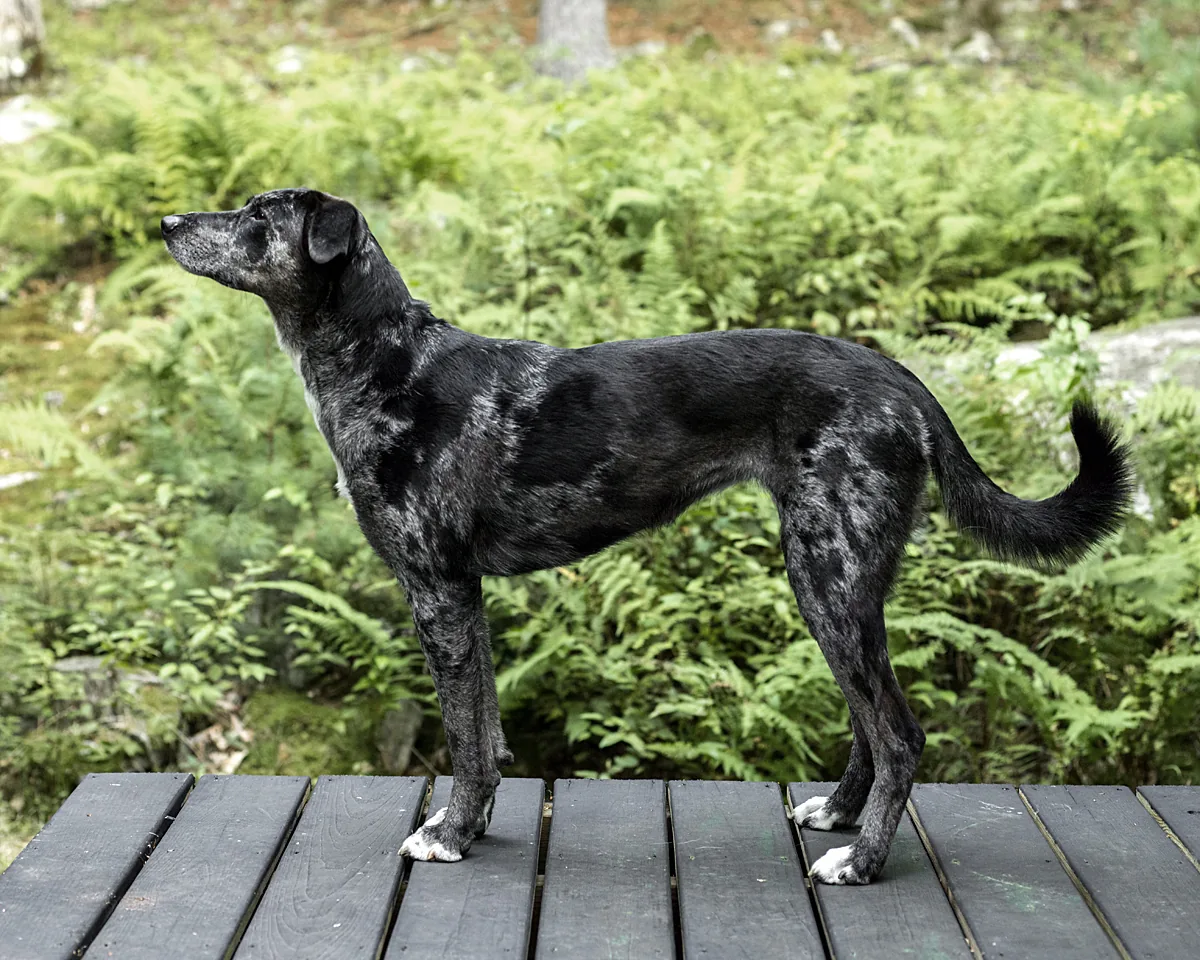

If you like the look of a merle bull-type dog, the Bulldog Catahoula is a cross where merle comes honestly from one parent.
Appearance and size
Apart from the coat, a blue merle pitbull looks like whichever pit bull type it comes from. That varies a lot:
- American Pit Bull Terrier type: lean and athletic, “a broad, blunt wedge” of a head; 18 to 21 inches and 35 to 60 pounds for males, 17 to 20 inches and 30 to 50 pounds for females (UKC).
- American Staffordshire Terrier type: stockier; about 18 to 19 inches for males and 17 to 18 for females, 40 to 70 pounds (AKC).
- American Bully type: heavy-boned and compact, in four UKC size classes from Pocket (as small as 13 inches) up to XL (as tall as 23 inches). Our American Bully XL guide covers the largest class (UKC).
A blue merle may also have blue or odd-colored eyes, pink patches on the nose and paw pads, and more white than a typical pit bull. Merle patterns are random, so no two dogs look alike, and patches can be hard to see on a dilute coat. Our guide to dogs with blue eyes explains more about eye color genes.
Temperament
The merle gene changes coat color. No study has linked it to personality. What you get is a pit bull-type dog, and the UKC standard describes the American Pit Bull Terrier as having “strength, confidence, and zest for life,” eager to please and “outstanding” with people, while also noting that “most APBTs exhibit some level of dog aggression” (UKC).
Even breed predicts less than people think. A study of more than 18,000 dogs found that breed explained only about 9% of the variation in individual dogs’ behavior (Morrill et al., 2022). So meet the dog in front of you. Ask how it handles strangers, other dogs, cats, being handled and being left alone.
Exercise needs
Pit bull types are athletic terriers. Most adults need daily walks plus some play: fetch, tug with rules, scent games or a flirt pole. Many enjoy a job like agility or nose work. A bored, under-exercised pit bull tends to find its own entertainment, often by chewing, digging or pulling on the leash. Heavier American Bully types tire faster and can overheat; walk them in the cooler parts of the day.
If your dog turns out to be deaf or low-vision (see health below), keep it on a leash or in a securely fenced area. A dog that can’t hear you call won’t come back from across a park.
Grooming
The coat is the easy part: short, close and glossy (UKC). Brush weekly with a rubber mitt, bathe only when dirty, trim nails, and check ears and skin. Blue dogs deserve a closer look. Check for thinning hair, flaking or bumps, because they can be prone to color dilution alopecia (below). Dogs with pink, unpigmented skin can also sunburn, so give pale, white-patched dogs shade.
Health: what the merle and blue genes add
Every blue merle pitbull carries the usual pit bull-type health risks plus some linked to its two coat genes.
Deafness and eye problems (the merle gene)
Clark’s team noted that dogs with one or two merle copies “exhibit a wide range of auditory and ophthalmologic abnormalities” (Clark et al., 2006). How big is the risk? In a study of 153 privately owned merle dogs of different breeds, tested with BAER hearing tests (Strain et al., 2009):
| Deaf in one ear | Deaf in both ears | |
|---|---|---|
| Single merle (Mm) | 2.7% | 0.9% |
| Double merle (MM) | 10% | 15% |
So most single merles hear normally. Double merles, born when two merles are bred together, face a far higher risk. The AKC warns that “double-merle dogs also often have microphthalmia” (abnormally small eyes), along with other eye defects, and that “it is not recommended to breed two merles together” (AKC).

A deaf or low-vision dog can still live a full, happy life. Many people train with hand signals and a vibration collar. But it’s a different kind of dog to live with, and you should know before you bring one home.
Color dilution alopecia (the blue gene)
Color dilution alopecia (CDA) is “a genetic, recessive, inherited condition that causes patches of hair thinning or loss,” and it’s most often seen in blue or fawn dogs. Signs may start from about six months of age, often with dry, flaky skin and sometimes bacterial skin infections (VCA). The same genetics papers that found the dilution gene name this condition too (Drögemüller et al., 2007). There’s no cure, but your vet can help manage the skin. Not every blue dog gets it.
Pit bull-type health concerns
OFA only screens dogs whose owners choose to send in results, so these numbers aren’t a random sample. They are still the best breed-level data we have.
| OFA screening (accessed November 2026) | American Pit Bull Terrier | American Staffordshire Terrier |
|---|---|---|
| Hips: dysplastic | 22.2% of 1,195 | 25.6% of 4,314 |
| Elbows: abnormal | 16.9% of 593 | 18.3% of 1,625 |
| Kneecaps (patella): abnormal | 1.2% of 410 | 0.7% of 750 |
| Thyroid: normal | 87.0% of 138 | 84.6% of 657 |
| Congenital heart: abnormal | 0.6% of 534 | 1.0% of 2,029 |
Source: OFA breed statistics. In OFA data for the American Bully, 44.2% of 955 hip evaluations were dysplastic.
Things to watch for:
- Hip and elbow dysplasia: a joint that develops loosely as the dog grows, leading to arthritis (ACVS). Watch for stiffness after rest or reluctance to jump.
- Cranial cruciate ligament (CCL) disease: the ligament is “one of the most important stabilizers inside the canine knee,” and tears often need surgery (ACVS). Muscular, active dogs are commonly affected.
- Patellar luxation: the kneecap slips out of its groove (ACVS). Watch for skipping steps.
- Skin allergies and thyroid disease: itchy skin, ear infections, weight gain or a dull coat are all worth a vet visit.
Training
Pit bull types are usually smart, eager and food-motivated, which makes reward-based training a pleasure. Use it. The American Veterinary Society of Animal Behavior says “evidence supports the use of reward based methods for all canine training” and that there is “no evidence that aversive training is necessary” (AVSAB). Prioritize:
- Loose-leash walking from day one. A strong dog that pulls is the biggest everyday risk for an older handler.
- Calm greetings and a reliable “leave it.”
- Careful dog-to-dog introductions, given the breed’s known tendency toward dog aggression (UKC).
- Hand signals for every cue if the dog is deaf, and a touch or flashlight signal to get its attention.
Diet basics
Feed a complete, balanced food appropriate to the dog’s age, and keep the dog lean. You should be able to feel its ribs easily. In a lifelong study of Labrador Retrievers, dogs fed 25% less lived significantly longer and developed chronic disease later than their littermates (Kealy et al., 2002). Extra weight also loads the hips, elbows and knees that pit bull types already strain. If your dog has skin problems or CDA, ask your vet before switching foods or adding supplements.
Is a blue merle pitbull right for you? A 50+ home check
Bone Voyage exists to help people over 50 adopt, keep and thrive with dogs of any age. A pit bull-type dog can be a wonderful, affectionate companion at any stage of life. Before you fall for the coat, walk through this checklist:
- Strength: can you hold a sudden lunge from a 35 to 70 pound muscular dog? If your grip, balance or wrists are uncertain, try walking the dog (with staff) before deciding, and ask about a front-clip harness.
- Daily energy: can you give at least one good walk and play session every day, or pay someone who can?
- Housing: does your lease, HOA or senior community allow pit bull-type dogs? Many restrict them by breed or weight. Get it in writing.
- Local law: check your city and county for breed-specific rules. These differ from place to place and change over time.
- Insurance: call your homeowner’s or renter’s insurer. Some exclude or surcharge certain breeds.
- Other pets: do you have another dog or a cat? Ask for a supervised meeting first.
- Hearing and sight: if the dog is deaf or partly blind, are you ready to learn hand signals and keep it leashed outside a fence?
- Vet budget: can you cover a possible knee or hip surgery, or does insurance make sense?
- Backup plan: who would take this dog if you got sick? (More on this below.)
If most of these are yes, a pit bull from a rescue can be a great fit, whether a puppy (if you have the time and energy for training) or an adult whose size and temperament you can already see. If several are no, a smaller, easier dog is not a lesser choice. Our best dog breeds for seniors guide has ideas.
Costs
We don’t quote puppy prices. Sellers set their own and often charge a premium for “rare” colors, and we found no reliable source. The ASPCA’s 2021 estimate for a dog is $1,391 a year and $3,221 in the first year, including one-time costs (ASPCA). For a blue merle pit bull, add the cost of a BAER hearing test, a coat-color DNA test, an eye exam and a cushion for possible knee or skin care. Adoption fees are usually far lower than breeder prices and often include spay or neuter, vaccines and a microchip.
Adoption and rescue tips
Many merle and blue pit bull-type dogs end up in shelters and rescues, and it’s the best place to start. Some things to know:
Shelter labels are guesses. In one study, shelter staff called 52% of dogs pit bull-type, but DNA identified only 21% (Olson et al., 2015). Another found that dogs labeled pit bull-type waited longer to be adopted (Gunter et al., 2018). The “merle pitbull” in a listing could be many things. Our what breed is my dog? guide explains DNA tests.
Double merle and coat dilution red flags: a screening checklist
Use this whether you’re talking to a rescue or a seller:
- Were both parents merle? If so, the puppy may be a double merle. Walk away from any breeder who breeds merle to merle on purpose.
- Has the dog had a BAER hearing test? It’s “the only accepted method of diagnosis” for congenital deafness and can be done from 35 days old (OFA). Ask for results for both ears.
- Has a vet examined the eyes? Look for normal-sized eyes and pupils that respond to light.
- Is there a DNA test for the M and D loci, including merle allele size? It can reveal a double merle or a cryptic merle parent.
- Is the dog mostly white with a little merle? That’s a common double merle look. Ask about hearing and vision.
- Any patchy hair loss or flaky skin on a blue dog? Ask about color dilution alopecia.
- Does the seller call merle “rare” or “purebred” and charge extra for it? Merle is disqualified by the UKC, so color is not a sign of quality.
- Are there OFA hip, elbow and knee results for the parents?
Questions to ask the shelter or rescue
- How old is the dog, and how did it come to you?
- How does it walk on a leash? Can I walk it?
- How does it react to other dogs, cats, children and visitors?
- Has it had a hearing test or eye exam? Any skin problems?
- Is it spayed or neutered, microchipped and up to date on vaccines?
- If it doesn’t work out, will you take the dog back?
Our 9 questions to ask when adopting a dog covers more. If you have a mixed bull-type dog already, see our Pitbull Lab mix and Boxer Pitbull mix guides.
Give your dog a backup plan
Pit bull-type dogs bond deeply with their people, and they often wait longer than other dogs for a new home if something happens to you. Naming a backup caregiver now matters: someone your dog already knows, who has agreed to step in. Our guide What Happens to Your Dog When You Die walks you through it, and the free My Dog’s Backup Plan worksheet records routines, vet details and, for a merle dog, any hand signals it knows. Bone Voyage ran as a shelter and rescue from 2019 to 2024 and is now an education resource. We’re building the backup-adopter pledge: a volunteer’s pledge to adopt a specific older adult’s dog if that person dies or can no longer care for it. You can join the free list on the guide page.
Frequently Asked Questions
Can you get a merle pitbull?
Yes, merle pit bull-type dogs exist, but merle is not part of the traditional breed. The United Kennel Club disqualifies merle in the American Pit Bull Terrier and the American Bully, and the AKC’s Staffordshire Bull Terrier standard says merle does not exist genetically in that breed. Merle is a dominant gene, so a merle puppy always inherits it from a merle parent, which means the line was mixed with a merle-carrying dog at some point (UKC APBT; UKC Bully; AKC SBT standard).
Is a blue merle pitbull purebred?
Not by the standards of the main pit bull registries. The UKC lists merle as a disqualification for the American Pit Bull Terrier, so a merle dog cannot be shown as a correct example of the breed. The ABKC, which registers American Bullies, does allow all colors and patterns. If a seller calls a blue merle pitbull a rare purebred, ask for registration papers and both parents’ DNA results (UKC APBT; ABKC).
What is the difference between a blue merle and a blue nose pitbull?
They come from different genes. A blue nose pit bull has two copies of the recessive dilution gene (MLPH), which turns black pigment an even gray-blue, including the nose. A blue merle has that same dilution plus one copy of the dominant merle gene (PMEL, also called SILV), which leaves random patches of darker blue-gray on a lighter, mottled base. Blue nose is a solid color; merle is a patchy pattern (Drögemüller et al., 2007; Clark et al., 2006).
Are blue merle pitbulls deaf or blind?
Most single merle dogs hear and see normally. In a study of 153 merle dogs, 2.7% of single merles were deaf in one ear and 0.9% in both. Double merles, from breeding two merles together, did much worse: 10% were deaf in one ear and 15% in both, and double merles also often have small or malformed eyes. A BAER hearing test and a vet eye exam tell you about the individual dog (Strain et al., 2009; AKC; OFA).
What is a double merle pitbull?
A double merle has two copies of the merle gene, one from each merle parent. These dogs are often mostly white and carry a much higher risk of deafness and eye defects such as microphthalmia (abnormally small eyes). The AKC advises against breeding two merles together. Double merles can still make loving pets, but they may need a home ready for a deaf or low-vision dog (AKC; Strain et al., 2009).
What is a blue nose pitbull called?
There is no separate breed. A blue nose pitbull is usually an American Pit Bull Terrier, American Staffordshire Terrier or pit bull-type mix with a diluted blue-gray coat and a gray nose. Blue is an accepted color in the UKC American Pit Bull Terrier standard, which allows any color except merle. Blue nose is a marketing nickname, not a bloodline or a sign of quality (UKC APBT).
Does the UKC or AKC accept merle pit bulls?
The UKC does not: merle is a disqualification in both its American Pit Bull Terrier and American Bully standards. The AKC does not register the American Pit Bull Terrier at all. Its Staffordshire Bull Terrier standard disqualifies merle, while its American Staffordshire Terrier standard, written in 1936, does not mention merle. The ABKC American Bully standard allows all colors and patterns (UKC APBT; UKC Bully; AKC SBT standard; AKC AmStaff standard; ABKC).
Is a blue merle pitbull a good dog for someone over 50?
It can be, for the right person. Coat color says nothing about temperament, so judge the individual dog. A strong, 35 to 70 pound pit bull-type dog needs steady leash handling, daily exercise and a home where breed rules, leases and insurance allow it. An adult from a rescue, already tested for hearing, lets you see its size and temperament first; a puppy can be a great fit too if you have the time and energy for training.
Before you go
A blue merle pitbull is a pit bull-type dog in an unusual coat, not a rare breed. The coat is beautiful, but it’s the dog underneath that you’ll live with. Choose for temperament, check hearing and eyes, and be wary of anyone selling color as quality. If you have the strength, time and a home that welcomes bull breeds, an adult merle or blue pit bull from a rescue could be your next great companion.
Sources
- United Kennel Club, American Pit Bull Terrier, American Bully and Louisiana Catahoula Leopard Dog breed standards
- American Kennel Club, American Staffordshire Terrier and Staffordshire Bull Terrier breed pages; standards for the American Staffordshire Terrier, Staffordshire Bull Terrier and Australian Shepherd; Merle in Dogs
- American Bully Kennel Club, American Bully standard
- The Royal Kennel Club, Registration of dogs of merle colouring (2020)
- Orthopedic Foundation for Animals, Breed statistics (accessed November 2026) and Congenital deafness
- American College of Veterinary Surgeons, Canine Hip Dysplasia, Cranial Cruciate Ligament Disease and Patellar Luxations
- VCA Animal Hospitals, Color Dilution Alopecia in Dogs
- American Veterinary Society of Animal Behavior, Position Statement on Humane Dog Training (2021)
- ASPCA, Cutting Pet Care Costs
- Clark LA et al. (2006). Retrotransposon insertion in SILV is responsible for merle patterning of the domestic dog. PNAS 103(5):1376-81.
- Strain GM et al. (2009). Prevalence of deafness in dogs heterozygous or homozygous for the merle allele. J Vet Intern Med 23(2):282-6.
- Langevin M et al. (2018). Merle phenotypes in dogs: SILV SINE insertions from Mc to Mh. PLOS ONE 13(9):e0198536.
- Murphy SC et al. (2018). Length variations within the Merle retrotransposon of canine PMEL: correlating genotype with phenotype. Mobile DNA 9:26.
- Drögemüller C et al. (2007). A noncoding melanophilin gene (MLPH) SNP at the splice donor of exon 1 represents a candidate causal mutation for coat color dilution in dogs. J Hered 98(5):468-73.
- Kealy RD et al. (2002). Effects of diet restriction on life span and age-related changes in dogs. JAVMA 220(9):1315-20.
- Morrill K et al. (2022). Ancestry-inclusive dog genomics challenges popular breed stereotypes. Science 376(6592):eabk0639.
- Olson KR et al. (2015). Inconsistent identification of pit bull-type dogs by shelter staff. Vet J 206(2):197-202.
- Gunter LM et al. (2018). A canine identity crisis: Genetic breed heritage testing of shelter dogs. PLOS ONE 13(8):e0202633.