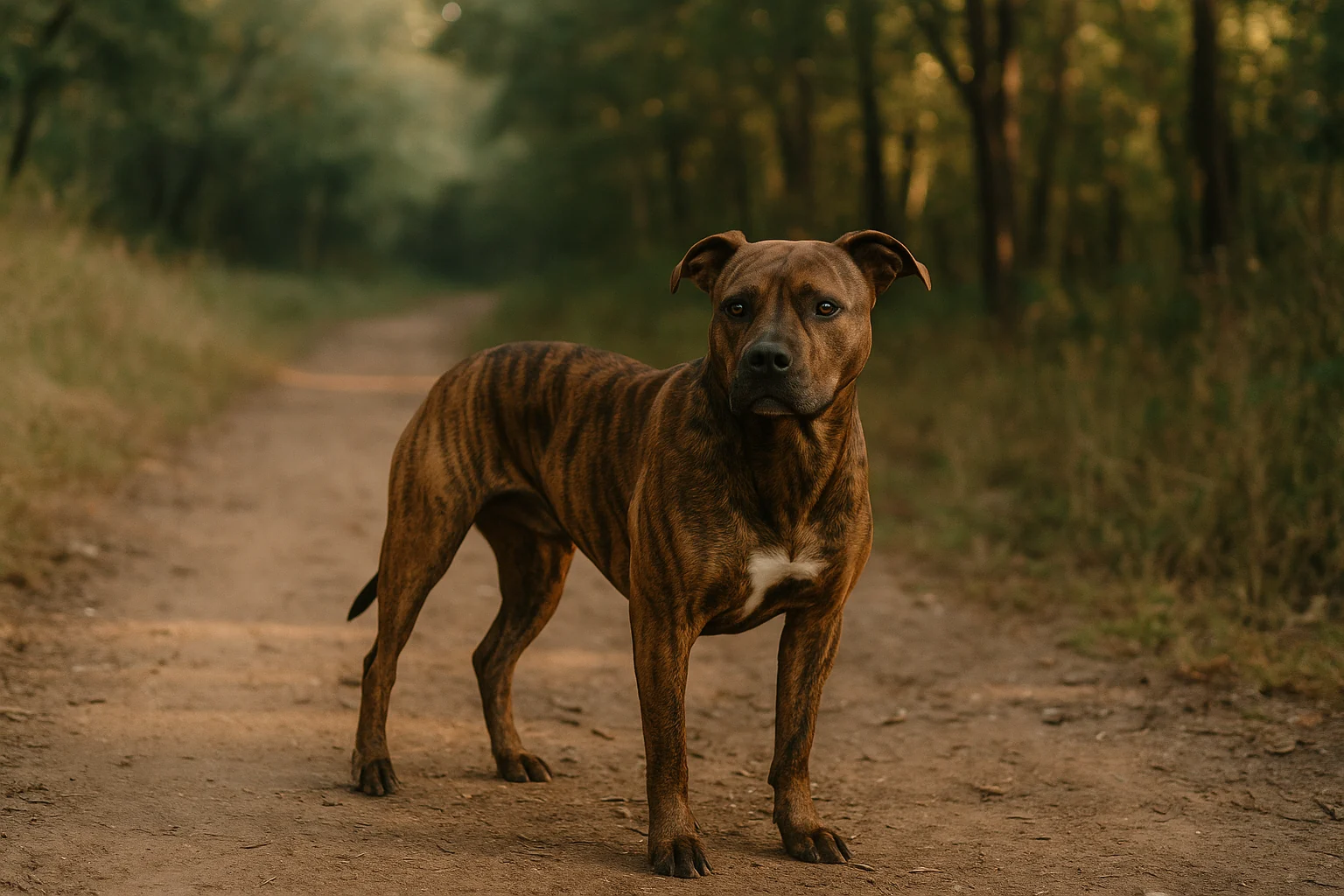
A Mountain Cur Pit Bull mix is a working dog twice over. One parent was bred in the Appalachians to tree squirrels, bay wild hogs and guard a homestead. The other was bred for grip, stamina and a pain threshold that makes it keep going long after it should stop. Cross them and you get roughly 55 pounds of brindle muscle that needs a job and will invent one if you don’t provide it.
That’s the honest headline. These are excellent dogs for the right household and a genuinely difficult fit for the wrong one, and the difference comes down to whether you have two hours a day and a fence the dog can’t climb.
At a glance
- Adult size: 40 to 70 pounds, 18 to 24 inches at the shoulder
- Coat: short, often rough-textured, brindle most commonly
- Lifespan: 12 to 14 years
- Exercise: two hours a day, plus mental work
- Food: roughly $40 to $70 a month
- Prey drive: high, from both parents
- Fencing: six feet, and they climb
What the Mountain Cur brings
The Mountain Cur is one of the few genuinely American landrace breeds. Settlers from Scotland, Ireland and England brought working dogs into the mountains of Tennessee, Kentucky and Virginia and bred them for one thing: usefulness. A cur that couldn’t tree game, drive stock and guard a cabin didn’t get bred. Nobody selected for coat, color or head shape.
The breed nearly disappeared after World War II when rural families moved to cities. It was pulled back by a handful of breeders who founded the Original Mountain Cur Breeders Association in 1957, and the UKC recognized it in 1998. It’s still primarily a hunting dog rather than a show dog, which matters more than it sounds like it should.
What that history means for your dog: the Cur side brings very little inherited disease. Centuries of breeding purely for function, with an open gene pool and no cosmetic standard, produced one of the healthier dogs in the working world. It also brings enormous stamina, an independent working style, and a strong instinct to chase things up trees and then tell you about it at volume.
The Pit Bull side brings the opposite of that history: a closed studbook, dense muscle on a shorter frame, a much higher inherited-disease load, and an intense orientation toward people. Our Mountain Cur breed profile goes deeper on the Cur parent.
How big does a Mountain Cur Pitbull mix get
A Mountain Cur runs 30 to 60 pounds at 16 to 26 inches, built lean and leggy with a deep but narrow chest. An American Pit Bull Terrier runs 30 to 60 pounds at 17 to 21 inches, built short and wide with heavy bone.
Cross them and expect 40 to 70 pounds at 18 to 24 inches, with most adults sitting near 50 to 60 pounds. Females commonly land in the mid-forties, males in the sixties.
The shape is more distinctive than the numbers. You typically get the Pit Bull’s chest width and shoulder mass on the Cur’s longer legs, which reads as a taller, more athletic Pit Bull. The head is usually broad with a shorter muzzle than a Cur’s, and the ears come out rose-folded or half-pricked rather than either parent’s typical set. Some inherit the Mountain Cur’s natural bobtail, which occurs in the breed and surprises people who assume the tail was docked.
Coat is short either way, sometimes with the Cur’s slightly coarse, weather-resistant texture. Brindle is the most common color by a wide margin, because both parent breeds carry it commonly. Yellow, fawn, black, blue and brindle-with-white-points all show up, and a white chest blaze and white toes are nearly universal from the Pit Bull side.
Grooming takes about five minutes a week with a rubber curry. The coat is the easiest thing about this dog.
Prey drive and containment: read this part twice
Every article about this cross calls it “energetic.” That undersells the specific problem.
The Mountain Cur’s job was to locate an animal, chase it, corner it or drive it up a tree, and hold it there. That behavior is hardwired, it develops on its own without any training, and it turns on around six to twelve months old. The Pit Bull’s contribution is grip and the willingness to keep going.
In a suburban yard, that looks like this:
- The dog goes over the fence. Curs are climbers. Four-foot chain link is a ladder. Six feet with no horizontal rails is the realistic minimum, and some need a coyote roller.
- The dog goes under the fence. Digging out at the corner where the ground is soft. Buried wire or a concrete apron along the fence line solves it.
- Cats and small animals are a genuine question. Not a training project, a compatibility question about one specific dog. Ask any rescue how the dog tested with cats and small dogs, and believe the answer.
- Recall over a live trail is unreliable in most of these dogs, no matter how good it is in the yard. Long lines are not a training failure, they’re how you keep this dog alive near roads.
The upside of the same drive is that this dog is fantastic at anything scent-based or chase-based that you channel: a flirt pole, tracking games, hiking with a long line, barn hunt, a decoy on a rope. Give it that outlet and most of the destructive behavior evaporates.
Temperament: what this dog does in your house
It alarm-barks at everything. Curs were guard dogs and they announce things: the mail carrier, a car door, a squirrel on the roof. This is the single most common complaint from owners in close-quarters housing.
It stares at the ceiling. Genuinely. The treeing instinct shows up indoors as a dog that locks onto a spot where it heard something and won’t drop it.
It leans on you. The Pit Bull side wants physical contact. Expect the full weight of the dog against your leg while you cook, and a 60 pound dog attempting to be a lap dog on the couch.
It has a real off switch, once tired. Unlike some working breeds, this cross settles hard. After two good hours it will sleep for six. That’s the whole trick with these dogs.
Dog selectivity often shows up in adolescence. Between about 10 months and two years, many bull-type dogs become choosy about other dogs, especially of the same sex. It’s normal for the type, it isn’t a training failure, and it’s much easier to manage if you’re expecting it. Leash reactivity in this cross is common and very responsive to good training.
With people, these dogs are usually excellent: outgoing, tolerant, forgiving, and enthusiastic about children to the point of knocking small ones over. Aloofness with strangers is more of a Cur trait, so a dog that hangs back and watches a new visitor for ten minutes before deciding is behaving normally.
Exercise: what actually tires one out
Two hours a day minimum, and at least one of those hours should be off-pavement and off a six-foot leash: a long line in a field, a securely fenced acre, a hiking trail.
What works:
- A morning run or bike run, once the dog is past 18 months
- A flirt pole session in the yard, five minutes of it beats twenty minutes of fetch
- Scent games: hide food, scatter kibble in long grass, teach a “find it”
- A frozen stuffed toy or a raw recreational bone for the settling hour afterward
- Basic obedience woven into everyday life rather than a training session
What doesn’t work: two leash walks around the block. That’s a maintenance dose for a Beagle, not exercise for this dog.
Wait until 14 to 18 months for repetitive high-impact work like long road runs and jumping. The growth plates need to close first.
Health: mostly the Pit Bull side
| Concern | Which parent | What to know |
|---|---|---|
| Hip dysplasia | Pit Bull | The Orthopedic Foundation for Animals reports roughly a quarter of evaluated American Staffordshire Terriers as dysplastic. This is the main structural risk in the cross. |
| Skin allergies | Pit Bull | Atopic dermatitis, showing up as itchy paws, belly rashes and recurring ear infections, usually between one and three years old. The most common ongoing expense in these dogs. |
| Cruciate ligament tears | Pit Bull | Heavy muscle plus hard stops and turns. Common enough to price pet insurance before you need it. |
| Hypothyroidism | Both | Middle-age weight gain, coat loss and lethargy. Cheap blood test, cheap daily pill. |
| Demodectic mange | Pit Bull | Usually a puppy issue, patchy hair loss around the eyes and muzzle. Treatable. |
| Working injuries | Lifestyle | Torn pads, thorn punctures, eye scratches, foxtails and tick-borne disease. Check paws and ears after every off-trail outing. |
| Inherited disease from the Cur | Mountain Cur | Very little documented. That’s the genuine advantage of a working landrace breed with an open gene pool. |
Two practical notes. First, keep this dog lean. A dysplastic hip on a lean 55 pound dog is a manageable problem, and the same hip on a 75 pound dog is arthritis by age six. Second, if your dog turns out itchy, get in front of it early with a vet rather than cycling through shampoos. Chronic atopy that goes untreated for two years is much harder and much more expensive to control than the same problem caught at the first summer.
Lifespan and what it costs
Lifespan is 12 to 14 years, and often on the longer end. The Cur side is genuinely long-lived, and neither parent is a deep-chested giant breed.
Food runs about $40 to $70 a month. A 55 pound active adult needs roughly 1,200 to 1,500 calories a day, which is around three to three and a half cups of typical dry food, so a 30 pound bag lasts about six weeks. A dog that’s actually working or hiking daily eats at the top of that range or above it.
Acquisition cost. Shelter and rescue fees run roughly $50 to $350, and this is one of the most common dog types in shelters across the rural South and Appalachia. That fee usually covers vaccinations, microchip and spay or neuter, which alone would cost several times more. Working Mountain Cur puppies from hunting kennels run $300 to $600, but nobody deliberately crosses them to Pit Bulls. Anyone advertising “Mountain Cur Pitbull mix puppies” at designer prices is selling an unplanned litter.
Ongoing costs beyond food: roughly $60 to $90 a month averaged over the year for routine care, plus whatever allergies cost you. Also check your lease and your homeowner’s insurance. Housing restrictions on bull-type dogs are the most common practical reason these dogs get returned, and they’re the easiest thing to check before you fall for a photo.
Mountain Cur Pitbull mix puppies
What to expect. Fast growth, hard mouths, and a puppy that’s smarter than it looks. They’re mouthy in play and they bite harder than a retriever puppy, which startles first-time owners. Housetraining is usually easy. Recall training should start on day one and continue for the dog’s entire life, because you’re competing with instinct.
Socialization window matters more here than in most crosses. Get the puppy meeting calm adult dogs, riding in cars, walking on different surfaces and hearing loud noises before 16 weeks. The dog selectivity that shows up in adolescence is easier to live with in a dog that had a broad, positive puppyhood.
Ask the rescue: stray or surrender? How does it do with cats, with same-sex dogs, with kids? Has it lived indoors? What does it do when it sees a squirrel? That last one sounds trivial and it tells you more about the next ten years than anything else on the list.
Is this the right dog for you?
Yes, if you hike, run, hunt or otherwise move for two hours a day anyway, you have a tall secure fence, you don’t have a cat you can’t manage separation from, and you’ve confirmed your housing allows bull-type breeds.
Probably not, if you live in an apartment, work long days away from home, or wanted a dog that would be satisfied with a walk and a yard.
For comparison, the Weimaraner Pit Bull mix is a similar-sized hunting-dog cross with the same energy profile but much worse tolerance for being left alone, and the Vizsla Pit Bull mix sits in the same family. If you want the temperament in a smaller package, the Pomeranian Pit Bull mix is an unlikely but real one.
Frequently Asked Questions
How big does a Mountain Cur Pitbull mix get?
Most adults weigh 40 to 70 pounds and stand 18 to 24 inches at the shoulder. The Mountain Cur adds leg length and lung capacity, the Pit Bull adds chest width and muscle mass, so the cross usually looks like a leaner, longer-legged Pit Bull.
Can a Mountain Cur Pitbull mix live with cats?
Often not. The Mountain Cur was bred to tree squirrels and raccoons and the Pit Bull to grip, so this cross carries prey drive from both sides. Some individuals live peacefully with a cat they grew up with. Treat it as something to test carefully with a specific dog, not something training reliably fixes.
How much exercise does a Mountain Cur Pitbull mix need?
Two hours a day minimum, and it needs to include something the dog has to think about. This is a working farm dog crossed with a working terrier. Under-exercised ones dig, climb fences, bark at everything and chew through drywall.
What health problems does a Mountain Cur Pitbull mix have?
Nearly all the inherited risk comes from the Pit Bull side: hip dysplasia, skin allergies, cruciate ligament tears and thyroid disease. The Mountain Cur has very little documented inherited disease, so the rest of what you’ll deal with is working-dog injury: torn pads, cuts and ear infections.
What does a Mountain Cur Pitbull mix cost?
Shelter adoption fees run roughly $50 to $350, and these dogs are common in shelters across the rural South and Appalachia. No reputable breeder makes this cross deliberately, so anyone selling puppies at $500 and up is selling a farm accident at a designer price.
Before you go
Cur crosses land in shelters constantly, and they get overlooked because they don’t photograph as anything in particular. The ones that get adopted by people who actually use them, hikers, runners, rural families with land, tend to be the easiest dogs those people have ever owned.
If that sounds like your household, our breeds and adoption guides are worth a browse.