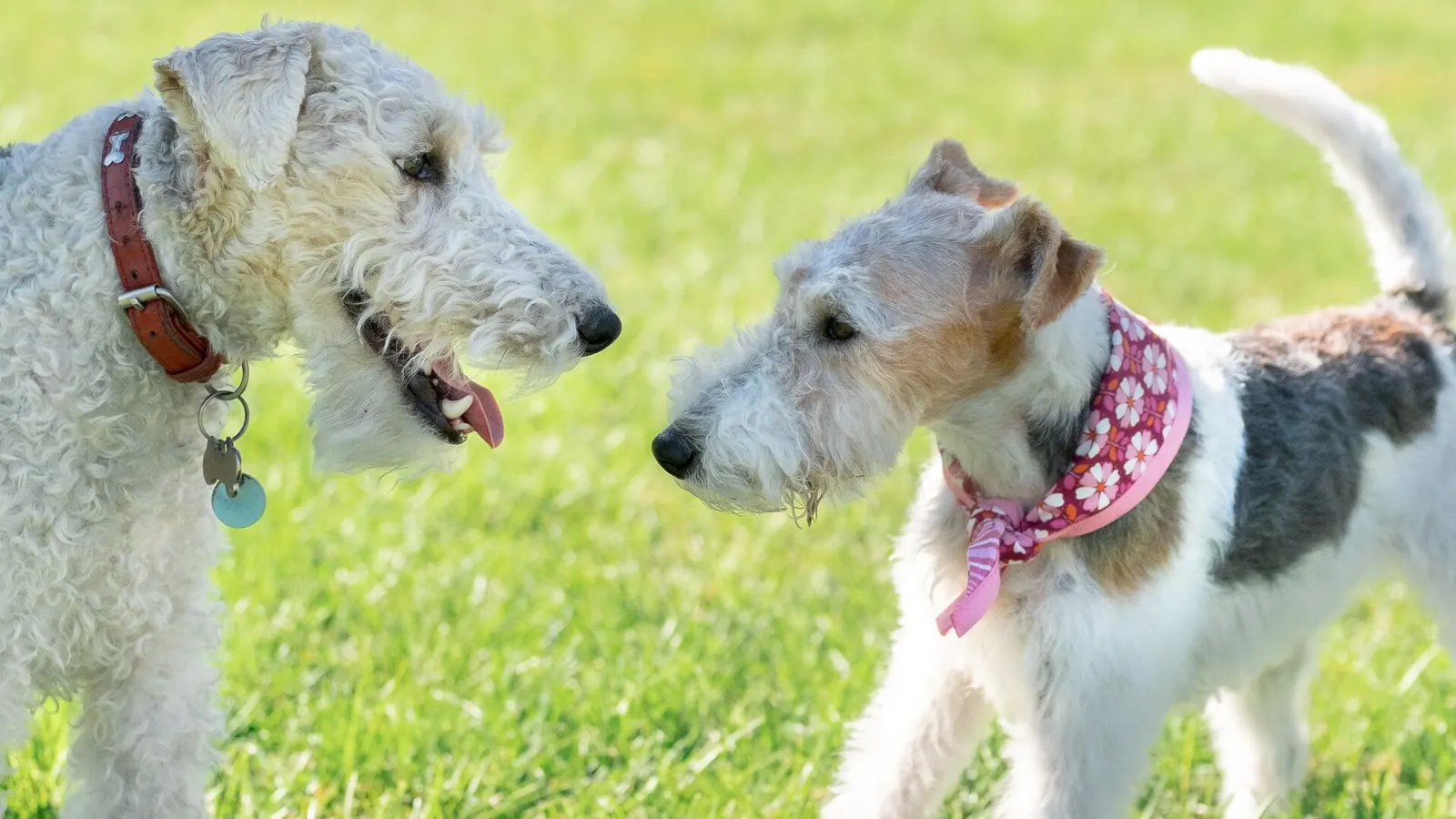

A Fox Terrier is a small, lively British terrier, no more than about 15½ inches tall and roughly 15 to 18 pounds, originally bred to drive foxes out of their dens during hunts. There are two Fox Terrier breeds, the Smooth and the Wire, and they are essentially identical except for their coats. Both are mostly white, bright, funny and full of energy, with a strong prey drive and a real love of digging.
That mix of charm and terrier spark is why Fox Terriers have been loved for so long, and also why some end up looking for new homes. Below is what the kennel clubs, the breed’s own club and veterinary sources actually say about size, temperament, grooming, health and costs, how Smooths and Wires differ, how they compare with the Jack Russell, Toy Fox, Lakeland, Patterdale and Fell Terriers, and how to adopt one if it’s the right dog for you.
Fox Terrier quick facts
- Two breeds: the Smooth Fox Terrier and the Wire Fox Terrier, separate breeds at the American Kennel Club (AKC), the UK’s Royal Kennel Club and the United Kennel Club (UKC). The Toy Fox Terrier is a third, much smaller breed.
- Height: a male “should not exceed 15½ inches at the withers” (the top of the shoulder); females are “slightly lower in height and lighter in weight” (UKC Smooth standard, UKC Wire standard).
- Weight: about 18 pounds for a male and 15 to 17 pounds for a female, for both breeds (AKC Wire, AKC Smooth).
- Life expectancy: 12 to 15 years for both breeds, per the AKC. The Royal Kennel Club says “over 12 years.”
- Energy: high. The AKC rates both breeds 4 out of 5 for energy. The Royal Kennel Club suggests up to an hour of exercise a day.
- Grooming: Smooth, a weekly brush (Royal Kennel Club). Wire, more than once a week, plus stripping or clipping (Royal Kennel Club). Both shed; the AKC rates the Wire 2 and the Smooth 3 out of 5 for shedding.
- Colors: predominantly white, with black, tan, or black and tan markings. Brindle, red, liver and slate blue are serious faults in the UKC standards.
- With kids: the UKC says they are “affectionate with children but may be too active for some.” The AKC rates the Wire 5 and the Smooth 3 out of 5 for good with young children.
- With other pets: the AKC rates both 3 out of 5 with other dogs. Prey drive means cats and small pets need careful thought (more below).
- Home: the Royal Kennel Club says a small house and a small or medium garden can suit, in town or country, as long as the dog gets its exercise.
- Best fit: an active person or family who enjoys a clever, independent dog and has a secure fence, a sense of humor and time to train.
History: from the hunt field to the show ring
Fox Terriers took shape in Britain to help mounted fox hunts. The UKC standard explains that hunters needed a dog that could “go to ground and bolt the quarry,” but most early terriers “were dark in color and too low on leg to run with a pack of foxhounds.” So hunters developed “a longer-legged terrier, predominantly white in color so as not to be mistaken for a fox” (UKC). The AKC adds that the terriers sometimes “rode in saddlebags and were released when the fox went underground” (AKC Smooth).
To get that white coat, the Royal Kennel Club says breeders introduced the Old English White Terrier (now extinct), the Bull Terrier and the Beagle. The first show class for Fox Terriers was held at Islington, London, in 1862. By 1876 the first Fox Terrier Club of England had drawn up a breed standard, and “by the start of the 20th century the Fox Terrier was the most popular breed in England” (Royal Kennel Club).
The Wire has a famous show record. The AKC calls it “a consistently successful show dog,” with what it describes as a record 13 Westminster Best in Show wins, including Matford Vic, “a Wire bought from a farmer for $10,” who won in 1915 and 1916. Movie fans may remember Asta, the Wire Fox Terrier in the Thin Man films of the 1930s and ’40s (AKC Wire).
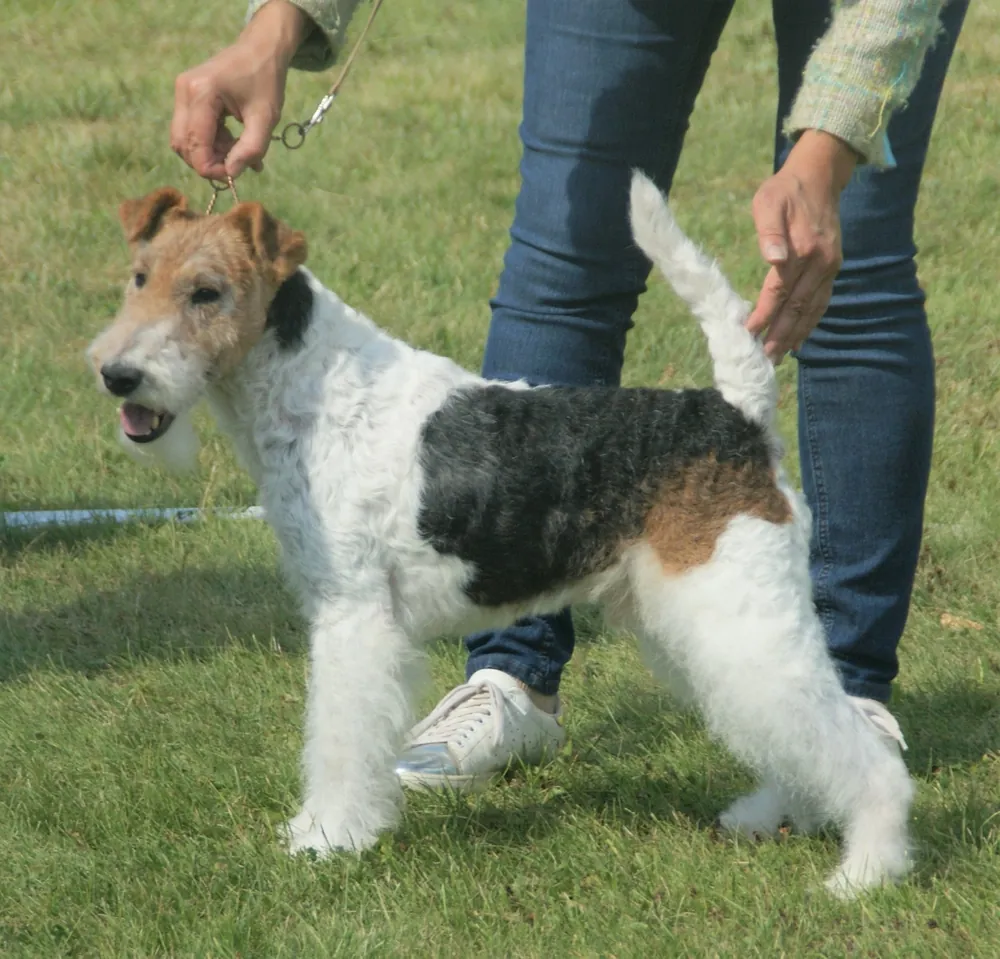

Smooth vs Wire Fox Terrier: two breeds, one dog underneath
For a long time Smooths and Wires were simply two coats of the same breed. That changed at different times in different places:
- Royal Kennel Club (UK): Wires were given separate classes in the 1870s, and “from that time interbreeding of the two coats was discouraged” (Royal Kennel Club). The AKC says the two have been separate breeds in England “since the late 19th century.”
- American Kennel Club: recognized the Fox Terrier in 1885, but “did not recognize Wire and Smooth Fox Terriers as distinct breeds until 1985” (AKC Wire). The American Fox Terrier Club, founded in 1885, is the parent club for both.
- United Kennel Club: recognized the Fox Terrier in 1912; “the two breeds were separated effective January 1, 1999” (UKC).
The UKC sums it up: “Except for coat, however, the two breeds are essentially identical.” In practice, here’s how to tell them apart:
| Smooth Fox Terrier | Wire Fox Terrier | |
|---|---|---|
| Coat | Short, flat, hard, dense | Hard, wiry outer coat over a soft undercoat |
| Look | Sleek; the AKC says the head is “more V-shaped” | Longer, crisp hair on the muzzle, legs and lower body (UKC) |
| Grooming (Royal Kennel Club) | Once a week | More than once a week, plus stripping or clipping |
| AKC shedding rating | 3 of 5 | 2 of 5 |
| AKC temperament words | Independent, friendly, amusing | Alert, confident, gregarious |
| UK status | Listed as a Vulnerable Native Breed | Not on the vulnerable list |
| Size and life expectancy | Same as the Wire: up to 15½ in, about 15 to 18 lb, 12 to 15 years | Same as the Smooth |
Sources: AKC Smooth, AKC Wire, Royal Kennel Club Smooth, Royal Kennel Club Wire, UKC standards.
Does coat type change personality? The American Fox Terrier Club says it is often asked about temperament differences between Smooths and Wires, and that “such differences vary widely among individuals and bloodlines, so it is neither fair nor accurate to generalize” (AFTC). Choose the individual dog, not the coat.
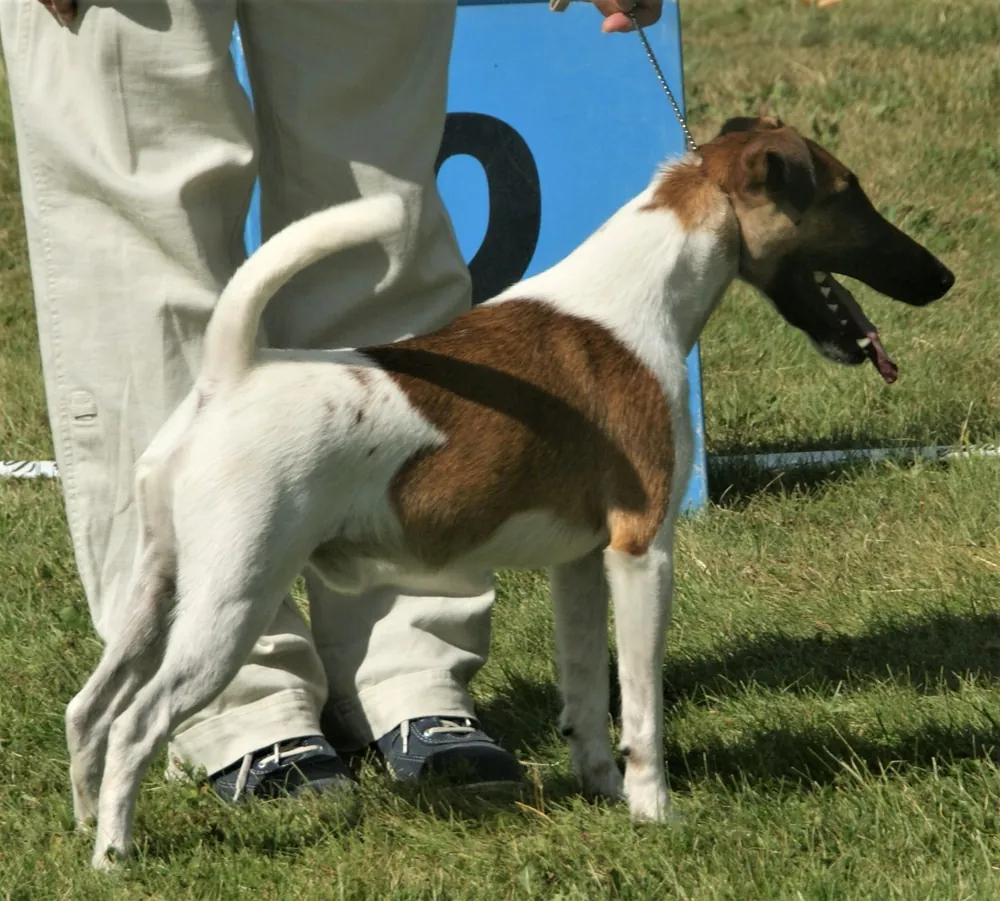

Appearance and size
The UKC describes both breeds as “a muscular but agile, active, small-to-medium size hunting terrier, with sufficient length of leg to run with the foxhounds in a hunt, and built to go to ground after fox.” The body is square, the back is short, and the dog is “modeled on the symmetry and power of the Fox Hound” (UKC).
- Head: long and moderately narrow, with a flat skull and a muzzle the same length as the skull.
- Eyes: “deep set, moderately small, nearly round, dark in color, with a lively, intelligent, sometimes fiery expression.”
- Ears: small, V-shaped and folded forward. Prick, tulip or rose ears are disqualifications.
- Tail: set high and carried up. The UKC standard says it is “normally docked,” while the AKC notes that docking, “though customary, is optional” (AKC Smooth). You’ll meet Fox Terriers with both docked and natural tails.
- Size: males up to 15½ inches and about 18 pounds; females a little smaller (UKC, AKC). The American Fox Terrier Club says the average Smooth or Wire “weighs about 20 pounds” (AFTC).
- Colors: white should predominate. The Royal Kennel Club’s standard colors include white, black and white, tan and white, and tricolour, and for Wires also “hound marked.”
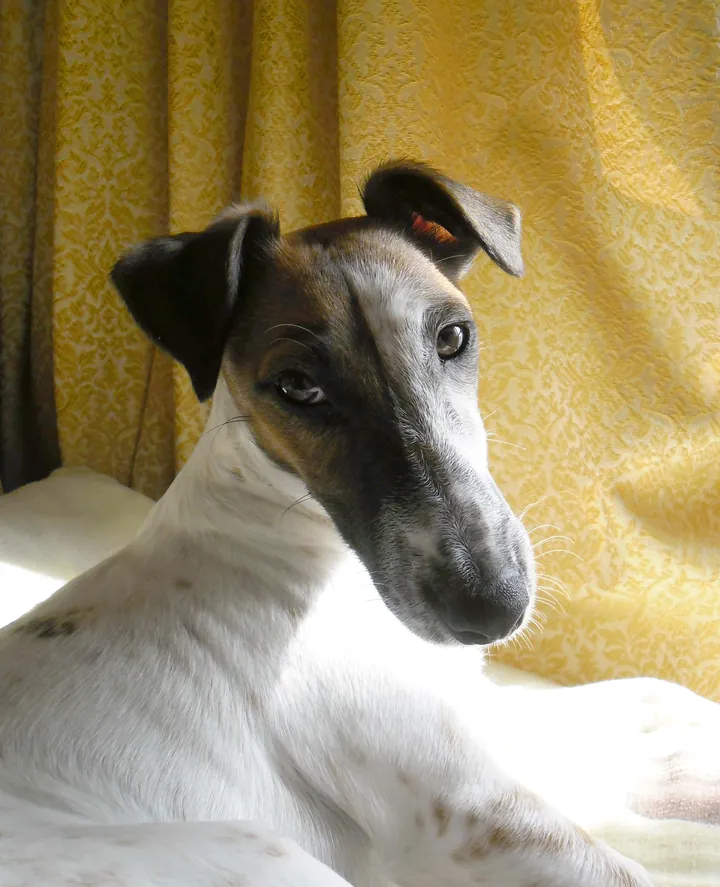

Temperament: what living with a Fox Terrier is like
The UKC standard paints a cheerful picture: the Fox Terrier is “friendly, alert, active, and lively without being high-strung,” gives “the impression of a dog ready to go anywhere and take on any task,” and is “bold but not aggressive with people” (UKC). The AKC calls Wires “excellent athletes, natural comedians, and charming housemates” (AKC Wire), and calls the Smooth “the gentleman of the terrier world,” a “lively, gregarious terrier with a devil-may-care attitude” (AKC Smooth).
The breed club’s own description is a good reality check (AFTC):
- Independent thinkers. Fox Terriers are “more independent than the herding, retrieving or working breeds,” which makes them “more of a challenge to train but they are certainly not untrainable.”
- Big dogs in small bodies. One breeder quoted by the club says they “have no clue they are a small dog.”
- Energy, then snuggles. They are “a high energy breed, lively, cheerful and funny. But after running and playing they will sleep all night on your bed or fall asleep next to you on the couch.”
- They’ll invent a job. The same breeder says if you don’t give them something to do, “they’ll find something on their own.”
Two traits come straight from their working past. The UKC says the breed “retains a strong prey drive and will dig tirelessly after any underground vermin.” And they are vocal: the AKC rates the Wire 4 and the Smooth 5 out of 5 for barking. They also make keen watchdogs, which the AKC rates 4 for the Wire and 5 for the Smooth.

With children
The American Fox Terrier Club says “traditionally, Fox Terriers are excellent playmates for children,” as long as children are “taught to treat the dog with kindness and respect.” It also warns that some “may be irritated by the noise and activity level of small children” (AFTC). If grandchildren visit often, look for a dog who has already met children calmly, and always supervise.
With other dogs, cats and small pets
This is where Fox Terriers need the most thought. According to the American Fox Terrier Club (AFTC):
- Fox Terriers “can get along well with other animals if introduced in puppyhood (cats, parrots etc.).”
- Most “get along well with mellow larger breeds but are not usually safe to have as companions for Toy breeds.”
- If you already have a terrier, a second one “should be of the opposite sex. Two male terriers will almost never be compatible, and two females, rarely.”
- Some intact adult males can be “quarrelsome with other male dogs.” The club suggests neutering at the age your veterinarian recommends; ask your vet what’s right for your dog.
The AKC adds that some Smooths “can mature to become jealous or aggressive toward other dogs, cats, or other small pets” (AKC Smooth). If you have a cat, an adult Fox Terrier who has already lived calmly with one in a foster home is a far safer bet than a puppy you hope will learn. Our guide to introducing a cat and a dog walks through the basics.
Exercise needs
The AKC says that “like most terriers, the Wire Fox requires a good bit of exercise,” and suggests “long walks with his owner, chasing a tennis ball in the backyard, or playtime in a large, securely fenced area.” The Royal Kennel Club suggests up to an hour a day for both breeds. Just as important is mental work: the AKC rates the Wire 4 out of 5 for mental stimulation needs.
Good outlets for a Fox Terrier:
- Two or more brisk daily walks on a secure harness and leash.
- Fetch, tug and flirt-pole games in a fenced area.
- Dog sports. The AKC says Wires are “wonderfully suited for participation in earthdog trials as well as other performance events that require agility, speed, and intelligence,” and the AFTC lists obedience, agility, search and rescue, detection work and service dogs among Fox Terrier careers.
- A digging box in the yard, scent games and food puzzles at home.
Keep them safe: leash and fence
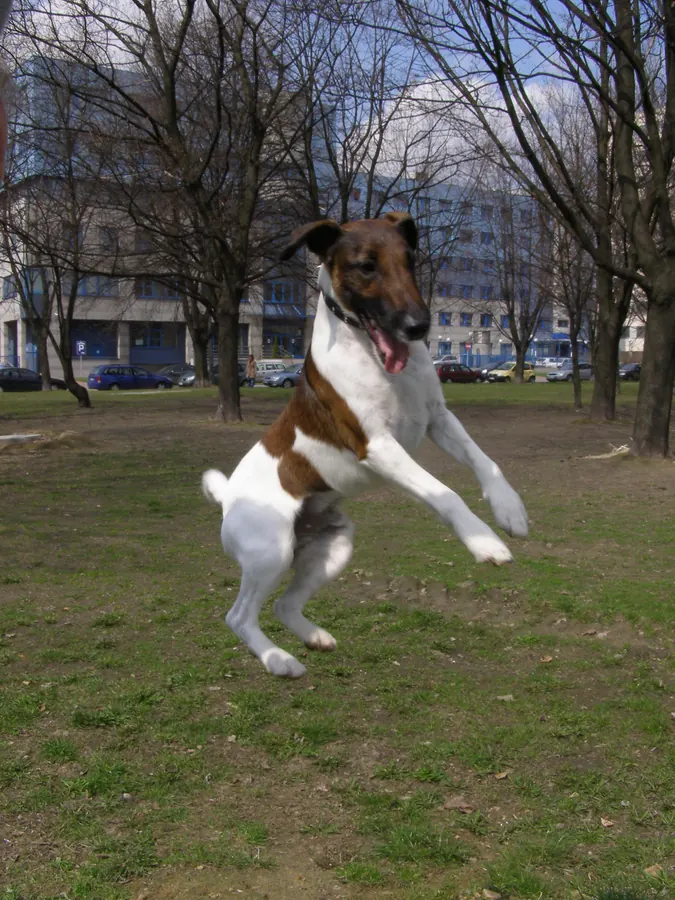
Both AKC breed pages carry the same warning: never let a Fox Terrier run off lead, because the Wire “is likely to forget all training if he catches sight of a small animal he perceives as prey,” and the Smooth “is likely to take off” (AKC Wire, AKC Smooth). Check your fence for gaps and dig-proof the bottom, keep ID tags and microchip details current, and consider a long line for practicing recall in open spaces.

Training
The AKC’s advice for Wires applies to both breeds: training “requires consistency, patience, and a great sense of humor.” Fox Terriers “are very smart but are also somewhat independent and get bored easily, so training sessions must be kept fun and interesting.” Importantly, “they react well to positive training methods and will shut down if treated harshly” (AKC Wire). For Smooths, the AKC says puppy classes “with a sensible, terrier-savvy trainer are highly recommended” (AKC Smooth).
That matches veterinary behavior guidance. The American Veterinary Society of Animal Behavior “recommends that only reward-based training methods are used for all dog training, including the treatment of behavior problems” (AVSAB).
- Recall every day, with high-value treats, starting indoors and on a long line.
- Turn the chase into a game you control: tug, flirt poles and “find it.”
- Teach “quiet” and “settle” early, since barking is part of the package.
- Give digging a place. The AKC warns the breed’s urge to dig “may affect the family yard or flowerbeds unless the dog is taught otherwise.” A sandbox with buried toys helps.
- Keep sessions short, five to ten minutes, and end on a win.
Grooming: the big Smooth vs Wire difference
Smooth Fox Terriers are easy. The AKC says the “short but hard, dense coat should be groomed weekly with a thick brush or hound glove,” with a bath “every month or so,” or as needed if the dog “ends up digging a hole in the mud” (AKC Smooth).
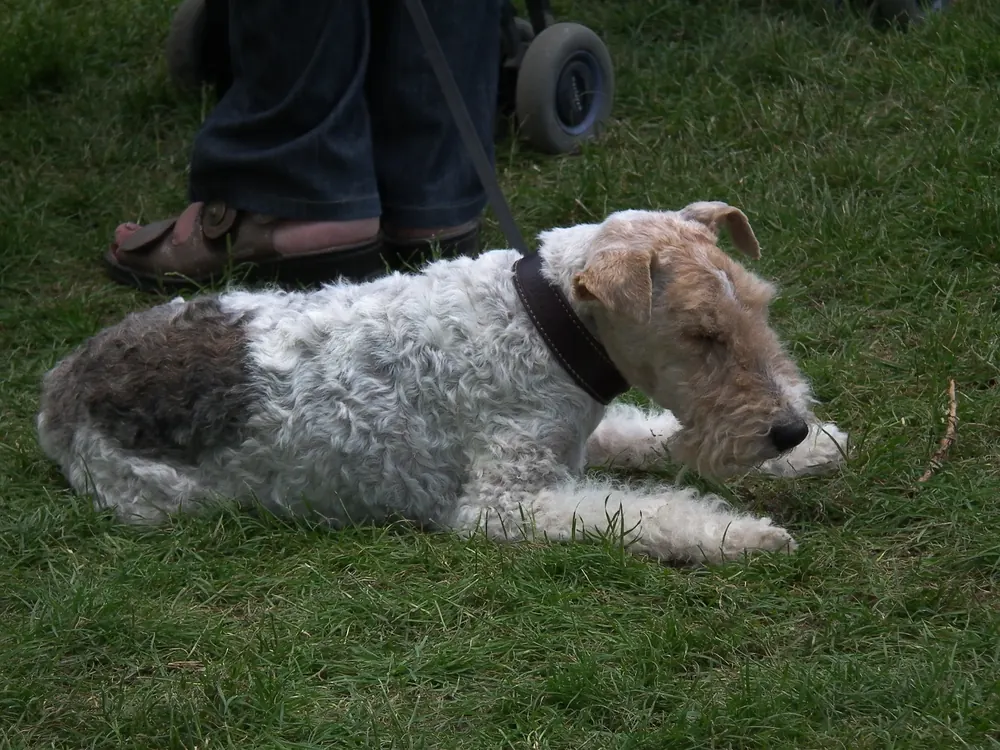
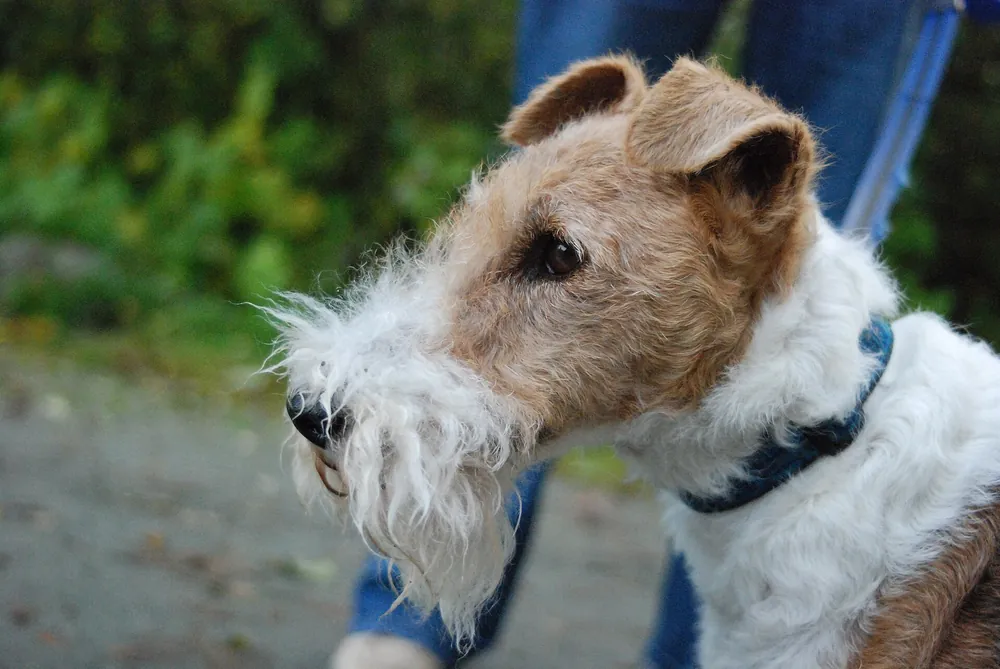
Wire Fox Terriers take more work. The UKC says the coat “is trimmed by stripping,” meaning the old, dead hairs are plucked out by hand so a new, hard coat grows in. The AKC explains your options: show dogs need hand-stripping, while “pets, however, can be clippered into a trim similar to a show trim with much less effort.” Either way, “all Wire Foxes will require regular brushing to avoid matting” (AKC Wire). The photo at the top of this page shows the difference: the shaved dog on the left has a curly, pale coat, while the hand-stripped dog on the right keeps a straight, hard, richly colored one. The Royal Kennel Club notes that “the demands of trimming and presentation have made the breed less popular” (Royal Kennel Club), so budget for a groomer or learn to do it.

For both breeds, the AKC recommends regular nail trims (monthly for Wires), weekly ear checks and frequent tooth brushing with a toothpaste made for dogs. Low shedding isn’t the same as allergy-free, so if anyone at home has dog allergies, spend real time with the dog before adopting.
Diet basics
There’s no special Fox Terrier diet. The AKC advises “a high-quality dog food” suited to the dog’s age, and warns that “some dogs are prone to getting overweight, so watch your dog’s calorie consumption and weight level.” Treats count too: “giving too many can cause obesity” (AKC). Your vet can tell you what a healthy weight looks like for your dog.
Health
The AKC and the American Fox Terrier Club both describe Fox Terriers as generally healthy dogs. The AFTC says “in general, Fox Terriers from reputable breeders are extremely healthy and hardy,” and adds that “the majority of health problems seen in this breed are in stock from commercial breeders” (AFTC). Here is what responsible breeders are asked to screen for.
What breeders screen for
- Wire Fox Terrier (AKC): “eye disorders (cataracts, primary lens luxation, and glaucoma), luxating patellas, elbow and hip dysplasia, and a neurological condition known as ‘wobbler’s gait’” (AKC Wire).
- Smooth Fox Terrier (AKC): “patellar luxation and cardiac disease” (AKC Smooth).
- Both (Royal Kennel Club): eye testing under the BVA/KC/ISDS Eye Scheme is among the health tests it recommends for breeders of both breeds.
- Both (AFTC): the club takes part in the Canine Health Information Center (CHIC) program, where you can look up the recommended tests for each breed (AFTC health information).
A luxating patella is a kneecap that slips out of place. If your dog often skips or holds up a back leg, ask your vet to check its knees.
Primary lens luxation (PLL)
Primary lens luxation is “a painful and potentially blinding inherited canine eye condition” in which the lens slips out of place. Cornell’s veterinary college says many terrier breeds are predisposed and that it most often develops between three and eight years of age. Its signs include “red, teary, hazy, or cloudy, painful eyes” (Cornell Riney Canine Health Center). A 2011 study found the ADAMTS17 gene variant linked to PLL in affected dogs of many breeds, including the Wire-haired Fox Terrier (Gould et al., 2011, summarized by OMIA). A DNA test exists, so ask a breeder whether the parents were tested. If your dog’s eye suddenly looks red, cloudy or painful, call your vet right away.
Deafness
Fox Terriers appear on Louisiana State University’s veterinary list of dog breeds with reported congenital (present at birth) deafness. The list notes that breeds with white pigmentation are most affected (LSU School of Veterinary Medicine). If you adopt, ask whether the dog’s hearing has been checked, and ask your vet if you have any doubts.
Routine care
Keep up with yearly checkups, vaccinations and parasite prevention as your vet advises, brush teeth often, and watch your dog’s weight. The AKC notes that “regular visits to the vet for checkups and parasite control help to ensure the dog a long, healthy life.”
Fox Terrier puppies
Puppies are adorable and a lot of work, and a Fox Terrier puppy is a busy, mouthy, digging bundle of energy. The American Fox Terrier Club warns that because Wires are popular, “they are often bred in puppy mills and sold in pet stores,” and recommends buying “from a member of the American Fox Terrier Club,” whose members follow a code of ethics. Its advice for choosing: a puppy “which is neither timid nor a holy terror” (AFTC).


If you go the puppy route, ask the breeder:
- Are you a member of the American Fox Terrier Club (or a Royal Kennel Club breed club in the UK)?
- Can I meet the mother, and ideally the father? How do they behave with visitors, children and other dogs?
- Which health tests have the parents had (eyes, knees, heart, PLL DNA)? Can I see the results?
- Has the puppy’s hearing been checked?
- How have the puppies been socialized with people, household noises, cats and handling?
- Will you take the dog back at any age if I can’t keep it?
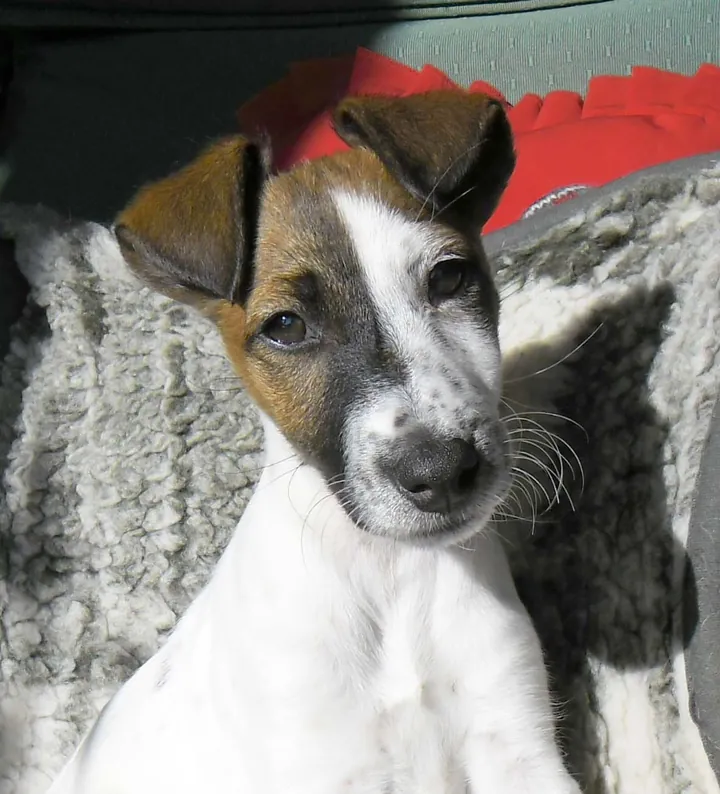

For many people, especially if you’d rather skip the chewing and house-training stage, an adult Fox Terrier from a rescue is a wonderful option. You’ll know their size, coat, energy and manners before you commit.
Fox Terrier vs Jack Russell, Toy Fox, Lakeland, Patterdale and Fell Terrier
Small, mostly white terriers often get mixed up in shelters and online. Here’s how they compare using registry and breed-club figures.
| Breed | Height | Weight | Coat | AKC | UK Royal Kennel Club |
|---|---|---|---|---|---|
| Smooth Fox Terrier | Up to 15.5 in (male) | About 18 lb male, 15-17 lb female | Short, flat, hard | Yes (separate breed since 1985) | Yes |
| Wire Fox Terrier | Up to 15.5 in (male) | About 18 lb male, 15-17 lb female | Wiry, double | Yes (separate breed since 1985) | Yes |
| Toy Fox Terrier | 8.5-11.5 in | 4-9 lb | Short, smooth | Yes, 2003 | Not listed |
| Jack Russell Terrier | 10-12 in (UKC) | About 11-13 lb (UKC) | Smooth or wiry | No (the similar Russell Terrier, 2012) | Yes |
| Parson Russell Terrier | 14 in male, 13 in female | 13-17 lb | Smooth or broken | Yes, 1997 | Yes |
| Lakeland Terrier | 14.5-15 in (male) | About 17 lb (male) | Wiry, double | Yes, 1934 | Yes |
| Patterdale Terrier | 10-15 in (UKC) | 12-26 lb average (breed club) | Smooth, broken or rough | No | No |
| Fell Terrier | No published standard | No published standard | Varies (working type) | No | No |
Sources: AKC breed pages for the Smooth, Wire and Toy Fox Terrier, Russell Terrier, Parson Russell Terrier and Lakeland Terrier; UKC standards for the Jack Russell Terrier, Lakeland Terrier and Toy Fox Terrier; the Royal Kennel Club’s Breeds A to Z; Patterdale figures as sourced in our Patterdale Terrier guide.
What actually tells them apart:
- Fox Terrier vs Jack Russell: the Jack Russell is shorter, at 10 to 12 inches in the UKC standard, so a Fox Terrier stands taller and has a longer head and muzzle. The leggier Parson Russell Terrier is closer in height, at 13 to 14 inches. If you love the Jack Russell look, our Jackapoo guide covers its best-known cross.
- Fox Terrier vs Toy Fox Terrier: the UKC says the Toy Fox Terrier’s “immediate ancestor” is the Smooth Fox Terrier, bred down from the smallest dogs and registered under its own name from February 24, 1936 (UKC). At 4 to 9 pounds, it’s a toy breed, not a small Fox Terrier.
- Wire Fox Terrier vs Lakeland: similar size and wiry coats, but the UKC standard describes the Lakeland as solid-colored (blue, black, liver, red or wheaten) or wheaten with a darker saddle, rather than mostly white. It was “bred to hunt vermin in the rugged shale mountains of the northern England Lake District” (UKC Lakeland).
- Fox Terrier vs Patterdale and Fell Terriers: these working terriers from northern England are usually dark (black, red or chocolate), and the UKC standard treats white on a Patterdale’s body or head as a disqualification. Our Patterdale Terrier guide explains how the Patterdale grew out of the old Fell Terrier.
If terriers are your thing, our guides to the Airedale Terrier (the big “king of terriers”) and the Bedlington Terrier are worth a look too. Our guide to Chihuahua terrier mix breeds covers small crosses, including Fox Terrier and Chihuahua.
Is a Fox Terrier right for you?
A Fox Terrier may be a great fit if:
- You want a small dog with a big, funny personality and you enjoy an independent streak.
- You’re up for daily walks and games, and maybe a dog sport.
- You have a securely fenced yard, or you’re happy to keep your dog on a leash every time you’re outside.
- You like a dog who barks to let you know someone’s at the door.
- You’re patient with training and prefer reward-based methods.
- For a Wire: you’re ready to brush often and pay for, or learn, stripping or clipping.
Think it over carefully if:
- You have a cat, rabbits, guinea pigs or birds, or a small toy-breed dog.
- You already have a terrier of the same sex.
- You want a quiet dog for an apartment with thin walls.
- You love a perfect lawn and flowerbeds.
- Your balance, grip or knees would struggle with a quick, strong little dog who lunges after a squirrel. A front-clip harness and good leash training help a lot.
- You’re away most of the day and would rather have a dog who’s happy with a short stroll.
If the second list sounds like you, that’s a kind and honest decision, not a failure. Our guides to the best dog breeds for first-time owners, the best small dog breeds and the best dog breeds for seniors are good places to keep looking.
Costs to plan for
We couldn’t find a reliable, published price for Fox Terrier puppies, so we won’t quote one. Ask breeders and rescues directly. For the general cost of keeping a dog, the ASPCA’s 2021 estimates were about $1,030 in one-time costs and $1,391 a year after that (ASPCA). Those are averages for all dogs, not Fox Terriers specifically.
Budget extra for:
- Grooming, especially for a Wire: regular clipping or hand-stripping by a groomer, unless you learn it yourself.
- Secure fencing, including dig-proofing along the bottom.
- Training classes, ideally with a terrier-savvy, reward-based trainer.
- Durable toys and a digging box.
- Pet insurance or an emergency fund for eye problems, knee problems or injuries.
Adopting a Fox Terrier

Why Fox Terriers end up in rescue
Life happens. Owners move, get sick, take new jobs or simply discover that a busy, barking, digging terrier is more dog than they expected. None of that makes them bad people, and it often means a wonderful adult dog is waiting for a better-matched home. If you’re older and drawn to an adult or senior dog, our guide to senior pet adoption has more ideas.
Where to look
- Breed rescues. The AKC Rescue Network lists the American Fox Terrier Club’s rescue contacts and American Fox Terrier Rescue under Fox Terrier, and Wire Fox Terrier Rescue Midwest under Wire Fox Terrier.
- General terrier and Jack Russell rescues. Many take in Fox Terriers and Fox Terrier mixes.
- Local shelters and adoption sites. Search “Fox Terrier,” “Smooth Fox Terrier,” “Wire Fox Terrier” and “Wirehaired Terrier mix,” and ask staff to let you know when a small white terrier comes in.
Shelter breed labels are educated guesses. One study comparing adoption-agency breed labels with DNA results found that only about a quarter of dogs had DNA evidence of the breed the agency named (Voith et al., 2009). So meet the dog in front of you, whatever the kennel card says.
Foster-based rescues are especially helpful with Fox Terriers, because a foster family can tell you how the dog really behaves with visitors, other dogs and cats.
Questions to ask the rescue
- How does this dog do with other dogs? Male or female dogs? On leash and off?
- Has it lived with cats or other small pets, in a home rather than in kennels?
- How good is its recall? Has it ever slipped a fence, dug out or bolted?
- How much does it bark, and at what?
- How much exercise does it get now, and what happens when it doesn’t get enough?
- How does it handle visitors, children, and being handled for nails, ears and brushing?
- For a Wire: how has the coat been kept, and how does the dog behave at the groomer?
- Any eye, hearing, knee or dental issues in its vet records?
- Is there a foster-to-adopt period, and what happens if it doesn’t work out?
Our list of 9 questions to ask when adopting a dog covers the general ones.
Make a plan for the long haul
With a life expectancy of 12 to 15 years, a Fox Terrier can be part of your life for a long time. That’s a gift, and it’s worth planning for. Naming a backup caregiver now, someone who knows your dog, can handle a lively terrier and has agreed to step in, means your Fox Terrier never has to start over in a shelter. Our guide What Happens to Your Dog When You Die explains how to set that up.
Frequently Asked Questions
What are Fox Terriers like as pets?
Bright, funny, affectionate and busy. The United Kennel Club describes them as friendly, alert, active and lively without being high-strung, and bold but not aggressive with people. They also keep a strong prey drive and love to dig, so they need a securely fenced yard, a leash outdoors, daily exercise and patient, reward-based training. The American Fox Terrier Club says that after running and playing, many will happily fall asleep next to you on the couch.
What are the two types of Fox Terriers?
The Smooth Fox Terrier and the Wire Fox Terrier. According to the American Kennel Club, they have been separate breeds in England since the late 1800s; the AKC itself split them in 1985 and the United Kennel Club in 1999. The United Kennel Club says that except for coat, the two are essentially identical: the Smooth has a short, flat, hard coat and the Wire has a dense, wiry double coat that needs stripping or clipping.
Which terrier is best with cats?
No terrier breed is reliably safe with cats, because terriers were bred to chase small animals. For Fox Terriers, the American Fox Terrier Club says they can get along with other animals, including cats, if introduced in puppyhood, but the American Kennel Club notes that some Smooth Fox Terriers mature to become jealous or aggressive toward cats and other small pets. The best bet is an adult dog whose foster home has already seen it live calmly with a cat.
How much does a Fox Terrier cost?
We couldn’t find a reliable published price for Fox Terrier puppies, so ask breeders and rescues directly. For the cost of keeping any dog, the ASPCA’s 2021 estimates were about $1,030 in first-time costs and $1,391 a year after that. A Wire Fox Terrier also needs professional grooming several times a year unless you learn to do it yourself.
How big does a Fox Terrier get?
Small. The American Kennel Club and United Kennel Club standards say a male should not exceed 15.5 inches at the shoulder and should weigh about 18 pounds, with females slightly smaller; the AKC lists females at 15 to 17 pounds. Both Smooth and Wire Fox Terriers share the same size standard.
Is a Toy Fox Terrier the same as a Fox Terrier?
No. The Toy Fox Terrier is a separate, much smaller breed. The United Kennel Club says it was developed between 1912 and the mid-1920s from the smallest Smooth Fox Terriers and was registered under its own name from 1936. The American Kennel Club, which recognized it in 2003, lists it at 8.5 to 11.5 inches and 4 to 9 pounds, about half the size of a Smooth or Wire Fox Terrier.
What is an English Fox Terrier?
It’s an informal name for the Smooth or Wire Fox Terrier, which both come from England. The Royal Kennel Club says the first class for Fox Terriers was held in London in 1862 and the first Fox Terrier Club of England drew up the breed standard in 1876. Kennel clubs don’t use the name English Fox Terrier; they list the breeds as Smooth Fox Terrier and Wire Fox Terrier.
Before you go
A Fox Terrier is a small dog with a big heart and a bigger sense of fun: alert, affectionate, athletic and never boring. In the right home, with a good fence, a leash, daily play and a patient, upbeat approach to training, there are few more entertaining companions. If that doesn’t fit your life right now, a calmer adult dog matched to you by a good rescue may be the kinder choice. And whatever dog you bring home, make a plan so they’ll always have someone.
Sources
- American Kennel Club breed pages: Wire Fox Terrier and Smooth Fox Terrier (size, life expectancy, trait ratings, history, grooming, exercise, training, health screening), plus Toy Fox Terrier, Russell Terrier, Parson Russell Terrier and Lakeland Terrier
- United Kennel Club breed standards: Smooth Fox Terrier, Wire Fox Terrier, Toy Fox Terrier, Jack Russell Terrier and Lakeland Terrier
- The Royal Kennel Club (UK): Fox Terrier (Smooth), Fox Terrier (Wire) and Breeds A to Z
- American Fox Terrier Club: home page, Finding a Fox Terrier and Health information
- AKC Rescue Network: F breeds and W breeds
- Cornell University College of Veterinary Medicine, Riney Canine Health Center, Primary lens luxation
- Gould D et al. (2011). ADAMTS17 mutation associated with primary lens luxation is widespread among breeds. Veterinary Ophthalmology 14(6):378-84. Summarized with the list of breeds in OMIA entry 000588-9615.
- Louisiana State University School of Veterinary Medicine, Dog breeds with reported congenital deafness
- Canine Health Information Center (CHIC)
- American Veterinary Society of Animal Behavior, Humane dog training position statement (2021)
- Voith VL et al. (2009). Comparison of adoption agency breed identification and DNA breed identification of dogs. Journal of Applied Animal Welfare Science.
- ASPCA, Cutting pet care costs (2021 update)
- Photos: Wikimedia Commons contributors, credited under each image. Full license records are kept in this site’s image-credits file.