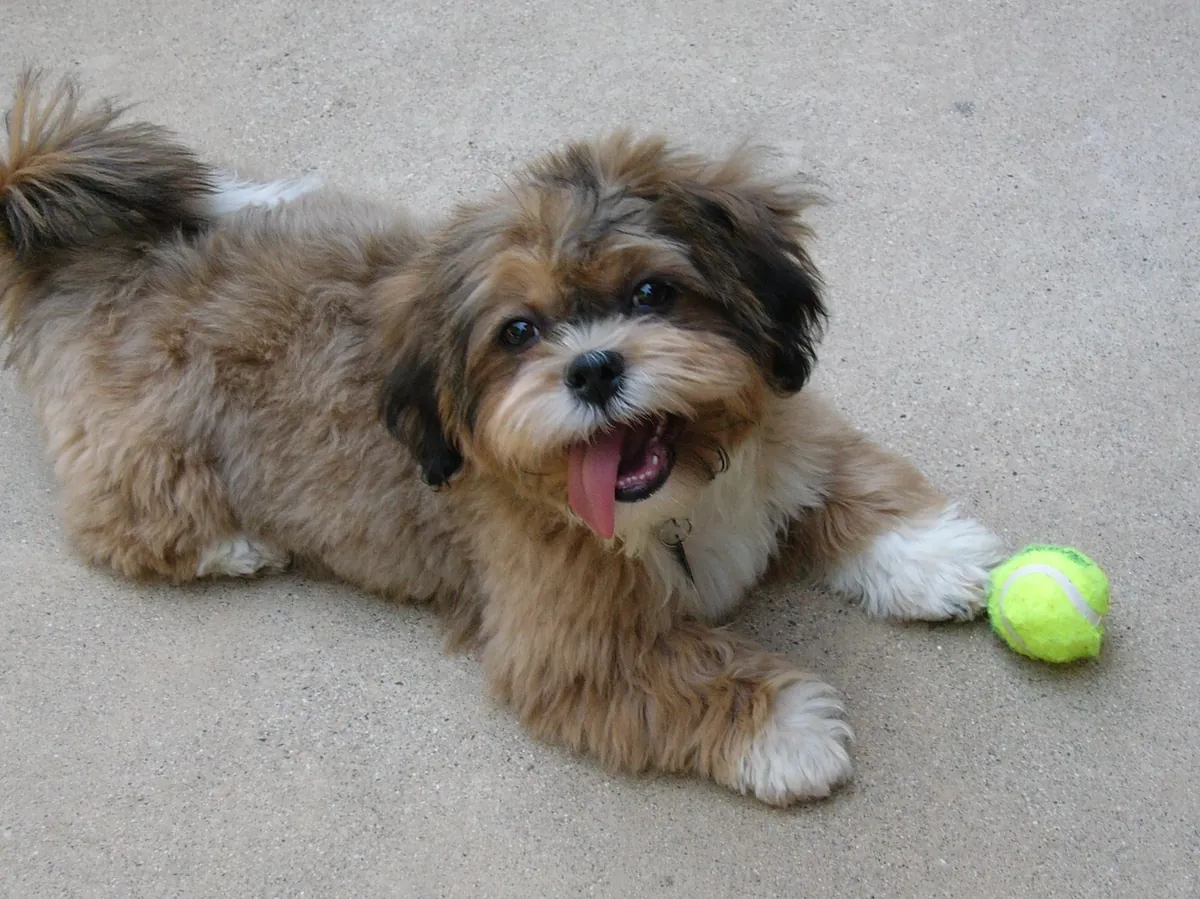

A Shih-Poo is a cross between a Shih Tzu and a Toy or Miniature Poodle: a small, low-shedding, people-loving companion that usually weighs somewhere between about 4 and 16 pounds. It isn’t a recognized breed, so its size, coat, face shape and personality can land anywhere between its two parents. Plan on daily brushing, regular grooming, close attention to teeth and eyes, and a dog who wants to be wherever you are.
You’ll also see it spelled Shih-poo, Shihpoo or Shipoo, and sometimes called a Shoodle. Most pages about Shih-Poos are puppy ads or photo galleries. This guide sticks to what the AKC, veterinary researchers and animal-welfare groups actually say about the two parent breeds, is honest about what nobody can predict, and covers adopting a Shih-Poo, with a frank fit checklist.
Shih-Poo quick facts
Every figure below is for a parent breed, from the AKC or a cited study. None is a measurement of the mix itself.
- Also called: Shih-poo, Shihpoo, Shipoo, Shoodle. Informal names, not a recognized breed.
- Size (parent breeds): Shih Tzu 9 to 10.5 in, 9 to 16 lb (AKC); Toy Poodle 10 in or less, 4 to 6 lb (AKC); Miniature Poodle 10 to 15 in, 10 to 15 lb (AKC).
- Lifespan (parent breeds): 10 to 18 years for all three (AKC). Not documented for the mix.
- Energy (AKC ratings): 3 out of 5 for the Shih Tzu, 4 for both Poodle sizes.
- Barking (AKC ratings): 3 out of 5 for the Shih Tzu, 4 for both Poodle sizes.
- Shedding (AKC ratings): 1 out of 5 for all three. Low shedding is not the same as allergy-free.
- Coat grooming (AKC ratings): 4 out of 5 for all three. Expect daily brushing and a groomer every month or so.
- Face: the Shih Tzu is short-faced (brachycephalic); Poodles have long muzzles. A Shih-Poo can be anywhere in between.
- Health to ask about: teeth, eyes, breathing, kneecaps and the hip condition Legg-Calve-Perthes. Sources below.
- Good fit for: someone home a good part of the day who wants a small lap dog and doesn’t mind a grooming routine.
Where the Shih-Poo comes from
The Shih-Poo is a deliberate cross, often sold as a “designer” dog. It isn’t on the AKC’s list of recognized breeds, and there is no breed standard, parent club or health-testing program for it. We couldn’t find a reliable record of when or where Shih Tzus and Poodles were first crossed on purpose, so we don’t guess. What we can describe well is the two parents.
The Shih Tzu side
The AKC says the Shih Tzu (the name means “lion dog”) was developed centuries ago by imperial breeders in the palace of the Chinese emperor from Tibetan stock, and is most likely a cross of two even older breeds, the Lhasa Apso and the Pekingese. It stayed “hidden behind palace walls” until the 1930s, and entered the AKC Stud Book in 1969 (AKC Shih Tzu). The breed standard is clear about its job: “the sole purpose of the Shih Tzu is that of a companion and house pet,” with a temperament that is “outgoing, happy, affectionate, friendly and trusting towards all.” It calls for a short, square muzzle, ideally no longer than an inch, and a “luxurious, double-coated, dense, long, and flowing” coat (AKC Shih Tzu standard). Our Shih Tzu breed guide covers the breed in more depth, and our Lhasa Apso and Shih Tzu comparison explains how those two cousins differ.
The Poodle side
The AKC says the Poodle started as a German water retriever, that the Standard was bred down to the Miniature, and that the Toy “was first bred in America, in the early 20th century, as a city-dwelling companion dog” (AKC Toy Poodle). All three sizes share one standard, which calls for a “long, straight and fine” muzzle and a curly coat “of naturally harsh texture, dense throughout” (AKC Poodle standard). The AKC calls Toy Poodles “extremely intelligent” and “easily trained.” Our brown Poodle guide looks at one Poodle color in detail.


Shih Tzu vs Toy Poodle vs Miniature Poodle vs Shih-Poo
AKC registry figures and the AKC’s 1 to 5 trait ratings (5 = most). The Shih-Poo column is the range between its parents, not measured data.
| Shih Tzu | Toy Poodle | Miniature Poodle | Shih-Poo (Shih Tzu x Poodle) | |
|---|---|---|---|---|
| AKC recognized | Yes (1969) | Yes | Yes | Not a recognized breed |
| Height | 9 to 10.5 in | 10 in or less | 10 to 15 in | Varies; parent span about 9 to 15 in |
| Weight | 9 to 16 lb | 4 to 6 lb | 10 to 15 lb | Varies; parent span about 4 to 16 lb |
| Life expectancy | 10 to 18 yrs | 10 to 18 yrs | 10 to 18 yrs | Not studied |
| Muzzle | Short, square (brachycephalic) | Long, fine | Long, fine | Anywhere in between |
| Coat | Long, flowing, double | Curly, dense | Curly, dense | Straight, wavy or curly |
| Affectionate with family | 5 | 5 | 5 | Not rated |
| Good with young children | 5 | 5 | 5 | Not rated; supervise |
| Good with other dogs | 5 | 3 | 3 | Not rated; ask |
| Openness to strangers | 3 | 5 | 5 | Not rated |
| Adaptability | 5 | 4 | 4 | Not rated |
| Energy | 3 | 4 | 4 | Not rated |
| Trainability | 4 | 5 | 5 | Not rated |
| Mental stimulation needs | 3 | 5 | 5 | Not rated |
| Barking | 3 | 4 | 4 | Not rated |
| Shedding | 1 | 1 | 1 | Not rated |
| Coat grooming | 4 | 4 | 4 | Not rated |
Sources: AKC Shih Tzu, AKC Toy Poodle, AKC Miniature Poodle, AKC Shih Tzu standard, AKC Poodle standard.
The pattern to notice: all three parents score 5 for affection and 1 for shedding, and all need real coat care. Where they differ is bounce and brainwork. The Poodles rate higher for energy, trainability and need for mental work, and are more outgoing with strangers. The Shih Tzu rates higher for getting along with other dogs and adapting to change. So one Shih-Poo may be a busy little problem-solver and its littermate a mellow lapdog.
Weighing other small Poodle crosses? See our guides to the Maltipoo, Yorkie Poodle mix, Cavapoo and Pomeranian Poodle mix.
Curious about a Shih Tzu cross without a Poodle? Our Shih Tzu Yorkie mix (Shorkie) guide covers the Shih Tzu and Yorkshire Terrier cross.
If you’d like a bigger, more athletic Poodle cross, our Whoodle guide covers the Soft Coated Wheaten Terrier and Poodle mix.
Appearance and size
How big does a Shih-Poo get?
Most Shih-Poos are small, but there’s no standard size. The biggest factor is which Poodle was used. A cross with a Toy Poodle (4 to 6 lb) and a Shih Tzu (9 to 16 lb) will usually stay a toy-size dog; a Miniature Poodle parent (up to 15 in and 15 lb) can produce a taller, leggier dog (AKC Toy Poodle; AKC Miniature Poodle; AKC Shih Tzu). For a sense of scale, a study of UK vet records found that adult Shih Tzus averaged 7.9 kg, about 17 pounds (Dale et al., 2024). “Teacup” and “mini” are seller labels, not sizes set by any registry.
Coat and color
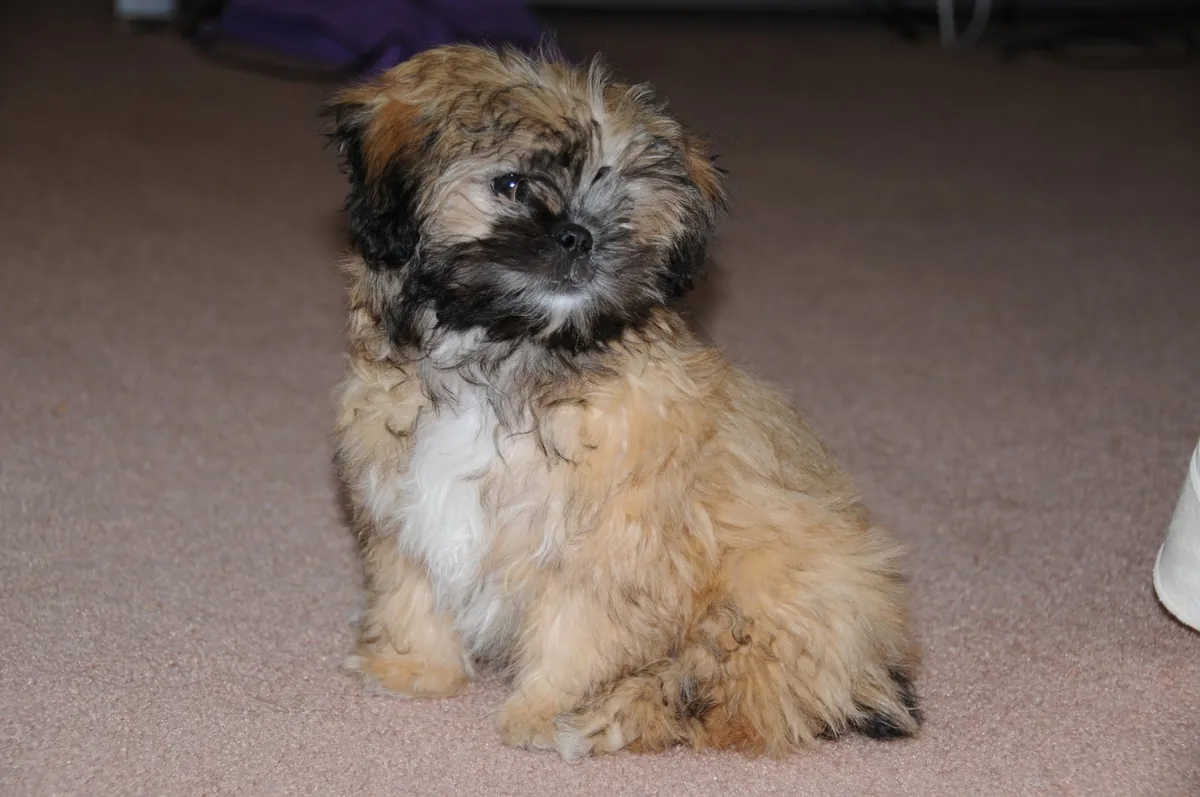
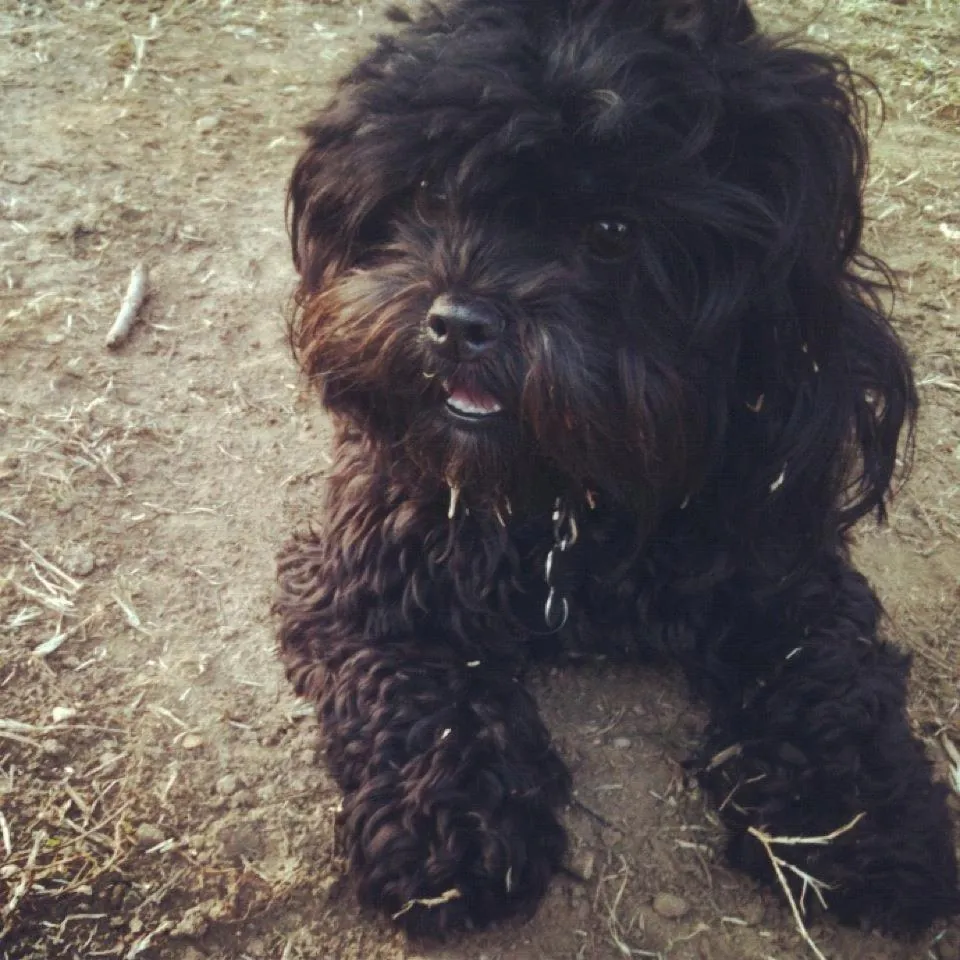
A Shih-Poo’s coat can be anything from the Shih Tzu’s long, straight, double coat to the Poodle’s tight curls, and often lands in a soft wave. Color is wide open: the Shih Tzu standard permits all colors (AKC Shih Tzu standard), and Poodles come in many solid colors. A puppy’s coat can also change as it matures, so an adult is the only sure way to know what you’re getting.


Temperament: what to realistically expect
These are registry descriptions of the purebred parents, not predictions for any one mix.
The Shih Tzu side. The breed standard asks for a dog that is “outgoing, happy, affectionate, friendly and trusting towards all” (AKC Shih Tzu standard). The AKC rates the Shih Tzu 5 out of 5 for affection, for getting on with young children, and with other dogs (AKC Shih Tzu).
The Poodle side. The AKC describes Toy Poodles as intelligent, agile and self-confident, and rates them 5 out of 5 for openness to strangers and for playfulness (AKC Toy Poodle).
What the science says about breed and behavior. A 2022 study in Science surveyed owners of 18,385 dogs and genotyped 2,155. Breed explained just 9% of the behavioral differences between individual dogs (Morrill et al., 2022). A label is a weak guide to the dog in front of you.
In daily life:
- Family: both parents rate 5 for affection. Expect a little shadow who follows you from room to room.
- Being alone: a dog this people-focused may struggle with long days by itself. The ASPCA says dogs with separation anxiety often start barking or showing distress within minutes of being left (ASPCA). Ask how this dog copes alone.
- Children: the AKC rates all three parents 5 with young children, but a small dog can be hurt if dropped or stepped on. Supervise visiting grandchildren and have them sit on the floor to cuddle.
- Other pets: the Shih Tzu rates 5 with other dogs, Poodles 3. Ask how this particular dog does with dogs and cats.
- Barking: expect some alert barking. The ASPCA says the first step is working out why the dog barks (ASPCA).

Exercise needs
A Shih-Poo is a companion, not an athlete. The AKC says the Shih Tzu “was bred to be a house companion” and needs minimal exercise: “short daily walks with their owner and indoor playtime” (AKC Shih Tzu). Poodles of every size are busier; the AKC calls them “very active dogs who require good exercise every day” and rates them 5 out of 5 for mental stimulation needs (AKC Toy Poodle).
In practice, most Shih-Poos do well with:
- Two short walks a day, at the dog’s pace. Sniffing counts.
- Indoor play: fetch down a hallway, gentle tug, hide-and-seek with treats.
- Brain games, about 10 minutes a day: food puzzles, scatter-feeding, learning a new trick.
- Care in the heat. The AKC says Shih Tzus, with their heavy coats and short faces, “do not tolerate heat well and are not good swimmers” (AKC Shih Tzu). If your Shih-Poo has a short face, walk in the cool of the day and skip the pool.
A harness is kinder than a collar for many small dogs; ask your vet. Avoid lots of jumping off furniture, given the kneecap and hip issues covered under health.

Grooming: the real commitment
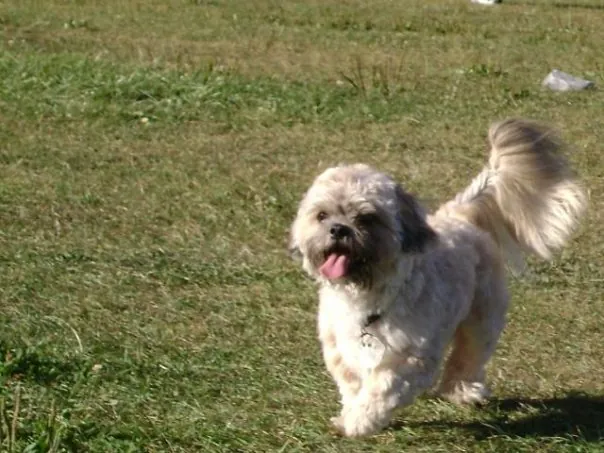
Low shedding means the loose hair stays in the coat, so it has to be brushed out. For a long-coated Shih Tzu, the AKC calls for daily brushing right down to the skin, a bath “about every three or four weeks,” daily combing of the mustache and topknot, and trimming or tying up the hair on top of the head so it doesn’t irritate the eyes. It also says a professional “puppy trim” is a fine choice if you don’t want to spend time on the coat (AKC Shih Tzu). For Poodles, the AKC says a full coat not combed to the skin “will mat near the roots,” and many owners use a groomer “every four to six weeks” (AKC Toy Poodle).
A Shih-Poo coat falls somewhere between those, so plan for:
- Brushing and combing most days, down to the skin, especially behind the ears, under the legs and on the belly. That’s where mats start.
- A short trim every four to six weeks if daily brushing is hard on your hands. It’s a perfectly good choice.
- Baths every few weeks, after brushing out tangles. Ask your vet or groomer what suits your dog’s skin.
- Eyes: keep hair trimmed away from the eyes and gently wipe the corners with a damp cloth (AKC Shih Tzu).
- Ears: check weekly. In a UK study of Poodle crosses, researchers noted that abundant ear hair, as in Poodles, can hold moisture and heat in the ear canal and raise infection risk (Bryson et al., 2024). Ear disorders were among the three most common problems in UK Shih Tzus (Dale et al., 2024).
- Nails and teeth: trim nails regularly, and brush teeth often (see health).

Are Shih-Poos hypoallergenic?
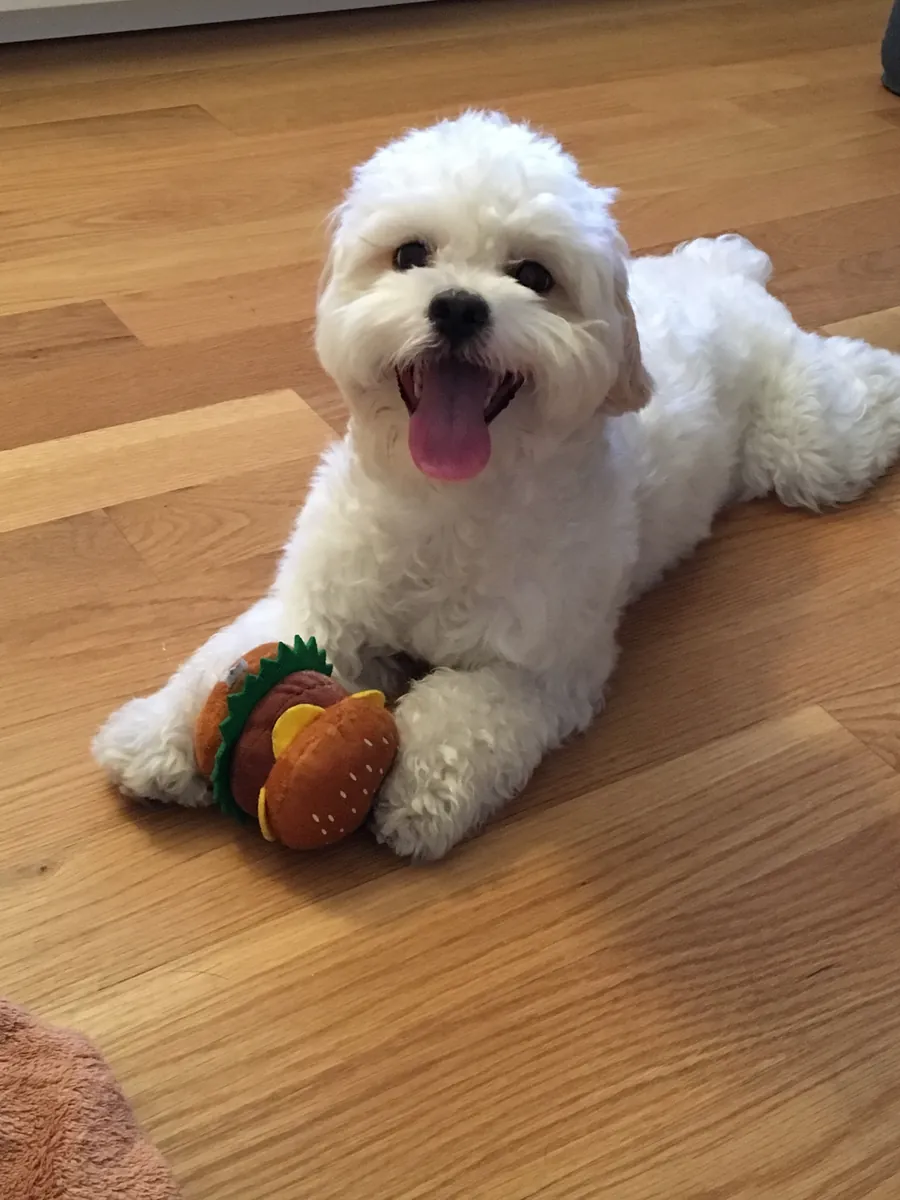
No dog is. All three parents rate just 1 out of 5 for shedding with the AKC, but shedding isn’t the whole story. A 2012 study measured the main dog allergen in coats and homes and found that dogs sold as hypoallergenic, including Poodles, had more allergen in their coats than other dogs, with no difference in the air of their homes; the authors concluded there is “no evidence” for calling any breed hypoallergenic (Vredegoor et al., 2012). The AKC says mixed-breed dogs marketed as hypoallergenic are “just that – marketing” (AKC). If you have allergies, spend time with the specific dog and talk to your doctor first. Our hypoallergenic dog breeds page has more.
Health issues to know about
There is no published health study of Shih-Poos. The largest study of Poodle crosses so far looked at Cockapoos, Labradoodles and Cavapoos and found that for most of the 57 disorders it studied, the crosses didn’t differ from Poodles (Bryson et al., 2024). A UC Davis study found purebred dogs more likely to have some inherited conditions, but no difference for 13 others, including patellar luxation (Bellumori et al., 2013). Being a mix isn’t a guarantee of good health, so learn both parents’ lists.
| Condition | Which parent breed | What the source says |
|---|---|---|
| Dental (periodontal) disease | Both | The most common single diagnosis in UK Shih Tzus, at 9.5% in one year (Dale et al., 2024). Toy Poodles had about 4 times the odds of crossbred dogs (O’Neill et al., 2021). |
| Eye problems | Shih Tzu, mostly | Eye disorders affected 11.9% of UK Shih Tzus in a year (Dale et al., 2024). Shih Tzus had one of the highest rates of corneal ulcers (3.45%) in English vet records (O’Neill et al., 2017). |
| Breathing problems (BOAS) | Shih Tzu | Rated moderate risk; extra weight raised the odds (Tomlinson et al., 2026). |
| Slipping kneecaps (patellar luxation) | Both | Named by the AKC for the Shih Tzu and on the Poodles’ AKC screening lists; ACVS says it mainly affects small dogs (AKC; ACVS). |
| Progressive retinal atrophy (PRA) and cataracts | Both | Named for the Shih Tzu; a PRA DNA test and eye exam are on the Poodles’ screening lists (AKC; AKC). |
| Juvenile renal dysplasia (kidneys don’t develop normally) | Shih Tzu | Rare but serious, per the AKC (AKC). |
| Legg-Calve-Perthes, a hip condition of young small dogs | Poodle | More likely in Toy and Miniature Poodles than Standards (AKC); VCA lists Poodles among affected breeds (VCA). |
| Hip dysplasia | Both | Named for both parents by the AKC (AKC; AKC). |
| Epilepsy, von Willebrand’s disease, thyroid and adrenal disorders | Poodle | Named in the Poodle health statement summarized by the AKC (AKC). |
Teeth come first. Cornell’s vet college says 80 to 90% of dogs over age 3 have some periodontal disease, that it’s worse in smaller breeds, and that it often isn’t recognized until it’s advanced (Cornell). The authors of the UK Shih Tzu study named oral hygiene a healthcare priority for the breed (Dale et al., 2024). Brush often with dog toothpaste, never human toothpaste, and budget for cleanings.
Watch the eyes. The AKC warns that a breed “with large eyes and no muzzle to protect them” is prone to eye injuries, and to seek prompt vet care if you suspect a problem (AKC Shih Tzu). Squinting, rubbing, cloudiness or a red, weepy eye is worth a same-day call. Breeders can have parent dogs examined by a board-certified veterinary ophthalmologist (ACVO) through the OFA eye registry; ask for those results.
Breathing. The American College of Veterinary Surgeons says short-faced dogs can have noisy breathing, gagging, and trouble with exercise, excitement or heat, and that “obesity will aggravate the problems” (ACVS). A 2026 University of Cambridge study of 14 short-faced breeds rated the Shih Tzu at moderate risk of BOAS: between a quarter and a half of the 42 Shih Tzus tested had no signs, and overweight Shih Tzus were more likely to be affected (Tomlinson et al., 2026). A Shih-Poo with a longer Poodle-type muzzle may be at lower risk, but no study has measured this in the mix. Keep your dog lean.
Watch for a skip. ACVS says many dogs with a slipping kneecap will suddenly carry a back leg for a few steps, then carry on (ACVS). Tell your vet if you see that or any limping.
Backs. The ACVS lists short-legged “chondrodystrophoid” breeds, including the Pekingese and Lhasa Apso, the Shih Tzu’s likely ancestors, as accounting for most disc ruptures (intervertebral disc disease, IVDD) (ACVS). Neither the Shih Tzu nor the Poodle is on that list, but sudden back pain, wobbliness or reluctance to jump is an emergency. Our senior dog care guide covers keeping an older small dog comfortable.
Lifespan
We found no study of this mix’s lifespan. The AKC lists 10 to 18 years for the Shih Tzu and for Toy and Miniature Poodles (AKC Shih Tzu; AKC Toy Poodle). In UK vet records, the median age at death for Shih Tzus was 12.7 years, which the researchers described as relatively long-lived compared with dogs overall (Dale et al., 2024). Those are parent-breed figures, not a forecast for your dog, but a Shih-Poo could easily live into its teens. That’s one reason we encourage every owner to make a backup plan (more below).
Training
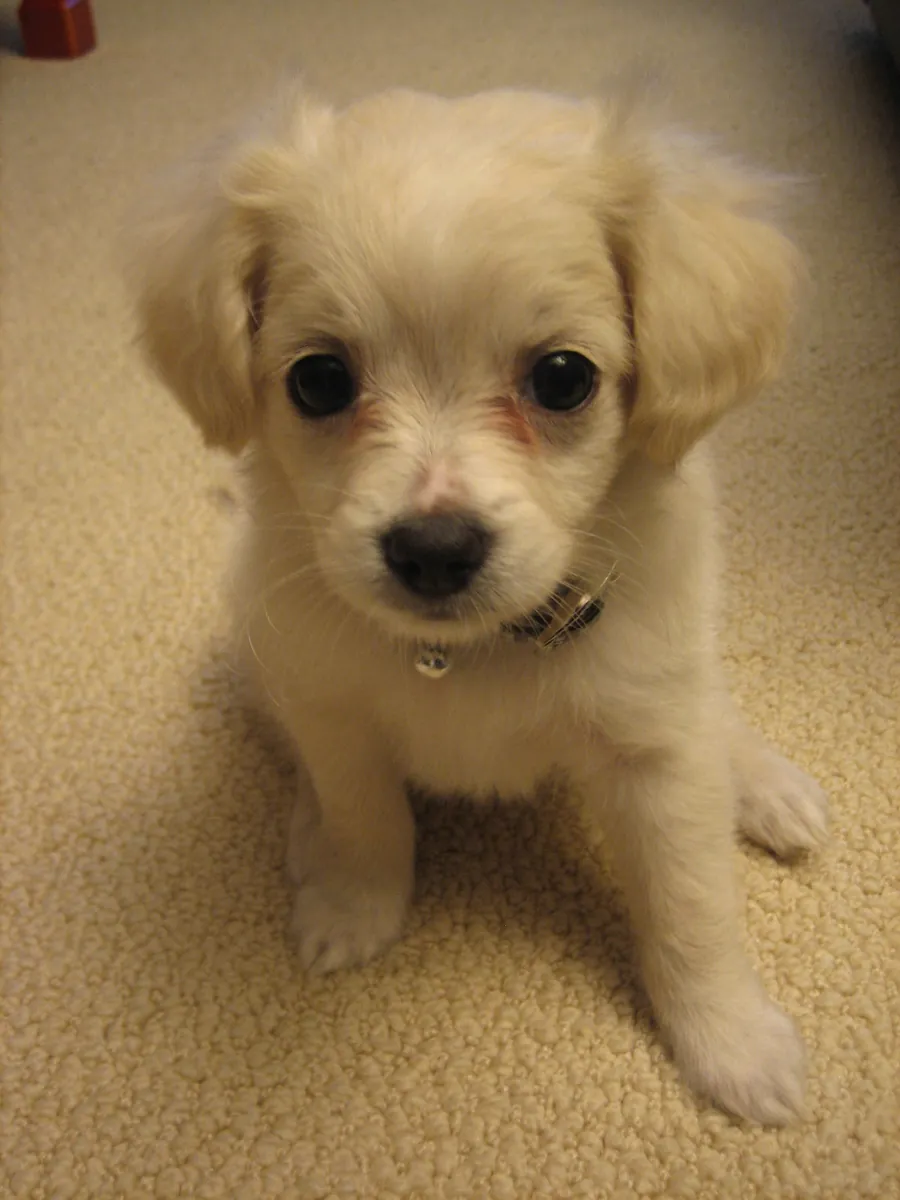
Expect a willing learner with a charming stubborn streak. The AKC says training a Shih Tzu “can be both an amusing and a frustrating experience,” that the breed “tends to charm his owner into letting him have his own way,” and that praise and rewards work best, not harsh corrections (AKC Shih Tzu). Poodles rate 5 out of 5 for trainability (AKC Toy Poodle). The American Veterinary Society of Animal Behavior recommends reward-based training for all dogs (AVSAB, 2021).
What to work on first:
- Toilet training. The AKC warns an indulged Shih Tzu can end up “less-than-completely-housebroken.” Frequent trips out, lots of praise, and patience.
- Handling. Pair brushing, tooth brushing, nail trims, eye wipes and ear checks with treats from day one.
- Being alone. Build up time alone gradually, starting with short absences that don’t upset the dog (ASPCA).
- Quiet on cue, and a calm “sit to say hello.”
- A “wait” at doors and stairs, which helps keep both of you safe.

Diet basics
There’s no special Shih-Poo diet. The AKC’s advice for both parents is a high-quality food suited to the dog’s age, an eye on treats, and a check with your vet about weight (AKC Shih Tzu). Three practical points:
- Keep them lean. Extra weight raised BOAS risk in Shih Tzus (Tomlinson et al., 2026) and adds strain on small knees.
- Tiny puppies, small frequent meals. Toy-size puppies can run low on blood sugar between meals (AKC hypoglycemia). Follow your vet’s schedule.
- “Natural” doesn’t mean safe. The ASPCA lists foods that are dangerous to dogs, including grapes and raisins, onions and garlic, and xylitol, a sweetener in some sugar-free products (ASPCA).
Who a Shih-Poo suits, and who should skip one
A Shih-Poo may suit you if you want a small, affectionate companion, you’re home a good part of the day, you live in an apartment or a smaller home (the AKC rates the Shih Tzu 5 out of 5 for adaptability), and you enjoy grooming or will pay for it.
Consider another dog if daily brushing would be a chore you’d skip, if the dog would be alone for long workdays, if you live somewhere very hot and can’t keep a short-faced dog cool, or if you have allergies and haven’t tested your reaction to this particular dog.
Is a Shih-Poo right for me? A checklist for adopters over 50
A few “no” answers don’t rule you out; they tell you what to plan for or which dog to ask about.
- Yes / No: I can brush and comb a dog most days, or I’m happy with a short trim and a groomer every four to six weeks.
- Yes / No: I’ll brush its teeth regularly and budget for dental cleanings.
- Yes / No: I’ll check its eyes daily and call the vet promptly about squinting or redness.
- Yes / No: Someone is home much of the day, or I can arrange company for the dog.
- Yes / No: I can keep a dog cool in summer and lean all year.
- Yes / No: I’ve spent time with this dog and checked whether my allergies react.
- Yes / No: I’ve thought about a small dog underfoot: night lights, a set spot for its bed, a “wait” cue at stairs.
- Yes / No: I can budget for vet care, grooming and possible dental, eye or kneecap treatment.
- Yes / No: I’ve thought about who would care for this dog if I ever couldn’t.
A word on trips and falls
A US study estimated that emergency visits for fractures linked to walking leashed dogs among people 65 and older rose from 1,671 in 2004 to 4,396 in 2017 (Pirruccio et al., 2019). A Shih-Poo won’t pull you over, but a small dog can get under your feet. Hold the leash in your hand rather than wrapping it around your wrist, wear sturdy shoes, and keep a light on at night.
What a Shih-Poo costs
We don’t quote puppy prices: we found no independent, verifiable survey of what Shih-Poo puppies sell for, and seller prices vary widely. What we can source is the cost of keeping a dog. The ASPCA’s 2021 estimate is $1,391 a year, and $3,221 for the first year once one-time costs, professional grooming and dental care are included (ASPCA). For a Shih-Poo, budget specifically for:
- Grooming. The ASPCA’s estimate includes $300 a year for professional grooming. A coat trimmed every four to six weeks, as the AKC describes for Poodles (AKC Toy Poodle), will likely cost more. Ask local groomers for their prices.
- Dental care. The ASPCA budgets $500 for dental in the first year. Small dogs may need cleanings more often.
- Eye care. Treating an eye injury or ulcer promptly can mean an unplanned vet visit.
- Pet insurance or an emergency fund, priced before anything becomes a pre-existing condition.
Finding a responsible breeder
Humane World for Animals (formerly the Humane Society of the United States) says: “You don’t want to buy a puppy from a pet store or a website. Most of those puppies come from mass breeding facilities—better known as puppy mills” (Humane World). It estimates there are 10,000 puppy mills in the US and says their puppies “frequently suffer from a variety of health issues” (Humane World). It recommends checking shelters and rescues first, meeting the breeder in person and visiting where the puppy was raised.
Because there’s no Shih-Poo club or health program, ask:
- Can I meet the mother, and see the father or his records? Which Poodle size is the parent?
- What health tests have the parents had? The AKC’s screening lists for Toy Poodles are a patella evaluation, an eye exam by a veterinary ophthalmologist and a PRA DNA test, plus a hip evaluation for Miniature Poodles (AKC Toy Poodle; AKC Miniature Poodle). For the Shih Tzu parent, ask for a patella check and an ACVO eye exam, given the issues the AKC names (AKC Shih Tzu). Ask to see results, not assurances.
- How flat is the Shih Tzu parent’s face, and does it breathe quietly?
- Will you take the dog back at any age if I can’t keep it?
Red flags: puppies always available in every size and color, “teacup” sizes at a premium, no chance to visit, pressure to pay a deposit fast, or a hand-off in a parking lot.
Adopting a Shih-Poo
Shih-Poos do end up in shelters and rescues, often as adults whose size, coat, face and personality you can see before you commit. That’s a real advantage. (Bone Voyage itself is no longer a rescue and doesn’t place dogs.)
Where to look
- Local shelters and all-breed rescues. Search “Shih-Poo,” “Shih Tzu mix” and “Poodle mix,” since labels are often a guess.
- Shih Tzu rescue. The American Shih Tzu Club lists its rescue and welfare contacts. Ask whether local groups take Shih Tzu mixes.
- Poodle rescue. The Poodle Club of America Rescue Foundation works through regional groups across the US. Ask about Poodle mixes.
Foster-based groups are especially helpful, because a foster family can tell you how the dog behaves in a real home. The ASPCA’s adoption tips suggest leaning on shelter staff to help match a dog to your lifestyle and being patient while a new dog settles in (ASPCA).
Is that shelter dog really a Shih-Poo?
Maybe. Small, shaggy dogs are easy to label, and Havanese, Lhasa Apso and Maltese mixes can look similar. In a study of 919 shelter dogs, staff matched at least one breed found by DNA in 67.7% of dogs, but both named breeds in only 10.4% (Gunter et al., 2018). Meet the dog, not the label. Our guide to figuring out your dog’s breed explains what DNA tests can and can’t tell you.
Questions to ask the shelter or rescue
- How was the breed label decided? Is either parent known?
- How old is the dog, and what does it weigh?
- How does it breathe at rest, on walks and in warm weather? Does it snore?
- Any eye history: ulcers, dry eye, drops or ointments?
- When were its teeth last cleaned? Any extractions?
- Any limping, skipping on a back leg, or kneecap findings?
- How does it handle brushing, baths, nail trims and eye wipes?
- How has it done with dogs, cats and children, and how does it cope alone?
- Is there a foster-to-adopt or trial period?
Our list of 9 questions to ask when adopting a dog covers the general ones, and our guide to the best dog breeds for seniors can help if you’re still deciding.
Give your dog a backup plan
A small dog who could live into its teens deserves a plan for every stage of life, including one where you can’t be there. Naming a backup caregiver now, someone the dog already knows, makes it far less likely your dog will end up in a shelter. Our guide What Happens to Your Dog When You Die walks you through it, and the free My Dog’s Backup Plan worksheet records your dog’s routine, vet, grooming schedule and quirks. Bone Voyage is also building the backup-adopter pledge: a volunteer’s pledge to adopt a specific older adult’s dog if that person dies or can no longer care for it. You can join the free list on the guide page.
Frequently Asked Questions
What is a Shih-poo puppy?
A Shih-poo puppy is a cross between a Shih Tzu and a Toy or Miniature Poodle, usually a first-generation cross of two purebred parents. It isn’t a recognized breed, so there is no breed standard, and puppies in one litter can differ in size, coat and face shape. Going by AKC figures for the parents, most adults end up somewhere between about 4 and 16 pounds (AKC Shih Tzu; AKC Toy Poodle).
Which is better, Shih Tzu or Shih-poo?
Neither is better overall; they suit different people. A Shih Tzu is a known quantity: a recognized breed with a standard, a parent club and predictable size and coat. A Shih-poo is less predictable, and may have a longer muzzle or a curlier coat, or may not. If you want to know exactly what you’re getting, pick a Shih Tzu or an adult dog of either kind whose size, coat and personality you can see.
How often should you wash a Shih-poo?
There’s no Shih-poo-specific rule. For the Shih Tzu, the AKC suggests a bath about every three to four weeks (AKC Shih Tzu), and many Poodle owners use a professional groomer every four to six weeks (AKC Toy Poodle). Daily brushing to the skin matters more than frequent baths, and your vet or groomer can tell you what suits your dog’s coat and skin.
How big does a Shih-Poo get when fully grown?
There’s no standard size. The AKC lists the Shih Tzu at 9 to 10.5 inches and 9 to 16 pounds, the Toy Poodle at 10 inches or less and 4 to 6 pounds, and the Miniature Poodle at 10 to 15 inches and 10 to 15 pounds (AKC Shih Tzu; AKC Toy Poodle; AKC Miniature Poodle). A Shih-Poo usually lands somewhere in that span, and a Miniature Poodle parent makes a bigger dog more likely. Adopting an adult is the only sure way to know.
Are Shih-Poos hypoallergenic?
No dog is truly hypoallergenic, and the AKC says mixed breeds marketed that way are just marketing (AKC). The Shih Tzu and both Poodle sizes all rate 1 out of 5 for shedding with the AKC, but a 2012 study found no evidence that any breed called hypoallergenic, including Poodles, had lower allergen levels in the home (Vredegoor et al., 2012). If you have allergies, spend real time with the specific dog and talk to your doctor.
How long do Shih-Poos live?
No study has measured the Shih-Poo’s lifespan. The AKC lists 10 to 18 years for the Shih Tzu and for Toy and Miniature Poodles, and a study of UK vet records found a median age at death of 12.7 years for Shih Tzus (Dale et al., 2024). Those are parent-breed figures, so plan for a dog who could well reach its teens.
Do Shih-Poos have breathing problems?
Some may. The Shih Tzu is a short-faced breed, and a 2026 University of Cambridge study rated it at moderate risk of brachycephalic obstructive airway syndrome (BOAS), with extra weight linked to higher risk (Tomlinson et al., 2026). Poodles have long muzzles, so a Shih-Poo’s face can fall anywhere in between. No study has measured breathing problems in the mix itself. Loud breathing, snoring while awake or tiring quickly in warm weather is worth a vet visit.
Is a Shih-Poo a good dog for someone over 50?
It can be a lovely match if you want a small, affectionate companion, are home much of the day, and are happy to brush most days and book a groomer regularly. The small size is easy to lift and walk, but a small dog underfoot is a trip risk. A puppy can be a great fit at any age if you have the time and energy for training; a calm adult Shih-Poo from a rescue can be easier if you’d rather skip that stage.
Sources
- American Kennel Club, Shih Tzu breed page and Shih Tzu standard
- American Kennel Club, Toy Poodle breed page, Miniature Poodle breed page and Poodle standard
- American Kennel Club, Hypoglycemia in Dogs and Do Hypoallergenic Dogs Exist?
- American Shih Tzu Club, Rescue committee contacts
- Poodle Club of America Rescue Foundation, home page
- Orthopedic Foundation for Animals, Eye certification (CAER) by ACVO ophthalmologists
- Humane World for Animals (formerly HSUS), How to find a responsible dog breeder and Puppy mills
- ASPCA, Cutting Pet Care Costs (2021 cost update), Barking, Separation Anxiety, Finding Your Fido: Tips for Adopting and People Foods to Avoid Feeding Your Pets
- Dale F et al. (2024). Demography, common disorders and mortality of Shih Tzu dogs under primary veterinary care in the UK. Canine Medicine and Genetics 11:2. doi:10.1186/s40575-023-00135-y
- O’Neill DG et al. (2017). Corneal ulcerative disease in dogs under primary veterinary care in England: epidemiology and clinical management. Canine Genetics and Epidemiology 4:5. doi:10.1186/s40575-017-0045-5
- Tomlinson F et al. (2026). A cross-sectional study into the prevalence and conformational risk factors of BOAS across fourteen brachycephalic dog breeds. PLOS ONE 21(2):e0340604. doi:10.1371/journal.pone.0340604
- O’Neill DG et al. (2021). Epidemiology of periodontal disease in dogs in the UK primary-care veterinary setting. Journal of Small Animal Practice 62(12):1051-1061.
- Vredegoor DW et al. (2012). Can f 1 levels in hair and homes of different dog breeds: lack of evidence to describe any dog breed as hypoallergenic. Journal of Allergy and Clinical Immunology 130(4):904-9.
- Bellumori TP et al. (2013). Prevalence of inherited disorders among mixed-breed and purebred dogs. JAVMA 242(11):1549-55.
- Bryson GT et al. (2024). The doodle dilemma: How the physical health of ‘Designer-crossbreed’ Cockapoo, Labradoodle and Cavapoo dogs’ compares to their purebred progenitor breeds. PLOS ONE.
- Morrill K et al. (2022). Ancestry-inclusive dog genomics challenges popular breed stereotypes. Science 376(6592):eabk0639.
- Gunter LM et al. (2018). A canine identity crisis: genetic breed heritage testing of shelter dogs. PLOS ONE 13(8):e0202633.
- Pirruccio K et al. (2019). Fractures in elderly Americans associated with walking leashed dogs. JAMA Surgery 154(5):458-459.
- Cornell Riney Canine Health Center, Periodontal disease
- American College of Veterinary Surgeons, Brachycephalic Syndrome, Patellar Luxations and Intervertebral Disc Disease
- VCA Animal Hospitals, Legg-Calve-Perthes Disease in Dogs
- American Veterinary Society of Animal Behavior, Position Statement on Humane Dog Training (2021)
- Photos: Wikimedia Commons contributors, credited under each image. Full license records are kept in this site’s image-credits file.