

A Whoodle is a cross between a Soft Coated Wheaten Terrier and a Poodle, usually a Standard Poodle and sometimes a Miniature. Most are medium-sized, low-shedding, people-loving dogs with a soft, wavy or curly coat and plenty of bounce. It isn’t a recognized breed, so its size, coat, energy and personality can land anywhere between its two parents. Plan on daily exercise, regular brushing and trims, and one health topic most breed pages skip: the inherited kidney and gut diseases that run in Wheaten Terriers.
You’ll also see it called a Wheatendoodle. Most pages about Whoodles are puppy ads or short profiles that call the mix “hypoallergenic” and leave it there. This guide sticks to what the AKC, the parent breed standards and veterinary researchers actually say, is honest about what nobody can predict, and covers adopting a Whoodle, with a frank checklist for adopters.
Whoodle quick facts
Every figure below is for a parent breed, from the AKC or a cited study. None is a measurement of the mix itself.
- Also called: Wheatendoodle. An informal name, not a recognized breed.
- Size (parent breeds): Soft Coated Wheaten Terrier 17 to 19 in, 30 to 40 lb (AKC); Standard Poodle over 15 in, 40 to 70 lb; Miniature Poodle 10 to 15 in, 10 to 15 lb (AKC; AKC).
- Lifespan (parent breeds): 12 to 14 years for the Wheaten, 10 to 18 years for Poodles (AKC). Not documented for the mix.
- Energy (AKC ratings): 4 out of 5 for the Wheaten and for both Poodle sizes.
- Shedding (AKC ratings): 1 out of 5 for all three. Low shedding is not the same as allergy-free.
- Coat grooming (AKC ratings): 4 out of 5 for all three. Expect brushing most days and a trim every month or two.
- Health to ask about: protein-losing kidney and gut disease (PLN and PLE) and Addison’s disease from the Wheaten side; hips, eyes, bloat and skin from the Poodle side. Sources below.
- Good fit for: someone active who wants a medium-sized, affectionate dog, enjoys training, and will keep up with coat care.
Where the Whoodle comes from
The Whoodle is a deliberate cross, often sold as a “designer” dog. It isn’t on the AKC’s list of recognized breeds, and there is no breed standard, parent club or health-testing program for it. We couldn’t find a reliable record of when Wheatens and Poodles were first crossed on purpose, so we don’t guess. What we can describe well is the two parents.
The Soft Coated Wheaten Terrier side
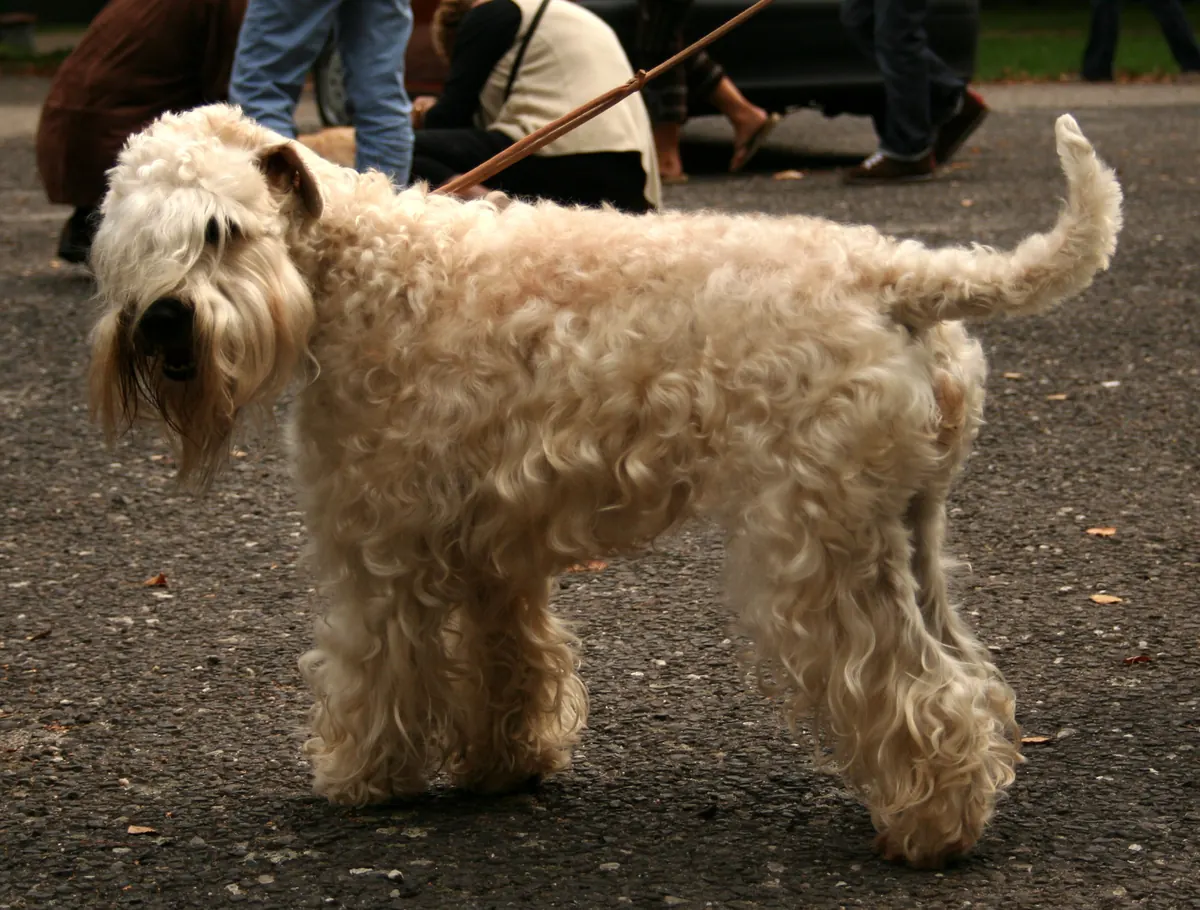
The AKC describes the Wheaten as one of Ireland’s three “long-legged terriers,” a versatile farm dog expected to do “any number of rustic chores, like ratting, guarding the chicken coop, and even herding or bird-dogging,” and then be an “engaging fireside companion” in the evening. The Irish Kennel Club recognized the breed in 1937, and the first Wheatens came to the United States in the 1940s (AKC Wheaten). The breed standard calls for a “happy, steady dog” that “exhibits less aggressiveness than is sometimes encouraged in other terriers” (AKC Wheaten standard).

The Poodle side
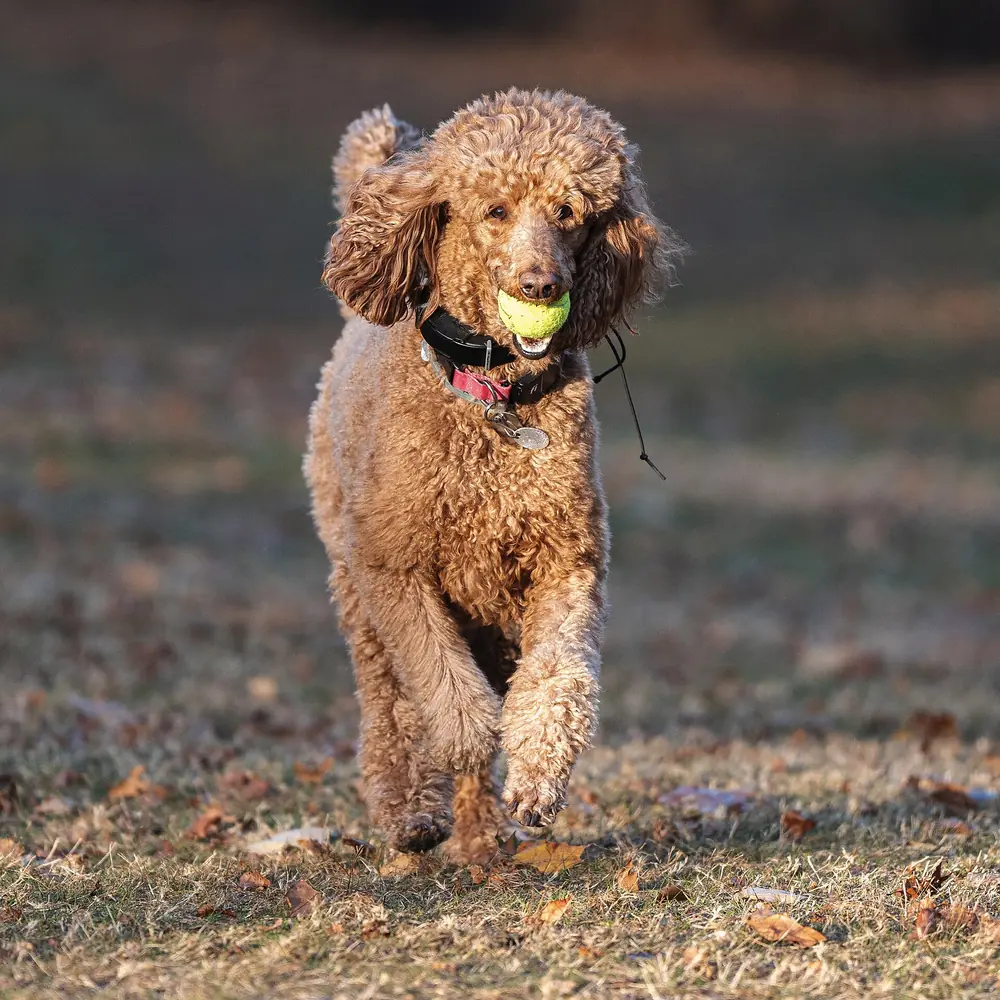
The AKC says the Poodle began as a water retriever in Germany more than 400 years ago and that the Standard “was bred down to the Miniature.” Today it describes Poodles as “eager, athletic, and wickedly smart dogs of remarkable versatility” (AKC Standard Poodle). The breed standard calls for a curly coat “of naturally harsh texture, dense throughout” (AKC Poodle standard).

Wheaten Terrier vs Standard Poodle vs Miniature Poodle vs Whoodle
AKC registry figures and the AKC’s 1 to 5 trait ratings (5 = most). The Whoodle column is the range between its parents, not measured data.
| Soft Coated Wheaten Terrier | Standard Poodle | Miniature Poodle | Whoodle (Wheaten x Poodle) | |
|---|---|---|---|---|
| AKC recognized | Yes | Yes | Yes | Not a recognized breed |
| Height | 17 to 19 in | Over 15 in | 10 to 15 in | Varies; depends on the Poodle parent |
| Weight | 30 to 40 lb | 40 to 70 lb | 10 to 15 lb | Varies; parent span about 30 to 70 lb (Standard cross) or 10 to 40 lb (Mini cross) |
| Life expectancy | 12 to 14 yrs | 10 to 18 yrs | 10 to 18 yrs | Not studied |
| Coat | Single, soft, silky, gently waving | Curly, dense, harsh | Curly, dense, harsh | Wavy, shaggy or curly |
| Color | Any shade of wheaten | Many solid colors | Many solid colors | Wide range |
| Affectionate with family | 5 | 5 | 5 | Not rated |
| Good with young children | 5 | 5 | 5 | Not rated; supervise |
| Good with other dogs | 3 | 3 | 3 | Not rated; ask |
| Openness to strangers | 3 | 5 | 5 | Not rated |
| Playfulness | 3 | 5 | 5 | Not rated |
| Adaptability | 3 | 4 | 4 | Not rated |
| Energy | 4 | 4 | 4 | Not rated |
| Trainability | 3 | 5 | 5 | Not rated |
| Mental stimulation needs | 3 | 5 | 5 | Not rated |
| Barking | 3 | 4 | 4 | Not rated |
| Shedding | 1 | 1 | 1 | Not rated |
| Coat grooming | 4 | 4 | 4 | Not rated |
Sources: AKC Wheaten, AKC Standard Poodle, AKC Miniature Poodle, AKC Wheaten standard, AKC Poodle standard.
The pattern to notice: all three parents score 5 for affection, 4 for energy and 1 for shedding, and all need real coat care. Where they differ is brainwork and sociability. The Poodles rate higher for trainability, playfulness, openness to strangers and need for mental work. The Wheaten rates lower on all of those and, in the AKC’s words, is “keenly smart and willful.” So one Whoodle may be an eager student who greets every visitor, while its littermate has more terrier independence.
Weighing other Poodle crosses? See our guides to the Goldendoodle, the miniature Labradoodle and, for smaller dogs, the Shih-Poo, Maltipoo and Cavapoo.
Appearance and size
How big does a Whoodle get?
There’s no standard size. The biggest factor is which Poodle was used. A cross with a Standard Poodle (40 to 70 lb) and a Wheaten (30 to 40 lb) will usually be a medium-to-large dog; a Miniature Poodle parent (10 to 15 lb) usually means a smaller dog, sometimes sold as a “mini Whoodle” (AKC Standard Poodle; AKC Miniature Poodle; AKC Wheaten). Male Wheatens run a little bigger than females: 18 to 19 inches and 35 to 40 pounds, against 17 to 18 inches and 30 to 35 pounds. Puppies in one litter can still grow to different sizes.
Coat and color
A Whoodle’s coat can be anything from the Wheaten’s soft, silky single coat with a gentle wave to the Poodle’s dense curls, and often lands in a shaggy wave. The Wheaten standard says the coat comes in “any shade of wheaten,” while Poodles come in many solid colors, so Whoodles range from cream and apricot to black.
Here’s something few breed pages mention: a Whoodle puppy may not look like the adult it becomes. The Wheaten standard notes that in puppies and adolescents “the mature wavy coat is generally not yet evident,” that puppies under a year “may carry deeper coloring and occasional black tipping,” and that the adolescent under two years “is often quite light in color,” with the true wheaten color obvious only by about age two (AKC Wheaten standard). If coat color or texture matters to you, an adult dog is the only sure way to know what you’re getting.



Temperament: what to realistically expect
These are registry descriptions of the purebred parents, not predictions for any one mix.
The Wheaten side. The AKC calls Wheatens “merry extroverts” and says their temperament combines “the alert intelligence of the terrier tribe with the steadiness of the working dog” (AKC Wheaten). It rates them 5 out of 5 for affection and with young children, and 3 for getting along with other dogs.
The Poodle side. The AKC calls Poodles “very people-oriented” and rates them 5 out of 5 for affection, openness to strangers and playfulness (AKC Standard Poodle).
What the science says about breed and behavior. A 2022 study in Science surveyed owners of 18,385 dogs and genotyped 2,155. Breed explained just 9% of the behavioral differences between individual dogs (Morrill et al., 2022). A label is a weak guide to the dog in front of you.
In daily life:
- Family: both parents rate 5 for affection. Expect a dog who wants to be with you, not alone in the yard.
- Being alone: a dog this people-focused may struggle with long days by itself. The ASPCA describes how separation anxiety can show up as barking, destructiveness or house-soiling when a dog is left alone (ASPCA). Ask how this dog copes alone.
- Chasing: the AKC says Wheatens have “a strong prey drive” and “will have an urge to chase after just about anything that moves, from squirrels to cars,” so it calls for a securely fenced yard and says walks “must always be on a leash” (AKC Wheaten).
- Other pets: all three parents rate 3 with other dogs. Ask how this particular dog does with dogs and cats.
- Exuberant hellos: a bouncy, medium-sized dog who jumps up to greet you can knock a person off balance. Teaching a calm “sit to say hello” is worth the effort (see training).


Exercise needs
A Whoodle is an active dog. This is the most important thing for anyone to weigh honestly. The AKC says the Wheaten “has a medium to high energy level that does not diminish, even in old age,” needs “plenty of exercise every day,” and that owners “should expect to participate in the daily exercise sessions” (AKC Wheaten). It says Poodles of every size “are very active dogs who require good exercise every day,” love to swim and retrieve, and “thrive on going for jogs or long walks with their human” (AKC Standard Poodle).
In practice, most Whoodles do well with:
- Two good walks a day, on leash, with time to sniff.
- Play that tires the body without tiring you: fetch in a fenced area, a flirt pole, or swimming if your dog enjoys water.
- Brain games, about 10 to 15 minutes a day: food puzzles, scatter-feeding, learning a new trick. The AKC rates Poodles 5 out of 5 for mental stimulation needs.
- Help if you need it. A dog walker, a neighbor’s teenager or doggy daycare a few days a week can cover the days your knees say no.

Grooming: the real commitment
Low shedding means the loose hair stays in the coat, so it has to be brushed out. For the Wheaten, the AKC describes a daily session with a pin or slicker brush, followed by “a thorough combing with a medium- and fine-toothed metal comb,” with mats “pulled apart with the brush, comb, and fingers” and never cut out with scissors (AKC Wheaten). For Poodles, it says that unless you keep a short trim you’ll need to brush daily, and that if you don’t brush “completely to the skin, the hair will mat near the roots and will have to be shaved off.” Many owners use a professional groomer “every four to six weeks” (AKC Standard Poodle).
A Whoodle coat falls somewhere between those, so plan for:
- Brushing and combing most days, down to the skin, especially behind the ears, under the legs and on the belly, where mats start.
- A short trim every four to six weeks if daily brushing is hard on your hands or shoulders. It’s a perfectly good choice.
- Ears: check weekly. The AKC reminds Wheaten owners to check ears regularly for infection (AKC Wheaten), and in a UK study of Poodle crosses, researchers noted that abundant ear hair, as in Poodles, can hold moisture and heat in the ear canal and raise infection risk (Bryson et al., 2024).
- Teeth and nails: brush teeth often with a dog toothpaste, and trim nails regularly; the AKC says overly long nails “can be painful to the dog and cause problems walking and running.”


Are Whoodles hypoallergenic?
No dog is. All three parents rate just 1 out of 5 for shedding with the AKC, but shedding isn’t the whole story. A 2012 study measured the main dog allergen in coats and homes and found that dogs sold as hypoallergenic, including Poodles and Labradoodles, had more allergen in their coats than other dogs, with no difference in the air of their homes; the authors concluded there is no evidence for calling any breed hypoallergenic (Vredegoor et al., 2012). The AKC agrees that no breed or mix is hypoallergenic, “no matter what fancy name or ‘designer’ label someone tries to put on it” (AKC). Our hypoallergenic dog breeds guide explains more. If you have allergies, spend real time with the specific dog first.
Health issues to know about
There is no published health study of Whoodles. The largest study of Poodle crosses so far looked at Cockapoos, Labradoodles and Cavapoos and found that for most of the 57 disorders it studied, the crosses didn’t differ from Poodles (Bryson et al., 2024). In other words, a mix doesn’t erase its parents’ risks. Here is what’s documented for each side.
| Condition | Which parent breed | What the source says |
|---|---|---|
| Protein-losing nephropathy (PLN), a kidney disease that leaks protein into the urine | Wheaten | Named by the AKC as a condition responsible breeders screen for. In a study of 222 affected Wheatens, PLN was diagnosed at an average age of about 6 years (Littman et al., 2000). |
| Protein-losing enteropathy (PLE), gut disease that loses protein | Wheaten | Diagnosed at an average age of about 4.7 years in the same study; signs included vomiting, diarrhea, weight loss and fluid buildup (Littman et al., 2000). |
| Addison’s disease (hypoadrenocorticism) | Both | Named for Wheatens and Standard Poodles by the AKC. In 82 Wheatens with Addison’s, the median age at diagnosis was 3.5 years (Haviland et al., 2016). |
| Renal dysplasia (kidneys that don’t develop normally) | Wheaten | Named by the AKC as a screening concern (AKC Wheaten). |
| Bloat (gastric dilatation-volvulus, GDV) | Standard Poodle | The AKC says Standards are more at risk than smaller Poodles (AKC Standard Poodle). A deep chest is a risk factor (ACVS). |
| Sebaceous adenitis (an inflammatory skin disease) | Poodle | More likely in Standards, per the AKC (AKC Standard Poodle). |
| Hip dysplasia, eye disease (PRA, cataracts), epilepsy, von Willebrand’s disease, thyroid disorders | Poodle | Named in the Poodle health statement summarized by the AKC (AKC Standard Poodle). |
| Slipping kneecaps and Legg-Calve-Perthes | Miniature Poodle | More likely in Toy and Miniature Poodles than in Standards (AKC Miniature Poodle). |
The Wheaten kidney and gut diseases deserve real attention. University of Pennsylvania researchers and colleagues reviewed records of 222 Wheatens with PLE, PLN or both and called them “common diseases in this small breed population,” with a poor prognosis; affected females outnumbered males 1.6 to 1 (Littman et al., 2000). Later work found PLN in Wheatens is linked to variants in two genes, NPHS1 and KIRREL2, with the highest risk in dogs carrying two copies of both (Littman et al., 2013), and a review concluded that PLE most likely makes PLN worse in affected dogs (Vaden et al., 2013). PLN is diagnosed from protein in the urine and low albumin in the blood (Littman et al., 2000), so ask your vet whether routine urine and blood checks make sense for your Whoodle, especially from middle age on.
Know the signs of bloat. The American College of Veterinary Surgeons lists early signs such as an anxious look, standing and stretching, drooling, a swelling belly and “retching without producing anything” (ACVS). It’s an emergency: go to a vet straight away. ACVS also lists feeding a single large meal once a day as a risk factor.
Addison’s can be sneaky. In the Wheaten study, 26% of dogs with Addison’s later developed PLN or end-stage kidney disease (Haviland et al., 2016). If your dog is diagnosed with either, ask your vet about monitoring for the other.
Being a crossbreed doesn’t mean better health. A UC Davis study found purebred dogs were more likely to have some inherited conditions, but found no difference for many others (Bellumori et al., 2013).
Lifespan
We found no study of this mix’s lifespan. The AKC lists 12 to 14 years for the Wheaten and 10 to 18 years for Standard and Miniature Poodles (AKC Wheaten; AKC Standard Poodle). Those are parent-breed ranges, not predictions; plan for a dog who may well be with you for 12 years or more.
Training
Expect a smart learner who may test you. The AKC says the Wheaten is “keenly smart and willful, and often has his own agenda,” which makes it “challenging to train,” and that it is “sensitive to harsh treatment” (AKC Wheaten). Poodles, it says, “are extremely intelligent and are easily trained” and respond best to routines that are “fun and positive” (AKC Standard Poodle). The American Veterinary Society of Animal Behavior recommends reward-based training and advises against punishment-based methods (AVSAB).
What to work on first:
- Four paws on the floor. Reward a sit for every greeting, and turn away calmly when the dog jumps. This protects you and visiting grandchildren.
- Loose-leash walking. A medium-sized dog that lunges at squirrels can pull you over (see the fall-risk note below).
- A rock-solid recall, practiced in fenced areas only, given the Wheaten’s chase drive.
- Handling. Pair brushing, combing, nail trims and ear checks with treats from day one.
- Being alone. Build up time alone gradually, starting with short absences that don’t upset the dog (ASPCA).
Diet basics
There’s no special Whoodle diet. The AKC’s advice for both parents is a high-quality food suited to the dog’s age, an eye on treats, and a check with your vet about weight, since “some dogs are prone to getting overweight” (AKC Wheaten). Three practical points:
- Split meals for big dogs. ACVS lists a single large meal once a day as a bloat risk factor (ACVS). Ask your vet about two or more smaller meals.
- Any diet change is a vet conversation for a dog with PLE or PLN. A research review found strong evidence that food sensitivities are common in Wheatens and may play a part in PLE (Vaden et al., 2013).
- “Natural” doesn’t mean safe. The ASPCA lists foods that are dangerous to dogs, including grapes and raisins, onions and garlic, and xylitol, a sweetener in some sugar-free products (ASPCA).
Who a Whoodle suits, and who should skip one
A Whoodle may suit you if you enjoy daily walks and play, want a medium-sized affectionate dog who’ll be part of everything you do, like training, and enjoy grooming or will pay for it.
Consider another dog if you want a quiet couch companion, can’t manage a strong, bouncy dog on a leash, can’t fence a yard, or if daily brushing would be a chore you’d skip. If you love the idea of a Poodle cross but need a smaller, calmer companion, look at adult dogs of smaller mixes or our guide to the best dog breeds for seniors.
Is a Whoodle right for me? A checklist for adopters over 50
A few “no” answers don’t rule you out; they tell you what to plan for or which dog to ask about.
- Yes / No: I can give a dog two good walks and some play every day, or I can pay someone to help.
- Yes / No: I can hold a strong, medium-to-large dog on a leash if it lunges at a squirrel.
- Yes / No: I have a securely fenced yard, or I’m happy to keep the dog on leash outdoors.
- Yes / No: I can brush and comb most days, or I’m happy with a short trim every four to six weeks.
- Yes / No: I’ll keep up with vet visits and ask about urine and blood checks for kidney disease.
- Yes / No: I’ve spent time with this dog and checked whether my allergies react.
- Yes / No: Someone is home much of the day, or I can arrange company for the dog.
- Yes / No: I can budget for grooming and possible ongoing treatment for a chronic condition.
- Yes / No: I’ve thought about who would care for this dog if I ever couldn’t.
A word on trips and falls
A US study estimated that emergency visits for fractures linked to walking leashed dogs among people 65 and older rose from 1,671 in 2004 to 4,396 in 2017 (Pirruccio et al., 2019). A strong, chase-prone dog raises the stakes. Never wrap the leash around your wrist, consider a front-clip harness (ask your vet or trainer), and practice loose-leash walking before tackling busy streets or icy sidewalks.
What a Whoodle costs
We don’t quote puppy prices: we found no independent, verifiable survey of what Whoodle puppies sell for, and seller prices vary widely. What we can source is the cost of keeping a dog. The ASPCA’s 2021 estimate is $1,391 a year, and $3,221 for the first year once one-time costs, professional grooming and dental care are included (ASPCA). For a Whoodle, budget specifically for:
- Grooming. The ASPCA’s estimate includes $300 a year for professional grooming. A coat trimmed every four to six weeks, as the AKC describes for Poodles (AKC Standard Poodle), will likely cost more. Ask local groomers for their prices.
- Kidney and gut monitoring. Urine and blood tests, and if PLN or PLE is diagnosed, ongoing medication, prescription food and rechecks.
- Food for a medium-to-large dog, which costs more than the ASPCA’s $300 average if your Whoodle takes after a Standard Poodle.
- Pet insurance or an emergency fund, priced before anything becomes a pre-existing condition.
Finding a responsible breeder
Humane World for Animals (formerly the Humane Society of the United States) says: “You don’t want to buy a puppy from a pet store or a website. Most of those puppies come from mass breeding facilities—better known as puppy mills” (Humane World).
Because there’s no Whoodle club or health program, ask:
- Can I meet the mother, and see the father or his records? Which Poodle size is the parent?
- What health screening have the Wheaten parent’s kidneys and gut had? The AKC says responsible Wheaten breeders screen for PLN, PLE, Addison’s disease and renal dysplasia (AKC Wheaten). Ask whether the Wheaten parent has been DNA tested for the PLN-associated gene variants described by University of Pennsylvania researchers (Littman et al., 2013), and for recent urine protein results.
- What tests has the Poodle parent had? Ask about hips and eyes. The Orthopedic Foundation for Animals explains that a dog earns CHIC certification only when it has been screened for every test its parent club recommends (OFA); you can look up the parents’ results in the OFA database.
- Will you take the dog back at any age if I can’t keep it?
Red flags: puppies always available in every size and color, no chance to visit, pressure to pay a deposit fast, or a hand-off in a parking lot.
Adopting a Whoodle
Whoodles do end up in shelters and rescues, often as adults whose size, coat, energy and personality you can see before you commit. That’s a real advantage, especially when coat color can change until age two. (Bone Voyage itself is no longer a rescue and doesn’t place dogs.)
Where to look
- Local shelters and all-breed rescues. Search “Whoodle,” “Wheaten mix,” “doodle” and “Poodle mix,” since labels are often a guess.
- Wheaten rescue. The Soft Coated Wheaten Terrier Club of America lists rescue organizations. Ask whether they take Wheaten mixes.
- Poodle rescue. The Poodle Club of America Rescue Foundation works through regional groups across the US. Ask about Poodle mixes.
Foster-based groups are especially helpful, because a foster family can tell you how the dog behaves in a real home. The ASPCA’s adoption tips suggest leaning on shelter staff to help match a dog to your lifestyle and being patient while a new dog settles in (ASPCA).
Is that shelter dog really a Whoodle?
Maybe. Shaggy, wheaten-colored dogs are easy to label, and Goldendoodles, Labradoodles and terrier mixes can look similar. In a study of 919 shelter dogs, staff matched at least one breed found by DNA in 67.7% of dogs, but both named breeds in only 10.4% (Gunter et al., 2018). Meet the dog, not the label. For health planning, though, it helps to know if a Wheaten is truly in the family tree, so ask your vet whether a DNA breed test is worth it.
Questions to ask the shelter or rescue
- How was the breed label decided? Is either parent known?
- How old is the dog, and what does it weigh?
- How much exercise does it need to settle in the house?
- Does it jump up on people, pull on the leash or chase cats and squirrels?
- Has it had a urine test, and any history of vomiting, diarrhea or weight loss?
- Any skin, ear or eye problems?
- How does it handle brushing, baths, nail trims and ear checks?
- How has it done with dogs, cats and children, and how does it cope alone?
- Is there a foster-to-adopt or trial period?
Our list of 9 questions to ask when adopting a dog covers the general ones.
Give your dog a backup plan
A Whoodle who could live well into its teens deserves a plan for every stage of life, including one where you can’t be there. Naming a backup caregiver now, someone the dog already knows, makes it far less likely your dog will end up in a shelter. That’s the idea behind Bone Voyage’s backup-adopter movement: a pledge from someone who agrees to adopt a specific older adult’s dog if that person dies or can no longer care for it. Our guide What Happens to Your Dog When You Die walks you through it.
Frequently Asked Questions
How long do Whoodles live?
No study has measured the Whoodle’s lifespan. The AKC lists 12 to 14 years for the Soft Coated Wheaten Terrier and 10 to 18 years for Standard and Miniature Poodles (AKC Wheaten; AKC Standard Poodle). Those are parent-breed figures, not a forecast for any one dog, so plan for a companion who could be with you for well over a decade.
Do Whoodles shed?
Usually very little. The AKC rates both the Soft Coated Wheaten Terrier and the Poodle 1 out of 5 for shedding. But low shedding means loose hair stays tangled in the coat instead of on your floor, so a Whoodle needs regular brushing and combing to the skin, or a short trim, to stop mats forming.
Which is the calmest doodle breed?
No study ranks Poodle crosses by calmness, and breed is a weak guide to any one dog’s behavior: in a 2022 study of more than 18,000 dogs, breed explained only about 9% of the differences between individuals (Morrill et al., 2022). If calm matters most, look for an adult dog, from any doodle cross or none, whose calm nature you have seen for yourself in a foster home or at the shelter.
What does the Poodle side bring to a Whoodle?
The AKC describes Poodles as extremely intelligent and easily trained, rates them 5 out of 5 for trainability and 1 out of 5 for shedding, and notes they come in three sizes (AKC Standard Poodle). In a Whoodle that can mean a quicker learner and a curlier coat, but every puppy inherits a different mix of genes, so none of those traits is certain.
Is there a mini Whoodle?
Sellers use the name for Whoodles bred from a Miniature Poodle instead of a Standard. The AKC lists Miniature Poodles at 10 to 15 inches and 10 to 15 pounds, and Wheatens at 17 to 19 inches and 30 to 40 pounds (AKC Miniature Poodle; AKC Wheaten), so a so-called mini usually lands somewhere between those. There is no official mini size, so judge by the adult dog in front of you.
How big does a full-grown Whoodle get?
It depends mostly on which Poodle was used. Going by AKC figures for the parents, a Standard Poodle cross can land anywhere from about 30 to 70 pounds, and a Miniature Poodle cross from about 10 to 40 pounds. Many grown Whoodles are medium-sized, but no one can predict a puppy’s adult size for certain.
Are Whoodles hypoallergenic?
No dog is. Both parents shed very little, but a 2012 study found that Poodles and other dogs sold as hypoallergenic carried more of the main dog allergen in their coats, not less, with no difference in airborne allergen in their homes (Vredegoor et al., 2012), and the AKC says no designer mix is hypoallergenic (AKC). If you have allergies, spend real time with the specific dog before you commit.
Is a Whoodle a good dog for someone over 50?
It can be, if you enjoy daily walks and play and will keep up with grooming. The AKC says the Wheaten’s medium-to-high energy does not fade even in old age (AKC Wheaten), and both parents are bouncy, so expect a lively companion rather than a lap dog. A puppy can be a great fit at any age if you have the time and energy for training; an adult Whoodle from a rescue, whose energy and manners you can already see, can be easier if you’d rather skip that stage.
Sources
- American Kennel Club, Soft Coated Wheaten Terrier breed page and Soft Coated Wheaten Terrier standard
- American Kennel Club, Standard Poodle breed page, Miniature Poodle breed page and Poodle standard
- American Kennel Club, Does a Completely Hypoallergenic Dog Exist?
- Soft Coated Wheaten Terrier Club of America, Rescue organizations
- Poodle Club of America Rescue Foundation, home page
- Orthopedic Foundation for Animals, CHIC programs
- Humane World for Animals (formerly HSUS), How to find a responsible dog breeder
- ASPCA, Cutting Pet Care Costs (2021 cost update), Separation Anxiety, Finding Your Fido: Tips for Adopting and People Foods to Avoid Feeding Your Pets
- Littman MP et al. (2000). Familial protein-losing enteropathy and protein-losing nephropathy in Soft Coated Wheaten Terriers: 222 cases (1983-1997). Journal of Veterinary Internal Medicine 14(1):68-80.
- Littman MP et al. (2013). Glomerulopathy and mutations in NPHS1 and KIRREL2 in soft-coated Wheaten Terrier dogs. Mammalian Genome 24(3-4):119-26.
- Vaden SL et al. (2013). Familial renal disease in soft-coated wheaten terriers. Journal of Veterinary Emergency and Critical Care 23(2):174-83.
- Haviland RL et al. (2016). Clinical features of hypoadrenocorticism in soft-coated wheaten terrier dogs: 82 cases (1979-2013). Canadian Veterinary Journal 57(4):387-94.
- Bryson GT et al. (2024). The doodle dilemma: How the physical health of ‘Designer-crossbreed’ Cockapoo, Labradoodle and Cavapoo dogs’ compares to their purebred progenitor breeds. PLOS ONE.
- Bellumori TP et al. (2013). Prevalence of inherited disorders among mixed-breed and purebred dogs. JAVMA 242(11):1549-55.
- Vredegoor DW et al. (2012). Can f 1 levels in hair and homes of different dog breeds: lack of evidence to describe any dog breed as hypoallergenic. Journal of Allergy and Clinical Immunology 130(4):904-9.
- Morrill K et al. (2022). Ancestry-inclusive dog genomics challenges popular breed stereotypes. Science 376(6592):eabk0639.
- Gunter LM et al. (2018). A canine identity crisis: genetic breed heritage testing of shelter dogs. PLOS ONE 13(8):e0202633.
- Pirruccio K et al. (2019). Fractures in elderly Americans associated with walking leashed dogs. JAMA Surgery 154(5):458-459.
- American College of Veterinary Surgeons, Gastric Dilatation-Volvulus
- American Veterinary Society of Animal Behavior, Position Statement on Humane Dog Training (2021)
- Photos: Wikimedia Commons and Unsplash contributors, credited under each image. Full license records are kept in this site’s image-credits file.