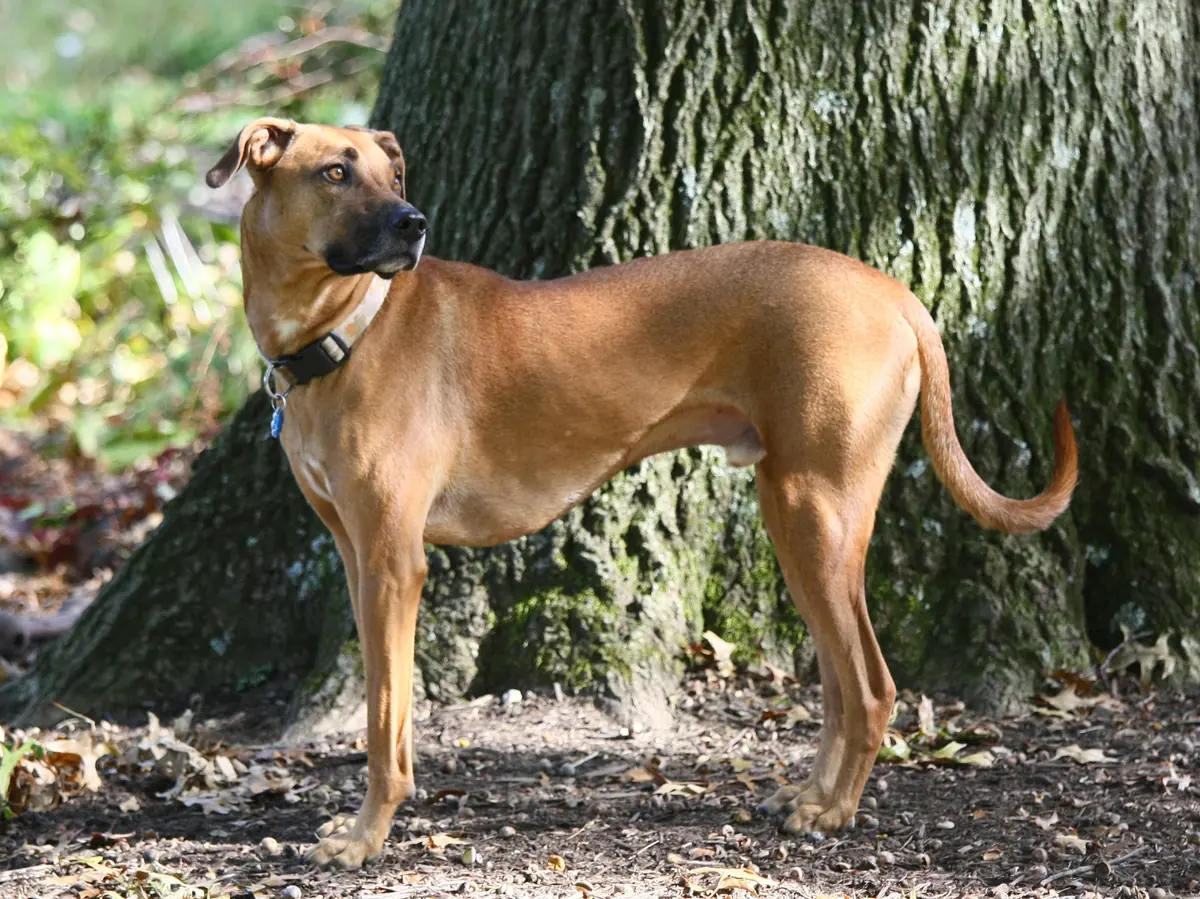

The Canadian Cur is a rare cur-type hunting dog: a medium-sized, short-coated working dog of the kind bred to trail game and “tree” raccoons and squirrels. It is not recognized by the United Kennel Club, the American Kennel Club or the Canadian Kennel Club, and we could not find a breed standard or breed club record for it. So almost everything about its size, looks and temperament is undocumented, and the honest answer is to judge each dog as an individual.
That may not be the tidy answer you hoped for, but it’s the true one. Many websites give the Canadian Cur exact heights, weights, lifespans and even a registration history, and when we checked those claims against the registries, they didn’t hold up. Below is what we could actually verify, what the closely related, well-documented cur breeds are like, and how to tell whether a cur-type dog in a rescue is the right match for you.
Canadian Cur quick facts
- Type: a cur, meaning an all-purpose American-style hunting dog bred for performance rather than looks (see “What is a cur?” below).
- Registry status: not on the United Kennel Club’s breed standards list, not among the 205 breeds the American Kennel Club registers, and not one of the four breeds the Canadian Kennel Club recognizes as uniquely Canadian (Government of Newfoundland and Labrador).
- Origin: not well documented. We found no registry or breed club history.
- Height and weight: not documented. For comparison only, Mountain Curs are 16 to 26 inches (UKC) and 30 to 60 pounds (AKC).
- Life expectancy: not documented. The AKC lists 10 to 13 years for the related Mountain Cur.
- Coat: not documented. Related curs have short, close coats (UKC Black Mouth Cur).
- Energy: not formally rated, but curs are hunting dogs; the UKC describes related curs as “bred for stamina.”
- With kids and other pets: not documented. Related curs have strong treeing instincts, so cats and small pets need careful thought.
- Best fit: an active adult or family with a securely fenced yard, time for long daily outings and patience for a dog with a strong nose and a mind of its own.
What is a cur?
“Cur” sounds like an insult, but among hunters it describes a specific kind of dog. The United Kennel Club explains that the cur breeds “were developed in remote and rural parts of the United States,” and that cur breeders “had little interest in standardizing the looks of their dogs - they were only interested in performance.” Most “were not well off,” so they needed “a dog that could serve multiple purposes: hunter, guardian, and stock dog” (UKC Treeing Cur standard).
Several of these dogs later became registered breeds. On its scenthound list, the UKC recognizes the Black Mouth Cur, Mountain Cur, Stephens’ Cur, Treeing Cur and Treeing Tennessee Brindle, among others (UKC breed standards). The Canadian Cur is not on that list.
Where the Canadian Cur comes from: what we could and couldn’t verify
Here’s what we checked, so you can see exactly where the gaps are:
- United Kennel Club: the UKC says it “currently recognizes over 300 separate breeds,” and none of them is the Canadian Cur (UKC breed standards).
- American Kennel Club: the AKC “currently registers 205 dog breeds,” and its full list by year of recognition has no Canadian Cur, or any cur (AKC).
- Canadian Kennel Club: the four breeds the CKC recognizes as uniquely Canadian are the Newfoundland, the Labrador Retriever, the Nova Scotia Duck Tolling Retriever and the Canadian Inuit Dog (Government of Newfoundland and Labrador).
- Breed clubs: we searched for a Canadian Cur breed club, studbook or published standard and found none we could confirm.
Some breed-listing websites name the people who supposedly created the Canadian Cur in Canada, list its founding breeds, or say the UKC recognized it in 1998. They don’t agree with each other on those details, and none points to a primary record. On the 1998 claim, the UKC’s own standards say that November 1, 1998 is when it recognized the Mountain Cur, Black Mouth Cur and Treeing Cur. So treat any detailed Canadian Cur origin story as unconfirmed until a registry or club publishes one.
What that means in practice: “Canadian Cur” is best understood as a name some hunters and breeders use for their line of cur dogs, not as a breed with a fixed, written description.
Appearance, size and coat
Since no standard exists, a dog called a Canadian Cur could look like many cur-type dogs. The UKC describes its recognized curs in very similar terms: “a powerful, agile tree dog of medium size,” with drop ears and a short coat, built to “move quickly and with agility in rough terrain” (UKC Mountain Cur, UKC Black Mouth Cur). Colors in cur breeds range widely, from red, yellow and buckskin to black, blue and brindle (UKC Mountain Cur).


Canadian Cur vs Mountain Cur vs Black Mouth Cur
The People Also Ask box for this search shows that many people are trying to sort out the cur breeds. Here’s how the Canadian Cur compares with its two best-documented cousins, using only registry sources. “Not documented” means we couldn’t find a reliable source, not that the trait is absent.
| Canadian Cur | Mountain Cur | Black Mouth Cur | |
|---|---|---|---|
| UKC recognized | No, not on the UKC breed list | Yes, November 1, 1998 | Yes, November 1, 1998 |
| AKC recognized | No | No, not among the 205 AKC breeds | No, not among the 205 AKC breeds |
| Origin | Not documented | Declared a breed in 1957 with the Original Mountain Cur Breeders of America | ”Uncertain”; Tennessee and Mississippi are both claimed |
| Height | Not documented | Males 18 to 26 in., females 16 to 24 in. | Minimum 18 in. (males), 16 in. (females) |
| Weight | Not documented | 30 to 60 lb (AKC); “proportionate to height” (UKC) | Minimum 40 lb (males), 35 lb (females) |
| Coat | Not documented | Short outer coat, smooth or rough, soft undercoat | Short, dense, close-lying |
| Colors | Not documented | Black, blue, brindle, brown, red, yellow, buckskin; up to one-third white | Reds, yellows, fawn, black, brown, buckskin, brindle; no more than 10% white |
| Tail | Not documented | Naturally bobbed, bobbed or medium length; bobbed preferred | Any length |
| On the trail | Not documented | Open, semi-open or silent on track, with a clear bark | Silent trailing preferred; “never open like a hound” |
| Life expectancy | Not documented | 10 to 13 years (AKC) | Not listed by UKC |
Sources: UKC standards for the Mountain Cur and Black Mouth Cur; UKC breed standards list; AKC Mountain Cur; AKC breeds by year recognized.
The quick version of the Black Mouth Cur vs Mountain Cur question: the Black Mouth Cur usually has a dark mouth and muzzle and very little white, and should trail quietly, while the Mountain Cur comes in more colors, can carry more white, and may have a bobbed tail. Our Mountain Cur guide has more on that breed.

Temperament: what living with a cur can be like
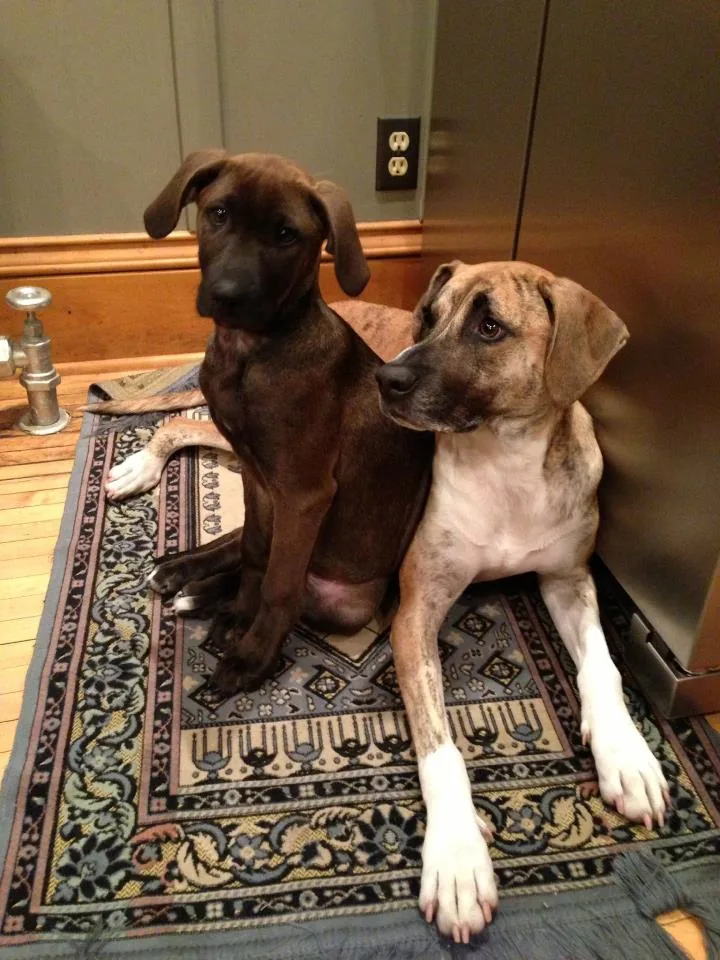
No registry or breed club has described the Canadian Cur’s temperament, so please be wary of confident personality profiles. What we can share is how the UKC describes the related cur breeds, as context:
- Mountain Cur: “intelligent, with a strong desire to please,” with “strong treeing instincts on all game.” It “responds better to training if it has lots of human contact,” and Mountain Curs “make great family companions and watch dogs” (UKC).
- Black Mouth Cur: “combines tenacity and courage with a strong desire to work,” and is “very loyal and protective of their owner and family” (UKC).
- Treeing Cur: “alert and easily trained,” and “good watchdogs and excellent family companions” (UKC).
A dog sold as a Canadian Cur may share some of these traits, all of them, or few of them. The best predictor is the individual dog’s history: how it behaves in a foster home, with visitors, with other dogs and around small animals.
Prey drive, treeing and training
The UKC describes the Mountain Cur, Black Mouth Cur and Treeing Cur each as “a powerful, agile tree dog.” Its Black Mouth Cur standard says the dog “finds game using its eyes, ears and nose” and describes the bark it gives “on bay or tree,” that is, once the animal is cornered or has climbed a tree (UKC). The Mountain Cur standard mentions “strong treeing instincts on all game” (UKC). If the dog you’re meeting comes from hunting lines, expect a strong nose and real interest in squirrels, raccoons and cats.
Living well with that instinct is mostly about management and kind, consistent training:
- Leash and fence. Assume a cur-type dog will follow a scent if given the chance. Walk on a leash and check your fence for gaps and low spots.
- Reward-based training. The American Veterinary Society of Animal Behavior says evidence “supports the use of reward based methods for all canine training” and that “there is no evidence that aversive training is necessary” (AVSAB, 2021).
- Give the nose a job. Scent games, hiding treats and long sniffy walks give a hunting dog an outlet that doesn’t involve chasing the neighbor’s cat.
- Recall is a project, not a promise. Practice in a fenced area for a long time before trusting it outdoors, and keep a long line handy.
Exercise needs
There’s no published exercise guideline for the Canadian Cur. The UKC describes the Mountain Cur and Black Mouth Cur as “fast, hard” hunters, and both standards say “this is a dog bred for stamina” (UKC Mountain Cur, UKC Black Mouth Cur). A dog from working lines will usually need far more than a stroll around the block: think long walks, hikes, scent work or a large fenced area to run in. If you’re adopting an adult, ask the foster how much activity actually settles the dog; that real-world number is worth more than any breed estimate.

Grooming
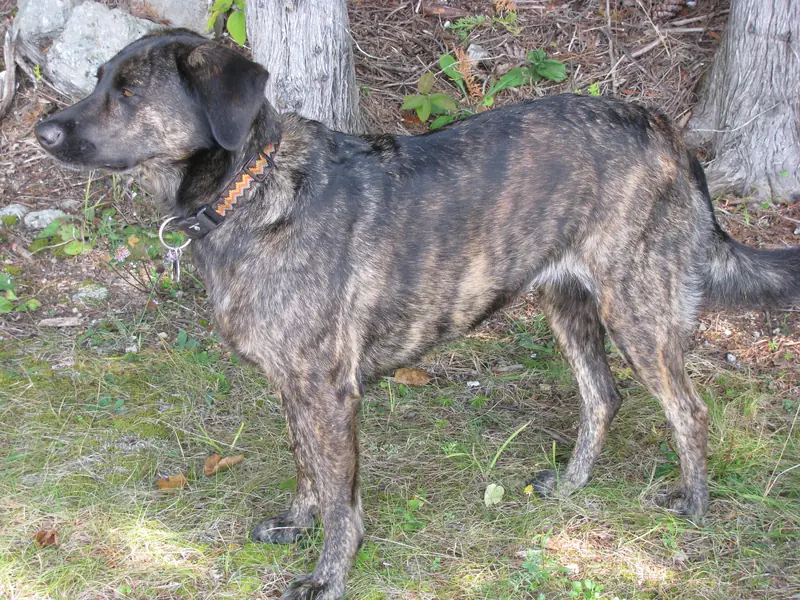
Grooming needs for the Canadian Cur aren’t documented, but the recognized cur breeds have short coats: the UKC describes the Black Mouth Cur’s as “short, dense, and close lying” and the Mountain Cur’s outer coat as “short” (UKC Black Mouth Cur, UKC Mountain Cur). For most short-coated dogs, a regular brush, nail trims, ear checks and the occasional bath cover the basics.
Because these dogs love the woods, ticks deserve a mention. The Companion Animal Parasite Council recommends that all dogs “be treated year round and throughout their life with tick control products” (CAPC). Ask your vet which product suits your dog and area, and check your dog after every outing in tall grass or woods.
Health
We found no health study, breed health survey or breed club screening list for the Canadian Cur, so we can’t tell you which conditions it’s prone to, and you should be skeptical of anyone who claims to know. A few general notes for any active, medium-to-large dog, clearly not Canadian Cur-specific:
- Hips. The Orthopedic Foundation for Animals grades hip X-rays sent in by veterinarians into seven categories, from Excellent to Severe (OFA). If you’re buying a puppy, ask whether the parents were screened.
- Ticks and outdoor wear and tear. See the tick advice above, and check pads, ears and coat after hikes.
- Routine care. Regular vet checkups, vaccinations, dental care and parasite prevention matter more than any breed label.
Anything beyond that is a question for your vet, who can look at the actual dog in front of them.
Diet basics
There’s no special Canadian Cur diet. How much an active dog needs depends on its size, age, body condition and how hard it works. The World Small Animal Veterinary Association’s Global Nutrition Guidelines were written to help veterinary teams make sure pets are fed “according to an optimal and individually tailored nutrition plan.” Ask your vet to assess your dog’s body condition and suggest a food and portion size, and adjust as activity changes with the seasons.
Is a Canadian Cur right for you? A checklist
Bone Voyage is about helping people 50+ adopt, keep and thrive with dogs, and a cur-type dog can be a wonderful partner for an active older adult. Run through these honestly:
A cur-type dog may suit you if:
- You enjoy long daily walks or hikes and want a dog who’ll happily join you.
- You have a securely fenced yard, or easy access to a safe fenced space.
- You like a smart, independent dog and enjoy training with treats and games.
- You don’t have cats or small pets, or the dog has a proven record of living calmly with them.
- You’re comfortable handling a strong, medium-sized dog on a leash when it catches a scent.
You may want a different dog if:
- Your walks are short or your mobility is limited right now.
- You’d need the dog off leash in open areas.
- You live in an apartment without regular access to a place to run.
- You want a dog whose size and personality are predictable from its breed.
If the second list sounds more like you, that’s a thoughtful choice, not a failure. Our guides to the best dog breeds for seniors and senior pet adoption can help you find a calmer match. If you love hound-type dogs, our overview of the types of hounds is a good next stop.
Costs to plan for
We couldn’t find reliable prices for Canadian Cur puppies, so ask breeders or rescues directly. For the cost of keeping any dog, the ASPCA’s 2021 estimates were about $1,030 in first-time costs and $1,391 a year after that (ASPCA). An active outdoor dog may add costs for tick prevention, sturdy gear and fence repairs.
Adopting a Canadian Cur (or a cur-type dog)
The breed-label reality check
You will probably never see “Canadian Cur” on a shelter kennel card. And even when a breed is listed, it’s usually a staff member’s best guess from looks. In one study of adopted dogs, DNA confirmed the breed the adoption agency had named as a main breed in only 4 of 16 dogs, or 25% (Voith et al., 2009). In a much larger study of shelter dogs, staff at one shelter matched at least one breed in a dog’s DNA 67.7% of the time, but agreement fell to 10.4% when they had to identify more than one breed (Gunter et al., 2018). Our guide to figuring out what breed your dog is explains more.
So a dog labeled “hound mix,” “Black Mouth Cur mix” or “shepherd mix” might be every bit as cur as anything sold under a fancier name. Meet the dog, not the label.
Where to look
- Local shelters and rescues, especially in rural and hunting areas, using searches like “cur,” “Mountain Cur,” “Black Mouth Cur,” “Treeing Cur” and “hound mix.”
- Hound and cur rescues near you. Ask how they assess prey drive and whether the dog has lived in a home.
- Breeders, if you’re set on a dog from a named line. Since no club standard exists, ask to see the parents, their health records and how the dogs live day to day.
Questions to ask the rescue
- How does this dog behave with cats, small dogs and wildlife on walks?
- How much exercise does it need before it settles at home?
- Has it lived in a house, and how is it with being left alone?
- How does it walk on a leash when it catches a scent?
- Has it been around children or visitors, and how does it greet strangers?
- Any known health issues, and what vet care has it had?
Our list of 9 questions to ask when adopting a dog covers the general ones.
Make a plan for the long haul
A healthy cur can be part of your life for many years. Naming a backup caregiver now, someone who knows your dog, can handle an energetic hunting dog and has agreed to step in, means your dog never has to start over in a shelter. Our guide What Happens to Your Dog When You Die walks you through it, and the free My Dog’s Backup Plan worksheet records your dog’s routine, vet, quirks and favorite things, so the person who steps in knows exactly how to care for them. Bone Voyage is also building the pledge: a promise by a volunteer to adopt a specific older adult’s dog if that person dies or can no longer care for it. You can join the free list on that same page.
Frequently Asked Questions
What is a Canadian Cur?
It’s a name used for a rare cur-type hunting dog: a medium-sized, short-coated working dog of the kind used to trail game and tree raccoons and squirrels. Beyond that, very little is documented. We couldn’t find a breed standard, a kennel club listing or a breed club record for it, so its size, looks and temperament haven’t been written down by any official body.
Is the Canadian Cur recognized by the UKC or AKC?
Not that we could find. The United Kennel Club, which recognizes more than 300 breeds including several curs, has no Canadian Cur on its breed standards list. The American Kennel Club’s list of the 205 breeds it registers doesn’t include it either, and it isn’t one of the four breeds the Canadian Kennel Club recognizes as uniquely Canadian. Some websites say the UKC recognized it in 1998; the UKC’s own records show that is when it recognized the Mountain Cur, Black Mouth Cur and Treeing Cur.
What’s the difference between a Black Mouth Cur and a Mountain Cur dog?
Both are medium-sized American tree dogs recognized by the United Kennel Club in 1998, but their standards differ. The Black Mouth Cur usually has a red, yellow, fawn, brown, black or brindle coat with dark lips and mouth, very little white (no more than 10%), and should trail silently (UKC). The Mountain Cur comes in more colors, can be up to one-third white, may have a bobbed tail (the UKC prefers one), and may be open, semi-open or silent on the track (UKC).
Which dog breeds are officially Canadian?
According to the Government of Newfoundland and Labrador, four breeds are currently recognized by the Canadian Kennel Club as uniquely Canadian: the Newfoundland, the Labrador Retriever, the Nova Scotia Duck Tolling Retriever and the Canadian Inuit Dog. The Canadian Cur is not one of them.
How big is a Canadian Cur?
No registry or breed club has published a size standard for the Canadian Cur, so any exact figure you see online is unverified. For comparison, the United Kennel Club’s Mountain Cur standard is 18 to 26 inches for males and 16 to 24 inches for females, and the American Kennel Club lists Mountain Curs at 30 to 60 pounds. A dog sold or labeled as a Canadian Cur could fall anywhere in a similar range, so judge the individual dog.
Is a Canadian Cur a good family dog?
There’s no published temperament description for the Canadian Cur, so it depends on the individual dog. Related cur breeds are described by the United Kennel Club as loyal family dogs and watchdogs with strong treeing and hunting instincts. That can make a great companion for an active home with a secure fence, and a hard fit for homes with cats, small pets or little time for exercise. Ask the rescue or foster about the specific dog.
How do I find a Canadian Cur to adopt?
Because the name is so rare, you’re unlikely to see it on a shelter kennel card. Search rescues and shelters for cur-type dogs instead, such as Mountain Cur, Black Mouth Cur or Treeing Cur mixes, especially in rural hunting areas. Shelter breed labels are educated guesses, so focus on the dog’s energy, prey drive and history rather than the name, and ask the foster how the dog behaves at home.
Before you go
The Canadian Cur is one of those dogs that’s easier to find on the internet than in any official record. That’s okay. What matters is the dog in front of you: its energy, its nose, its manners and its heart. If an active, independent, outdoorsy companion fits your life, a cur-type dog from a good rescue could be a joy for years. And whatever dog you bring home, make a plan so they’ll always have someone.
Sources
- United Kennel Club: Breed standards list (more than 300 recognized breeds; no Canadian Cur), and the breed standards for the Mountain Cur, Black Mouth Cur and Treeing Cur (history, recognition dates, size, coat, color, characteristics)
- American Kennel Club: Breeds by year recognized (205 registered breeds) and Mountain Cur (height, weight, life expectancy)
- Government of Newfoundland and Labrador, Newfoundland Dog and Labrador Retriever recognized for their cultural significance (2023), on the four breeds the Canadian Kennel Club recognizes as uniquely Canadian
- American Veterinary Society of Animal Behavior, Humane dog training position statement (2021)
- Companion Animal Parasite Council, Ticks guideline
- Orthopedic Foundation for Animals, Hip dysplasia
- World Small Animal Veterinary Association, Global Nutrition Guidelines
- ASPCA, Cutting pet care costs (2021 update)
- Voith VL et al. (2009). Comparison of adoption agency breed identification and DNA breed identification of dogs. Journal of Applied Animal Welfare Science 12(3):253-62.
- Gunter LM et al. (2018). A canine identity crisis: Genetic breed heritage testing of shelter dogs. PLOS ONE 13(8):e0202633.
- Photos: Wikimedia Commons contributors, credited under each image. We could not find any freely licensed photo of a dog identified as a Canadian Cur, so every photo on this page shows a related, clearly labeled cur breed. Full license records are kept in this site’s image-credits file.