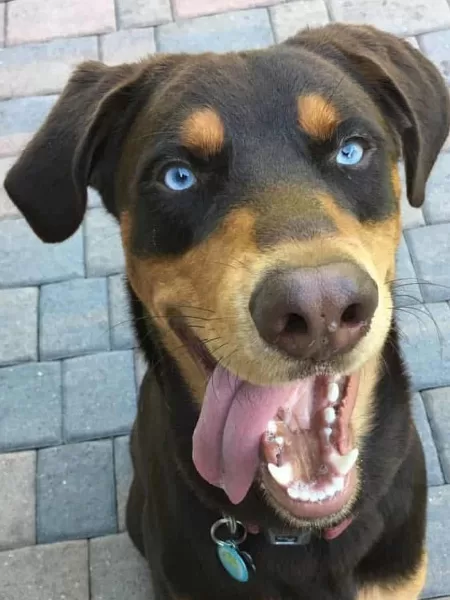
A Husky Doberman mix looks like a Doberman someone left out in the snow: the black and rust markings, the long legs and deep chest, wrapped in a thick double coat with a plumed tail and, often, one or two blue eyes. It’s a striking dog and a demanding one, and the two things owners consistently underestimate are the shedding and the escaping.
Here’s the practical picture, parent by parent.
At a glance
- Adult size: 50 to 85 pounds, 22 to 26 inches at the shoulder
- Coat: dense double coat, heavy shedding, two blowouts a year
- Lifespan: 10 to 13 years
- Exercise: two hours a day, minimum
- Food: roughly $60 to $100 a month
- Non-negotiable: annual heart screening from age three
- Fencing: six feet, buried at the base, latches the dog can’t work
Size and build
A Siberian Husky runs 35 to 60 pounds at 20 to 23.5 inches: compact, deep-chested, built for endurance rather than power. A Doberman Pinscher runs 60 to 100 pounds at 24 to 28 inches: taller, leaner and considerably more dog.
The cross lands at 50 to 85 pounds and 22 to 26 inches, with females often in the fifties and sixties and males in the seventies and eighties. The build is usually a Doberman outline thickened: same long legs and square topline, wider through the ribs, heavier through the neck.
Coat is where the Husky wins. A Doberman has a short, single, close coat that needs no maintenance. A Husky has a dense double coat with a woolly undercoat built for Arctic cold. In the cross, the double coat almost always shows, often in Doberman colors, so you get black and rust or blue and rust in a medium plush coat. Sable, agouti, gray and white and solid black all appear too.
What that means day to day: constant moderate shedding, plus two heavy coat blows a year, usually spring and fall, where the undercoat comes out in handfuls for two or three weeks. Brush weekly, use an undercoat rake during a blow, and don’t shave the coat. A double coat insulates against heat as well as cold, and shaving it damages regrowth without making the dog cooler.
Eyes. Blue is possible and comes from the Husky side. Researchers traced blue eyes in Siberian Huskies to a duplication near the ALX4 gene that behaves as a dominant trait, so one copy from the Husky parent can produce one or both blue eyes. One blue and one brown is common and isn’t a defect.
Temperament: a specific combination of problems
It will try to leave. Siberian Huskies are among the most determined escape artists in the dog world, and it isn’t misbehavior, it’s what a dog bred to run for a living does with a boring afternoon. Combine that with a 75 pound frame and you have a dog that can clear a four-foot fence without effort, dig under a six-foot one, and open an unsecured gate latch. Off-leash recall is unreliable in most of these dogs even after good training, because the Husky’s independence overrides the Doberman’s biddability more often than the reverse.
It probably won’t guard. This surprises people, and it’s the most useful thing on this page for anyone getting one for protection. Huskies were bred to work in groups and be friendly with everyone, and they’re famously poor guard dogs. That friendliness frequently cancels the Doberman’s protective instinct. Plenty of these dogs bark once at a stranger and then roll over. If you want a genuine protection dog, this isn’t a reliable route to one, and the Doberman Cane Corso mix is much closer to it.
It talks. Huskies howl, whine, grumble and produce that theatrical wooing sound when they want something. The cross usually inherits it. It’s charming for about three weeks.
It is affectionate and highly people-oriented. Both parents want to be with their humans, so this is not a dog to leave alone in a yard all day. The Doberman side in particular bonds hard.
It has serious prey drive. Huskies historically hunted for part of their own food, and Dobermans are alert to movement. Cats and small pets are a real question.
Exercise is two hours a day, and at least part of it needs to be running rather than walking. What works: a bike run or a jog once the dog is past 18 months, hiking on a long line, canicross or skijoring if you’re in the right climate, a flirt pole in the yard, and scent games indoors. What doesn’t: two leash walks around the block, which is a maintenance dose for a small dog and nothing for this one.
Health: heart first, then eyes
Dilated cardiomyopathy is the thing that matters most. It’s the leading cause of death in Doberman Pinschers, with long-term European screening studies putting lifetime prevalence above half the breed, and the cross inherits the risk. The heart muscle thins and weakens silently for years before any symptom appears, and some dogs die suddenly with no warning at all.
The real screening protocol is an annual 24-hour Holter monitor plus an echocardiogram, starting at age three. A stethoscope at the yearly checkup misses almost everything. Expect roughly $400 to $700 a year for the pair. DNA tests exist for two associated variants, PDK4 and TTN, and they add information without replacing screening. Catching the disease in its silent phase and starting medication meaningfully extends survival, which is exactly why the screening is worth the money.
Everything else, by parent:
| Concern | Which parent | What to know |
|---|---|---|
| von Willebrand disease | Doberman | An inherited clotting disorder carried at high frequency in the breed. Cheap DNA test, worth knowing before surgery. |
| Wobbler syndrome | Doberman | Cervical vertebral instability producing a wobbly, uncoordinated hind end, usually in middle age. |
| Bloat (GDV) | Doberman | Deep chest, real risk. Ask your vet about a preventive gastropexy at spay or neuter. |
| Chronic hepatitis | Doberman | Copper-associated liver disease, more common in females, usually caught on routine bloodwork. |
| Juvenile cataracts | Husky | Can appear before age two. An annual eye exam catches them. |
| Progressive retinal atrophy and corneal dystrophy | Husky | Both documented in the breed, both found on eye exam. |
| Zinc-responsive dermatosis | Husky | Crusting around the eyes, muzzle and elbows from poor zinc absorption, not diet quality. Frequently misdiagnosed as an allergy. Responds well to supplementation. |
| Hypothyroidism | Both | Weight gain, coat loss, lethargy. Cheap test, cheap pill. |
| Hip dysplasia | Both | Lower risk than most large breeds, since Huskies score unusually well in OFA evaluations, but not zero. |
Lifespan is 10 to 13 years. The Husky side pulls it up and the Doberman side pulls it down.
What it costs
Food runs $60 to $100 a month. A 70 pound active adult needs roughly 1,600 to 1,800 calories a day, about four to four and a half cups of typical dry food, so a 30 pound bag lasts about four weeks.
Cardiac screening adds $400 to $700 a year from age three, and it’s the line most owners don’t plan for.
Acquisition. Rescue and shelter adoption fees run roughly $150 to $450, and that typically covers vaccinations, microchip and spay or neuter. This is a common shelter cross, particularly in regions where Huskies are popular, because Huskies get surrendered at high rates once the escaping and shedding become real. Sellers ask $600 to $1,500 for puppies, and no breed club or health-testing standard exists for the cross.
Fencing is a real cost. Six feet, no horizontal rails to climb, wire or a concrete apron along the base, and latches the dog can’t nose open. Budget for it up front rather than after the first escape.
Insurance and housing. Dobermans appear on many US homeowner insurers’ restricted-breed lists. Check before you commit.
Is this the right dog for you?
Good fit if you run, hike, ski or otherwise move for two hours daily, someone is home most of the day, you have secure fencing already, and you’ll do the cardiac screening.
Poor fit if you wanted a guard dog, if you can’t tolerate hair on everything, or if your exercise plan depends on a fenced yard doing the work for you. It won’t. A Husky cross alone in a yard is a Husky cross planning its exit.
For related crosses, see the Weimaraner Husky mixes, the Vizsla Husky mix, and our Doberman breed profile for more on the parent that contributes the heart risk.
Frequently Asked Questions
How big does a Husky Doberman mix get?
Most adults weigh 50 to 85 pounds and stand 22 to 26 inches at the shoulder. The Doberman adds height and length of leg, the Husky adds a broader, more compact body, so the cross typically looks like a slightly heavier Doberman with a thicker coat.
Does a Husky Doberman mix make a good guard dog?
Usually not, despite the look. Siberian Huskies were bred to be friendly with everyone and make notoriously poor guard dogs, and that tendency often cancels the Doberman’s protectiveness. Many of these dogs will bark at a stranger and then ask for a belly rub.
Do Husky Doberman mixes shed?
Heavily. The Husky’s dense double coat usually dominates the Doberman’s short single coat, so expect year-round shedding plus two heavy blowouts a year. An undercoat rake in spring and fall does more than any amount of daily brushing.
What health screening does a Husky Doberman mix need?
An annual 24-hour Holter monitor and echocardiogram from age three, because dilated cardiomyopathy is the leading cause of death in Dobermans and the cross inherits the risk. Add an annual eye exam for the Husky side’s cataracts and retinal disease.
How much exercise does a Husky Doberman mix need?
Two hours a day, and it can’t all be leash walking. Both parents were built to work: one to pull a sled for miles, the other to patrol beside a person all day. Under-exercised ones dig, escape and destroy furniture.
Before you go
Bone Voyage rescues dogs from Mexico and places them with families across the US and Canada, and crosses like this one are exactly the dogs that get overlooked: big, active, and honest about what they need. If your life already has two hours of movement in it, one of them will fit into it easily.
Have a look through our breeds and adoption guides, or read about Bone Voyage if you’d rather help from where you are.