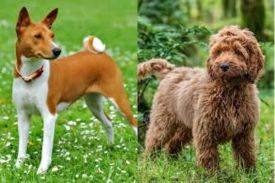
Two things about the Basenji Poodle mix get repeated everywhere and both are wrong. The first is that it’s a hypoallergenic dog. The second is that you can quote its adult size without knowing anything else.
Correcting those two is most of what’s useful here, so let’s start with them.
First question: which Poodle?
“Basenji Poodle mix” describes at least two very different dogs, and nobody can tell you what yours will weigh until you answer this.
A Basenji is a consistent 22 to 24 pounds at 16 to 17 inches. That part never varies much.
A Poodle comes in three sizes. A Standard Poodle is 45 to 70 pounds and over 15 inches tall. A Miniature is 10 to 15 pounds at 10 to 15 inches. A Toy is under 10 pounds.
So:
- Miniature Poodle cross: roughly 12 to 22 pounds, 12 to 16 inches
- Standard Poodle cross: roughly 30 to 50 pounds, 16 to 22 inches
- Toy Poodle cross: rare and usually not deliberately bred, given the size gap
That’s a 40 pound spread between the two common versions. If a seller quotes you “20 to 30 pounds” without naming the Poodle parent, they don’t know either.
The coat, and the hypoallergenic claim
No dog is hypoallergenic. The protein most people react to, Can f 1, comes from saliva and skin dander, and every dog produces it. Low-shedding breeds spread less of it around a room, which helps some people some of the time. That’s the real mechanism, and it’s the reason a Poodle works for some allergy sufferers and not others.
In a first-generation cross, even that partial benefit is unreliable. The traits that make a Poodle coat what it is, the tight curl and the furnished face and the reduced shedding, are governed by a handful of genes, and a Poodle parent passes only one copy of each. Curl in particular is incompletely dominant: one copy gives you a wave, not a curl. Shedding reduction works similarly, so a single copy dampens shedding without stopping it.
The practical result is that littermates from the same Basenji-Poodle pairing come out with visibly different coats. Some are wavy and light-shedding. Some have the Basenji’s short, sleek, close-lying coat and shed like any short-haired dog. A scruffy beard and eyebrows are common, because the gene for facial furnishings behaves as a dominant.
If someone in your house has allergies, don’t buy on the promise. Spend real time with the specific adult dog, in a house, more than once, before committing. It’s the only test that means anything.
Grooming follows the coat you actually get. A wavy, furnished coat needs brushing two or three times a week and a professional trim every couple of months. A Basenji-type coat needs almost nothing. Basenjis, incidentally, groom themselves like cats and are close to odorless, which is one of the nicest things they contribute to any cross.
Temperament: the part worth thinking hardest about
Here’s the tension in this cross. The Poodle is routinely ranked among the most trainable dogs in existence: eager, biddable, quick to generalize. The Basenji is one of the least conventionally trainable breeds there is: independent, self-directed, and completely willing to ignore you if something more interesting is happening.
A Basenji is often described as cat-like, and that’s accurate. They climb. They perch on the back of furniture. They’re fastidious. They’re affectionate on their own schedule. They have very high prey drive and recall that most owners never make reliable, so off-leash freedom is usually off the table.
The cross can land anywhere on that spectrum, and plenty land closer to the Basenji. People who buy one expecting Poodle biddability with an interesting face are the ones who end up frustrated at eighteen months.
Other specifics worth knowing:
- The voice. Basenjis can’t bark in the usual way because of the shape of their larynx. They produce a yodeling sound instead, known to owners as a baroo. In the cross, you might get barking, yodeling or both.
- Escape artistry. Basenjis climb fences and open latches. Check your gates.
- Heat and cold. The Basenji is an African breed with a thin coat and genuinely dislikes cold weather. A Standard Poodle cross with a denser coat handles winter better.
- The seasonal quirk. Basenji females typically come into season once a year rather than twice, unlike almost every other domestic breed. It’s a real oddity and worth knowing if you have an intact dog.
- Exercise: 60 minutes a day, more for a Standard Poodle cross. Both parents are athletic and both get bored destructively.
Health: what to test for
The good news is that the Basenji has a well-mapped set of inherited conditions with cheap, definitive DNA tests. Very few breeds are that clear.
From the Basenji:
- Fanconi syndrome. This is the one. It’s a kidney tubular disorder where the kidneys fail to reabsorb nutrients, and it was affecting roughly one in ten American Basenjis before a DNA test became available in 2007. Untreated it’s fatal. Managed with a specific supplementation protocol, affected dogs can live comfortably for years. The test is inexpensive, definitive, and worth running on any dog with Basenji in it.
- Progressive retinal atrophy (PRA-BJ1), causing gradual blindness. DNA testable.
- Pyruvate kinase deficiency, an inherited hemolytic anemia. DNA testable.
- Immunoproliferative small intestinal disease, a chronic inflammatory bowel condition seen in the breed. No DNA test, but chronic diarrhea and weight loss in a Basenji cross is worth investigating properly rather than treating as a food sensitivity.
- Hypothyroidism and persistent pupillary membranes.
From the Poodle:
- Addison’s disease, where the adrenal glands underproduce. Standard Poodles have one of the highest rates of any breed. It’s a great mimic, presenting as vague lethargy, intermittent vomiting and poor stress tolerance, and it’s often missed for months. Cheap to treat once diagnosed and dangerous if it isn’t.
- Sebaceous adenitis, an inflammatory skin condition causing scaling and hair loss along the topline. Standard Poodles again.
- Bloat in Standard Poodle crosses, since they’re deep-chested. Ask your vet about a preventive gastropexy at spay or neuter.
- Patellar luxation in Miniature Poodle crosses.
- Progressive retinal atrophy (prcd) and epilepsy in both Poodle sizes.
Lifespan is 12 to 16 years, which is genuinely long. Both parents are long-lived, and a Miniature Poodle cross often reaches the top of that range.
Food and cost
Food runs about $25 to $40 a month for a 25 pound dog, or $45 to $70 for a Standard Poodle cross in the 40 pound range. A 25 pound adult needs roughly 700 to 800 calories a day, which is about two cups of typical dry food.
Grooming is the variable cost people forget. If your dog gets the wavy furnished coat, a professional groom every eight to ten weeks runs $60 to $100 depending on where you live, which is $400 to $600 a year. If it gets the Basenji coat, that number is zero.
Acquisition. Rescue and shelter fees run roughly $200 to $450 and normally include vaccinations, microchip and spay or neuter. Sellers advertising Basenjipoo or Basenji Doodle puppies ask $800 to $2,000. Ask two questions before you pay anything: which Poodle, and has the Basenji parent been Fanconi tested? A seller who can’t answer the second one hasn’t done the single easiest thing available to them.
Is this the right dog for you?
Good fit if you like an independent, clean, athletic, slightly aloof dog, you’re realistic about recall, and you have a secure yard.
Poor fit if you were sold on the hypoallergenic promise, or if you wanted the eager, velcro-style companionship a Poodle usually offers and can’t live with the possibility of a dog that decides for itself.
For more on the parent breeds, see our profiles of the Basenji and the athletic Basenji hound, and our guide to Poodle coat care. The Cocker Spaniel Poodle mix is a much easier first dog if what you actually want is the Poodle temperament in a mix.
Frequently Asked Questions
How big is a Basenji Poodle mix?
It depends entirely on which Poodle. A Miniature Poodle cross runs 12 to 22 pounds and 12 to 16 inches tall. A Standard Poodle cross runs 30 to 50 pounds and 16 to 22 inches. Ask which Poodle was the parent before you ask anything else.
Is a Basenji Poodle mix hypoallergenic?
No, and no dog truly is. The allergen is a protein in saliva and skin dander, not hair. First-generation Poodle crosses inherit only one copy of the Poodle’s low-shedding coat genes, so shedding varies from light to substantial across a single litter. Spend time with the specific dog before you commit.
Do Basenji Poodle mixes bark?
Some do. Basenjis can’t bark normally because of the shape of their larynx, so they yodel instead, a sound owners call a baroo. In the cross it’s a coin flip: you may get a barking dog, a yodeling dog, or one that does both.
What health tests should a Basenji Poodle mix have?
The Fanconi syndrome DNA test is the important one. It’s a kidney tubular disorder that was affecting roughly one in ten American Basenjis before the test became available in 2007, and it’s easy to rule out. Add progressive retinal atrophy and pyruvate kinase deficiency tests from the Basenji side, and watch for Addison’s disease from a Standard Poodle parent.
Are Basenji Poodle mixes easy to train?
Not necessarily, and this is where people get caught out. The Poodle is one of the most trainable breeds alive and the Basenji is one of the least biddable, with famously unreliable recall. The cross can land anywhere, and plenty land closer to the Basenji.
Before you go
This is an uncommon cross, so the odds are you’re looking at one specific dog rather than choosing from a litter. Ask what its coat is like after a bath, what it does when it sees a squirrel, and whether it comes when called. Those three answers describe your next fourteen years better than any breed profile.
Our breeds and adoption guides cover the other Poodle crosses if you’re still comparing.