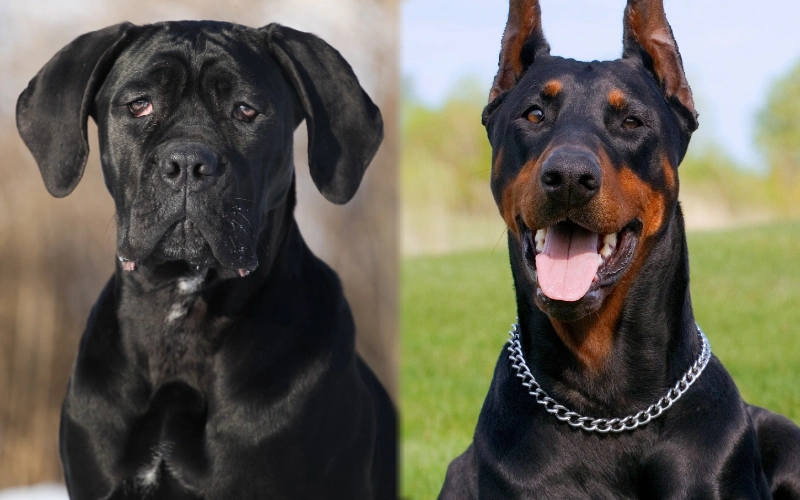
A Dobercorso is a Doberman Pinscher crossed with a Cane Corso: a hundred pounds of short-coated guarding dog with a Doberman’s legs and an Italian mastiff’s head. People also call it a Corsodo. It’s an impressive animal and a demanding one, and the two things worth knowing before you get attached are that it will probably live nine to eleven years and that its heart needs annual screening from age three.
That’s not a reason to avoid one. It’s a reason to plan.
At a glance
- Adult size: 85 to 120 pounds, 24 to 27 inches at the shoulder
- Coat: short and dense, minimal grooming, moderate shedding
- Lifespan: 9 to 11 years
- Exercise: 60 to 90 minutes daily plus training work
- Food: roughly $80 to $130 a month
- Non-negotiable: annual Holter monitor and echocardiogram from age three
- Check first: your homeowner’s insurance and local ordinances
Where the Dobercorso comes from
The Cane Corso traces back to Roman war and farm dogs in southern Italy, kept for guarding property, driving cattle and hunting boar. The breed almost vanished by the 1970s before a group of Italian enthusiasts rebuilt it, and the AKC only recognized it in 2010.
The Doberman Pinscher is younger and more deliberate. Karl Friedrich Louis Dobermann, a German tax collector who also ran the local dog pound, built the breed in the 1890s from whatever he had access to, specifically to have a dog beside him while he collected money from people who didn’t want to pay.
Both parents were made to protect. That’s not a marketing angle, it’s the shared design brief, and it’s what the cross inherits most reliably.
How big does a Dobercorso get
A Cane Corso male runs 99 to 110 pounds at 25 to 27.5 inches; a female 88 to 99 pounds at 23.5 to 26 inches. That’s a wide, heavy-boned dog with a large head and a broad muzzle.
A Doberman male runs 75 to 100 pounds at 26 to 28 inches; a female 60 to 90 pounds at 24 to 26 inches. That’s a taller, leaner, more athletic outline.
Cross them and expect 85 to 120 pounds at 24 to 27 inches. Females frequently land in the 80s, males in the low hundreds, and a Corso-dominant male can exceed 120.
The shape usually splits predictably: Doberman leg length and topline with Corso chest depth and skull width. The muzzle is somewhere between the Doberman’s fine wedge and the Corso’s blunt square, which means most Dobercorsos avoid the breathing problems of a genuinely short-faced dog. Ears come out naturally, and folded, in most cases. Both parent breeds are traditionally cropped in the US, and there’s no health argument for doing it.
Coat is short and dense from both sides. Black, black and rust, brindle, gray, fawn and blue all appear, and the Doberman’s rust points show up in about half of them. Grooming takes ten minutes a week. Shedding is moderate and constant, and short stiff hairs weave themselves into upholstery.
If the Corso’s loose lips and heavy flews come through, so does the drool. That’s worth knowing before it arrives on your ceiling.
The heart: the single most important section
Dilated cardiomyopathy is the leading cause of death in Doberman Pinschers. It’s a disease where the heart muscle thins and weakens, the chambers enlarge, and the heart eventually fails. Long-term European screening studies have put the lifetime prevalence in Dobermans above half the breed. That is not a small footnote, and the cross inherits the risk.
The hard part is that DCM is silent for years. A dog can be in the occult phase, with abnormal rhythms and a changing heart on ultrasound, while looking completely healthy on a hike. By the time you see coughing, exercise intolerance or a swollen belly, the disease is advanced. Some dogs die suddenly with no warning at all.
What actual screening looks like, and it is not what most vets do at a routine annual visit:
- A 24-hour Holter monitor, a wearable ECG the dog goes home in, counting abnormal beats over a full day. A stethoscope check at the clinic misses almost everything.
- An echocardiogram performed by a cardiologist, measuring chamber size and contraction.
- Both, annually, starting at age three. Expect roughly $400 to $700 a year for the pair depending on where you live.
DNA tests exist for two variants associated with Doberman DCM, in the PDK4 and TTN genes. They’re useful information and they do not replace screening: dogs without either variant still develop the disease, and dogs with them don’t always. Test if you like, screen regardless.
The reason to do all this is that catching the occult phase changes the outcome. Medication started before heart failure meaningfully extends both the time to failure and overall survival, which is not true of most things you can screen for.
Other health worth knowing
| Concern | Which parent | What to know |
|---|---|---|
| Hip dysplasia | Cane Corso | The Cane Corso is one of the worst-scoring breeds in OFA hip evaluations, with a large share of screened dogs graded dysplastic. Keep the dog lean and skip forced running until 18 months. |
| Bloat (GDV) | Both | Deep-chested, large, and at real risk. Ask your vet about a preventive gastropexy at spay or neuter. It’s cheap alongside surgery you’re already paying for and it prevents a condition that kills in hours. |
| Eyelid problems | Cane Corso | Entropion, ectropion and cherry eye, all from the breed’s loose facial skin. Usually surgical, usually a young-dog problem, and usually one bill rather than an ongoing one. |
| von Willebrand disease | Doberman | An inherited clotting disorder carried at high frequency in Dobermans. Cheap DNA test, and worth knowing before any surgery. |
| Wobbler syndrome | Doberman | Cervical vertebral instability causing a wobbly, uncoordinated hind end, usually in middle age. |
| Hypothyroidism | Both | Weight gain, coat loss, lethargy. Simple blood test, cheap daily pill. |
| Idiopathic epilepsy | Cane Corso | Seizures with no underlying cause found, typically starting between one and five years. Manageable in most dogs. |
| Chronic hepatitis | Doberman | A copper-associated liver disease, more common in females. Shows up on routine bloodwork before it shows up in the dog. |
Temperament: what this dog does in your house
It watches the door. Both parents are territorial, and the cross takes the front of the house as its responsibility. Visitors arriving unannounced are the flashpoint. Manage it with a routine: dog behind a gate or in another room, guest settles, dog comes out on a leash. Doing it that way from the first week is far easier than fixing it later.
It leans. A hundred pounds of dog resting its shoulder against the back of your knee while you stand at the counter. Corsos in particular are physical with their people.
It is affectionate and much sillier than it looks. Guarding breeds tend to be soft with their own families. Expect a dog that wants to be on the couch, follows you around, and plays like an oversized puppy well past the age when it looks ridiculous.
It is not for a first-time large-dog owner. That’s not a comment on aggression. It’s that a hundred-pound dog that pulls, jumps up, or decides on its own who’s allowed in your yard is a genuinely serious management problem, and the training window closes around adolescence. If you haven’t raised a big dog before, hire a trainer for the first year and treat it as part of the cost.
Alone time is manageable. Neither parent breed is as separation-anxious as a Weimaraner, though both are people-oriented enough that eight hours a day, every day, is not a great life for one.
Exercise is 60 to 90 minutes a day, which is less than the athletic-looking build suggests. What these dogs need more than distance is structured mental work: obedience, scent games, a job with rules. A Cane Corso is a thinking guard dog, not an endurance athlete, and the Doberman side adds enough drive that boredom becomes destructive.
Cost, honestly
Acquisition. Rescue adoption runs roughly $200 to $500. Sellers advertising Dobercorso puppies ask $800 to $2,500. There’s no breed club and no health-testing standard for the cross, so that price buys you nothing structural. If you’re buying, the only questions that matter are whether the Doberman parent has been Holter-tested and echoed, and whether the Corso parent has OFA hip results.
Food is $80 to $130 a month. A 100 pound adult needs roughly 2,000 to 2,400 calories a day, about six cups of typical dry food, so a 30 pound bag lasts under three weeks.
Cardiac screening adds $400 to $700 a year from age three, and it’s the line item most owners don’t budget for.
Everything else costs more because the dog is big: anesthesia is dosed by weight, so a dental cleaning or an eyelid surgery costs more than the same procedure on a Beagle. Medication is dosed by weight. Boarding is priced by size. Price pet insurance while the dog is young and healthy, because cardiac disease diagnosed first becomes a permanent exclusion.
Check the paperwork before the dog. Cane Corsos appear on the restricted-breed lists of many US homeowner’s insurers, and some municipalities and most rental leases restrict large guarding breeds. Find out before you commit, not after.
Is this the right dog for you?
Good fit if you’ve raised large dogs before, someone is home much of the day, you have a securely fenced yard, you’ll do the cardiac screening, and you’ve confirmed your insurance and lease.
Poor fit if this is your first big dog, if you have frequent unannounced visitors and no ability to manage a doorway, or if the nine-to-eleven-year lifespan is something you’d rather not think about. It’s worth thinking about.
For comparable crosses, see the Cane Corso Rottweiler mix, which is heavier and slightly longer-lived, the Doberman Husky mix, which trades guarding for escape drive, and the Doberman breed profile for more on the parent that contributes the heart risk.
Frequently Asked Questions
How big does a Dobercorso get?
Most adults weigh 85 to 120 pounds and stand 24 to 27 inches at the shoulder, with males at the top of that range. The cross typically has the Doberman’s leg length and the Cane Corso’s chest width and head mass.
How long does a Doberman Cane Corso mix live?
Nine to eleven years, which is short even for a large dog. Both parents are short-lived: Cane Corsos average around nine to twelve years and Dobermans around ten to twelve. Going into this cross expecting fifteen years is the most common disappointment.
What heart screening does a Dobercorso need?
Dilated cardiomyopathy is the leading cause of death in Dobermans, and the cross inherits the risk. The accepted protocol is an annual 24-hour Holter monitor plus an echocardiogram starting at age three, not a stethoscope check at the yearly visit. DNA tests for the PDK4 and TTN variants add information but don’t replace screening.
Is a Dobercorso good with children?
Usually affectionate with its own family, including children, but this is a 100-pound guarding dog with a low tolerance for strangers on its property. The real risks are size and territorial behavior, not temperament toward the family. Supervise, and manage the front door before guests arrive.
What does a Dobercorso cost?
Rescue adoption fees run roughly $200 to $500. Sellers ask $800 to $2,500 for puppies. The larger number is what you’ll spend annually: budget $80 to $130 a month on food alone, plus around $400 a year for cardiac screening once the dog turns three.
Before you go
Large guarding crosses are among the hardest dogs to place, because most people who want the look aren’t set up for the reality. If you are set up for it, you’ll get one of the most rewarding dogs you’ll ever live with, for a shorter time than you’d like.
Our breeds and adoption guides cover the other large crosses worth comparing before you decide.